A GPU's business usually reaches its endpoint upon shipment. The customer places an order, the supplier delivers, and the revenue is reflected in the financial report. However, the latest reports surrounding OpenAI's Ohio data center in the United States tell a different story. According to The Wall Street Journal and Bloomberg, NVIDIA is in discussions to provide guarantees for financing OpenAI's computing power through leasing. Once the chips are sold, the supplier may also need to endorse whether the customer can pay the rent long-term.
The reports mention a guarantee amount of around $250 billion and project sizes such as 10GW. As these details have not been cross-confirmed by NVIDIA, OpenAI, or the project financing parties through public documents, they cannot be treated as finalized terms. However, the most intriguing aspect of this rumor is not merely whether a certain figure is large enough. A guarantee implies that a chipmaker may have transitioned from being a "seller of shovels" to sitting at the same table as the customer raising funds to build a mine.
Why would this happen to NVIDIA? Let's first see where it currently stands.
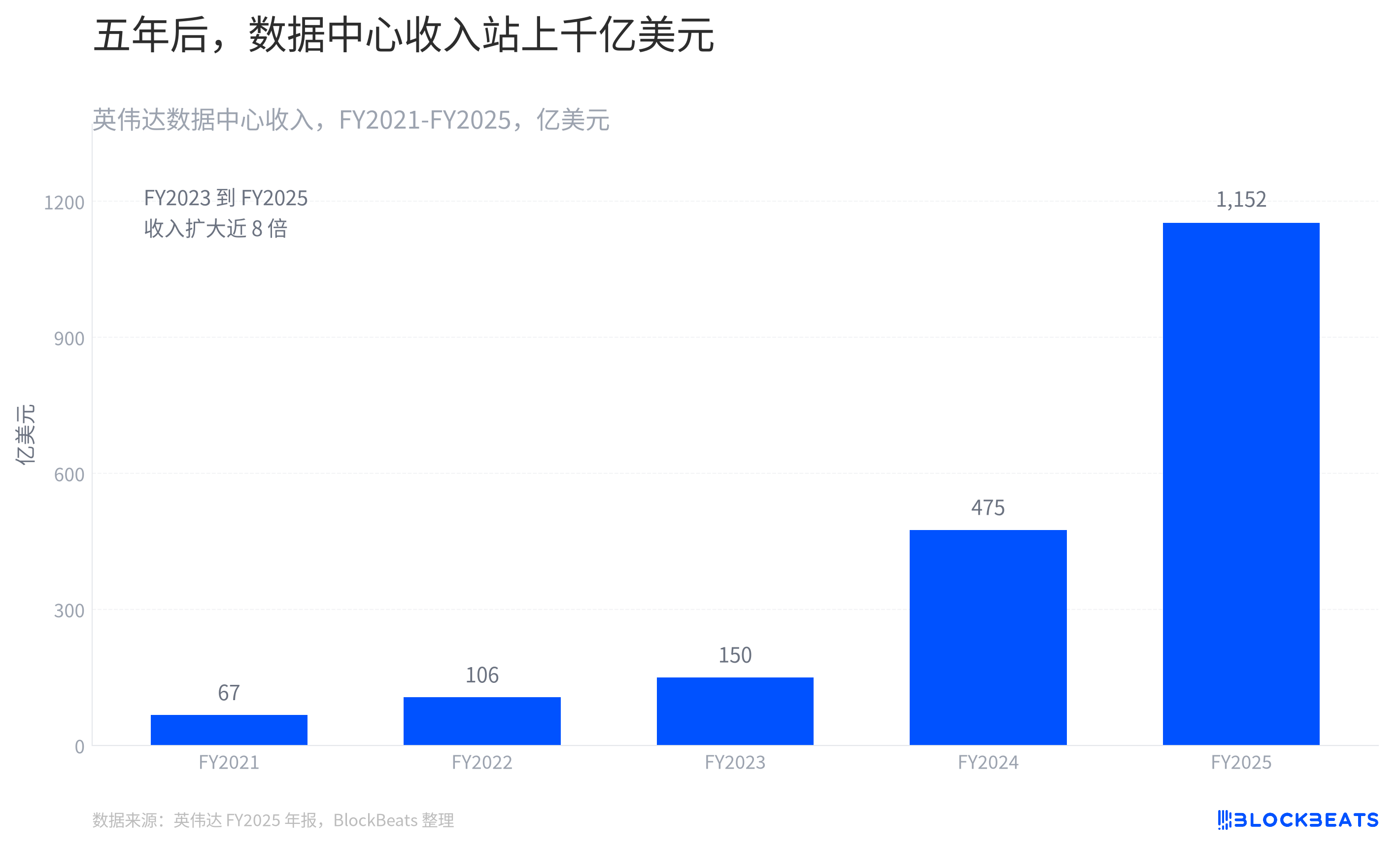
According to NVIDIA's FY2025 annual report, data center revenue has surged from $6.7 billion to $115.2 billion over five fiscal years. The slope on the graph is more intriguing than the conclusion. FY2023 was still a relatively flat step, but the following two years suddenly turned into nearly vertical walls. For a company that originally sold computing hardware, this is akin to the most critical customer base switching to a different procurement method in an extremely short period.
Previously, cloud providers refreshed servers by generation, and budgets were broken down to quarters. Now, what model companies desire is a whole piece of computing power that can run continuously for many years. A data center is no longer about buying a few more rows of server racks; it is more like building a power plant first and then deciding what applications to run inside. Equipment procurement is just the first step; land, power, facilities, and debt leasing all need to be settled within a single project.
NVIDIA doesn't need to personally build data centers to be pulled into this chain. If a customer cannot obtain financing, a GPU order is merely a letter of intent. If the customer secures financing, there is certainty in system delivery and service revenue for the coming years. The guarantee here is not a charitable act but a credit tool to transform demand from "wish to buy" to "can buy." However, once the tool is utilized, the risk will flow back along the same chain.
So, how does this differ from the past few rounds of large-scale AI procurement? The difference lies in the narrative unit of the projects.
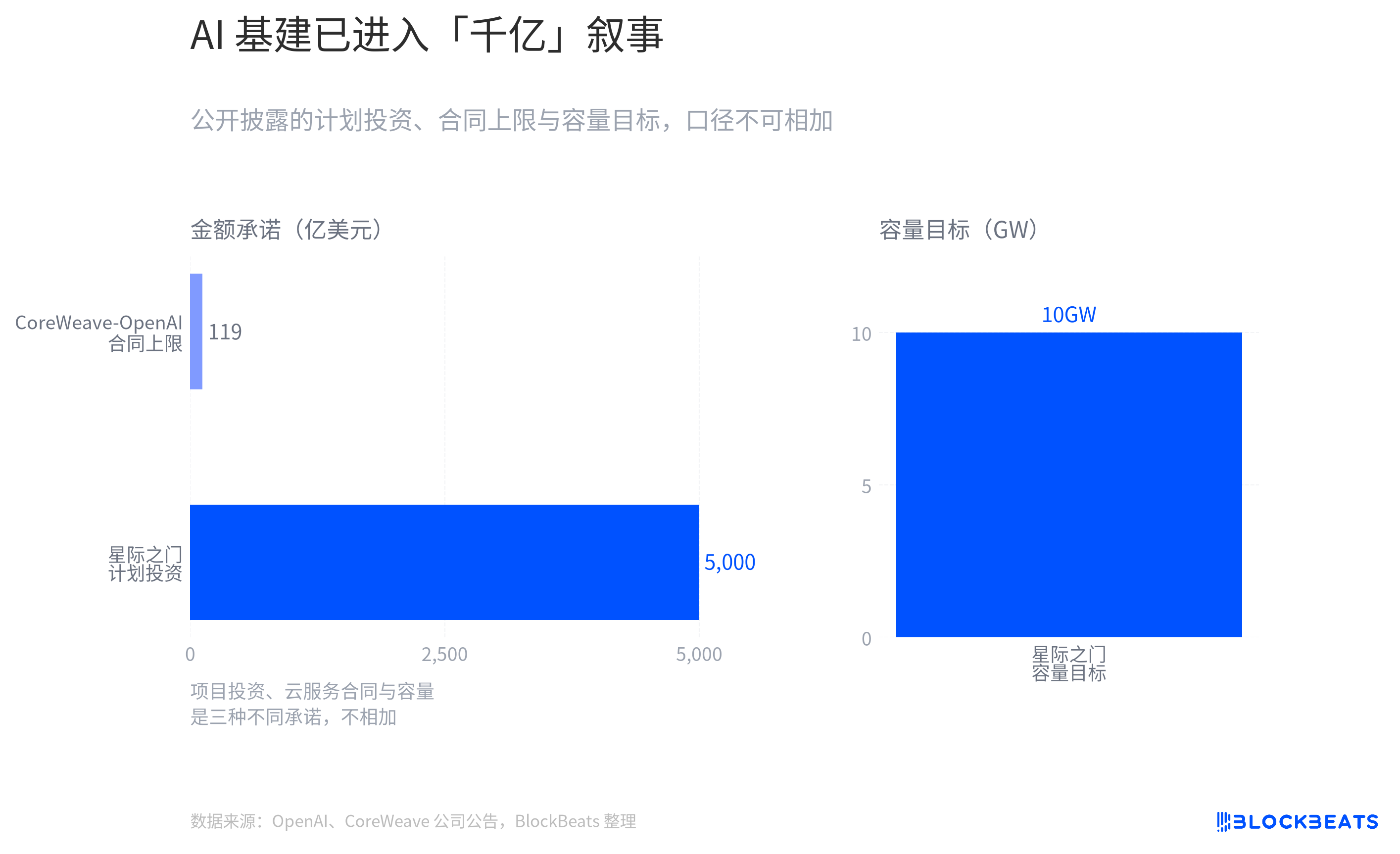
When OpenAI announced the "Stargate" plan in 2025, it stated a potential investment of up to $500 billion over the next four years, with a capacity target of 10GW. On the other hand, according to GPU cloud services provider CoreWeave's announcement, its cloud service contract with OpenAI could reach up to $11.9 billion. These two figures are not additive; one represents planned investment, the other is the service contract ceiling, and another is the power capacity. Placing them on the same graph is not for reconciliation but to understand that the transaction language has moved beyond a single server and annual procurement.
This is like building a railroad. While the train cars order is important, what truly determines whether the railroad can operate is who pays for the tracks upfront, who commits to continuously buying tickets, and who covers the shortfall in passenger numbers. For an AI data center, the GPU is the most visible train car, but electricity and financing determine if the train can leave the station.
Therefore, when the news mentions the word "guarantee," the market should not just see it as NVIDIA making another sale. It is more like the supplier telling the funder that they are willing to embed their assessment of downstream demand into the credit relationship. For model companies in urgent need of computing power, this can lower the financing threshold. For equipment lessors and lenders, this adds another party willing to share the risk.
Where will the risk ultimately fall? Many people might think that as long as model companies continue to grow, the entire chain will be fine. However, large-scale infrastructure projects are most afraid not of selling slightly fewer services in a particular month, but of having long lease terms, depreciation schedules, and debt maturities already underway while demand is not materializing at the expected pace.
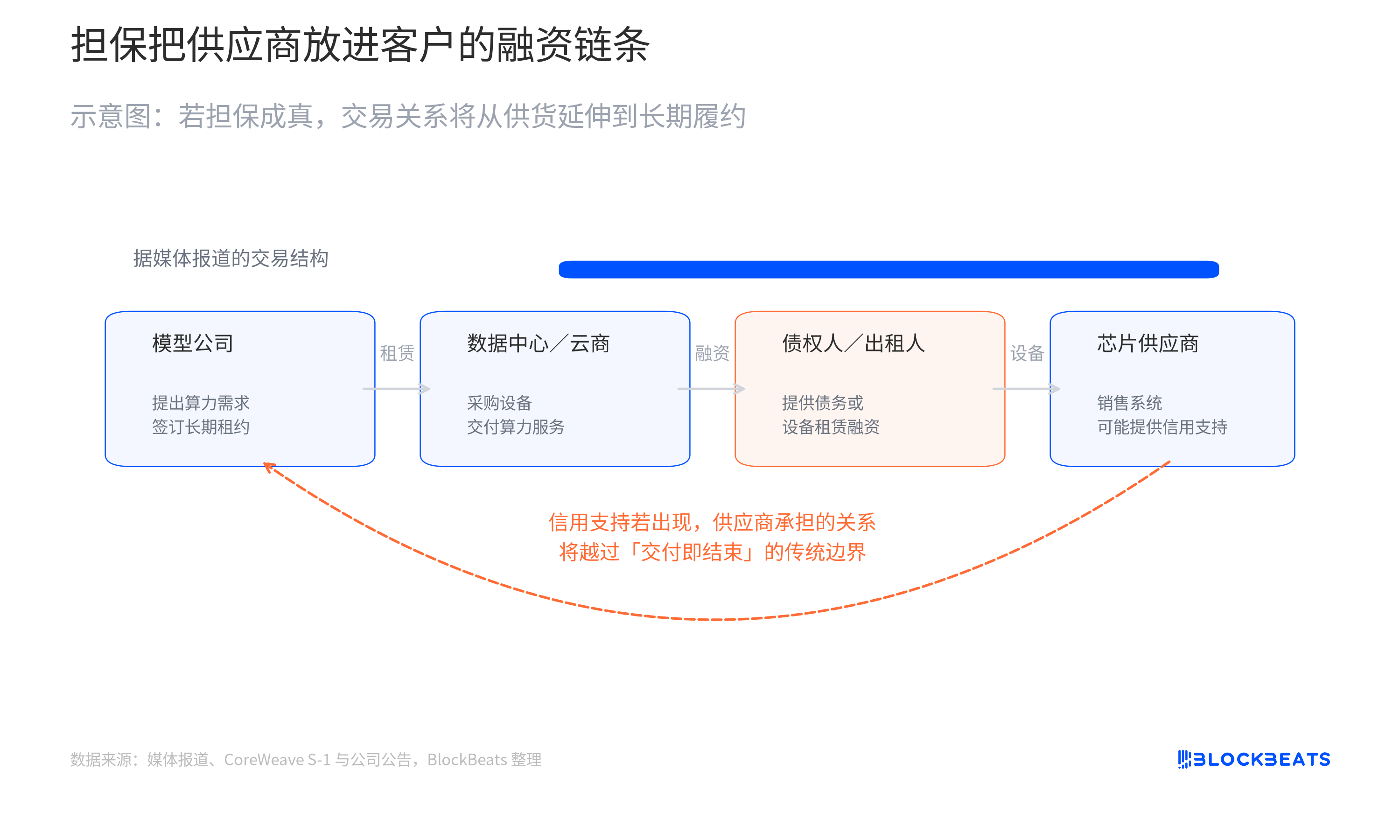
This diagram breaks down a computing power transaction into four positions. The model company needs computing power, data centers or cloud providers purchase equipment and provide services, creditors or lessors offer financing, and chip suppliers deliver systems. In a traditional supply relationship, the supplier's main risks focus on delivery and payment. If credit support is integrated into the contract, the relationship will extend to lease performance, equipment residual value, and even project refinancing.
This is not just a theoretical finance class. CoreWeave's S-1 filing reveals that Microsoft once contributed 62% of its revenue for 2024. When customer concentration is high, a cloud service provider's financing capability becomes intertwined with the few large customers' performance capabilities. For upstream suppliers, what they desire most is stable long-term demand. However, when they provide credit endorsement for such stability, some of the uncertainty that was originally absorbed by downstream parties will also be brought back upstream in the supply chain.
Therefore, this rumor is not really about who will buy tens of thousands of more GPUs, but rather about AI infrastructure transforming an "order" into a long-term contract that spans across equipment, leasing, and credit. While chip deliveries may come to an end, the credit relationship may not necessarily terminate at that moment.
Welcome to join the official BlockBeats community:
Telegram Subscription Group: https://t.me/theblockbeats
Telegram Discussion Group: https://t.me/BlockBeats_App
Official Twitter Account: https://twitter.com/BlockBeatsAsia
