In its global semiconductor report released on July 24, Citibank assessed that the storage upcycle is still ongoing. The key indicator is not phone demand, but rather the significantly low levels of NAND and DRAM inventory. The demand from AI servers for KV Cache and GPU-adjacent storage is still expanding.
This directly addresses recent market concerns about the peak of the storage cycle. The main sources of controversy come from two aspects: first, the weakening demand for Chinese smartphones, which could drag down consumer-grade NAND prices; second, the market is worried that NAND channel inventory is starting to rise, signaling that the price surge in storage may be nearing its end.
In the report titled "Global Semiconductors: Reality Check: Memory Upcycle Intact on Tight Inventories and Strong KV Cache Demand," Citibank looks at suppliers, cloud providers, and channel inventories together. The conclusion is that the current storage supply chain has not yet entered a typical loose state.
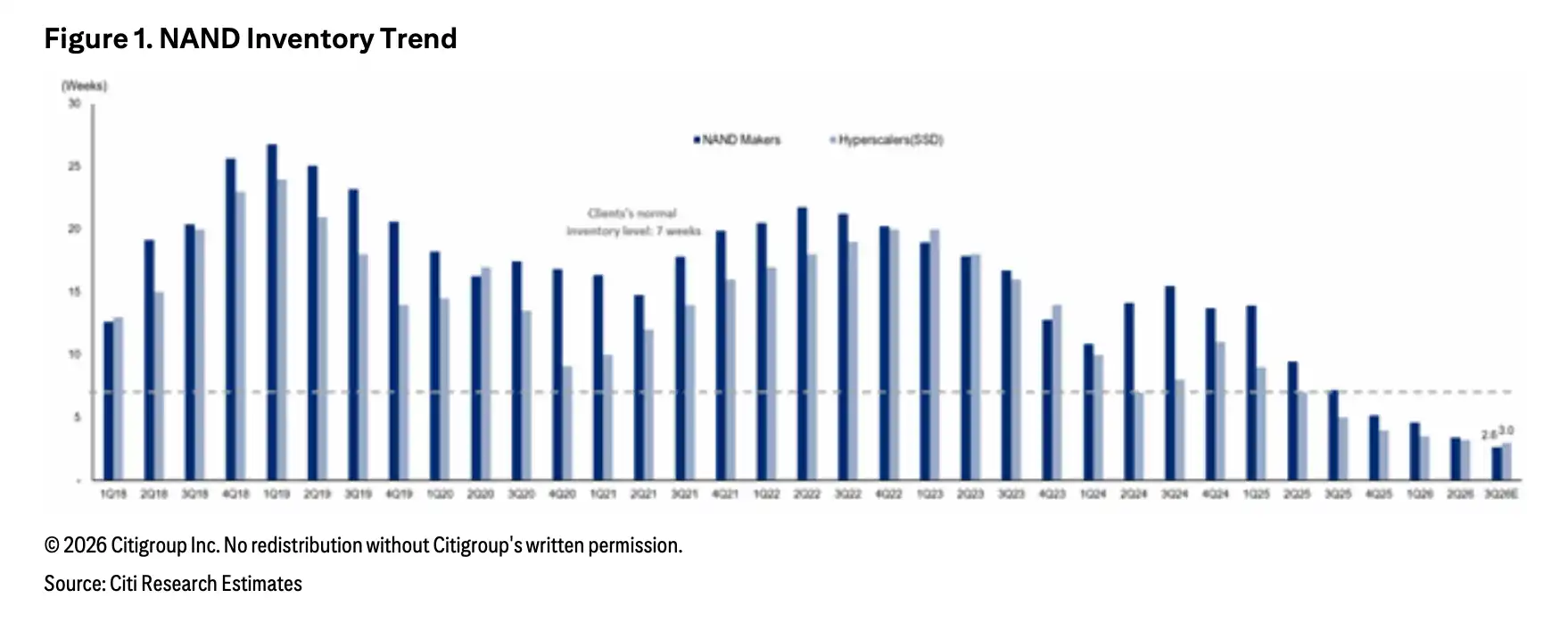
NAND Supplier Inventory at Only 2.6 Weeks, Normal Level Around 5 Weeks
The most crucial figure is the NAND inventory.
Citibank estimates that in the third quarter of 2026, NAND supplier inventory is only 2.6 weeks, significantly below the normal level of about 5 weeks; major cloud providers have about 3 weeks of NAND inventory, below the normal level of about 7 weeks; channel inventory is about 5 weeks, whereas the normal level is around 15 weeks.
This indicates that even with signs of weakening on the consumer side, the entire NAND chain is not loose. The low supplier inventory limits manufacturers' ability to quickly release spot market goods; low cloud provider inventory suggests that AI and data center customers may still continue to replenish stock; and low channel inventory also reduces the likelihood of prices being suppressed by channel dumping.
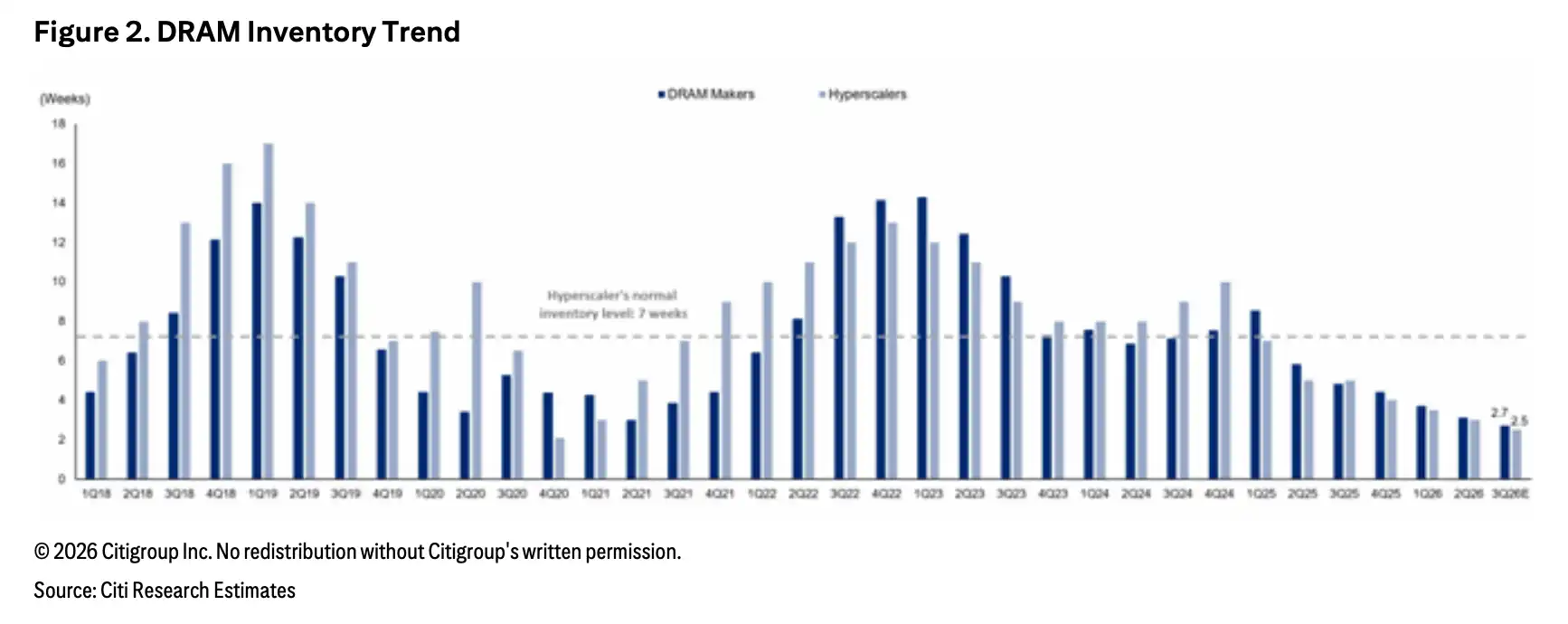
The situation is similar for DRAM. DRAM supplier inventory is around 2.7 weeks, below the normal level of about 5 weeks; cloud vendor DRAM inventory is about 2.5 weeks, below the normal level of about 7 weeks; channel inventory is about 4 weeks, with a normal level of around 15 weeks.
This set of data weakens the argument that "the cycle can turn just by the weakening of smartphone demand alone." At least from the inventory perspective, both DRAM and NAND have not yet returned to an oversupply state.
AI Servers Begin Eating More NAND, Rubin System SSD Demand Rises
The current storage upswing cycle differs from the traditional consumer electronics cycle in that AI servers are bringing new NAND demand.
Citi emphasizes two directions: CMX and QLC SSD. CMX corresponds to what NVIDIA calls the Context Memory Storage Platform, driven by BlueField-4 for pod-level context and KV Cache storage layer; QLC SSD is more used for high-capacity storage near the GPU to improve AI computational efficiency.
KV Cache can be understood as "context cache" in large model inference. The more frequent AI Agent usage, the longer the task chain, the more complex the context, the more the system needs to save intermediate states and historical information to avoid redundant calculations. Inference not only consumes GPU power but also increases memory and storage requirements.
A more intuitive assumption comes from NVIDIA's next-generation Vera Rubin platform. According to Citi's industry calculation, if Rubin server systems running CMX adopt 16TB TLC SSDs, the capacity of each system SSD can reach 1,152TB. NVIDIA's official statement is more conservative, indicating that each GPU pod provides PB-level shared capacity, and it has not confirmed that all Rubin systems will adopt this configuration.
This number explains why AI demand will change the NAND market. In the past, NAND was more easily influenced by the pace of smartphones, PCs, and consumer electronics; now, AI servers are also becoming significant buyers of high-capacity SSDs. As long as AI clusters continue to expand, storage demand is no longer just a function of the consumer end.
According to Citigroup's estimate, the NAND demand brought by CMX will reach 34.6 billion and 115.2 billion 8Gb equivalent units in 2026 and 2027, respectively, accounting for 2.8% and 9.3% of global NAND demand. This is a model assumption, not company guidance, but a nearly one-tenth share by 2027 is enough to impact supply-demand balance.
Weak Smartphone Sales Do Not Equal the Immediate Peak of the Storage Cycle
The market's concern about the weakening demand for Chinese smartphones is not unfounded. Smartphones remain one of the key end markets for NAND, and if shipments fall below expectations, consumer-grade NAND prices will come under pressure.
However, with current low inventory levels, the buffer left by demand fluctuations is not significant. Citigroup mentioned that the supply-demand balance of DRAM and NAND suppliers has dropped from 70% to 50%. The excess capacity in the hands of suppliers to meet demand is decreasing, not increasing.
In this scenario, the weakening of smartphone demand is more likely to slow down the rate of price increases, rather than directly change the direction of the cycle. As long as cloud providers and AI servers continue to make purchases, the low inventory will amplify the impact of additional demand on prices.
It is also necessary to differentiate between two types of NAND demand: consumer-grade NAND is more influenced by smartphones and PCs, while enterprise SSDs and AI-related SSDs are more influenced by data center construction, GPU cluster expansion, and model inference requirements. The market was previously concerned about the former, while Citigroup emphasized that the latter is still growing.
This is also the reason why the report continues to be bullish on Korean storage stocks. Publicly cited data shows that Citigroup has raised the target price for Samsung Electronics to 530,000 Korean won and maintains a buy rating; SK Hynix also maintains a buy rating, with Citigroup's previously reported target price being 3,100,000 Korean won.
The individual stock target price is not the most important part of this report. The real theme is that the market is concerned about the peak of the storage cycle, but inventory data and AI storage demand provide evidence to the contrary.
HBM Certification, Consumer Demand, and Expansion May Disrupt the Pace
Citigroup's conclusion does not mean that storage prices will only rise and not fall.
For Samsung, the main risks include delays in HBM shipment approval or certification to key customers, PC sales weaker than expected, NAND demand below expectations, aggressive investments by competitors in the storage or foundry fields, and a sharp appreciation of the Korean won eroding profits.
For SK Hynix, the risks lie in the downturn of DRAM demand, weaker-than-expected NAND demand, and a global consumption slowdown.
These risks illustrate that AI demand has not completely eliminated the cyclical nature of the storage industry. Storage is still an industry primarily driven by capital expenditure, inventory, and end demand. If competitors rapidly expand production capacity, or if consumer electronics demand deteriorates further, supply-demand tension may ease.
At least based on the inventory numbers provided in this report, the market's concerns about a "peak of the cycle" lack inventory-side support. NAND suppliers at 2.6 weeks of supply, DRAM suppliers at 2.7 weeks of supply, and cloud provider inventory similarly below normal levels indicate that the supply chain has not yet reached a typical oversupply state.
The current situation is more closely aligned with: noise on the consumer end, continued AI investments, and a still tight inventory end. As long as these three conditions do not significantly reverse, it is challenging to straightforwardly assess the storage cycle based on the traditional smartphone cycle.
Welcome to join the official BlockBeats community:
Telegram Subscription Group: https://t.me/theblockbeats
Telegram Discussion Group: https://t.me/BlockBeats_App
Official Twitter Account: https://twitter.com/BlockBeatsAsia
