Last month, we detailed the narrative of on-chain TCG (Trading Card Game) cards, where "card draw" is almost considered the second most significant crypto-native "money printer" after Hyperliquid and pump.fun:
"CARDS Surge 5x in 2 Months, Are On-Chain TCG Cards Another Major Narrative Post-HYPE?"
And last week, the frenzy of "card draw" finally made its way to the ETH mainnet. A new protocol called Fake World Assets, which had been live for just over a week, generated approximately $1.3 million in revenue, ranking 15th on the weekly crypto dapp revenue leaderboard:
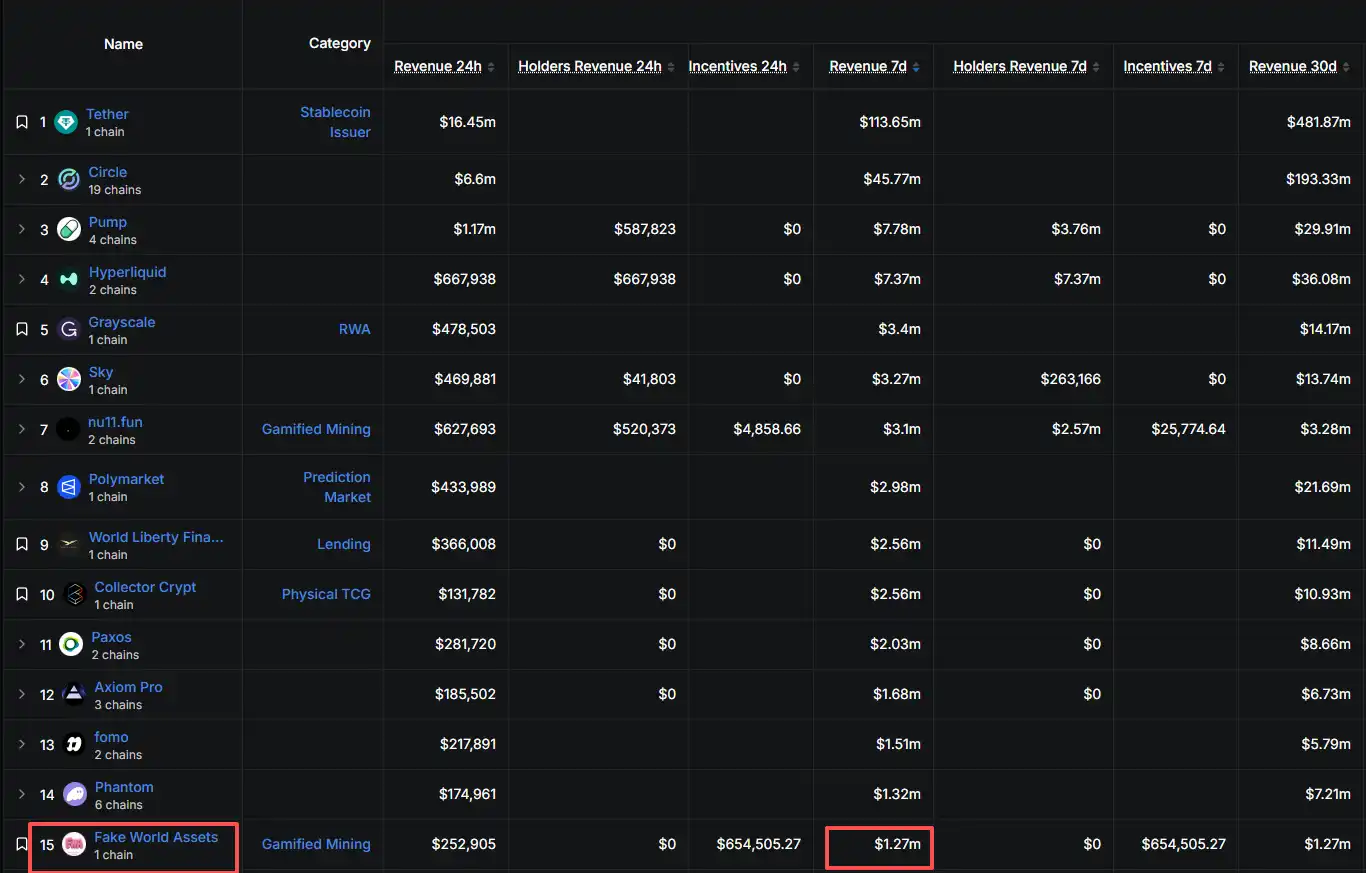
At the same time, the protocol's token $FWA, which initially debuted at around $47,550, briefly reached a market capitalization of approximately $38.8 million, marking an 800x surge. Meanwhile, as Collector Cards continued to maintain strong revenue momentum, its token $CARDS plummeted from a high market cap of nearly $90 million a month ago to only around $28.87 million.
Why?
FWA Gameplay
The team behind FWA, TokenWorks, should be familiar to many. Their previous sensational project was "Punk Strategy," which at one point reached a peak market cap of $300 million within a month.
However, TokenWorks doesn't hit the jackpot every time. Their previous project, TTT (Ten Thousand Tokens), was launched around the middle to late stage of the Uniswap v4 hype wave. The gameplay was essentially a launchpad where only NFT holders could mint coins, with 10,000 NFTs corresponding to the issuance of only 10,000 tokens on the platform, distributing fees among the minters, all NFT holders, and the protocol.
As they couldn't hit a trending target, shortly after the platform launched, the NFTs crashed.
I initially missed out on FWA this time, thinking it was just a simple "NFT card draw" gameplay. However, it incorporated a token flywheel mechanism that enabled $FWA to gain momentum.
$FWA, this token, cannot be directly purchased from an external source. To acquire this token, one must participate in a "gacha" event.
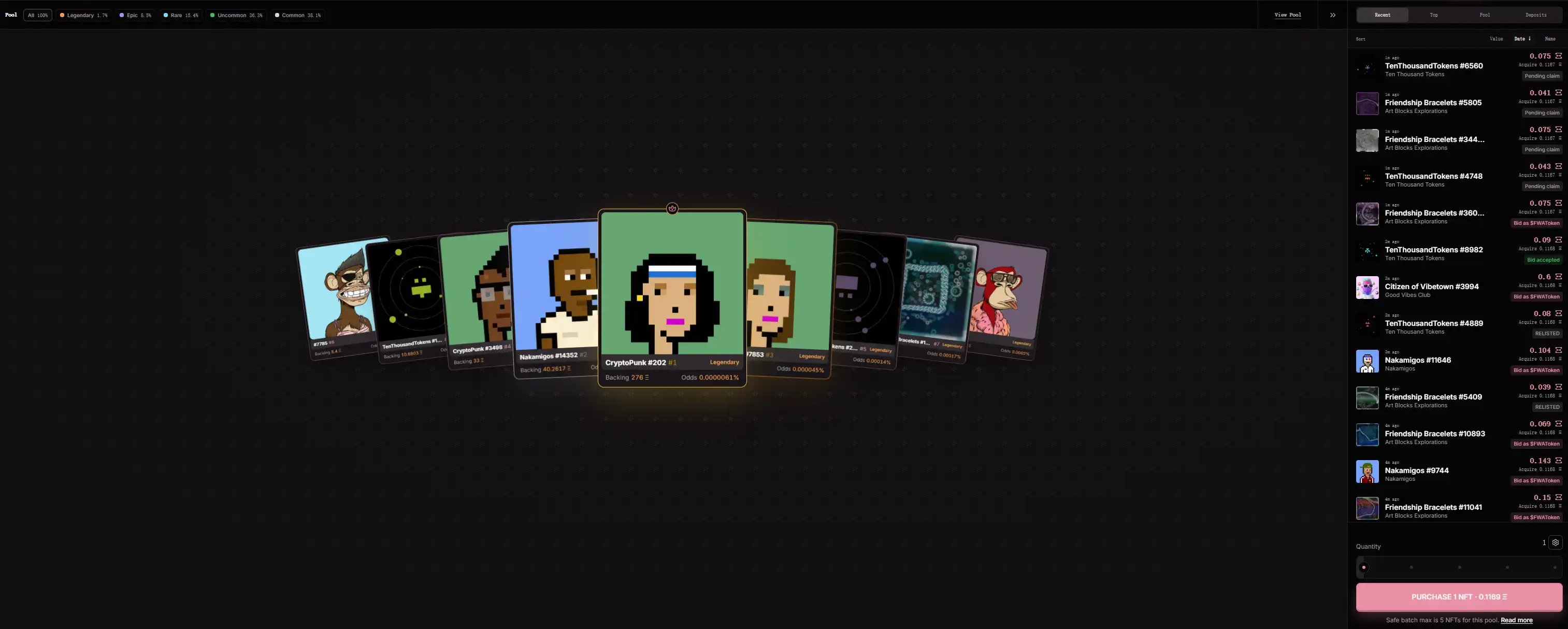
The NFTs in this pool are deposited voluntarily by players. When depositing an NFT, players also need to provide ETH as a form of liquidity. In other words, each player who deposits an asset effectively creates their own pool.
The more ETH that is deposited, the lower the probability of the corresponding NFT being drawn. Taking the example of the CryptoPunks below, which is paired with 276 ETH, the probability of it being drawn is only 0.0000061%, meaning it would take over a million draws to have a chance at obtaining it. Since the protocol launched on July 3, there have been a total of 73,884 lottery draws, averaging over 3,000 draws per day.
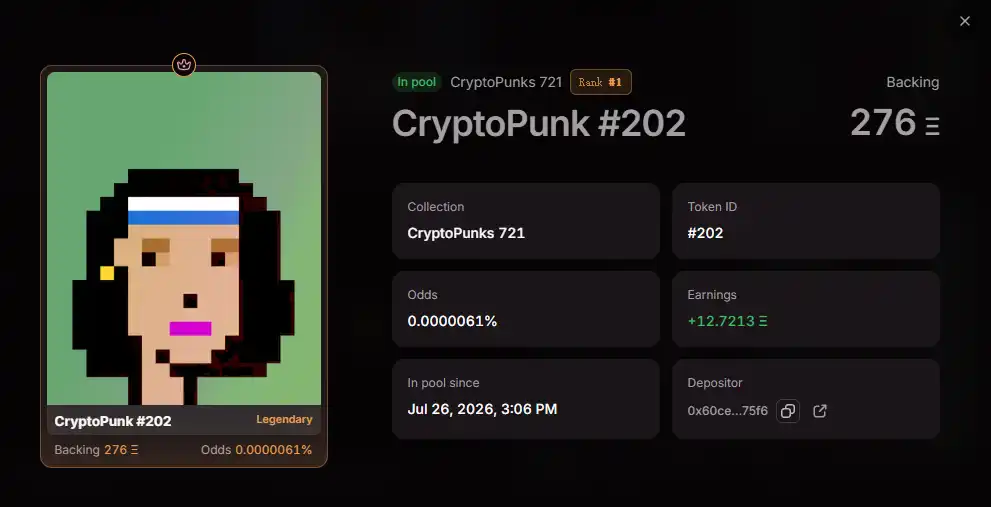
It can also be observed that the depositor of this CryptoPunks has already earned 12.7213 ETH in just over a day. This income is generated as follows:
- Every time someone participates in the lottery, a fixed 1% fee is deducted
- If someone wins a desirable NFT and chooses to keep it, 1% of the income generated by the depositor of that NFT is deducted
- Most players receive ordinary NFTs, which they immediately sell back to the depositor at an 85% discount, with the price difference forming income
Regarding how much each player who deposits NFTs and ETH into the protocol receives, it is not based on the amount of assets deposited but on how long the deposited NFT remains in the pool. As long as the deposited NFT is not drawn, profit-sharing continues. If it is drawn, profit-sharing stops, and a new NFT must be deposited.
To ensure that one's NFT remains in the pool for a longer duration, more ETH needs to be deposited, incentivizing the pool to grow thicker.
From this, we can deduce that this system is very much like an NFT AMM with an added gacha mechanism.
FWA Flywheel
One of the most intriguing aspects of the protocol's token $FWA is that it cannot be directly purchased from an external source. To obtain this token, one must actively participate in this NFT gacha machine.
50% of the total token supply was used to add initial liquidity, 30% was allocated to emissions for the first half month after launch (1% distributed to asset depositors and card draw participants daily), and the remaining 20% was distributed through an early snapshot airdrop.
The most common way to acquire $FWA is through card draws. As mentioned earlier, if a player receives an NFT they do not want, they can sell it back to the NFT depositor at an 85% discount. At this point, they can choose to receive ETH or $FWA (the protocol automatically converts the ETH received to $FWA).
Most players choose to receive $FWA after selling back unwanted NFTs. Data shows that in the last 7 days, up to 82.3% of transactions involved selling back immediately after a draw to acquire $FWA, especially when the token price was still low. However, as the $FWA price surged to new highs and then corrected in recent days, the option to receive ETH after selling back has been increasing gradually, although receiving $FWA still accounts for over 60% of daily transactions.
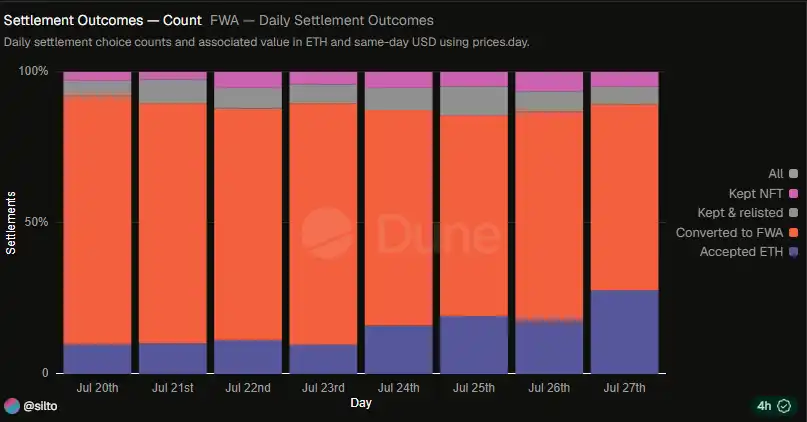
Calculating the cost of acquiring $FWA directly shows that each draw has a negative expected return. Therefore, obtaining $FWA through draws actually costs more than the daily $FWA price, resulting in a premium purchase.
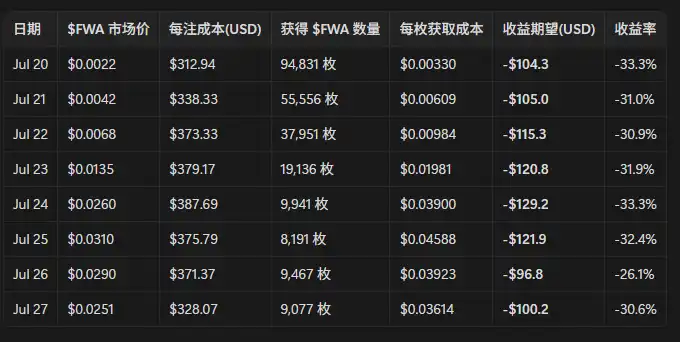
However, if holders do not sell their $FWA immediately after receiving it but choose to hold, the period from July 20th to July 23rd was a time of massive token minting through draw-to-$FWA conversions. This can be seen as a form of token printing frenzy, similar to the rush for a Blur airdrop in the past, betting on the future price surge of the token, essentially gambling on time for gains. The key difference is that this speculative cycle is much shorter and primarily focuses on gaming attention. If this mechanism is quickly discovered and becomes the center of attention, any increase in card draws will trigger significant $FWA buy pressure. New participants will continuously drive up the value of $FWA held by early adopters.
This is also why $FWA managed to surpass Collector Cards' token market value in a very short time. Both projects revolve around card draws, with the main revenue source being the immediate repurchase discount spread. Even though Collector Cards' card draws, featuring Pokémon cards, attract a wider audience than NFTs and demonstrate better profit performance, the utility of Collector Cards' token has been heavily criticized by the community. Apart from a buyback by the project team (which has been delayed due to the non-approval of the Clarity Act and lacks specific details), the Collector Cards token has virtually zero utility.
Even before the significant daily buybacks seen with pump.fun, the market was still unconvinced; much less will it be convinced by the Collector Cards, which have much weaker buyback pressure.
Conclusion
The flywheel effect of FWA is likely difficult to sustain in the long term. During price increases, everyone rushes in to pull cards, praising this as a great innovation that saved NFTs. However, once the price recedes and the losses from card pulling cannot be covered or even generate excess returns from the continuous rise of $FWA, this protocol will gradually be forgotten, and the NFT's "great revival" will come to a halt.
But the valuable lesson we can learn from this is that profitability is a narrative easily forgotten in the cryptocurrency market. Perhaps by understanding the relationship between attention and buying pressure conversion, many situations of being caught at the peak can be avoided.
Welcome to join the official BlockBeats community:
Telegram Subscription Group: https://t.me/theblockbeats
Telegram Discussion Group: https://t.me/BlockBeats_App
Official Twitter Account: https://twitter.com/BlockBeatsAsia
