In 1961, Unimate was deployed on an assembly line at General Motors in the United States. In earlier concepts, the operator could first walk through with a mechanical gripper, the machine would memorize the positions, and then replicate the process. The earliest lesson learned by industrial robots was not to interpret the world but to repeat an action reliably enough.
Over sixty years later, at the on-site of the Lunar Exploration Program Embodied Intelligence Hackathon, the LoopMaster team attempted to bring this concept to retail stores. A robot consisting of an omni-directional wheelbase, a lifting mechanism, dual robotic arms, and a front tray was envisioned by them as a "retail robot" capable of moving between shelves and customers. The store manager or staff first used remote control, voice commands, and minimal teaching to familiarize it with the counter, shelves, and retrieval path; the machine then went to grab, deliver, restock, and recorded each interaction.
This robot has not yet operated in a real store for an extended period; the team only conducted tests at the competition site, leaving behind hundreds of records. The path of achieving a two-year payback period, a 40% reduction in operating costs, deploying, collecting data, and iterating an end-to-end model is still being explored by the team. They are still a distance away from a real store ledger.
However, this team exhibits a rare kind of candor. They discuss Agent Loop and admit that the moat has not been clearly defined yet; they discuss the imagination of machines completely replacing human labor and acknowledge that the ability of companionship, warmth, and handling exceptions between humans is currently beyond what machines can do.
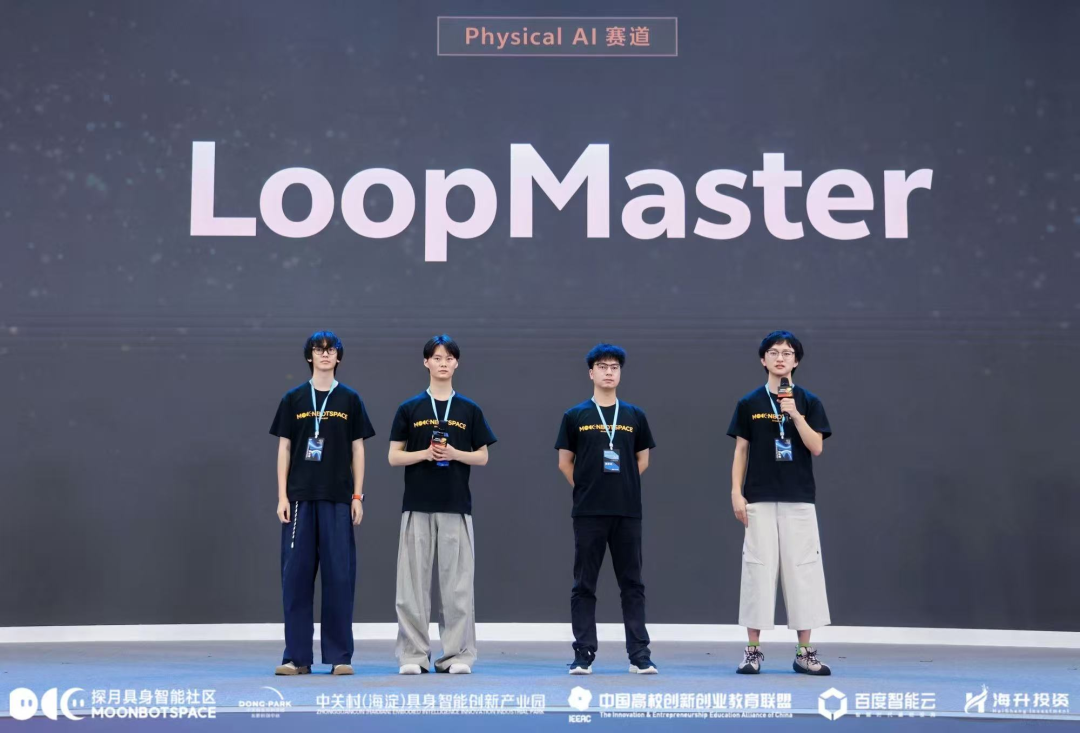
A group of people who had already met online, having their first offline collision of ideas
The four core members of LoopMaster include someone creating embodied intelligence content on Bilibili, someone pursuing a Ph.D. in robotics and human-computer interaction, and someone transitioning from automotive product design to independent design.
They said that what brought them together was the collaboration online over the past two years. Algorithms, ontology, data, low-cost robotic arms, product appearance – everyone entered through a different door and gradually realized which gaps each could fill. Some of them met for the first time only at the hackathon site, but the team did not know each other for such a brief period.
Beating by Dachace: Please introduce yourselves and what you are currently working on.
Xie Jun: I'm Xie Jun, currently a second-year master's student at Northeastern University, and also creating content related to Embodied Intelligence on Bilibili. I am currently mainly involved in the startup incubation of LoopMaster.
Zou Yanwen: My name is Zou Yanwen, and I am currently a PhD student at Shanghai Jiao Tong University in cooperation with the Smart Innovation Institute. My main focus is Embodied Operation and Human-Machine Interaction for Embodied Intelligence.
Li Pengdong: I'm Li Pengdong, a second-year master's student at Taiyuan University of Science and Technology, and also creating content related to Embodiment on Bilibili. By the end of 2024, I was one of the early reproducers of ALOHA and turned the process into an open-source tutorial. After that, I created several robots, and finally developed a dual-arm lifting robot, trying to make it completely open source so that students with limited budgets can reproduce it.
Xu Xinhao: I am the team's designer. I used to work in product design at a car company, then started working on Xiaohongshu (Little Red Book) and my own brand, and also took on some design services. Now I am an independent designer.
Dynamic Beating: Did you team up because of this hackathon? Are you now ready to start a formal business together, or are you still juggling your own matters?
Xie Jun: We knew each other long before this hackathon, almost about two years ago. In the early days, there was a lot of online collaboration, and everyone was working on Embodied Intelligence-related matters. I first met Pengdong when I started posting videos on Bilibili, and have always been following Xinhao's design work. While Yanwen was studying in the US, he was also working on related content.
Not everyone in our team had met offline early on. Some met for the first time at the hackathon venue, but this team was not put together at the last minute. In the past, we have always exchanged algorithms, ontology design, and data, and have also worked on DIY kits and early products, some of which were sold. To handle simple external business, we have also set up a few small companies.
Our previous status was more like a geeky lab or studio, not yet a complete startup company. Now, Pengdong, Xinhao, and I plan to continue working with Control Union to move the project towards a direction where it can truly be implemented. Yanwen is still studying and will not be coming out full-time for this for now.
Dynamic Beating: Before the hackathon, you had about two years of research and some commercialization attempts. How did you get through this period of running in?
Xie Jun: When we first met, we were all either new students or just starting our master's studies. We started as a group of Embodied Intelligence enthusiasts, discussing how to implement algorithms, ontology design, and data. Later on, we had DIY kits, some early products that were sold, and gradually took on external business and took the form of small companies.
So before the hackathon, we weren't yet a complete startup team, more like a group of people who had been working on things and meeting online. The competition just allowed these accumulations to come together for the first time at the same venue.
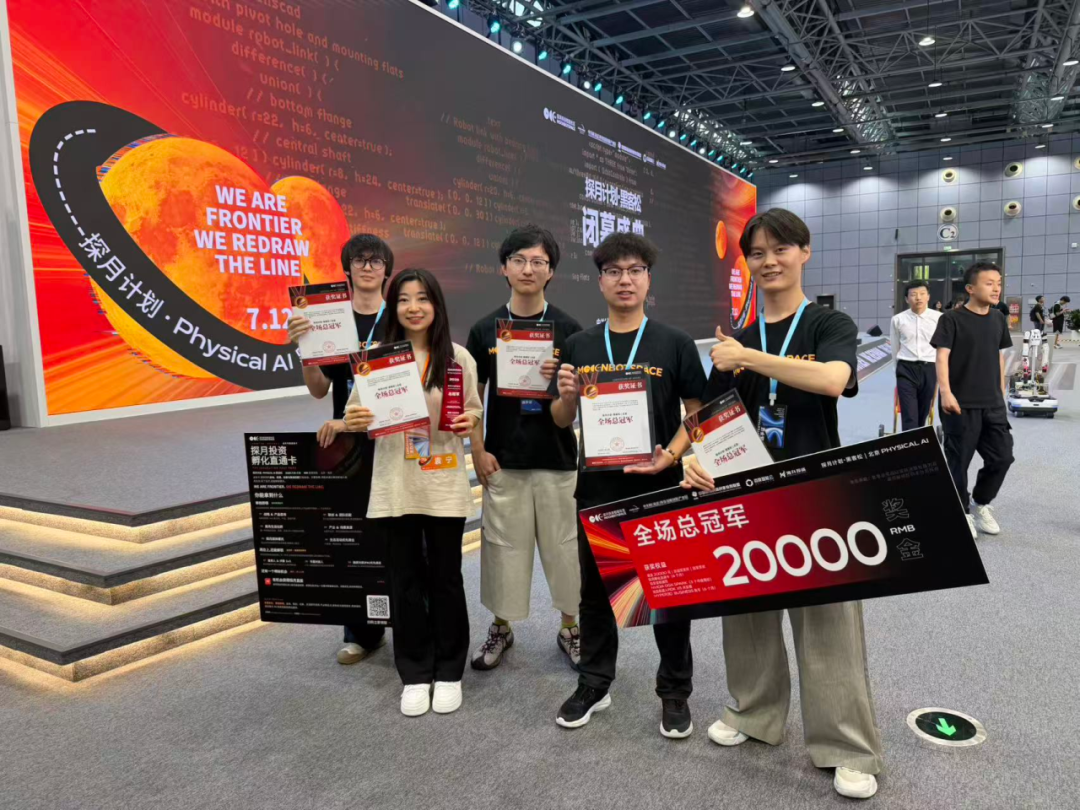
动察 Beating: Why Was LoopMaster Able to Win First Place in the Intelligent Embodiment Hackathon? What Did this 48-Hour Period Really Test?
Xie Jun: First and foremost, it was the accumulation of the past two to three years in intelligent embodiment. The robot's ontology, control, algorithms, and data were not something that just appeared when the competition started. LoopMaster's robot form and retail scenario were proposed and implemented on-site, but the ability to create it in a short time relied on long-term cognition and technical accumulation prior to this.
During the competition, we integrated the ontology, intelligent embodiment cognition, robot control experience, and algorithmic thinking, which led to this collision and spark.
Zou Yanwen: The hackathon tested us comprehensively. There needed to be clear division of work within the team, and each person's task had to be solid. Technically, you had to put together something that was originally only in your mind in a very short time. With little sleep, high intensity, people enter a wonderful working state. This is also why many people enjoy hackathons.
It's not just about technology either. In the end, you must package things into a product and create a demo that can be presented to the business and for implementation. You need to have judgment on the presentation effect and a sense of what should be accomplished at every point within the 48 hours. This time, our teamwork, project rhythm, and final pitch were quite coordinated.
动察 Beating: What's the Biggest Difference Between Hardware Hackathons and Software Hackathons?
Zou Yanwen: In software hackathons, many people can start working once they have their computer environment set up, and what they do is mostly geared towards the final deliverable. With hardware, it's different; there will be many unexpected issues at the venue that are unrelated to the project but must be resolved to continue.
On the first day, we encountered issues with the network connectivity that took up a lot of time to address. Someone might accidentally burn out a board and need to temporarily replace it with a new one; faults may occur with the onsite robotic arm or robot platform. Our own platform is just the same. Dealing with real-world hardware, you will constantly come across unforeseen events that were not originally planned for. They may not necessarily be related to the problem the project is trying to solve, but they will consume your most precious time.
Generation 5 Robot and the Removed Waist Joint
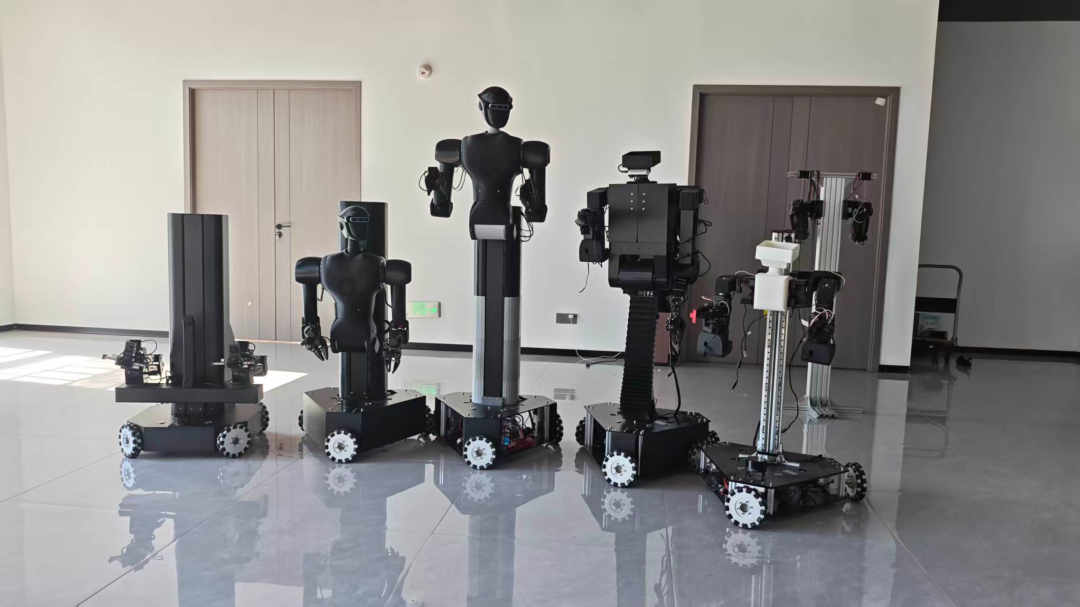
LoopMaster at the competition venue is not a robot that was created out of thin air in 48 hours. Li Pengdong said that they have been working on this type of robot for two years, and the latest version is the fifth generation. The previous generations of robots encountered many issues. Problems such as servo motor load, accuracy, backlash, and lifespan, a pulled wire harness, and a new malfunction that emerged after a feature was added could all bring a seemingly agile robot to a standstill.
One of the most interesting compromises was when they first gave the robot a "waist" and then cut off the waist joint in the fifth generation. The waist joint could have expanded the robot's desktop workspace, allowing it to reach further. However, they also wanted to make the product simpler, more stable, and easier to replicate, so they accepted a regression in the mechanical structure.
Dynamic Observation Beating: If a store places an order today, what will it actually receive? What can the robot do in the store?
Xie Jun: The product we envision is a robot with an omni-directional wheelbase, a lifting mechanism, dual robotic arms, and a front tray. After the store owner buys it, they can use relatively simple remote control or natural language commands to familiarize it with the store's warehouse, shelves, and item locations.
In a retail scenario, it mainly performs tasks such as picking and delivering orders placed by users, restocking, and placing items on shelves. The front tray can hold some items in advance, and the robot can also use it as a transfer between picking and delivering.
Dynamic Observation Beating: Has it been tested in real stores or simulated stores?
Xie Jun: Not yet. We have tested it at the competition venue and have left records of hundreds of orders.
The theme of this hackathon is to create something from scratch in 48 hours. We brainstormed retail scenarios, application methods, and algorithm frameworks on-site based on the existing wheeled dual-arm base. So the usage by users and product implementation are still very preliminary.
Dynamic Observation Beating: What indicators will be used next to determine if it meets expectations?
Xie Jun: It will be done in stages. First, stabilize the core, including the motors, wire harness, and overall functionality of the robot. Then, ensure the stability of the Agent control framework. Further down the line, it will involve self-evolutionary learning. Only once each component is stable will we discuss formal commercialization.
Dynamic Evolution: How did these five generations iterate from the original idea to today? What changes have you made to your understanding of the product?
Li Pengdong: The first four generations mainly used servo motors, which are also known as steering engines. They are more responsive in control, and the drive and structure are relatively simple, but they have limited load capacity.
Later, we made a version with a three-wheel omnidirectional chassis, added a lifting column and double arms. After completion, we found that its working range on the desktop is very small, roughly the size of a computer, and it cannot reach further away. We then made a version with a waist, expanding the working space on the desktop a bit more.
Next, we changed the structure, which originally relied heavily on 3D printed parts, to a sheet metal-based main body structure, improving stability. However, with more features came more problems. For example, if the wiring harness is lightly pulled, the entire system may pause the task; the body became heavier, reducing the payload. The fifth generation ultimately switched to joint motor modules, more metal parts, and a simpler structure. We reinforced where needed and removed unnecessary parts, hoping to find a balance between performance, cost, mass production, and reproducibility.
Xie Jun: Starting from the end of 2023, we used servo motors to create a low-cost, high-cost-effective embodied intelligent system. In practice, servo motors have limitations in stability, backlash, accuracy, and lifespan. After switching to joint motor modules, both cost and stability have seen significant improvements.
Dynamic Evolution: Was there a feature in the iterations that you particularly wanted to keep but had to cut in the end?
Li Pengdong: The waist joint is the most direct example. The fourth generation already had a waist, and we initially wanted to keep it in the fifth generation. However, to make the structure simpler, we ended up cutting it. It may seem like a step back in mechanical structure, but in reality, it prioritized reliability.
Dynamic Evolution: Why was this machine designed to be completely open source? What is the current cost and price positioning?
Li Pengdong: The body is completely open source, and anyone can see the BOM list. According to our initial estimate, if users process some parts themselves, purchase standard parts, and then complete assembly and debugging, the cost is approximately 30,000 RMB.
If users want to receive a semi-finished product or directly get a robot that is already calibrated, because it is completely open source, we expect the price to be within 50,000 RMB, roughly a little over 40,000 RMB. This pricing is primarily for the body and for research and development purposes. We want students and developers in the community with limited budgets to be able to participate, without being blocked by the high cost of the body.
Dynamic Inquiry Beating: After a customer purchases a machine, will there be any subscription service or other hidden costs?
Li Pengdong: Currently, we do not consider subscription services as a clear business model. The unmanned vending robot developed within 48 hours this time is initially just a demo.
If we truly enter the unmanned retail or specific retail scenes in the future, we will design a charging method based on the corresponding scenario. We are not thinking that far ahead right now.
Dynamic Inquiry Beating: Why did open source become an enhancement for your award this time?
Xie Jun: This may also be a significant reason we won the award. After full open-sourcing, the underlying libraries, code, and drivers are all open, and the agent can access this content, making development smoother. It makes hardware development somewhat closer to pure software development, with the underlying code being readable and callable, reducing on-site iteration resistance.
Open source is not just a technical choice for us. We hope that more students, professionals, and people from other industries can participate in embodied intelligence through a relatively low-cost approach.
Small-scale Teaching, Not Small-scale Training
LoopMaster repeatedly mentioned "small-scale teaching" in the interview. The common small-scale teaching involves using a person's operational trajectory as supervised data, putting it into imitation learning or visual language action models for training, and finally inferring by the model. What the team is currently referring to as small-scale teaching is a bit different.
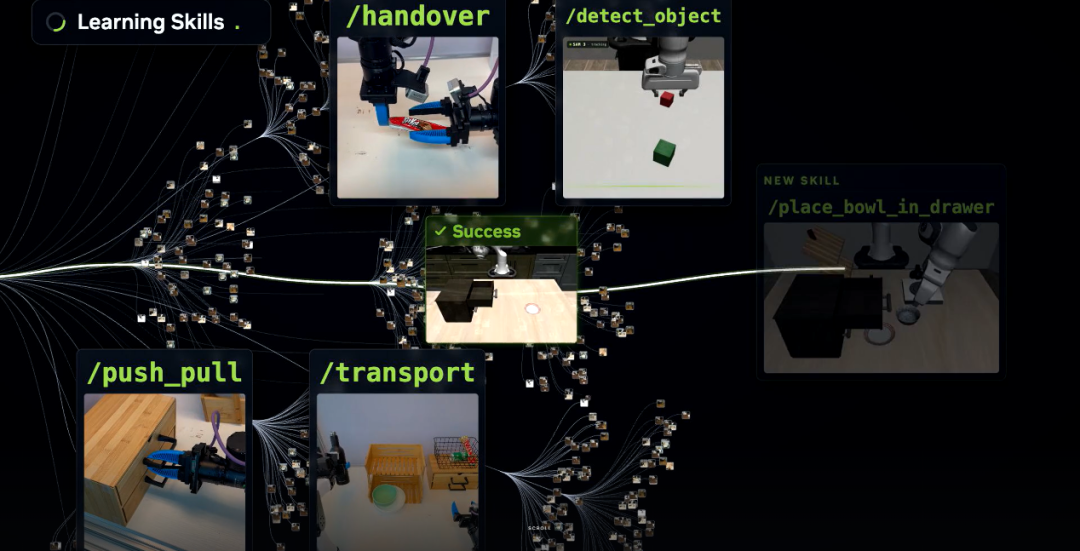
What they are dealing with is a more structured store space. The position of the containers is relatively fixed, and the grabbing action of a row of goods is similar. They first record a trajectory for the robot, move the base to a different location, and the robotic arm may still reuse similar actions. They first encapsulate similar tasks into skills and hand them over to the agent for scheduling.
The logic of this route is also easy to understand. Without deployment, there is no real data; without real data, subsequent training of end-to-end models is impossible. First, let a not-so-smart but functional system enter the field, and then let the data grow slowly.
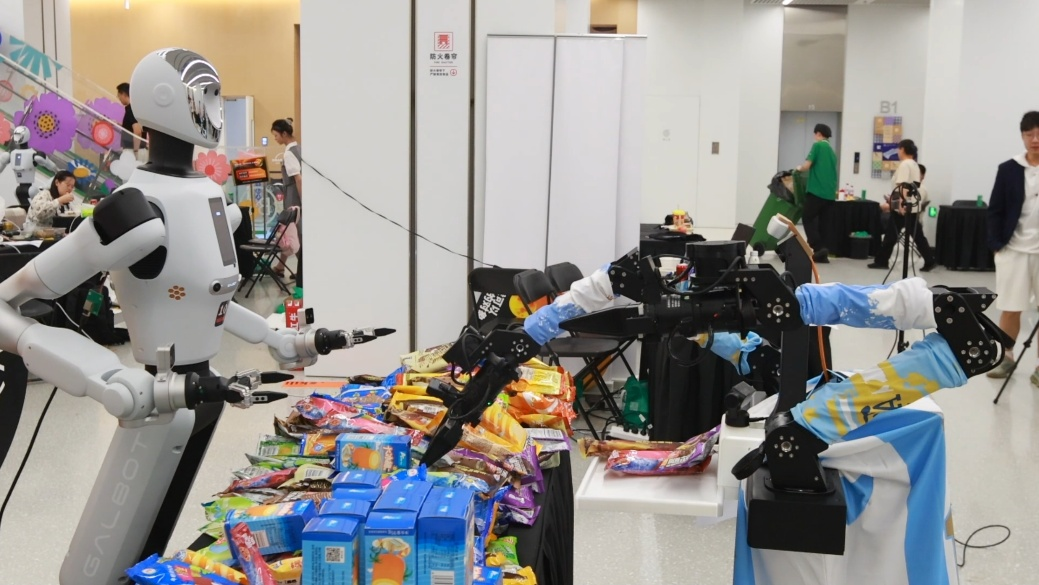
Dynamic Inquiry Beating: How is your concept of "small-scale teaching" different from the common small-scale teaching in embodied intelligence?
Zou Yanwen: Our idea of small-scale teaching is different from learning-based small-scale teaching. In traditional imitation learning, a person takes a small number of expert trajectories as supervised signals, puts them into networks like ACT or VLA for training, obtains a neural network in the end, and then takes it for inference.
We are currently recording trajectories, but these trajectories are not used directly for training. For example, the containers in a supermarket are relatively structured. After a teaching trajectory for a row of containers, when picking up the first item in this row, the robot moves from this position; when picking up the second item, the base moves slightly, and the robotic arm can still complete the action along a similar trajectory.
For now, we are not pursuing generalization in continuous space but rather organizing relatively fixed positions in a discrete space into a structured program. Then, we encapsulate similar actions into skills for the Agent to schedule.
Dynamic Insight Beating: Will this make it difficult for the robot to adapt to different types of offline stores?
Yanwen Zou: There will be boundaries. However, I believe that end-to-end models seen at the current stage also face this issue. They also need to collect data in specific scenarios, followed by post-training and iteration. Changes in lighting conditions or replacing a bag of Lay's potato chips with a bottle of Pepsi will also bring variations.
What we want to do is to first get things running with the Agent framework. It may look more cumbersome, but once deployed, the interactions between users and robots will themselves become data for this scenario. These expert trajectories can still support the iteration of end-to-end models.
Dynamic Insight Beating: Who will teach the robot? Why does it have to be an Agent self-evolution loop?
Yanwen Zou: It is impossible to deploy engineers to every store. Only managers and staff can learn to teach robots to work in their own environment, like learning to use a fan, to be able to collect new data in real scenarios.
Natural language interaction and the Agent Loop are designed for this purpose. Our idea is to minimize the part that humans must intervene in, allowing the Agent to reflect, adjust, and schedule different skills to complete tasks. This is still a framework being polished, not a solution that has been widely validated.
Dynamic Insight Beating: The introduction mentions "iterating sales behavior based on sales metrics." Does this mean that the robot, besides performing physical labor, also has to undertake sales tasks?
Yanwen Zou: The sales metrics mentioned here do not mean that it has to engage in sales. In a retail chain, supply chain management is already crucial, and there is sales data in the background. After the robot enters the front-end labor, the store's sales data, peak morning and evening foot traffic, container display, and restocking logs will all become part of its understanding of the scene.
This data can be sent back to the backend to optimize supply and display, reduce stockouts, or reduce losses due to expiration. It is still frontend work, just records accumulated during the work process that can enter the closed-loop of store operations.
40% of the Accounts, and Things Left for Humans in the Store
When robots enter the retail scene, the easiest thing to calculate is the payroll. LoopMaster has provided an estimation of "40% reduction in sales costs," but the team also acknowledges that this number is based on the expectation that a robot is stable enough to operate with minimal human intervention over the long term.
More challenging to calculate is the human factor. Currently, they want to assign tasks such as stocking, picking, and replenishing to machines; in the more distant future, they do not rule out the possibility of robots replacing more human labor. However, when it comes to human-to-human interaction, they also believe this is an area where humans cannot be replaced by machines.
Dynamic Beating: How Was the Figure of "40% Reduction in Sales Costs" Calculated?
Xie Jun: Our calculation compares the purchase cost of a robot, daily token cost, electricity cost, and minimal maintenance cost with the salaries of two employees. Calculated based on a two-year payback period, we obtained a result of approximately 40% reduction in traditional store sales labor costs.
Dynamic Beating: Do Maintenance, Repair, and Labor Takeover Costs for Engineers to Maintain Robots Include Costs That the Store Manager and Employees Cannot Solve?
Xie Jun: The premise of this figure is that the final product achieves the expected stability. Before true commercialization, we need to try to solve problems such as motor, wiring harness, obstacle avoidance, and stall issues, first achieving indicators of long-term continuous operation without human intervention, before discussing such calculations.
Maintenance will certainly exist. In the event of a serious breakdown, it may require an engineer for on-site handling or repair; if the main body is modular enough and the structure is simple enough, repair tutorials can also be provided. In the future, if there are enough robot deployments, repair services similar to fixing phones or computers may emerge. We hope to keep maintenance costs as low as possible.
Dynamic Beating: In an ideal retail store, what do humans and machines do respectively?
Zou Yanwen: It will be a gradual process. The first step will definitely be stocking. Later, it can be expanded to picking from the warehouse, engaging in partial interactions with customers, or integrating different robot and AI capabilities. Moving forward, based on the context and sales metrics accumulated in the store, some operational management assistance will be provided.
Insight Beating: What is the Journey of a Regular Customer Walking into a Robot-Run Store? Will They Trust It?
Xie Jun: Initially, they may find it novel, fun, and may not immediately trust it. But if every store has a robot in the future, people will gradually get used to it.
There are already scenarios where robots sell ice cream. The robot may also establish its own brand. For example, in a fully robotic restaurant where drinks and snacks are all made by robots, if the products are delicious and unavailable elsewhere, customers may not only see it as a substitute for human labor.
From the perspective of operators, robots may also have advantages in hygiene, personnel costs, and inventory management. They can help stores reduce unnecessary food expiration and waste.
Insight Beating: Do You Agree that "Replacing Labor" is the Most Direct Business Logic for Robots? Which tasks still require human intervention?
Xie Jun: The communication between people, seamless companionship, and warmth are still difficult for current robots to satisfy.
In the long term, if robots are agile enough and their AI is smart enough, complete replacement of human labor is not an unrealistic expectation. However, in some sensitive scenarios, progress may be slower.
Insight Beating: Both the hardware and AI models are updated rapidly. If businesses buy a robot expecting a two-year ROI, will they face hardware depreciation and obsolescence in the second year?
Xie Jun: Hardware obsolescence will certainly occur, similar to how computers and phones are updated after a few years. We do not promise that a robot can function healthily for 30 years. A more realistic target is 5 to 10 years.
Short-term updates within one or two years will result in depreciation. Therefore, during product design, we will try to reuse components like joint motors and structural parts in the next generation. We prefer the AI to be updated faster than the hardware. Software can be upgraded online, perhaps with a new version every few weeks or multiple versions in a month, while the hardware is intended to remain universal for a longer period.
Xie Jun uses the YuShu G1 as an example, believing that a universal hardware form may still hold value after one or two years. For LoopMaster, they hope that the earliest robots sold will not need complete replacement with every algorithm update.
First Deploy the Hardware in Stores, Then Discuss the Moat
Unlike many entrepreneurial teams who often talk about "grand narratives," LoopMaster's response is more genuine. Xie Jun directly states that what they can currently clearly articulate is a low-cost hardware, the evolving Agent self-evolution framework, and a path they hope to take to enter real scenarios earlier than end-to-end solutions to accumulate data.
All team members were born after the year 2000 and acknowledge their lack of experience in dealing with complex offline supply chains and B2B business. While a competition can showcase a prototype, the real retail deployment faces challenges such as procurement, after-sales service, customer decision-making, reliability, supply chain, and funding. Everything takes longer than a demo pitch.
Dynamic Beating: When facing mature large companies and robot manufacturers, what do you consider to be your moat?
Xie Jun: At the current stage, our advantages are, first, the low cost of the core technology. Second, we have this relatively new Agent self-evolving framework. Third, if we can enter real scenarios early, we can obtain data on real machine operation, user interaction, and the commercialization process sooner.
However, in terms of a specific commercialization moat, we haven't fully figured it out yet. We hope to first develop these capabilities and then find something truly valuable in the deployment.
Dynamic Beating: As all of you were born after 2000, do you lack experience in dealing with offline stores, supply chains, and consumer scenarios? What challenges have you encountered?
Xie Jun: Yes. At the current stage, the team members are all born after 2000, so we lack commercialization and B2B experience. If we want to truly commercialize later on, we may need to bring in experienced business partners and learn from people in the industry who have done these things before.
Dynamic Beating: In the future, in offline scenarios, will the running entities be general humanoid robots or robots designed for specific tasks?
Xie Jun: I think both will exist. General humanoid robots will be applicable in more scenarios, but in terms of energy consumption, complexity, and stability, they may not necessarily be better than specialized robots. Humanoids will have a stronger aesthetic appeal.
For scenarios like unmanned stores, a semihumanoid system with mobility and upper-body operation capability may already suffice. There is no need to bear all the complexity just to resemble a human.
Dynamic Beating: What is the timeline for the next steps of product landing, financing, and expansion?
Xie Jun: After the competition, we had in-depth discussions and cooperation with Exploratory. As the core technology serves as a laboratory and research tool, its progress will be relatively faster. We expect that there may be some orders in the next month.
However, the timeline for the actual deployment in specific commercial scenarios is currently uncertain. The team is still refining the project, seeking resources, investments, and industry advice, and continuing to iterate on the path to commercialization.
Don't Turn Every Company into a New Lab
When asked about bubbles in an interview, Zou Yanwen believed that the current embodied intelligence bubble is more serious than the large language model bubble. He said that at least people are already paying subscription fees for large language models, while many learning-based robots in embodied operations have not truly entered real-world scenarios. If we calculate based on market penetration rate, the bubble is actually even bigger.
At this stage, while research on embodied intelligence is important, he thinks we really don't need so many Neo Labs. Each company must answer a simpler question—where does it work and can that scenario support it to develop stronger capabilities.
The team finally brought the topic back to open source. Over the past two years, the ontology they have created is open to students and developers, and they also hope that people with backgrounds in design, art, and Chinese language and literature will participate. Embodied intelligence will not only emerge in model papers and funding news; it also needs to be installed, taught, repaired, and interact with specific people in a specific location.
Dynamic Observation Beating: What bubbles do you think are most likely to appear next in embodied intelligence?
Zou Yanwen: I don't think its bubble is smaller than that of large language models. Large language models already have people paying subscription fees. In embodied operations, many learning-based robots have not truly entered real-world scenarios. If we calculate based on market penetration rate, the denominator is very small, so the bubble may actually be even bigger.
In the next period, everyone may look forward to stronger capabilities emerging after the accumulation of data volume and end-to-end strategies. But we must be wary of turning every company into Neo Lab. Each entrepreneurial team needs to clarify its own application scenario and whether that scenario can support it in achieving the ultimate end-to-end capability.
Dynamic Observation Beating: Why do you say that the current industry's focus on embodied intelligence is somewhat limited?
Zou Yanwen: Traditional robots already have complex modules such as perception, decision-making, and control, each of which is a separate research direction. Today, when people argue about world models, VLA, or low-level strategies, they often just focus on a few blocks in a tower of building blocks.
These issues are certainly important, but if we want robots to truly land, both the ontology and algorithms need to continue to iterate, mass-produced components need to be selected, the Agent Loop needs to be built, and both learning-based and non-learning-based methods need to be implemented. Low-level strategies may become larger in the future and even engulf other modules, but what is more urgent right now is to first erect the entire building.
Insightful Beating: Why do you insist on open source and what kind of people do you hope to enter this industry?
Xie Jun: Pengdong and we spent two years on Ontology, but still willing to open source it because we hope to attract more students, professionals, and people from other industries to participate. With the help of AI and Agent programming, some people without a deep technical background can also quickly use robots and engage in exploration.
Now many embodied intelligence demos are somewhat homogenized. The industry needs new ideas. People in fine arts and Chinese language and literature may bring a different understanding than those with a purely technical background. We said at the hackathon pitch that we hope non-technical small business owners can also use robots at a lower cost, allowing them to take on some of the duties of sales clerks. This is the original intention of our open source efforts and lowering the threshold.
We also appreciate the opportunity provided by the lunar exploration for the team to showcase and collaborate. We hope the project can continue to move forward, and we also hope to see more new perspectives, new paradigms, and scenes that truly solve problems in the entire industry.
Insightful Beating: How do you view the trend of VCs entering universities today, encouraging students and professors to start businesses, and the so-called Neo Lab trend?
Zou Yanwen: I am not sure if I can simply describe it as a good thing or a bad thing. One reality is that the university system finds it difficult to absorb the amount of funding and computing power needed for deep learning research. For some professors, going out to start a business, collaborate with companies, or establish organizations like Neo Labs may be a way to access resources.
However, it may also lead to issues like market valuation discrepancies between primary and secondary rounds, and raising a large amount in the first round. Perhaps some research indeed requires a lot of money, but it does not necessarily need that many people. How research organizations access resources and how a company is priced by the market are ultimately not the same question.
First, Draw the Floor
The 2016 movie "The Founder" tells the story of how McDonald's transformed from a restaurant to a chain. At the beginning of the film, milkshake machine salesman Ray Kroc meets the McDonald brothers in San Bernardino, California. The brothers explain their "Speedee Service System" to him, and then on a vacant lot, they use chalk to outline the positions of the kitchen, serving counter, fryer, and where the employees pivot, allowing the staff to simulate ordering, bagging, and delivering over and over again. Until this assembly line becomes smoother and more efficient.
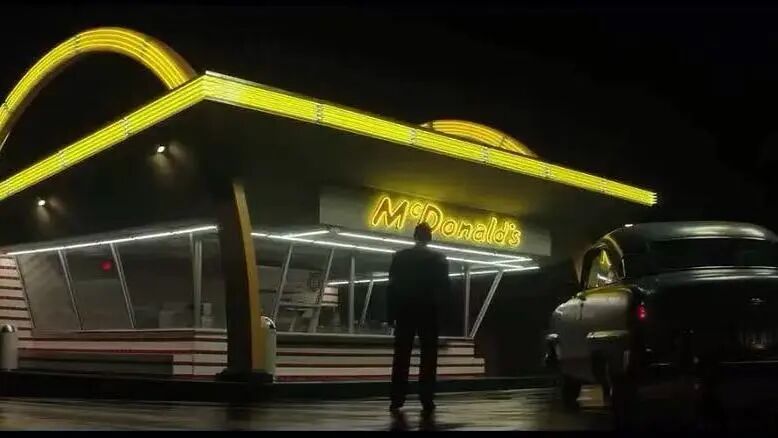
First, someone remembered who always took the long way around the store, who would bump into whom when taking food, and which action would make customers wait an extra half minute. Then came the blueprint, compressing the experiences of many people into actions that later individuals could follow.
In The Great Entrepreneur, another story unfolded later. After turning a set of processes into a replicable business, who owned the standards, who owned the space, who owned that brand, the matter was no longer just about the kitchen.
LoopMaster is certainly far from this step. It has not yet completed real-world store deployment, and the commercial moat still needs to be validated. But this is precisely what gives weight to those less-than-perfect answers in the interview. How data is accumulated, who takes over mistakes, how sales metrics are not deceived by promotions and foot traffic, how much time the first store is willing to invest in learning—these are not trivial issues that disappear naturally once the machine is brought into the store.
LoopMaster now has hundreds of on-site test records, an open BOM list, the waist joint removed from the fifth-generation body, and a set of Agents in waiting for inspection. It is one floor away from a real store. Someone has to draw the lines there first.
Welcome to join the official BlockBeats community:
Telegram Subscription Group: https://t.me/theblockbeats
Telegram Discussion Group: https://t.me/BlockBeats_App
Official Twitter Account: https://twitter.com/BlockBeatsAsia
