According to Morgan Stanley's Japan Electronic Components team citing TSR data, the estimated shipment capacity of enterprise SSDs in data centers is expected to reach 525.0EB by 2026, doubling year-on-year; the shipment capacity of nearline hard drives (NL HDD) in data centers is expected to increase to 1845EB, a 30.4% year-on-year increase.
The implications of this forecast are straightforward. The expansion of AI and cloud data centers is simultaneously driving up the demand for both types of storage. On one hand, enterprise SSDs are handling faster data read/write operations, while on the other hand, nearline HDDs continue to support large-scale, low-cost data storage. The demand growth is not simply "buying more hard drives," but rather a shift towards larger capacity, higher density products, with capacity growth rate significantly outpacing the unit growth rate.
Based on TSR's figures, the total SSD shipment capacity forecast for 2026 has been raised to 775.03EB, a 55.6% year-on-year increase, higher than the previous month's forecast of 759.36EB. Among them, enterprise SSDs in data centers are the most prominent source of incremental growth. The demand for nearline HDDs has also been revised upwards, but increased production is more easily constrained by head supply and testing capacity.
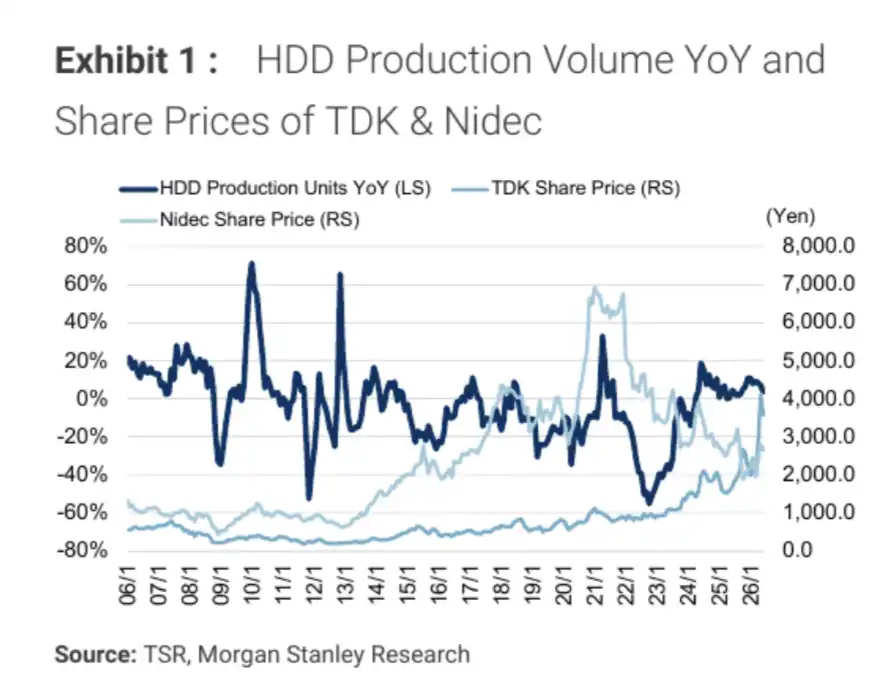
Enterprise SSD Leading the Way: June Capacity Up 124.5% Year-on-Year
Enterprise SSDs have already shown high growth in monthly data.
In June, the shipment capacity of enterprise SSDs in data centers reached 46.33EB, a 124.5% year-on-year increase, and a 12.0% increase from the previous month; the unit shipment volume was 6.35 million units, a 41.1% year-on-year increase. Capacity growth far outpaced unit growth, driven by the increased share of higher-capacity products.
This is also one of the reasons for the upward revision of the 2026 forecast. TSR's forecast for the shipment capacity of enterprise SSDs in data centers in 2026 has been increased from 509.33EB last month to 525.0EB, a 100.0% year-on-year increase. This figure is expected to be 262.5EB in 2025, a 58.2% year-on-year increase.
Looking at the entire SSD market, the growth is also significant. The total SSD shipment capacity is expected to reach 498.0EB in 2025, a year-on-year increase of 38.0%; further rising to 775.03EB in 2026, a 55.6% year-on-year increase. Enterprise data center products have contributed to the highest growth rate.
More importantly for investors, data center expansion not only drives the demand for GPUs, servers, and network equipment but also boosts the need for backend storage capacity. Model training, inference logs, vector databases, backup, and archives all require more storage space, with enterprise SSDs being key hardware for high-performance data access.
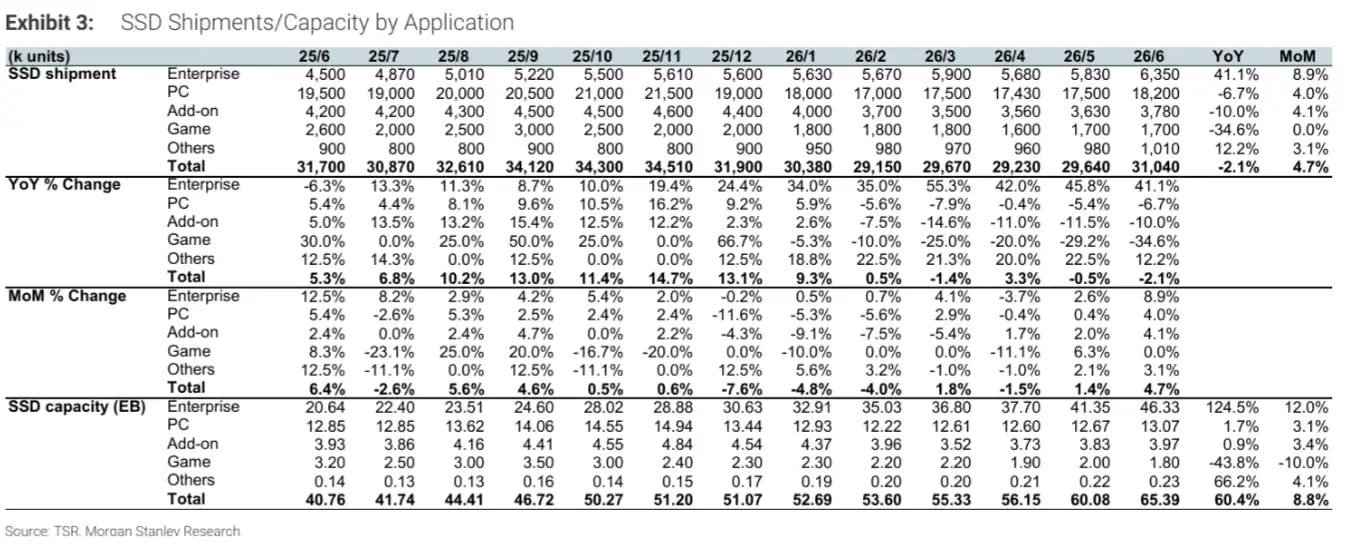
Nearline HDD Growth Also Rising, Relying on "Larger Disks" for Capacity
The growth of nearline HDDs is also strong but follows a different structure.
Based on TSR calculations, the estimated data center NL HDD shipment capacity in 2026 is expected to reach 1845EB, a 30.4% year-on-year increase. Over the same period, the total HDD shipment capacity is projected to be 2053.5EB, a 26.1% year-on-year increase; with the total HDD capacity in 2025 expected to be 1627.9EB, a 29.5% year-on-year increase.
In terms of unit numbers, the growth is not as dramatic as the capacity figures. The production volume of NL HDDs in June was 7.03 million units, a 12.3% year-on-year increase, and a 0.6% decrease from the previous month. The full-year production forecast for NL HDDs in 2026 is 84.39 million units, a 12.8% year-on-year increase. This indicates that the growth in nearline HDD capacity mainly relies on the increase in single-disk capacity rather than a significant expansion in unit shipments.
The proportion of higher-capacity helium-filled products continues to rise. In June, the production volume of He-filled products was 5.95 million units, a 17.4% year-on-year increase, outpacing the overall NL HDD production volume growth rate. For cloud providers and AI data centers, the increase in single-disk capacity allows for more data to be stored within the same rack space, with no or limited increase in power and operational costs.
Official materials from TDK also support this trend. In its FY3/26 performance update, TDK stated that nearline HDD demand continues to rise due to the growth in high-capacity storage needs, with HDD manufacturers preferring to meet this demand by increasing single-disk capacity. However, TDK's forecast for FY3/27 nearline HDD production is 76 million units, a 7% year-on-year increase, following a different calendar from TSR, making direct comparisons inadvisable.
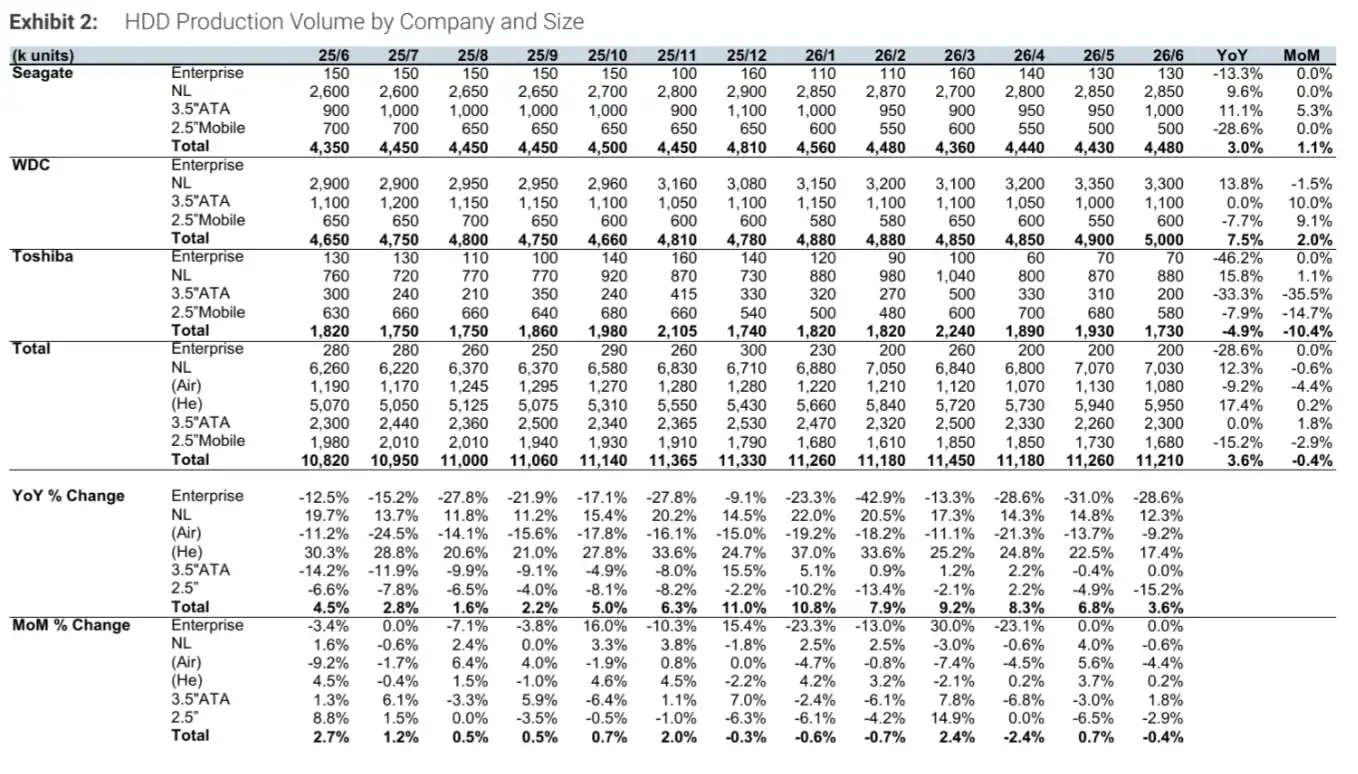
Demand Forecast Revision Does Not Equal Supply Chain Without Pressure
Strong storage demand is most easily misunderstood as supply being able to naturally catch up. Nearline HDDs are more likely to encounter manufacturing and testing constraints compared to SSDs.
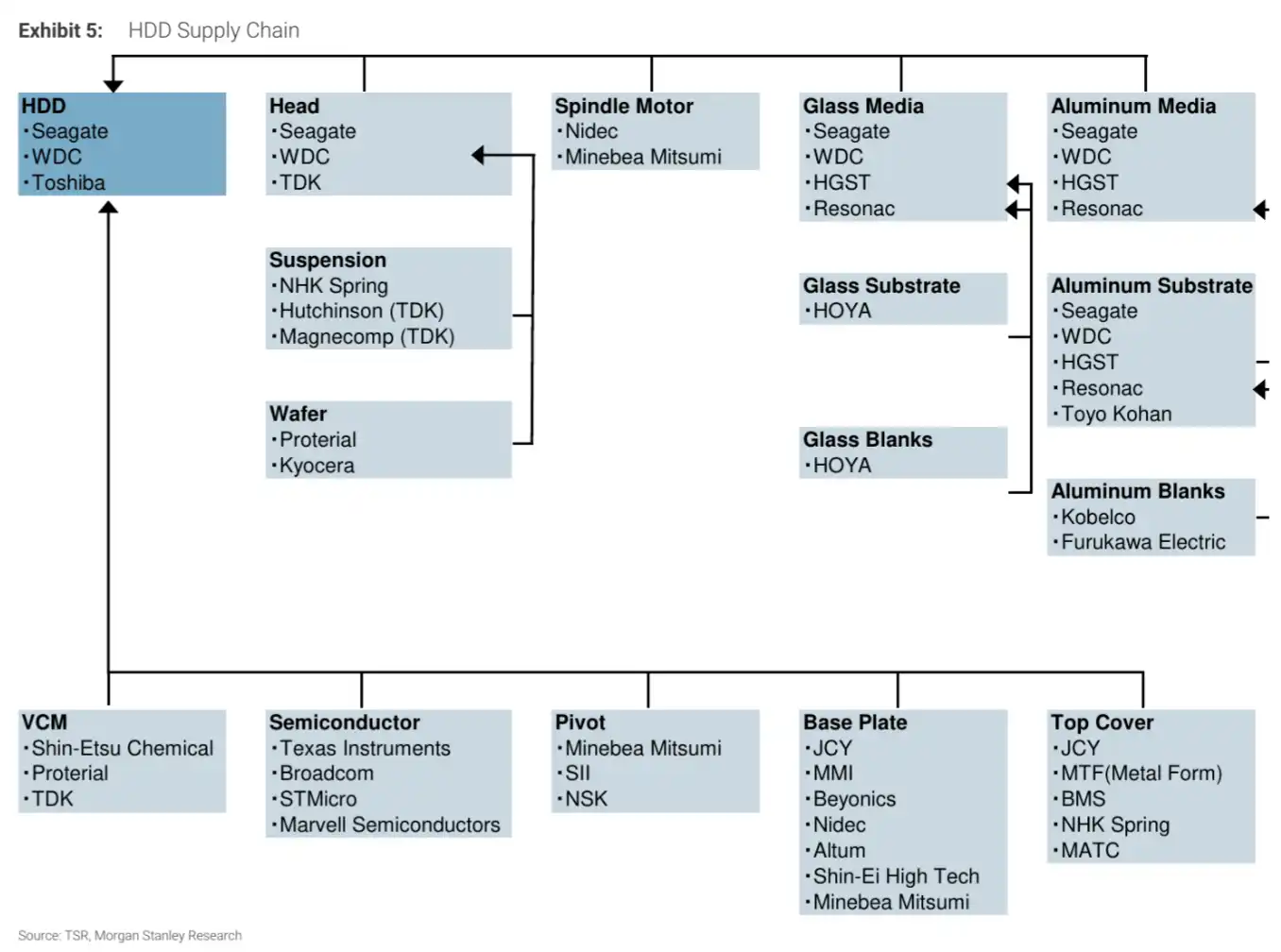
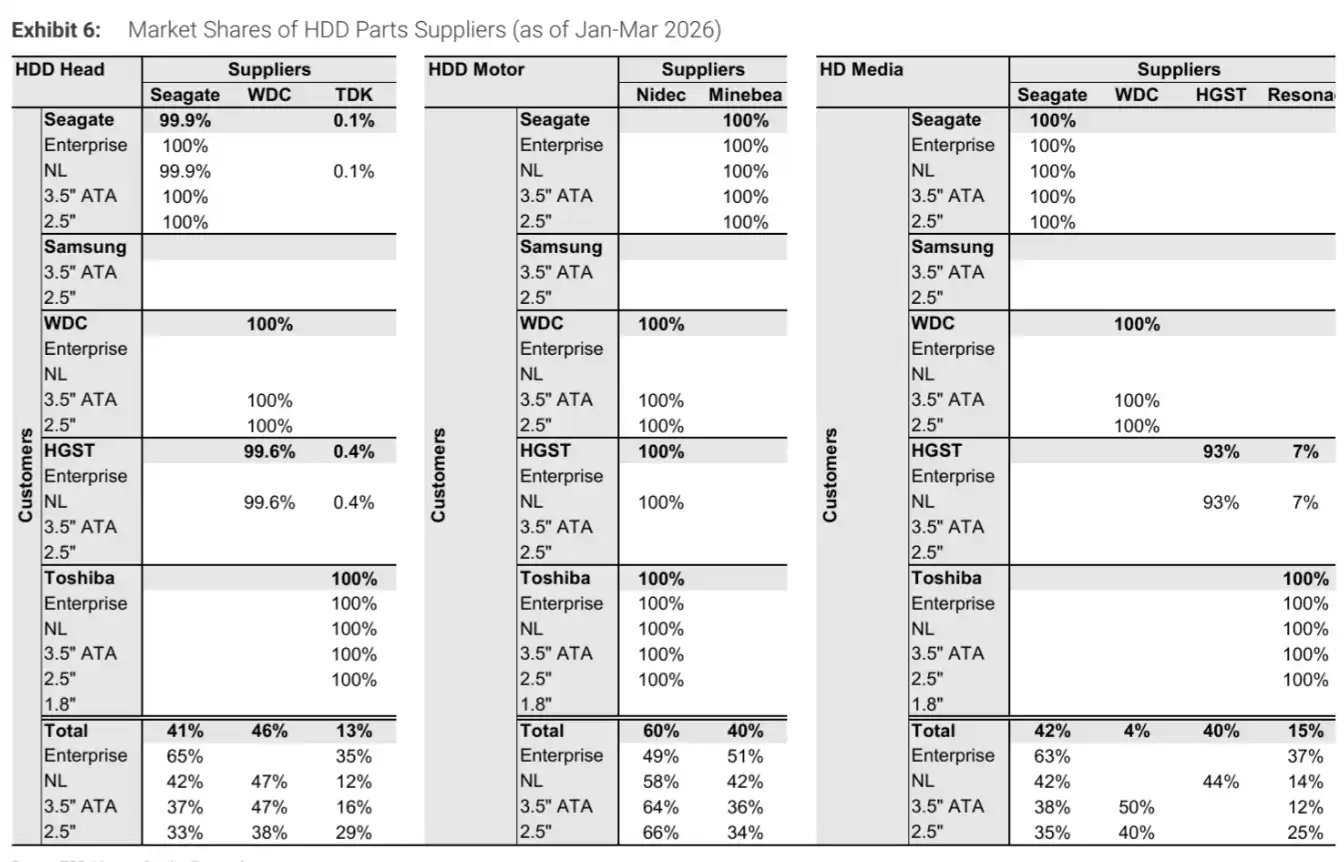
In the NL HDD production chain, the head, motor, disk, and testing stages could all affect the final shipment. The report mentions that further production increase may be limited by the progress of head supply and test facility expansion. Based on its supply chain share estimates, TDK holds approximately 12%-13% of the NL HDD head market share, while Seagate and Western Digital are highly self-sufficient.
TDK's overall share may seem low, but it will still draw market attention in terms of external sourcing and incremental supply. If data center customers continue to increase demand and the leading HDD manufacturers' in-house head production capacity and test capabilities cannot expand in sync, the difficulty of capacity forecast implementation will increase.
Test capacity is also crucial. High-capacity HDDs cannot be delivered immediately upon production; reliability verification and testing time will occupy production line capacity. The higher the capacity, the higher the customer's requirements for stability and yield, making the supply-side ramp-up more easily constrained.
External information is also pointing to the same pressure point. Seagate stated in its Q1 2026 10-Q that its data center business mainly includes high-capacity nearline products for cloud and enterprise customers, with AI applications driving data generation and storage demand growth. A TrendForce report on July 22 indicated that AI data centers are boosting HDD demand, Japanese HDD component suppliers are expanding production, and nearline HDD prices rose by about 10% month-on-month from April to June, with hyperscale customers still facing supply constraints.
525EB and 1845EB Are Still Just Forecast Figures
The most important signal from this forecast is not that the storage industry is already in widespread shortage, but that data center capacity demand is still being revised upward, with both SSDs and nearline HDDs benefiting simultaneously.
The mainstream of enterprise SSDs is more direct. The increasing demand for high-performance storage being driven by AI and cloud workloads, coupled with high-capacity products, has intensified the growth in exabyte-scale shipments. The mainstream of nearline HDDs is more supply-oriented. Long-term cold data, training data, backup, and archival data still require low-cost, high-capacity storage, but the pace of increase is constrained by component and testing capabilities.
The two numbers, 525EB and 1845EB, should be understood as shipment forecasts for 2026, not locked delivery outcomes. If head supply, testing facilities, or high-capacity product yields do not keep pace, the actual supply of NL HDDs may be lower than forecasted; if cloud provider capital expenditures or AI data storage demand slows, SSD capacity growth may also be lower than currently assumed.
The divergence in this round of data center storage expansion will ultimately hinge on two practical issues: whether the monthly capacity growth rate of enterprise SSDs can be sustained at a high level and whether nearline HDD manufacturers can consistently ramp up production of high-capacity products. Demand has already made it onto the forecast table; supply constraints are the real challenge to realization.
Welcome to join the official BlockBeats community:
Telegram Subscription Group: https://t.me/theblockbeats
Telegram Discussion Group: https://t.me/BlockBeats_App
Official Twitter Account: https://twitter.com/BlockBeatsAsia
