According to a JP Morgan report, Kioxia, after achieving record profits in the first quarter and announcing the establishment of a framework for a maximum 800 billion yen treasury stock acquisition, continues to be bullish with a target price of 155,000 yen. Compared to the then stock price of about 46,500 yen in the research report, this target price indicates significant upside potential.
The core of this assessment is not merely based on increased NAND shipments but on betting on price hikes for data center SSDs, rising profit margins, and simultaneous shareholder returns.
Kioxia's FY2026 first-quarter financial report released on July 31 showed that for the three months ending June 30, 2026, the company had revenue of approximately 1.77 trillion yen, a year-on-year increase of 415.5% and a quarter-on-quarter increase of 76.2%. The non-GAAP operating profit was about 1.33 trillion yen, a quarter-on-quarter increase of 121.4%, surpassing the full-year FY2025 non-GAAP operating profit of about 876.2 billion yen. The non-GAAP operating profit margin was approximately 75.0%.
The second-quarter guidance is more aggressive. The company expects revenue of about 2.39 trillion yen, non-GAAP operating profit of about 1.90 trillion yen, corresponding to a profit margin of about 79.5%, with a 35.2% quarter-on-quarter revenue increase. For storage cycle stocks, this represents a window where prices, profit margins, and capital returns are all being reevaluated by the market.
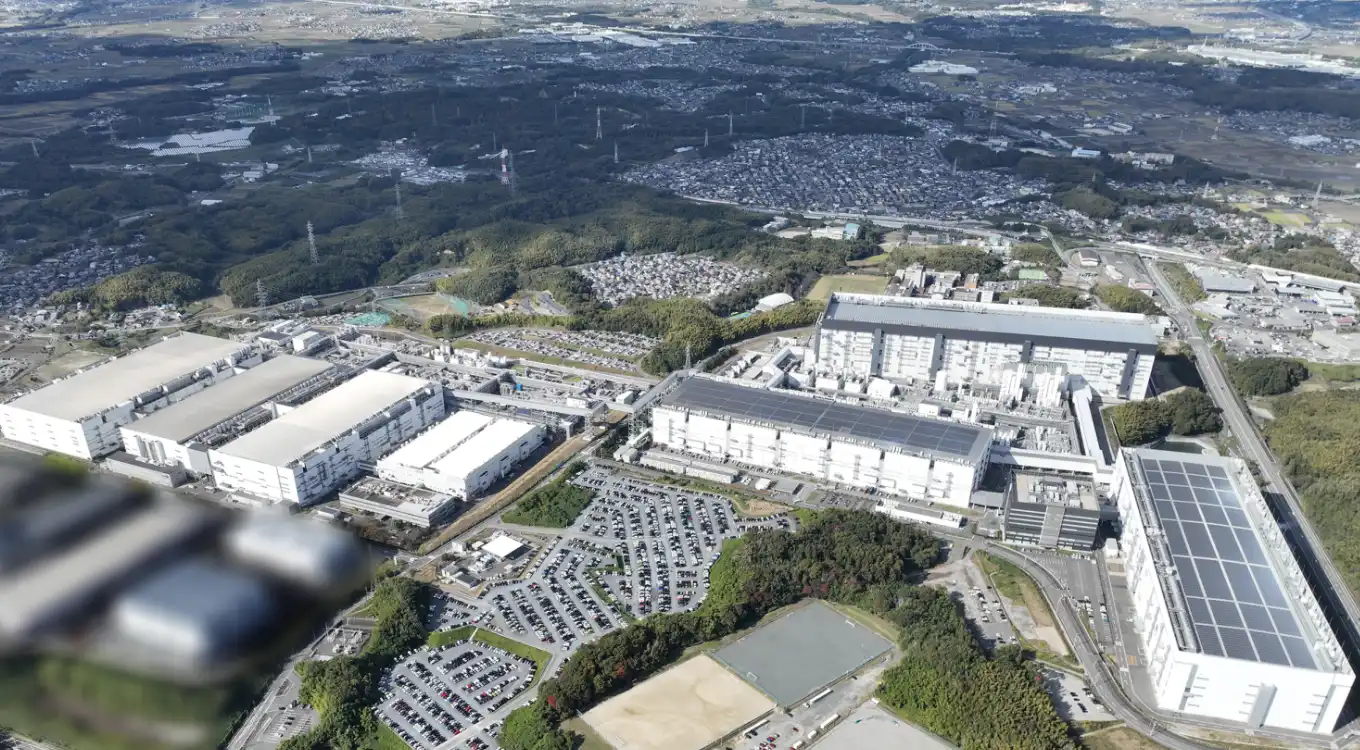
155,000 Yen Target Price, First Look at First-Quarter Profit Surge
The key driver of Kioxia's recent performance surge is the demand from enterprise SSD and data center customers.
The company mentioned in its financial report that demand from generative AI-related data center customers has significantly driven up average selling prices, while bit shipments have increased year-on-year. The report further specifies that in the first quarter, the SSD & Storage division's sales accounted for the majority of total revenue, with Datacenter & Enterprise being the most critical profit source, with the ASP of this division increasing by about 70% quarter-on-quarter, while bit shipments only saw low single-digit growth, with some orders slipping into the second quarter.
This also explains why the ¥15.5K target price seems high. Profit margin improvement is not just driven by increased sales volume, but also by enterprise SSD price hikes, product structure enhancement, and increased share of advanced processes. Once the price uptrend reaches the income statement, operating leverage will quickly magnify.
On the production side, the report mentions that BiCS 8 FLASH accounts for over 50% of the mix, with low-cost technologies like QLC and the joint venture system with SanDisk helping to support unit costs and investment efficiency. However, the more direct question for the stock price is not the technical roadmap itself, but whether Kioxia can turn this price cycle into more sustainable profits.
JP Morgan's valuation is based on FY2027 EPS and a P/E of around 11x. This multiple is higher than the global storage manufacturers' historical average of around 9x over the past 15 years. Premium reasons include reduced pressure from Bain Capital consortium selling off shares and the potential for long-term agreements to enhance earnings stability.
However, the ¥15.5K target price is not a guaranteed return. It is based on assumptions of the NAND price cycle, enterprise SSD demand, and the sustainability of high profit margins. If demand weakens after price hikes, or if the industry ramps up production again, this valuation framework will be reassessed.
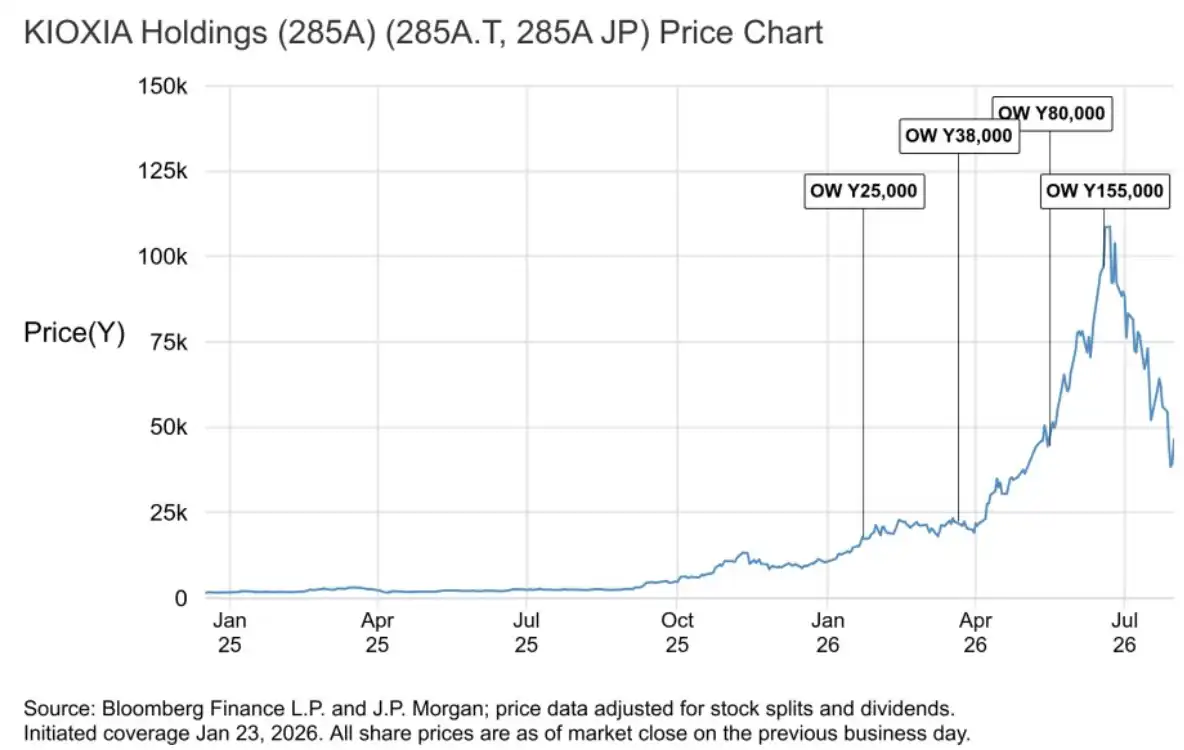
Continued Growth in Q2, AI Storage Demand Emerges as a New Narrative
The guidance for Q2 shows that Kioxia's upward momentum did not stop in Q1.
The company expects Q2 revenue to be around ¥2.39 trillion, a 35.2% QoQ increase, with a non-GAAP operating profit margin of approximately 79.5%. The financial report attributes the growth mainly to data center customer demand and a significant increase in ASP. From the report's perspective, Datacenter & Enterprise demand is the strongest, with contributions also from smartphones.
The focus is on 2027. Both management and the report suggest that industry NAND bit demand in CY2026 may sustain high teens growth, with a potential demand-supply imbalance in CY2027. If this assessment holds true, the NAND industry would not just experience a typical cyclic rebound, but enter a phase of tight supply, backed by more supportive prices and profit margins.
AI is the new catalyst. Management sees agentic AI as a new source of NAND workload and traditional server demand growth. In simple terms, as AI applications expand from training and inference to more autonomous agent workflows, the data that servers need to process, cache, and store will increase, leading to an expansion in enterprise SSD demand.
However, this trajectory is not yet as visibly direct as GPU orders. The pull of AI on NAND relies more on cloud vendor procurement, enterprise customer deployments, and server architecture changes. In the short term, the market has already witnessed an increase in enterprise SSD prices and Kioxia's profit margins. In the medium to long term, the key is to see how much additional storage orders agentic AI can bring.
¥800 Billion Buyback Boosts Sentiment, Cyclical Risks Remain
Kioxia also announced the establishment of an up to ¥800 billion stock repurchase framework. For storage cyclical stocks, this move directly responds to the market's expectations for shareholder returns and stock price support.
The significance of the buyback is that, during a phase of profit and cash flow improvement, the company is not only retaining funds for capacity expansion but is also signaling shareholder returns. This helps alleviate the market's concerns about storage manufacturers "making money, expanding capacity, and then facing oversupply."
A research report also mentioned that the company reaffirmed its CY2028 long-term agreement sales coverage target of 50%. If long-term agreements can increase visibility on sales volume and prices, Kioxia's profit volatility may be lower than that of traditional storage cyclical stocks, and the market may be more accepting of valuations above historical averages.
However, the buyback is not the answer to all issues. Although the second-quarter guidance is strong, it is still below some market high expectations. There are instances of first-quarter bit shipment spillage into the second quarter. The research report also has a more cautious short-term outlook on QLC penetration in the nearline HDD market, stating that the speed of SSD replacing HDD cannot be simply linearly extrapolated.
The bigger risks still lie on the supply side. The NAND industry has historically seen capital expenditure expansion after price increases, leading to a deterioration of supply-demand dynamics. If AI demand does not continue to exceed expectations, or major manufacturers accelerate capacity expansion once again, the assessment of "demand exceeding supply" in 2027 will come under pressure.
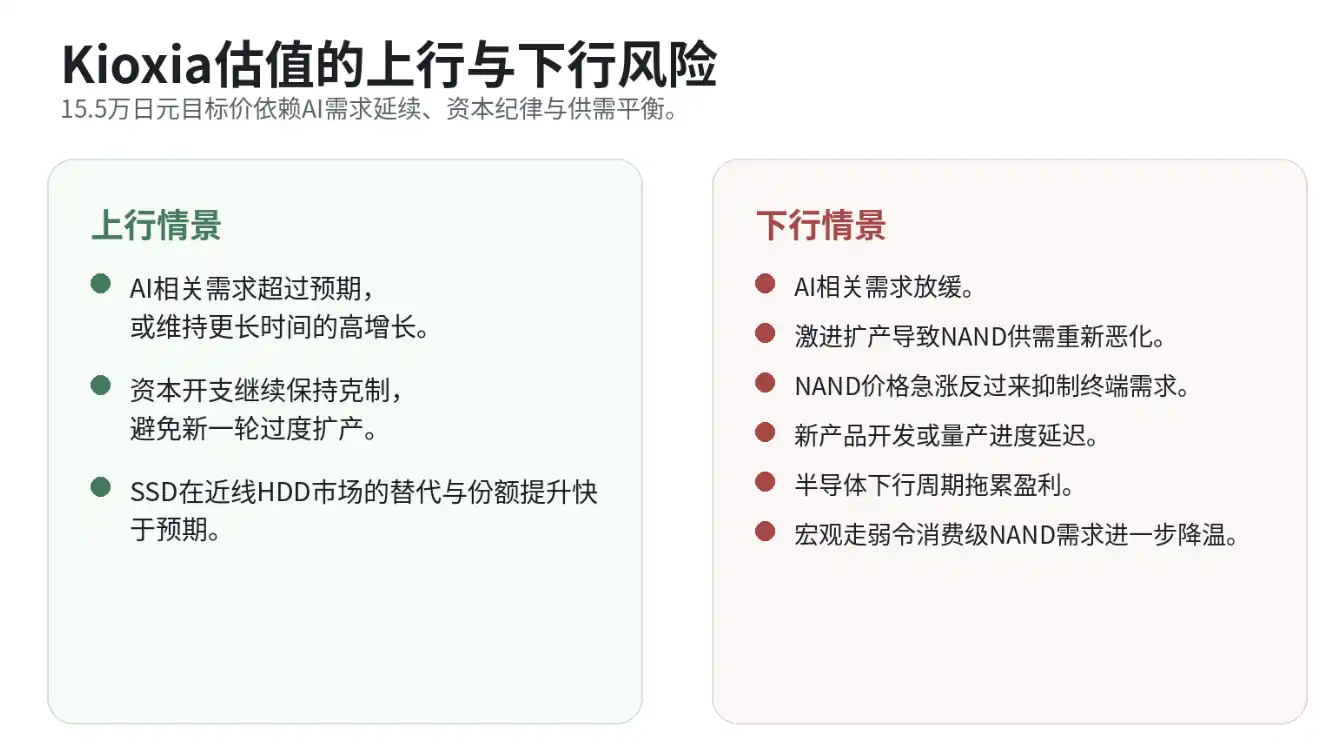
Kioxia's current market narrative is clear: with a 75% profit margin in the first quarter, a second-quarter profit margin guidance nearing 80%, a maximum ¥800 billion buyback offering emotional support, and a ¥155,000 target price that factors in both the NAND uptrend cycle and AI storage demand into a higher valuation.
This market situation will hinge on three specific questions: how long the enterprise SSD price increase can last, how much of the additional NAND demand from AI can materialize, and whether the industry can avoid another oversupply around 2027.
Welcome to join the official BlockBeats community:
Telegram Subscription Group: https://t.me/theblockbeats
Telegram Discussion Group: https://t.me/BlockBeats_App
Official Twitter Account: https://twitter.com/BlockBeatsAsia
