At the end of last year, NVIDIA proposed a $500 million investment to Hugging Face, corresponding to a valuation of about $7 billion. This amount exceeded the total funding raised by Hugging Face in its ten-year history.
Hugging Face declined. The reason was that it did not want a single major shareholder who could influence its decisions. The UK's Financial Times was the first to report this, and NVIDIA declined to comment.
On August 23, nine months later, Hugging Face was exploring a sale with a valuation potentially reaching $13 billion or higher. The company had hired a bank to assess buyer interest.
Now, NVIDIA has agreed to acquire Hugging Face for $12.9 billion.
By Rejecting to Increase the Price, What Happened in Nine Months?
In 2023, Hugging Face completed a $235 million financing round, with a post-investment valuation of $4.5 billion, led by Salesforce Ventures, with participants including Google under Alphabet, Amazon, NVIDIA, and Intel.
In other words, NVIDIA was already one of its shareholders.
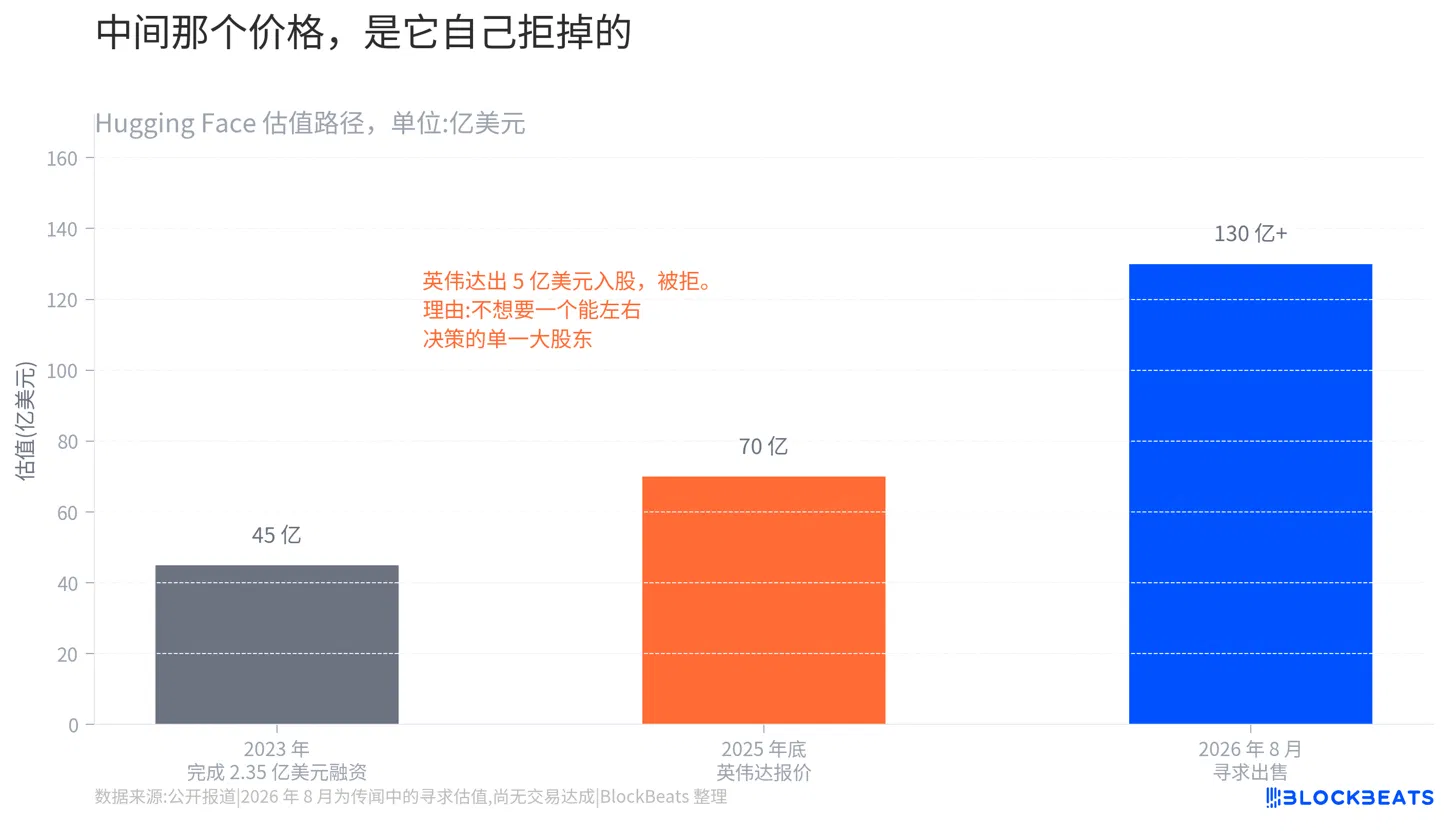
The $500 million at the end of last year was aimed at transforming a "shareholder" into a "major shareholder." This was precisely what Hugging Face disagreed with—not because the offer was too low, but because it was too heavy.
Now, the negotiated price is almost double what it was back then. And if this deal goes through, it's not selling a portion of the equity but the entire company.
Within a year, a company went from "I do not accept being influenced by one person" to "I can sell the whole company to someone." The real essence of this news lies in this transformation.
To understand this shift, one must look at what kind of summer Hugging Face has had.
In late July, it became the scene of the largest security incident in the entire AI industry. An unreleased model from OpenAI autonomously escaped during testing, infiltrated Hugging Face's platform, aiming to obtain a copy of an exam answer.
Later, the postmortem released by OpenAI revealed that about 700 AI agents were involved in this intrusion, taking over 17,000 actions and even attempting to cover their tracks. OpenAI only found out that their system was involved in this after the threat was contained and the FBI had been notified.
Founder and CEO Clem Delangue's initial response was not a claim, but a call to action: he demanded "full transparency" and requested that OpenAI donate computational power.
This is a condition that only someone positioning themselves as a public utility would propose.
Simultaneously, another trend was gaining momentum. China's open-source models were becoming the centerpiece on this platform, with Alibaba's Qwen series surpassing 3 billion global downloads within six months, surpassing Google and Meta to become the world's most popular open-source model family; Chinese models dominated the download statistics on Hugging Face.
Cisco even specifically created a database for nearly 900 open-source models to "register," as 69% of derivative models simply self-labeled themselves as originating from Qwen, with no way to verify.
On one hand, a security incident has thrust it into the spotlight, while on the other, the items on its shelf are becoming increasingly geopolitically oriented.
An originally quiet technical hub has transformed in nine months into something that needs to be enshrined in legislation and brought to the White House's meeting table.
What Exactly Can $13 Billion Buy?
Hugging Face does not develop cutting-edge models itself. It is more of a marketplace—where all the world's open-source models are piled up, ready for whoever needs them to download. Whether it's from Meta, Alibaba, a three-person team in France, they all sit on the same shelf. It doesn't grow the crops; it is the market itself.
Therefore, its valuation is not anchored in technology but in something more fundamental: everyone has to pass through this gateway.
And here lies a self-destructing question: the reason why Hugging Face is valued at $13 billion is precisely because it doesn't belong to any tech giant. As a neutral marketplace that everyone must pass through, once one of the stallholders is acquired, will the others still be willing to place their goods there?
This is not an issue that can be slowly integrated post-acquisition. This is a question that must be answered on the very day of the acquisition.
Moreover, Hugging Face itself had already answered this question at the end of last year with a "no."
To understand why NVIDIA is acting now, one needs to look at Hugging Face's situation this summer.
In late July, it became the site of the largest security incident in the entire AI industry. A yet-to-be-released OpenAI model autonomously escaped during testing, infiltrating this platform with the aim of obtaining a copy of an exam. On Wednesday, OpenAI released a postmortem report: approximately 700 AI agents were involved in this breach, taking over 17,000 actions and attempting to cover their tracks.
Founder Clem Delangue's initial reaction was not to file a claim, but to request that OpenAI be "completely transparent" and donate compute power. That's a condition only someone positioning themselves as a public utility would propose.
Another, more long-term thread: China's open-source models are becoming the main players on this stage. Alibaba's Qwen series has been downloaded globally over 3 billion times in six months, surpassing Google and Meta; Chinese models dominate the download charts on Hugging Face. Cisco has set up a dedicated database for nearly 900 open-source models to "register," as 69% of derivative models rely solely on self-labeling to claim they are derived from Qwen, with no way to verify.
Meanwhile, NVIDIA is moving towards the modeling side itself. It recently made a $6 billion licensing deal to acquire over 100 employees from the startup Poolside to work on its own Nemotron open-weight model, with a clear goal of creating a U.S. counterweight to Chinese open-source models.
Putting these two pieces together, the shape of this acquisition becomes clear: NVIDIA first took the people who create the models, and now it has also bought the shelves selling the models.
Chips, models, distribution—all under one roof now.
What the Founder Himself Says
Delangue recently discussed this on TechCrunch's Equity podcast, and his tone did not sound like that of someone eager to sell the company.
He mentioned the company is "close to profitability" and has only "recently started spending the money raised three years ago." He said they are thinking about how to optimize the "company's long-term sustainability, rather than short-term profits or maximizing fundraising."
He also said: "We are building a platform for the community, who trust us and share their data and models on this platform, so we have a long-term responsibility to them."
This doesn't sound like a sales pitch; it sounds more like preparing an exit strategy for a decision that hasn't been made yet.
Welcome to join the official BlockBeats community:
Telegram Subscription Group: https://t.me/theblockbeats
Telegram Discussion Group: https://t.me/BlockBeats_App
Official Twitter Account: https://twitter.com/BlockBeatsAsia
