After the U.S. stock market closed on Wednesday, Nvidia reported a record quarterly revenue of $96.22 billion, more than doubling year-over-year, surpassing Wall Street's expectations for the 15th consecutive quarter.
However, what truly turned the stock price from a decline to an increase was not this number. It was another number revealed by CFO Colette Kress during the earnings call forty minutes later.
First, Let's Look at This Outstanding Quarter
Revenue of $96.22 billion, with analysts expecting $92.27 billion on average.
Data center revenue was $89 billion, a 117% year-over-year increase. Edge computing (chips for AI capabilities in computers, gaming consoles, and robots) was $7.2 billion, up 27%.
Net income was $59.69 billion, $2.46 per share; compared to $26.42 billion, $1.08 per share a year ago. Earnings per share excluding certain items were $2.22, exceeding the market consensus of $2.09.
Operating expenses also rose by 55% to $8.41 billion.
Jensen Huang provided his own insight in a statement: "AI has reached the turning point. It is performing useful work. Its token is productive and profitable. Today, computing power is revenue."
At the beginning of after-hours trading, the stock price initially fell. In the forty minutes after the report was released, it hardly moved.
This was because the expectations were too high. The stock had been rising for three years, with its market cap soaring from $400 billion to $5 trillion; investors were not looking for "just another good quarter."
Then the earnings call began. Kress provided two key pieces of information.
First, the revenue guidance for the next quarter: $108 billion, /+/- 2%. Analysts' average expectations range from $104.2 billion to $105.2 billion. If achieved, this would be Nvidia's first quarter with over $100 billion in revenue, a feat only accomplished by nine other companies in the S&P 500.
Second, and more significant: the revenue forecast for the fiscal year 2028 is expected to grow by approximately 70%. Analysts surveyed by FactSet had an expectation of 45%, while LSEG's figure was 44.8%. She directly raised the expectation by 25 percentage points.
She also added an almost boastful remark: the company is still "supply-constrained," otherwise revenue could double next year.
Also announced was an expanded partnership with Amazon Web Services. In 2027 and 2028, AWS will redeploy 2 million of NVIDIA's latest GPUs across its global infrastructure.
The stock price then rose by 4.2%, with trading exceeding 50 million shares.
Seth Hickle, Chief Investment Officer of Mindset Wealth Management, commented, "It's hard to interpret this report as anything less than 'amazing'."
Questions About Reciprocal Financing
Ahead of this financial report, the biggest issue weighing on NVIDIA's shoulders was not demand, but the fact that it was fronting the money for that demand.
Over the past month, the company has done things that go beyond a chipmaker's usual scope: partnering with six of Wall Street's largest financial institutions to partially guarantee up to $500 billion in financing for customer data center builds; agreeing to backstop a large data center project for OpenAI in Ohio, potentially on the hook for billions if the leasing plan falls through.
The question is straightforward: If I lend you money to buy my chips, is my revenue from genuine demand or demand I created myself?
Kress did not shy away from the term. She said on the call:
"We recognize the scale of this support, and we know some people might call it reciprocal financing. We see it differently."
The defense logic she provided was that NVIDIA anticipated that large cutting-edge laboratories like OpenAI "would become the largest tech companies in history," and their current bottleneck is not having enough computational power to develop products and enhance models, so they need NVIDIA's financing.
She then upped the ante by announcing on the spot the next deal: the company will provide "selective credit enhancement" for nearly 2 exaflops of computing power to another cutting-edge AI lab. She did not name names.
Huang Renxun emphasized one thing on the call, that the sources of demand are broadening: "This time last year, there was only one lab driving this buildout; today, we're entering the golden age of new AI labs and startups."
Jay Hatfield, CEO of Infrastructure Capital Advisors, made perhaps the best summary of where the company stands now that day with a joke: "Feels like a boring day waiting for the Fed, but really it's waiting for NVIDIA. Some people call Huang Renxun the Fed Chair of AI."
The Only Way is Down
This earnings report is not without cracks. There is only one crack, but it is substantial.
Second-quarter gross margin 75%. Third-quarter guidance around 74%, plus or minus 50 basis points—lower than analysts' expectations of around 74.8%. The company itself warns that as the shortage worsens, the gross margin will continue to decline, possibly dropping to 71% early next year before recovering.
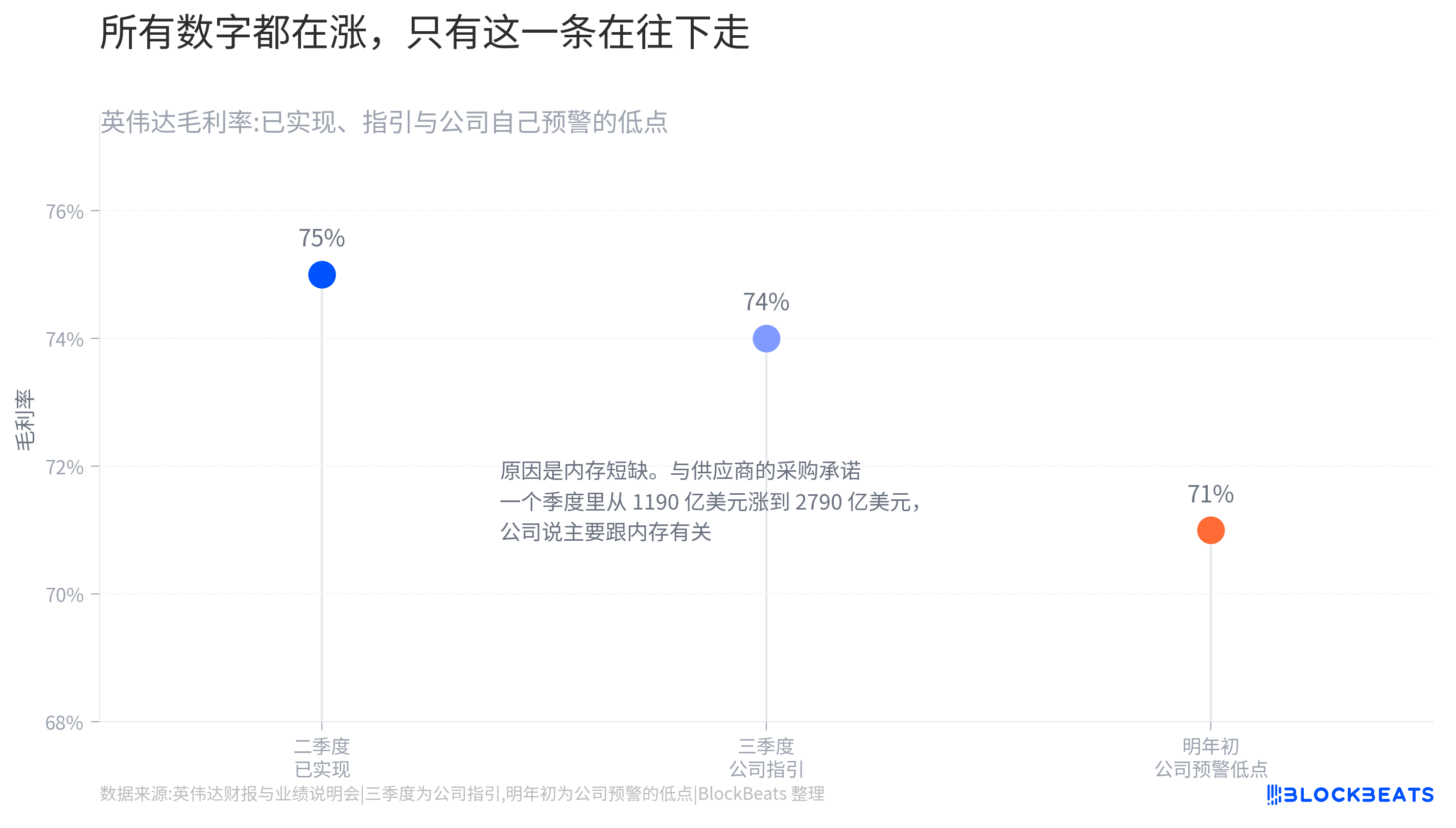
The culprit is memory. The data center demand has sucked dry the memory chips, with tech giants including Apple bearing this cost.
One number can illustrate how urgent this is: Nvidia's procurement commitment with suppliers has surged from $119 billion in the previous quarter to $279 billion, a $160 billion increase in a quarter, the company says, "largely related to memory procurement."
It is already passing on the costs: Servers in early 2027 based on the Vera Rubin and Grace Blackwell architecture will see prices to major customers rise by over 15%.
Even with this earnings report, one trend has not been deterred by these numbers: the increasing trend of tech companies' planned expenditures flowing into their own chips, aimed at reducing reliance on Nvidia's expensive and scarce processors.
This year's big tech spending on AI infrastructure is expected to exceed $730 billion, up from $400 billion last year. How much of this money ultimately ends up in Nvidia's account depends on the progress of in-house chip development.
One more detail worth noting: Nvidia's stock price has risen by 12.4% this year, while during the same period, AMD and Intel have both more than doubled.
After the past four earnings reports, Nvidia's stock price has dropped the day after.
Welcome to join the official BlockBeats community:
Telegram Subscription Group: https://t.me/theblockbeats
Telegram Discussion Group: https://t.me/BlockBeats_App
Official Twitter Account: https://twitter.com/BlockBeatsAsia
