Rate hike expectations pushing up risk-free rates, a stronger dollar, and rising oil prices have collectively exerted short-term pressure on gold prices, but safe-haven demand driven by geopolitical risks and long-term structural buying have formed an effective hedge, keeping gold prices resilient at key levels. OCBC has raised its gold forecast, projecting gold prices to reach $4,600 per ounce by December 2026. Fed rate hike expectations have surged, Treasury yields have broken through the psychological 5% threshold, yet gold has not been crushed—behind this is the tug-of-war between geopolitical risk-driven inflation hedging demand and interest rate pressure, reflecting the deep contradictions in the current macroeconomic environment.
The sharp deterioration in the Middle East situation has become the core driver of this round of market movement. According to Xinhua News Agency, Yemen's Houthi armed forces launched a new round of attacks on Saudi Arabia, and Saudi Arabia promptly shut down the East-West oil pipeline, which carries about 4% of global oil supply on a daily basis. Oil prices subsequently climbed to around $107 per barrel, with Brent crude at $106.96 per barrel. The energy shock reinforced market concerns about persistent inflation, and the CME FedWatch tool shows the probability of a 25 basis point Fed rate hike this week has risen to approximately 92% to 93%. The 10-year Treasury yield touched 5% intraday on Monday, the first time since October 2023.
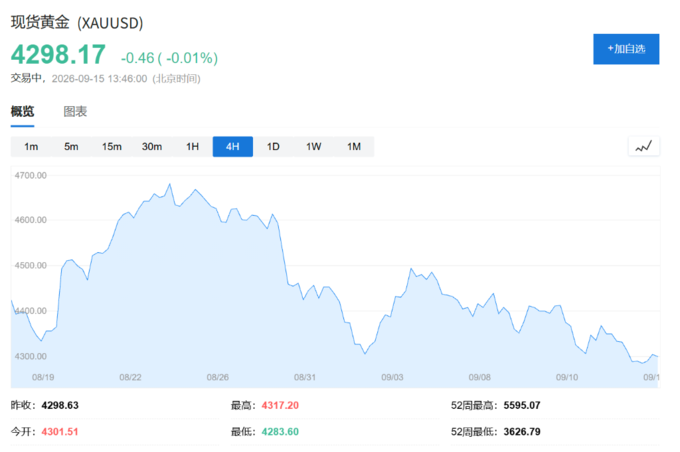
However, gold did not collapse under the above combination of bearish factors. Spot gold fluctuated in a narrow range around $4,300, down more than 3% from its late-August high of over $4,600 per ounce, but still firmly holding the $4,000 support level.Rate hike expectations pushing up risk-free rates, a stronger dollar, and rising oil prices collectively constitute short-term pressure, but safe-haven demand driven by geopolitical risks and long-term structural buying have formed an effective hedge, keeping gold prices resilient at key levels.
Supply Shock Combined with Rate Hike Expectations: Gold Under Pressure but Not Broken
Gold fell more than 1% to a five-week low on Monday before stabilizing slightly on Tuesday. Spot gold was at $4,298.86 per ounce.
From a logical chain perspective, rising oil prices → heightened inflation expectations → increased certainty of Fed rate hikes → higher Treasury yields → stronger dollar, with each link constituting a bearish factor for gold. Gold does not generate interest, and in a rising rate cycle, its appeal relative to interest-bearing assets naturally declines.
But this logic has encountered strong hedging in the context of the current Middle East conflict. After the Saudi East-West pipeline was attacked, Saudi Arabia has not yet stated when the pipeline will resume operations, nor has it clarified whether it can increase shipments through the Strait of Hormuz to compensate for the shortfall. The persistent uncertainty in supply prospects has maintained the market's high vigilance toward inflation risks and geopolitical turmoil, supporting gold's safe-haven properties.
US Treasury Yields Break 5%: Rate Hike Signal or Resonance of Fiscal Concerns?
The 10-year US Treasury yield breaking through 5% is not attributable to a single factor, but rather the result of multiple forces resonating together.
Inflation pressure is the direct trigger. In August, US CPI rose 3.4% year-over-year, core CPI rose 2.4% year-over-year but accelerated to 0.3% month-over-month, nonfarm payrolls added 162,000 jobs, and the unemployment rate held at 4.1%. This combination of "inflation not yet extinguished, employment resilient" leaves the market with little doubt that the Fed will hike rates at the September FOMC meeting. According to a Reuters survey, economists surveyed also expect at least one more rate hike within the year.
At the same time, fiscal factors are also continuously pushing up long-end yields. Public data shows that in the first 11 months of this fiscal year, US net interest payments exceeded $1 trillion for the first time in history, and total federal debt surpassed $40 trillion. In addition, corporate bond issuance related to AI infrastructure construction has expanded dramatically. According to Goldman Sachs data, hyperscale cloud computing service providers such as Alphabet and Amazon have issued approximately $194 billion in bonds this year, with full-year issuance expected to reach around $250 billion.
PGIM Credit co-chief investment officer Greg Peters said bluntly: "I keep asking myself, what exactly could serve as a catalyst to push yields down? Apart from a traditional recession, it's really hard to find any other factor. The conditions for keeping yields at elevated levels or even continuing to rise are fully in place." Zach Griffiths, head of investment grade and macro strategy at CreditSights, said the 10-year US Treasury yield could potentially push further toward 5.5%.
What Is the Market Betting On: One Rate Hike, or "Higher for Longer"?
What truly grips the market's nerves at this FOMC meeting is not the rate hike itself, but the policy path signals conveyed by the dot plot and the press conference afterward.
According to Morgan Stanley's forecast, the Fed is expected to hike rates by 25 basis points each in September and December, citing second-round effects of energy prices, strong demand driven by AI investment, a neutral rate that may be temporarily elevated, and considerations of maintaining monetary policy credibility.
On US Treasury yields, Standard Bank G10 strategy head Steven Barrow raised his year-end forecast for the 10-year US Treasury yield to 5.2% and expects it to rise further to 5.3% in the first quarter of 2027. "One factor that makes me firmly believe yields will break above 5% is that we have already risen to near 5% without inflation data significantly exceeding expectations," Barrow said. He also expects the Fed to keep rates steady until the end of 2027 after one rate hike each in September and December.
The team led by Gennadiy Goldberg, a strategist at TD Securities, believes that given the market has already priced in rate hikes substantially, yields will not rise uncontrollably due to the rate hikes themselves, but unless the economy shows signs of deterioration, long-term bond yields should generally remain at elevated levels through 2027.
Christopher Wong, an FX analyst at OCBC, pointed out that high oil prices, high U.S. Treasury yields, and diminished risk-aversion sentiment have collectively pushed the dollar higher, but with rate hikes already fully priced in, further dollar gains would require the Fed to explicitly keep the option of continued tightening on the table.
Long-term support remains, institutions raise gold price targets
Although short-term pressure cannot be ignored, institutional investors' long-term outlook for gold has not reversed.
OCBC has raised its precious metals price forecasts, citing a higher starting point for prices, improved investment participation, and continued structural demand support. Chez Anbu, head of OCBC's wealth advisory division, said gold's strong August rebound reversed the previously weak trend, with the macroeconomic backdrop improving. The bank now forecasts gold will reach $4,600 per ounce by December 2026, with a silver target price of $69.70 per ounce.
From a price structure perspective, the support level of approximately $4,000 per ounce established during gold's previous correction remains intact, and although it fell more than 3% in September, it remains well above that bottom range.
For gold holders, the core logic of the current situation is: Rate hikes have pushed up the opportunity cost of holding gold, but the same drivers of rate hikes — inflation concerns triggered by energy shocks and geopolitical uncertainty — are also supporting gold prices. As long as the Middle East situation shows no significant easing, this inherent tension will persist, and gold's safe-haven premium will not easily dissipate.
Welcome to join the official BlockBeats community:
Telegram Subscription Group: https://t.me/theblockbeats
Telegram Discussion Group: https://t.me/BlockBeats_App
Official Twitter Account: https://twitter.com/BlockBeatsAsia
