Ten teams have registered their own perpetual markets on Hyperliquid, most of them locking up roughly $40M in HYPE to do so. One of them accounts for 97.8% of the volume, and just posted a 44% single-month decline. This article sets out to answer what the other nine actually bought — and every number comes from on-chain data, not press releases.
Every figure in this article is pulled directly from Hyperliquid's public API: perpDexs, metaAndAssetCtxs, daily candleSnapshot covering all 519 registered assets, delegatorSummary, userNonFundingLedgerUpdates, and clearinghouseState{dex}.
"30 days" refers to the full UTC calendar days from August 15 to September 13, 2026; "the previous 30 days" refers to July 16 to August 14; "7 days" refers to September 7 to 13. HYPE is valued at $79.73. The routing data in Section 7 comes from Flowscan, because builder code volume cannot be aggregated from the public API.
Summary
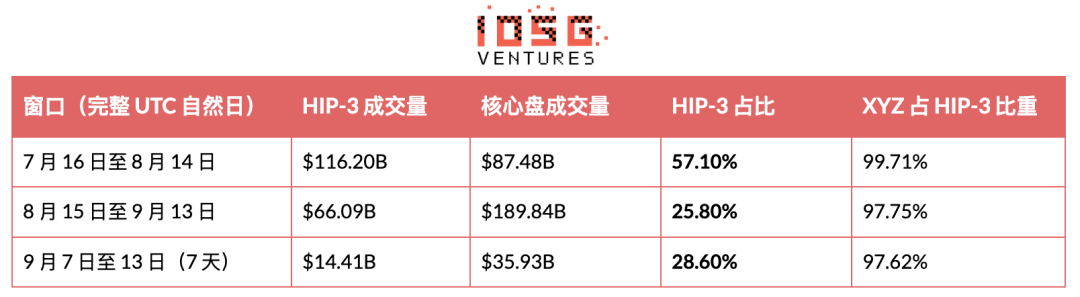
· HIP-3 has once again become a minority within Hyperliquid. Builder-deployed markets accounted for 25.8% of perpetual volume over 30 days, down from 57.1% the previous month. The shift is mainly a denominator effect: core order book volume more than doubled, while HIP-3 itself trended downward.
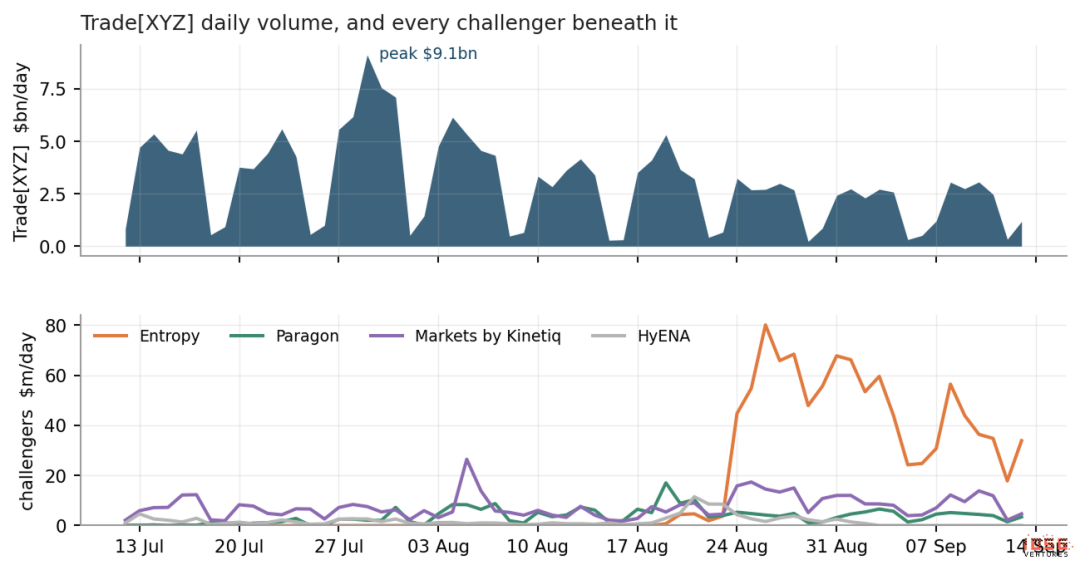
· The leader is contracting. Trade[XYZ] did $64.60B in 30-day volume, down 44.2% month-over-month, with its 7-day average falling from a peak of $5.36B/day in early August to $2.01B/day. Roughly half of that decline tracks the pullback in real-market trading across storage and AI sectors; the other half is specific to this venue. It has not outperformed the core order book on a single day since August 18.
· Entropy (io) led in a head-to-head market for a full week, then gave it all back. Its share on Nebius traced a path of 8.7%, 53.1%, 20.4% over three consecutive weeks, and its own volume has now fallen for three straight weeks. The contrarian signal is in open interest: OI rose 37% against the trend, to $51.4M.
· Settlement assets remain the lifeline, and the score is still 6 to 6. Every venue settling in non-USDC stablecoins has halted trading; every survivor settles in USDC.
· Asset listings can't hold the line. At current auction floor prices, one asset slot costs about $39,900, meaning buying up all of Paragon's live markets would cost only around $1.04M — roughly two weeks of Trade[XYZ]'s fee revenue.
· No one is competing on price. Every equity-style venue runs on deployerFeeScale = 1.0 plus Growth Mode, with measured fees of Trade[XYZ] 0.427 bp and Entropy 0.400 bp. All venues outside the leader, dead or alive, have earned a combined lifetime total of just $747,000 in deployer revenue share.
The ten deployers in the arena
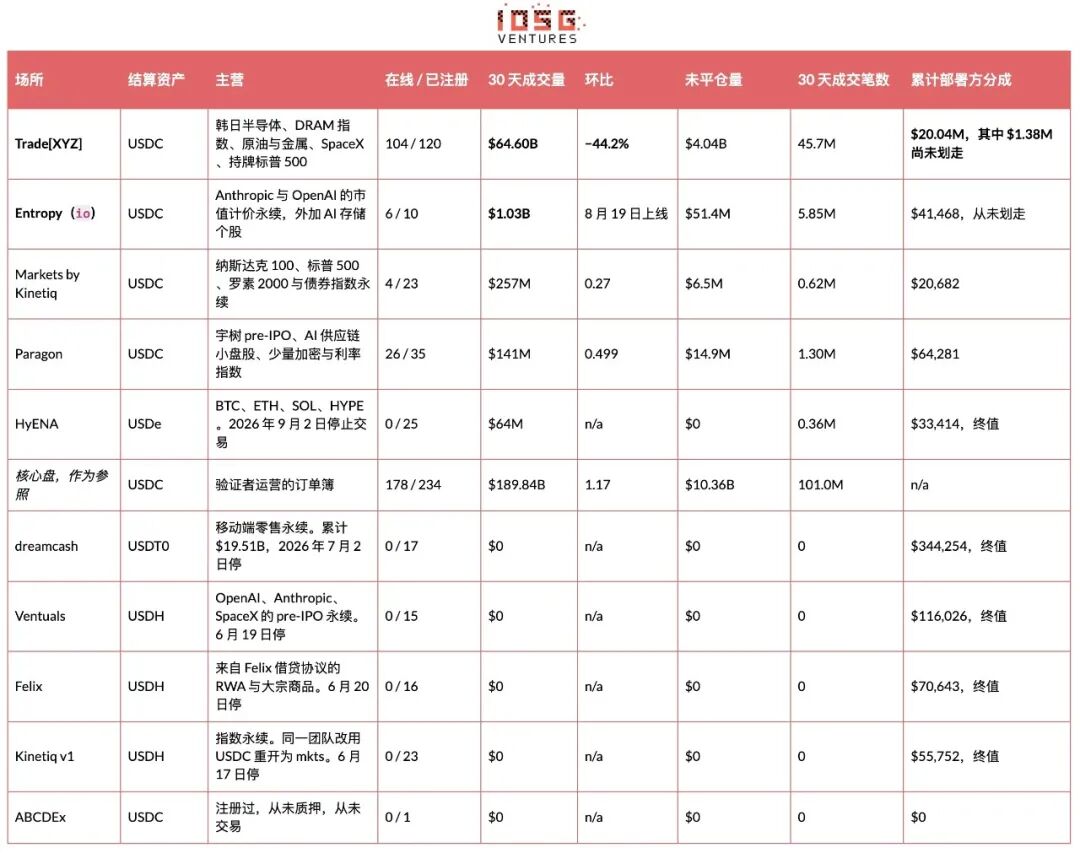
"Trade count" is the sum of the n field of daily candles over the window. The public API cannot derive unique trader counts.
Only ten perpetual DEXs have ever registered, and there has never been an eleventh. Four are trading, five have stopped, and one never opened. Trade[XYZ] accounts for 97.8% of HIP-3 volume over 30 days and 97.6% over the past 7 days.
The challengers can be summed up in a few sentences. Entropy did $1.03B in 26 days across six live markets, relying on a self-built oracle rather than an asset list. It is the only venue that has ever led in a market where the leader also quotes. Paragon is the only challenger whose order book looks like an order book, with 26 live markets and a spread-out tail distribution; even as Trade[XYZ] listed five of its tickers in one go, it still rose 49.9% that month. Markets by Kinetiq bought 23 tickers, with 95% of volume concentrated in two index perpetuals. HyENA is finished: all markets delisted, open interest at zero, and lifetime earnings of $33,414.
HIP-3's Share, and Why It Is Easy to Misread
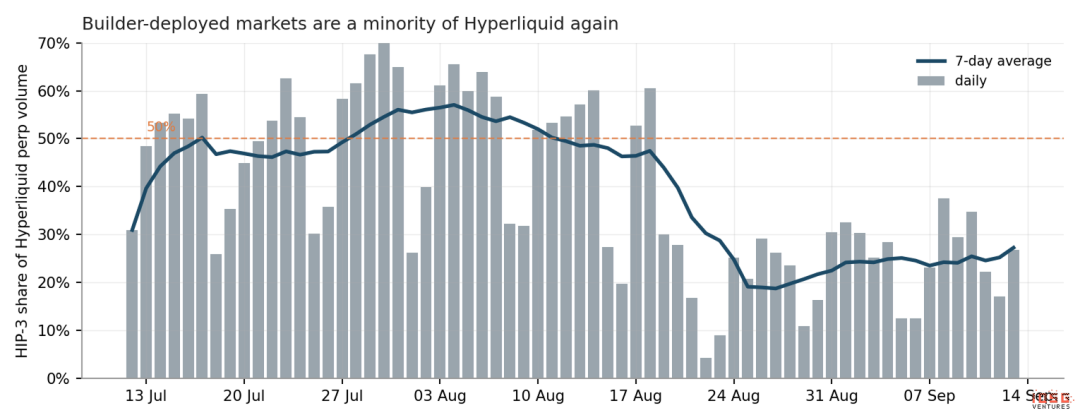
The 7-day average crossed 50% in mid-July, touched nearly 57% in early August, then fell below 30%, and has not climbed back since August 20. On August 18, a single builder's volume surpassed Hyperliquid's entire validator set. It has not done so since.
This ratio is really about its denominator. The numerator is an equity order book, the denominator is a crypto order book, and the leg that fluctuates is on the crypto side. The 57% was read during a quiet crypto period; the 26% was the same equity order book running into a market move, while core perpetual volume rose 117% over the same period. In the most recent seven days, the share even returned to 28.6%, while Trade[XYZ] continued to shrink. Before citing any HIP-3 share, first clarify what crypto was doing during that period.
What really matters is absolute volume, and absolute volume is deteriorating. Trade[XYZ] 30-day volume was $64.60B, down 44.2% month-over-month, with the 7-day average falling from $5.36B/day in early August to $2.01B/day, a 62% drawdown in its own order book. The largest market, SK Hynix, fell to $8.50B. Both legs of the share decline are real. And the section below will show that most of the HIP-3 leg is not a competition problem at all.
The Main Driver of the Volume Decline Is the Memory Sector Going Quiet, Not Share Loss
Reading the 44% drop directly as "the leader is losing" is the handiest explanation, but the data does not support it. The test is simple: if the decline were caused by competition, the underlying assets should still be trading as usual, with only Trade[XYZ]'s captured portion shrinking. What actually happened is that the underlying assets themselves went quiet.
There was no selloff. Using early August, when volume peaked, as the baseline, every major market in the order book is priced higher today.
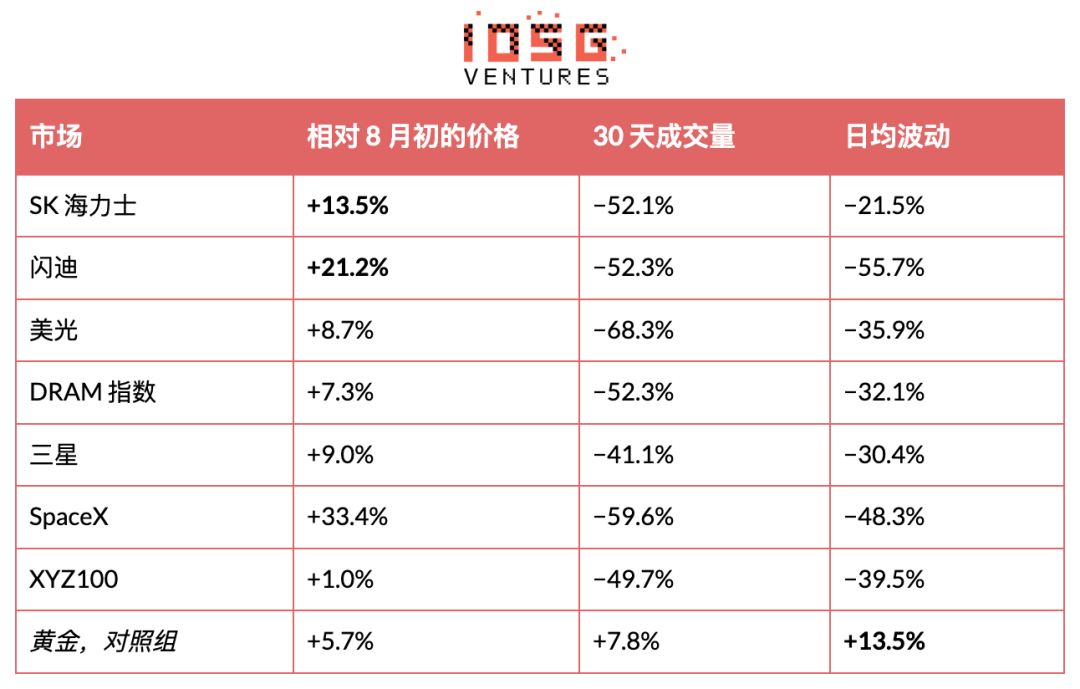
What truly collapsed is how far these assets can move in a day, and venue volume follows almost in lockstep.
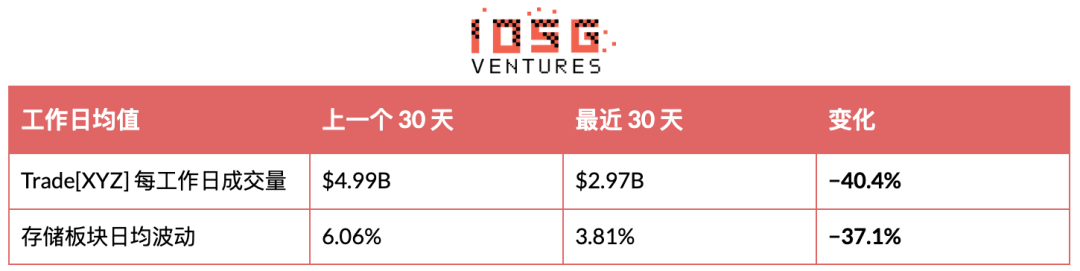
All of the above is on a weekday basis, because the stock market is closed on weekends while Trade[XYZ] trades as usual, and including weekends would significantly exaggerate this relationship. Looking only at weekdays, the correlation coefficient between the average daily volatility of the storage sector and the venue's daily trading volume is +0.47, with a sample of 45 days. Gold is a natural control group: it is the only major market this month where intraday volatility rose, and trading volume followed. Silver is the exception that does not fit this pattern.
But volatility is only a proxy variable. A more direct test is to compare actual stock trading volumes across the same nine tickers, and the answer is: traditional markets explain only about half.
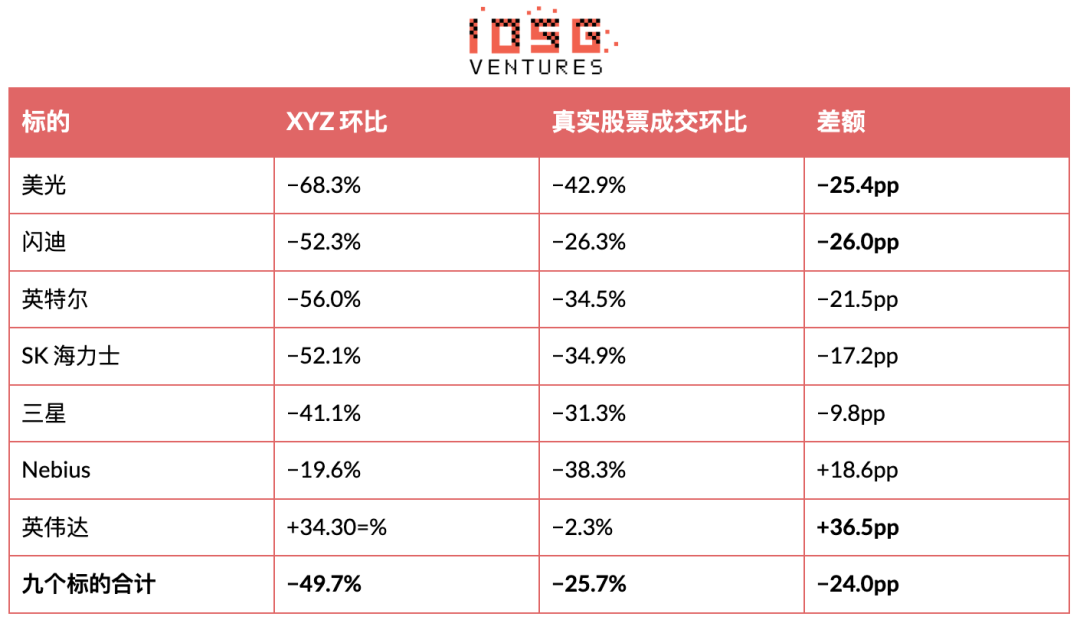
The actual trading volume of the storage and AI sectors did collapse by 25.7%, and that half is real. But XYZ fell 49.7%, nearly double. The extra 24 percentage points did not come from the sector.
And the largest gaps are precisely in its core: SanDisk −26.0pp, Micron −25.4pp, Intel −21.5pp, SK Hynix −17.2pp. It actually outperformed the real market on Nvidia (+36.5pp) and Nebius (+18.6pp), but those two order books are both very small.
Competition also cannot explain this gap. Entropy's SanDisk volume over the entire 30 days was $523M, while XYZ's own SanDisk order book was short by $6.14B, so challengers could have captured at most about 8% of it.
The rest looks more like capital rotation. Over the same period, Hyperliquid's core perpetual trading volume rose 117%, while HIP-3 was falling, and the combined total of the two still rose 26%. The money did not leave Hyperliquid; it merely moved from stock order books back to crypto order books.
An anchor on scale. Over the same 30 days, these nine tickers traded $2,004.7B on their respective exchanges, while XYZ traded $23.5B on them, accounting for 1.2%. XYZ's $64.60B across all 104 markets is only equivalent to 3.2% of the real trading volume of these nine names. The highest penetration rate is SK Hynix at 9.1%, and the lowest is Broadcom at 0.1%, and this curve itself explains what this business is: assets that crypto-native traders cannot reach have high penetration, while U.S. large-cap stocks that everyone can buy have low penetration.
So this decline is both things at once: about half is the sector's beta, and the other half is its own. The calculation in Section 6 uses only actual trading volume and does not ask where the volume comes from, so the fee accounting is unaffected. But it is important to separate these two halves: the sector half will come back, while the venue's own half may not.
The shakeout, and the only variable with predictive power
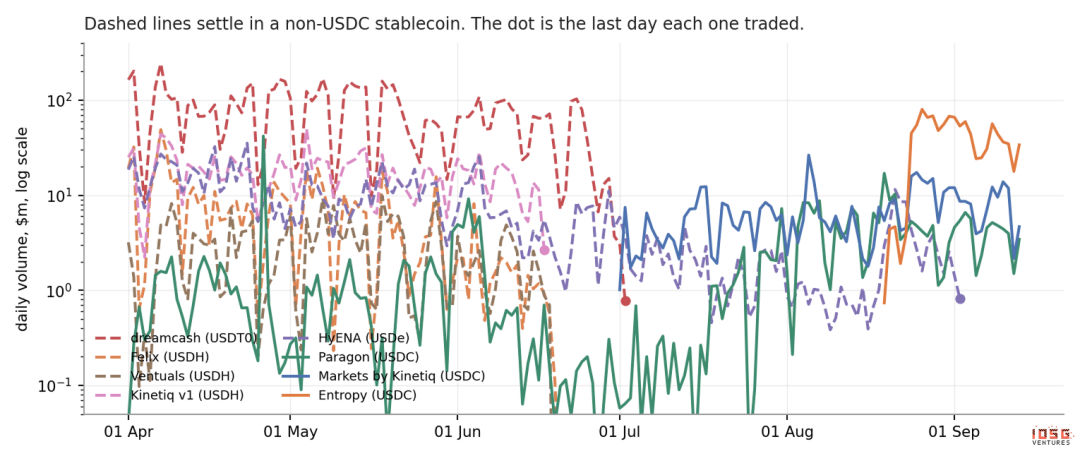
Six have stopped trading to date, and the variable that separated them was not asset selection, not team quality, and not historical volume — it was the stablecoin used for settlement.
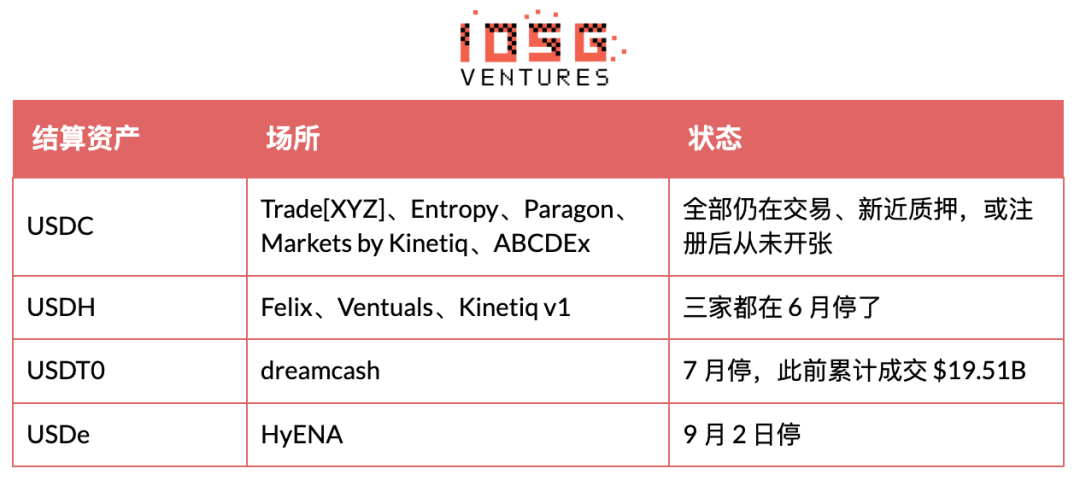
The mechanism itself is simple: traders have to go out of their way to swap into a specific stablecoin before they can place their first order, and they can't be bothered. Felix is the clearest example. The modest fee discount that once supported USDH was erased the moment Growth Mode launched, and after that the settlement asset was nothing but friction.
Kinetiq is the control experiment. The only operator that survived after shutting down, it did so by killing its USDH venue and relaunching the exact same index product on USDC. Historical volume predicts nothing: dreamcash did $19.51 billion, more than the entire June cohort combined, and still shut down. Entropy came in during August with more capital than any prior entrant and showed no hesitation in choosing USDC.
What actually determines the settlement asset, and what doesn't
It's natural to read USDC's sweep as a protocol arrangement, but Hyperliquid's own documentation says the opposite. Under Aligned Quote Assets v2 (enabled on USDC in late August, with Coinbase as treasury deployer and Circle as technical deployer), roughly 90% of the cost-adjusted reserve yield on USDC on Hyperliquid goes to the protocol and into the Assistance Fund. Interest is calculated in 30-day periods, with payment on the 8th day after each period ends, so the first payment won't arrive until early October — not a cent has landed yet.
What AQAv2 explicitly does not do is tilt the playing field toward HIP-3. The documentation is blunt: there is no preferential treatment in trading fees or volume counting, and other quote assets continue to be supported on HIP-3 perpetuals. The fee advantages belong to AQAv1, which gives venues lower taker fees, higher maker rebates, and higher volume counting on their collateral assets — and USDC is not in AQAv1 and structurally cannot be, because that tier requires the stablecoin to be exclusive to Hyperliquid. The privileges AQAv2 actually grants point to event contracts and validator-operated perpetuals, and require later upgrades — not the market measured in this article.
So the settlement asset question was decided by liquidity and a corporate action, not by fee design. USDH was shut down on July 17, 2026, holders redeemed 1:1 into USDC, Coinbase took over its brand assets and became the treasury deployer for USDC. In today's stablecoin supply on Hyperliquid, USDC accounts for 98.3%, USDT 1.2%, and feUSD, USDe, and USDH remnants at roughly one-thousandth each. A venue settling in a different asset did not lose out on fees. It was asking its own traders to leave the only pool with depth.
Sizing AQAv2, with the caveat that no official figure has ever been published. USDC on Hyperliquid stands at $6.77bn, SOFR is around 3.6%, and at a 90% revenue share, that line points to roughly $200M a year. Third-party estimates on a $5bn base land between $135M and $160M. What cannot be determined externally is the cost adjustment inside the AQA rate, which is a validator-reported oracle whose level is not public, so every number here is an estimate, not a measurement.
HyENA added a second mechanism. Because it listed crypto assets, it was locked out of Growth Mode, so it quoted around 5 bp on the same instruments where the core book underneath quoted around 3 bp, with worse fill quality. It spent about $0.88M on asset positions and earned $33,414 over its lifetime.
A shutdown is not an exit. HyENA has delisted all 25 markets, open interest is at zero, but its stake is still 508,915 HYPE, about $40.6M, and twelve days on it has not initiated any withdrawal. Felix and dreamcash both pulled their full stakes back, now reading zero, and Ventuals is down to just 7,967. A venue that delists every market but leaves $40M staked on-chain is either unwinding slowly or holding the deployer slot for something else.
What exactly killed Ventuals deserves its own paragraph, because the next generation of products is designed around it. Insufficient liquidity was only a symptom; the mechanism was in the funding rate: pre-IPO perpetuals have no convergence anchor, and the funding rate at one point ran to roughly 8,700% annualized, so longs would get liquidated regardless of whether the mark price was right. Entropy caps the annualized funding rate near 10% and settles to the TWAP of its own mark price rather than chasing an external price. Its contract design as a whole can be read as a patch list targeting Ventuals' specific cause of death. When looking at any pre-IPO order book, check the funding rate and settlement design first, then the asset list.
Trade[XYZ]'s order book composition, and why it doesn't list OpenAI
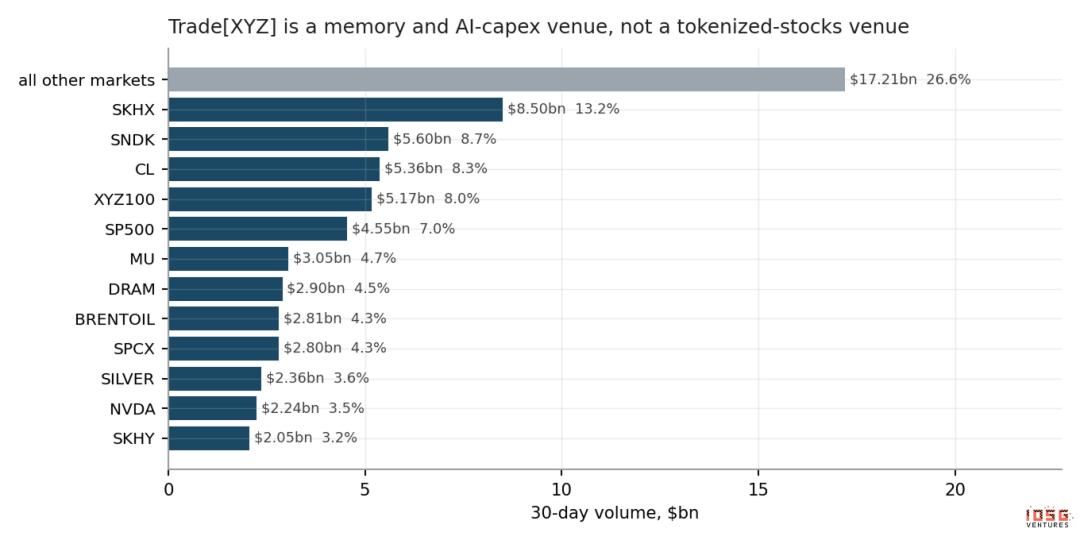
The top ten markets account for 66.7% of the order book, and the tail beyond the top six alone totals $32.4B. Nvidia accounts for 3.5%. Apple, Tesla, Alphabet, and Microsoft combined account for 3.3%, only a quarter of SK Hynix alone. The US mega-caps that the standard tokenized US equities narrative loves to talk about are not this business.
What Trade[XYZ] actually operates is a 7×24 venue for storage and AI capex trades, plus crude oil, metals, and index products: Korean and Japanese semiconductors, a synthetic DRAM index, SpaceX, its own XYZ100 basket, and a licensed S&P 500. Its turf is the set of assets that crypto-native traders cannot touch anywhere else at 3 a.m. And that is exactly the turf Entropy chose to attack, with SanDisk and Nebius as the entry point, not Apple.
Why it doesn't list OpenAI
The most intuitive answer, that it avoids private companies, is wrong. Pre-IPO is actually one of its better businesses. SpaceX alone did $2.80B over 30 days, 4.3% of the order book, ranking ninth. Below that: Unitree $511M, ChangXin Memory $317M, Zhipu $156M, MiniMax $92M, SHEIN $27M, and Yangtze Memory has already registered and is pending listing.
These names share one thing in common: all have observable secondary market transaction prices, and all have known share counts. SpaceX regularly runs tender offers, which give a clear per-share price; these Chinese companies have active pre-IPO gray markets on the mainland, and share counts can be obtained from business registration records and funding rounds. So this venue can quote them per share just like any other asset.
OpenAI and Anthropic have neither. Their secondary trades are all wrapped in SPVs, where what trades is a claim on a fund interest, and what is negotiated is a negotiated overall valuation, not some per-share price. Forcing a per-share quote would mean inventing a denominator yourself. That is the bottleneck here — it is a quoting convention problem, not a willingness problem. Entropy's solution is to simply not quote per share, and instead quote the company itself: 1 contract = $1bn market cap, which at the current midpoint implies Anthropic at nearly $2.17tn and OpenAI at nearly $1.53tn.
But that doesn't constitute a moat. If the leader wants to add a market-cap-denominated listing, it can just spend about $39,900 at any time. And its own roadmap points elsewhere: it has 16 registered but not yet enabled listings, with uranium, aluminum, the dollar index, VIX, corn, wheat, TTF, the Korean won, India's Nifty, Brazil's Ibovespa, Ibiden, and KSTR queued up, plus Yangtze Memory and H100. These are macro and commodities, not frontier AI labs.
There is one structural detail worth remembering. Trade[XYZ] has not set up an oracleUpdater, meaning it uses its own deployer key to push mark prices; while both Entropy and Felix point to the same third-party updater 0x94757f8d…. Entropy has publicly said RedStone is the price data source for its Anthropic market, which could explain why two otherwise unrelated venues share a single update address, though the on-chain data does not label this address. A self-built oracle is fine for assets with reference prices, but when the mark price has to be "constructed," the nature of the game changes, and constructing mark prices is exactly the business Entropy has chosen.
Head-to-head, and the week Entropy led
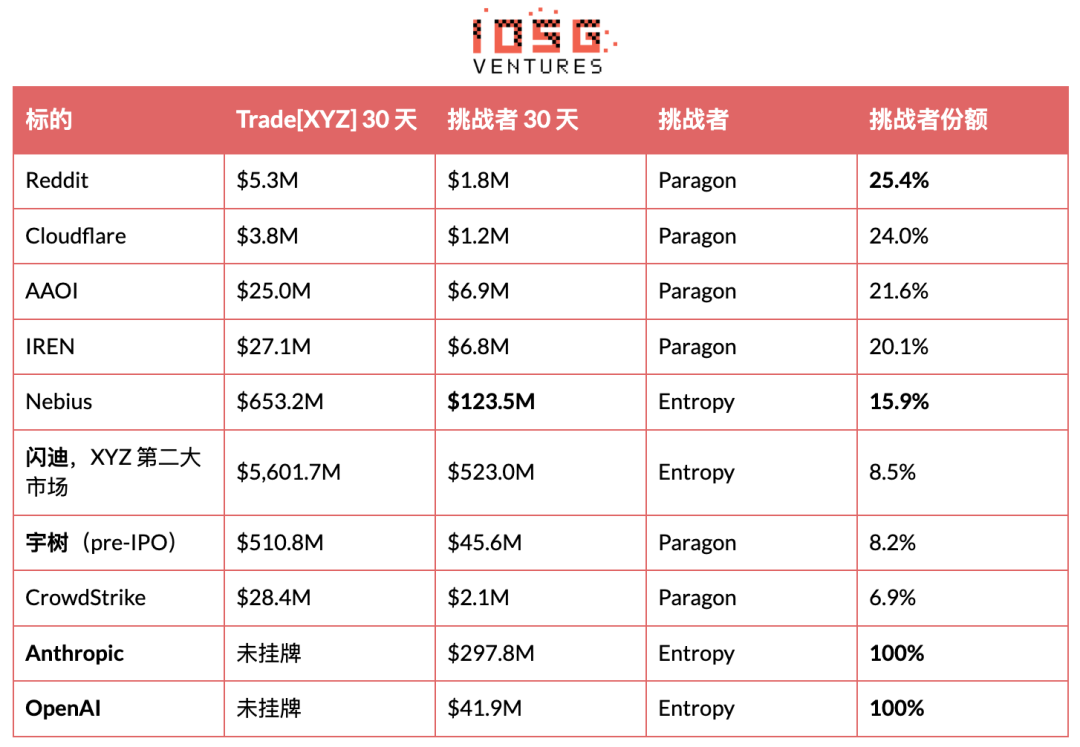
There are currently nine listings simultaneously active on both HIP-3 venues. Each venue no longer occupies a separate, non-overlapping order book; for any name worth listing twice, overlap has become the norm.
Racing to claim slots cuts into share, not the order book
Trade[XYZ] once held registrations for five of Paragon's core listings without enabling them, then opened all of them in a single day on August 18, and today it leads on all five. Filling that gap cost about three days of fee revenue and was done in a single afternoon. Whether that batch of listings was a deterrent or was simply already in the launch queue cannot be determined from on-chain data.
What can be determined is the outcome. Four weeks later, Paragon still holds 20% to 25% of four of those five, and its overall volume actually rose 49.9% that month. Unitree illustrates the mechanism best: Trade[XYZ]'s Unitree order book is about 11 times Paragon's, and Paragon accounts for only 8.2% of that pair, yet Paragon's own Unitree volume nearly doubled over the same period. The leader did not take volume away from the challenger; it grew the market around the challenger. Entering a market and owning a market are two different things.
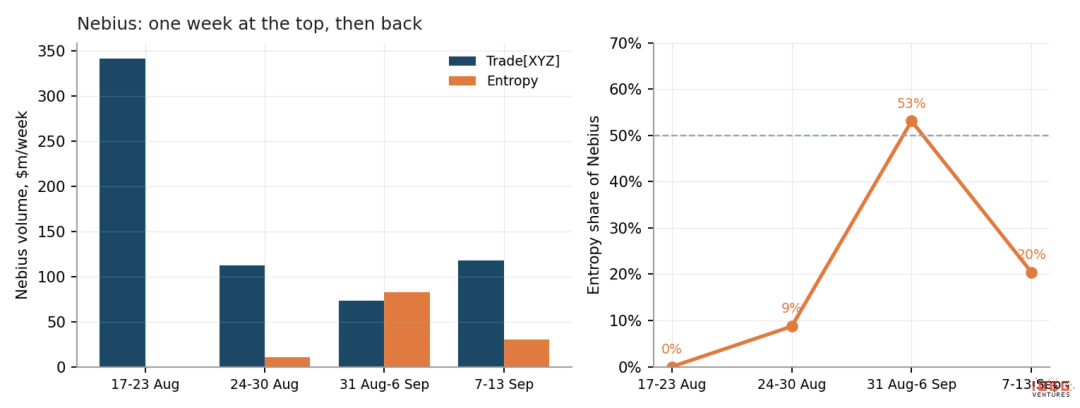
Entropy Led for a Week on Nebius, Then Handed It Back
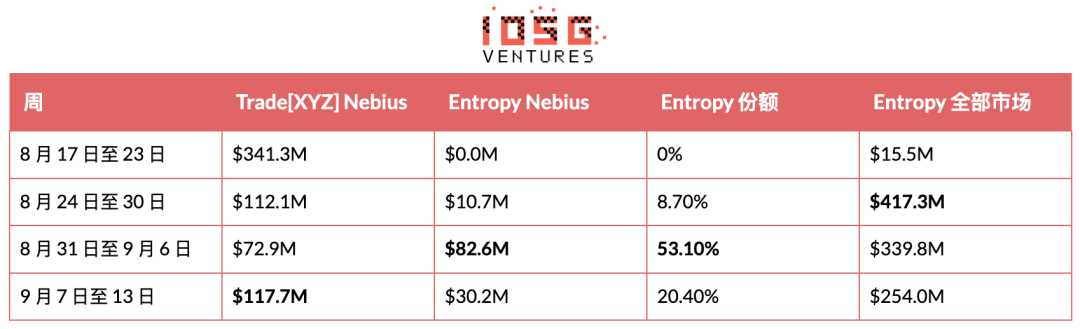
For one week, Entropy's Nebius volume actually beat Trade[XYZ], something no HIP-3 challenger had ever done. The very next week, the incumbent's Nebius book rose 61%, Entropy fell 63%, and the challenger was back to one-fifth of the pair. SanDisk tells the same story, just quieter: Entropy's share has been roughly flat around 13% in recent weeks, and 8.5% across the full 30 days.
So the lead was real, and it really lasted only a week. The honest read: Entropy proved it can cut into a market where the incumbent is actively quoting, but hasn't proved it can hold. Its total volume has now fallen three weeks straight, from $417M to $254M.
The counter-signal comes from inventory. While weekly volume pulled back 39% from its high, Entropy's open interest actually rose 37% to $51.4M, with Anthropic alone accounting for $29.9M. Wash volume nets out and leaves no inventory behind, so open interest accumulating while volume share slides points to real positioning rather than churn. These two facts point in opposite directions, and what's worth watching is the tension itself, not either number on its own.
Discount the volume here. Entropy has no token and hasn't confirmed an airdrop, but a pointsMultiplier parameter is already visible in its backend, and its own leaderboard page says "coming soon," so some of that flow is farming expectations rather than using the product, and from the outside the two are indistinguishable. Scale also needs to be kept in view: Entropy does about $1.0B a month, Trade[XYZ] does $64.6B, making it 1.6% of the incumbent. It's winning specific battles, not the category.
Its registered-but-not-yet-live markets hint at what's next. Entropy is holding EWY, SBE, TCNT, and a DRAM index. The DRAM index happens to be Trade[XYZ]'s own fourth-largest product, and EWY is Korea. The next clash looks set to go straight at the incumbent's core turf, rather than finding another uncontested pre-IPO name.
⚠️ Two counting rules
Only live books count. HIP-3 deployers often register markets long before enabling them, and such markets return an oracle markPx but have midPx as null, isDelisted as true, zero open interest, and no candle history. Trade[XYZ] has 16 of these, mkts has 19, Paragon has 9, Entropy has 4. HyENA's 25 are a different matter, those were enabled and then shut down.
A ticker is not the underlying. para:STX is Seagate, mid price 799; the core board's STX is Stacks, mid price 0.27. Matching by ticker alone would conjure a tenth venue market out of thin air, and it does not exist. Check the mid price before pairing.
The economics: one venue's costs, versus an entire layer's revenue
Nobody competes on price, because fees have already bottomed out
Everything comes down to two parameters per asset, both public in metaAndAssetCtxs: growthMode and deployerFeeScale. The all-in fee rate is base × (1 + s), where base is the standard perpetual fee schedule and s is the deployer coefficient, settable from 0 to 3.00 and capped at 1.00 under Growth Mode. The deployer takes s / (1 + s), so at s = 1.00 it's a fifty-fifty split. Growth Mode then cuts at least 90% off the all-in number, provided the market has zero overlap with validator-operated perps, which rules out crypto assets and crypto indices.
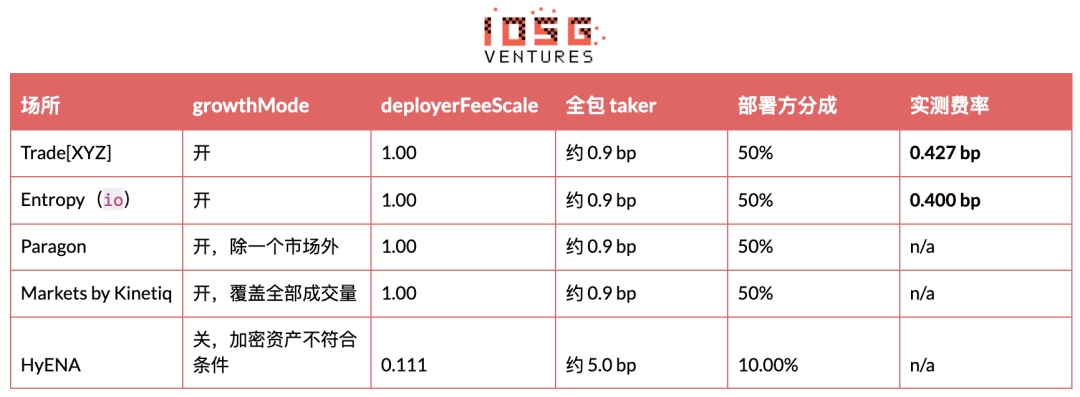
Every equity venue independently converged on the same configuration: deployer share maxed out, Growth Mode on. Entropy entered with differentiated products and venture capital, and it didn't undercut on price either. The only venue not on this configuration is the one that just stopped trading.
You can pin down deployer share precisely without any aggregator. Fee revenue settles in the fee recipient address's per-venue account: clearinghouseState with the dex field reads the unwithdrawn balance, and withdrawals show up in userNonFundingLedgerUpdates as sends where sourceDex equals the venue name. Withdrawals are highly irregular, so measure between two of them. Trade[XYZ] has accumulated $1,380,592 since its August 27 withdrawal, against $32.30B in volume, or 0.427 bp, roughly $79,000 a day. Entropy has never withdrawn, so its cumulative fees can be read directly: $41,468 against $1.036B in volume, or 0.400 bp.
Two outlays, entirely different in nature
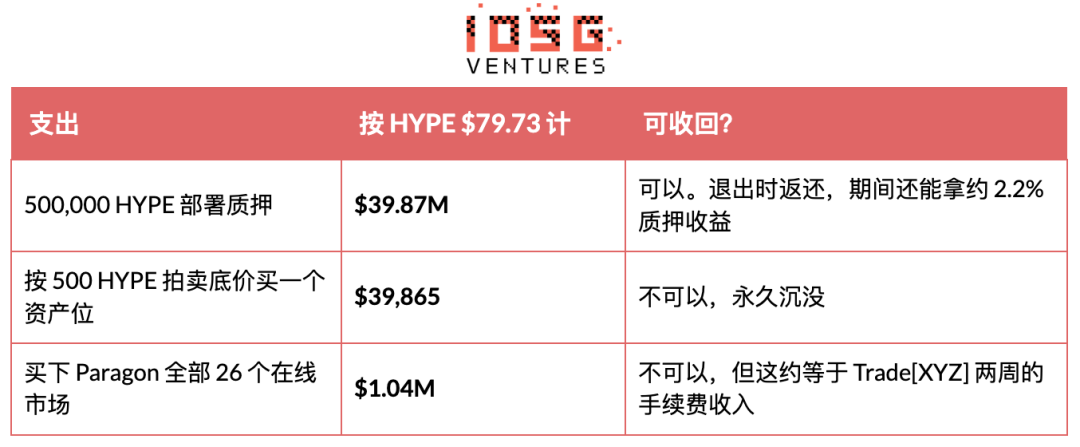
Staking is the scariest number, and it comes back. Nobody takes that money. It's delegated to validators, continuously accruing staking rewards, and returned in full on exit. It's locked for at least 183 days from deployment, can be slashed by a weight-based validator vote for maliciously operating a market (say, pushing a bad oracle price), and remains slashable during the 7-day unstaking queue, so a clean exit takes at least around 190 days. Felix and dreamcash both recovered in full, and their readings now sit at zero.
Currently staked: Entropy 500,973, Paragon 500,712, HyENA 508,915 (trading halted but not unstaked), Kinetiq 588,489 (a single stake covering both km and mkts), Trade[XYZ] 500,488 plus another 500,269 on a separate address. ABCDEx holds only 1,004 HYPE and has never staked.
The money in asset slots is the money nobody withdraws and that genuinely never comes back. The first 3 assets on any perpetual DEX are free; each additional market must be bought in a 31-hour Dutch auction using HYPE, starting at 2x the last clearing price and decaying linearly to a floor of 500 HYPE. The auction entering September 14 opened at the 500 floor and ended at 500, so one asset slot costs roughly $39,900, with asset-slot demand having cooled from a clearing price of 582 HYPE a week earlier.
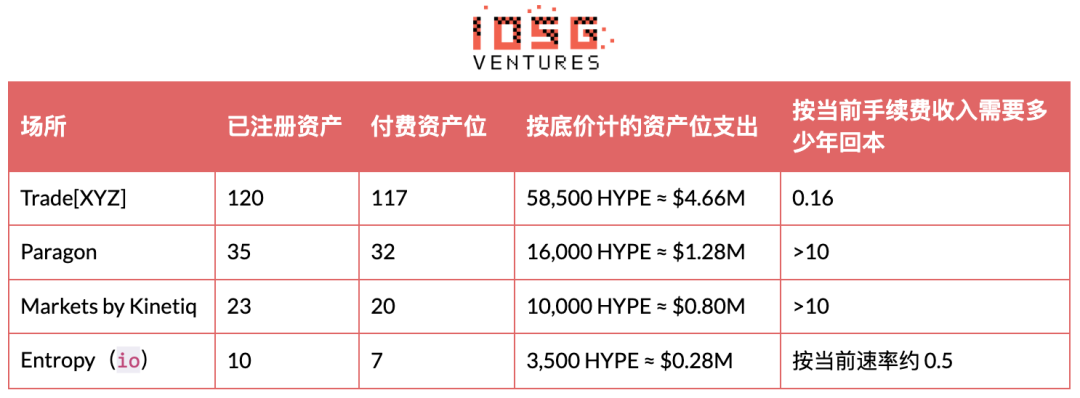
The last column is the point. Trade[XYZ] covers its entire underlying bill with roughly eight weeks of fees. Every challenger except Entropy needs longer than HIP-3 has existed; Entropy only clears because it bought seven asset slots instead of thirty.
Time keeps widening that asymmetry. Pausing a market is free and reversible, paid asset slots can be sealed and reopened, which is where the "pending listings" come from. Reserve slots accrue by historical deployment count, per the formula 7 + 0.2 × prior auction deployments, so Trade[XYZ] has about 30 ready to use while a new entrant has only 7. A venue opening today and planning 20 markets can list 10 at once, with the rest queued through auctions at a minimum of 31 hours each. Entropy's answer is not to play that game: it listed five markets and made every one of them count.
Staking Yield Trap
Every challenger except Entropy earns more from passive staking tickets than from running an exchange. Paragon's lifetime deployer share is $64,281, while $39.87M staked at roughly 2.2% yields about $877,000 a year, a ratio of about 14x.
That is no consolation. The yield is newly issued HYPE from the protocol's future emissions reserve, inflation rather than revenue, a dilution rebate paid on a position one is forced to hold, denominated in the very asset the operator is already passively long. A 30% drop in HYPE wipes $12.0M off that stake, more than a decade of yield. Over the past eight days HYPE has fallen from $88.37 to $79.73, costing every staked position $4.3M.
How Big a Business Can This Fee Pool Support
Growth Mode pins the realized fee rate at around 0.4 bp, with deployers taking half. Trade[XYZ] holds 97.8% share and roughly $786B in annualized volume, yielding about $29M a year in deployer share. Rather than being the leader's ceiling, this is roughly the entire venue-level prize under current volume and the current fee floor.
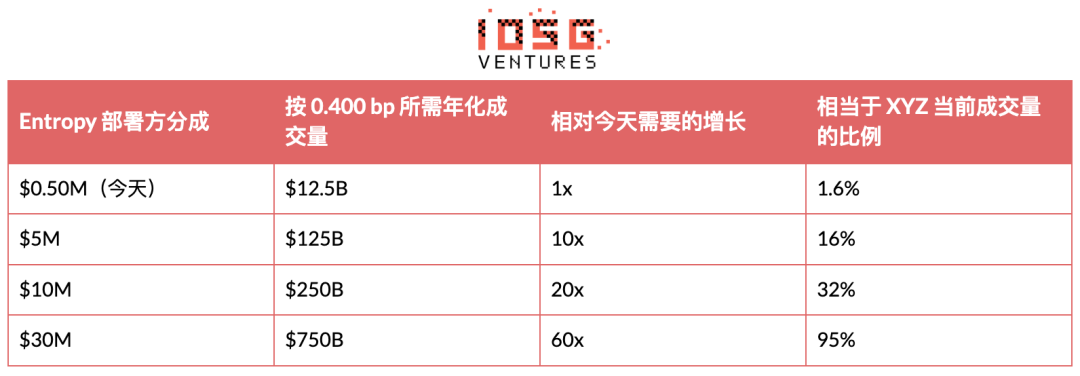
Outside the leader, venue-level players hold about $167M in HYPE today, and every one of them, dead or alive, has earned a combined lifetime total of just $747,000 in deployer share. Set next to a $14M seed round, the arithmetic says: under current volume and the current fee floor, HIP-3 operators cannot be valued on trading fees. Challenger value has to come from somewhere else — tokens, frontends, customer relationships, or some product the protocol hasn't priced yet.
What Actually Holds
HIP-3 deliberately commoditizes most of what a venue could otherwise defend. Staking can be bought, assets can be bought, the fee floor is shared, and even distribution is shared, because every HIP-3 order book is reachable from the same frontend.
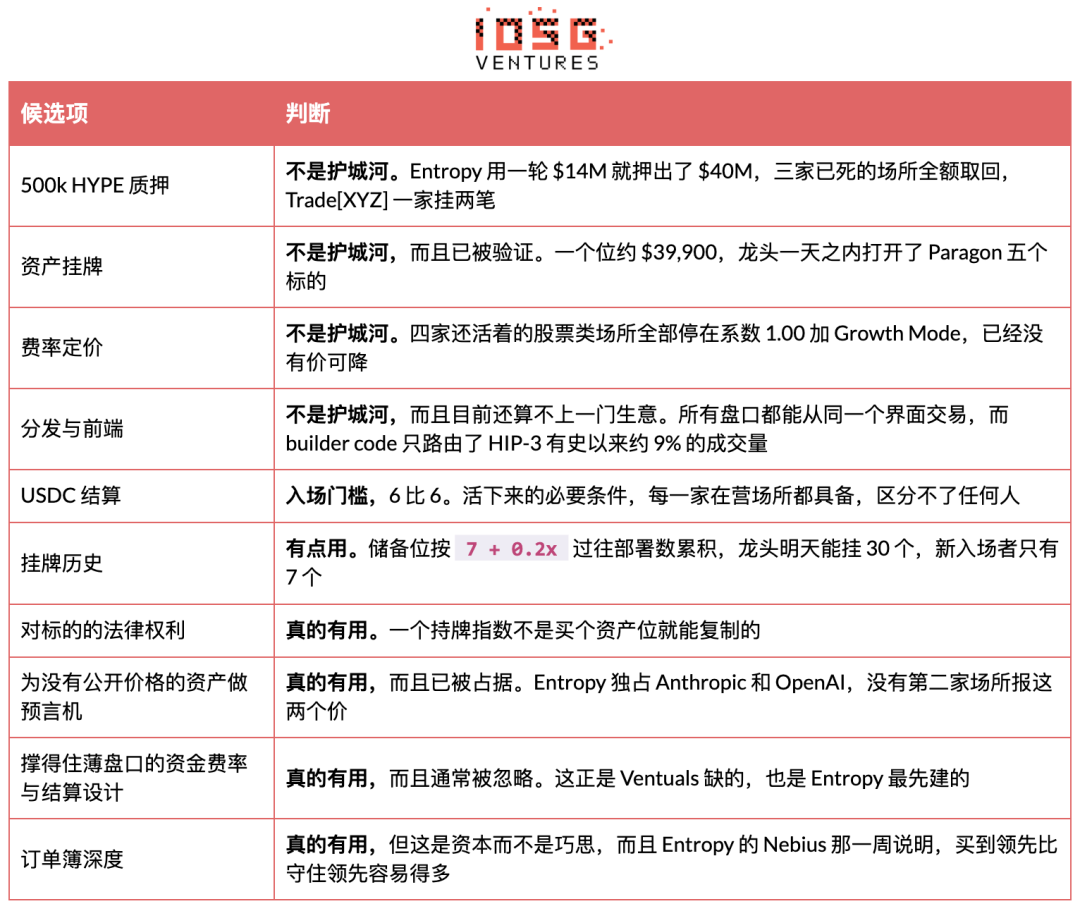
The useful screening question isn't "which assets will you list," because assets can be bought. It's "what do you have that the leader can't buy for the price of one asset slot." Of all the venues that have operated on HIP-3, only one has a clear answer to that question, and its answer is an oracle plus a settlement design, not an asset list.
Why Entropy is that exception is worth stating precisely, because the answer isn't in the assets. It was founded by researchers and traders from Citadel Securities, Optiver, Millennium, and Polymarket, and that bench shows up in two places. One is the order book depth available on day one — that's what actually impressed Nebius. The other is its funding rate and settlement design, which reads like a direct response to how Ventuals died. Its $14M seed round was led by Ribbit Capital, and Ribbit's home turf is retail brokerages and fintech distribution, not DeFi — pointing to an ambition to hold customers rather than farm a protocol. One naming caveat: Entropy Advisors, which is deeply tied to Arbitrum DAO, and the a16z-backed custody startup called Entropy are completely different companies — don't read any Hyper Foundation relationship into the name.
Put together, this track still looks thin. A shrinking company accounts for 97.8% of volume. A circle of challengers staked $167M in HYPE and got back a combined $747,000 in lifetime fees. And the only team that actually quotes just showed it can take a market for a week but can't hold it.
The handier alternative is to take the protocol's own half of fees rather than the operator's half — no lockup, no slashing risk, no operational burden. But it's also not the bulk of Hyperliquid's perp fee base, and it's already been proven that HIP-3 exceeding 50% was a crypto quiet-period illusion, not a trend.
The routing layer, and the flow it actually touches
Builder code is the closest thing to a "distribution business" on HIP-3. Frontends tag the orders they send and earn a builder fee from it, with no margin staked at all. Flowscan counted 819 such tags.
And the flow they touch really isn't much. Routed volume is about $52.6B, roughly 9% of HIP-3's all-time $587B; the last 30 days saw about $5.3B out of $66.09B, about 8%. Over 90% of flow carries no frontend tag at all, which is exactly what you'd expect from an order book dominated by market makers and API traders.
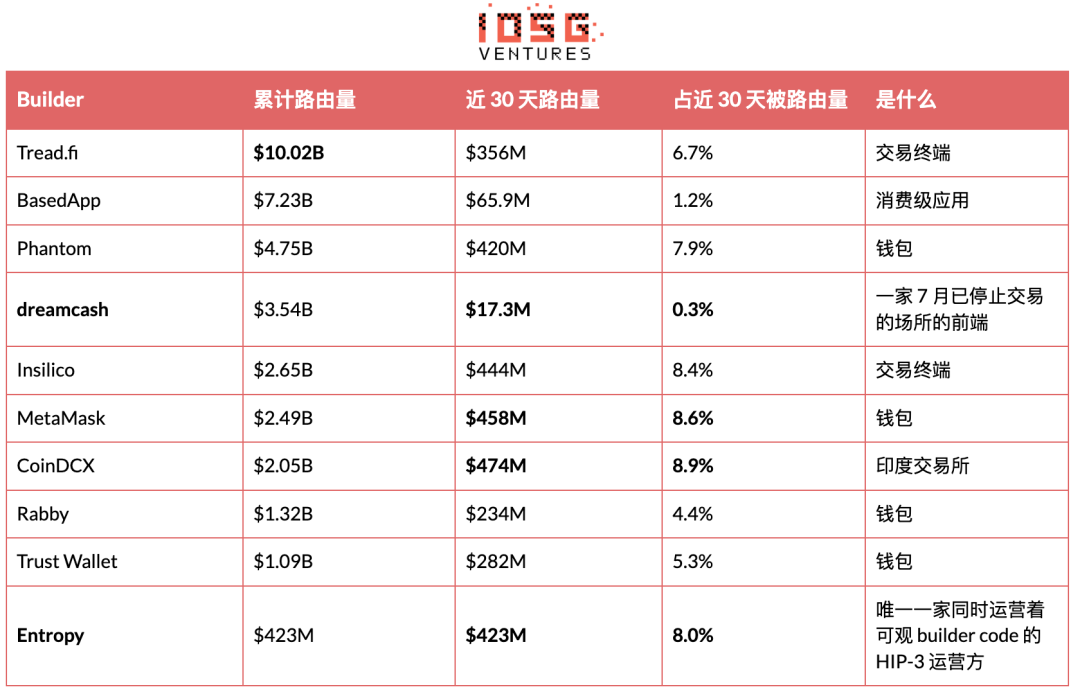
The denominator in the fourth column is the $5.30B routed by all builder codes over the last 30 days, not HIP-3's $66.09B in volume. Switch to the latter and the largest, CoinDCX, is only 0.7%. These ten together account for 59.7% of routed volume, and Flowscan counted 819 builder codes in total, so the 809 in the tail split the remaining 40%.
Two things in this table are worth pulling out. Entropy's $423M in routed volume all happened in the last 30 days, while its own venue did $1.03B over the same period — meaning roughly 40% of its order book comes in through a frontend it controls itself. The retail brokerage ambition behind Ribbit's round shows up in the data, not just in the press release, and it's a different business from being a deployer.
The other is dreamcash, and the lesson is cleaner. Its venue has been dead since July 2, its own order book reads zero, yet its builder code still routed $17.3M over the last 30 days, $3.54B cumulative. The deployer business and the frontend business can be cleanly separated, and only one of them requires $40M to get into.
There is an easy counting trap on third-party dashboards. Venue leaderboards typically default to ranking by cumulative volume, so a venue that shut down months ago can still look like it holds a sizable share. dreamcash reads 3.3% of HIP-3 volume on an all-time view, while showing $0 in any recent window. Before citing any share, first confirm which window it was calculated on.
So the front ends actually worth watching are mostly not the deployers. Coinbase announced a simplified in-wallet perpetuals interface on September 12, powered by Hyperliquid, covering crypto, tokenized equities, and prediction markets, for users outside the U.S. Kraken's parent company is separately in talks to bring Hyperliquid-related perpetuals onto a regulated U.S. venue. Neither is going to stake that 500,000 HYPE.
Conclusion: It's hard to be optimistic about yet another HIP-3 deployer
Putting everything above together, here is the set of numbers a new HIP-3 venue would face.
All HIP-3 volume outside the leader, summed over 30 days, is $1.49B, or about $18.1B annualized. At the measured 0.400 bp, that is $725,000 a year in deployer revenue, split among four venues. And those four venues are staking about $167M in HYPE today. The same money passively staked at 2.2% yields $3.67M a year.
In other words, the money earned from running these exchanges is about one-fifth of what the same capital would earn by simply staking it in place.
This is not an untapped market. It is a market already priced to near zero, for reasons that are measurable in the preceding sections. An asset slot costs $39,900, so nothing you list can hold its ground; the fee floor is shared, so there is no price to cut; distribution is shared too, and the builder code touches only 9% of flow; the settlement asset has already converged 6-to-6 to USDC, and AQAv2 explicitly gives HIP-3 no fee tilt, so the protocol has no intention of subsidizing this layer either.
The harder point is the ceiling. XYZ, with 97.8% share and every structural advantage, managed only 1.2% of real volume on the nine names it quotes, and its relative share in the core storage assets is still declining. A new entrant does not face "the leader is big," but "the leader is already small, and getting smaller."
The exception remains only one kind, as already laid out: a right others cannot buy, an oracle others cannot build, or a funding-rate and settlement design that can survive on thin order books. Entropy is the only one that qualifies, and it was beaten back within a week of leading. The asset list is not the answer, and there are now two independent sets of data saying the same thing.
What Would Change This Call
· Entropy can hold a contested market for a month instead of a week, and hold SanDisk's share instead of drifting around 13%. When traded share slides while open interest keeps building, that's the signal most worth watching, because it's more reliable than volume.
· Entropy's DRAM index and Korean underlyings go live. These two go straight at the leader's core turf, rather than being yet another pre-IPO name with no competition, and the result would be a much cleaner test than Nebius.
· The token's terms can make the equity math work. The fee math doesn't work, and the token doesn't exist today.
· The pre-IPO sector can sustain itself. Anthropic's order book decayed after the first week, and OpenAI opened at $5.3M a day, now around $4M. If even one of them stabilizes, this is a category, not a listing pop.
· AQAv2's first payment lands in early October. That will be the first observable read on the true scale of the protocol's USDC revenue line, to compare against the current third-party estimate range of $135M to $200M.
· The fee floor loosens. Hyperliquid signaled in early August that future upgrades would let HIP-3 deployers raise fees by up to 3x per individual underlying, i.e. clawing back the Growth Mode discount. No timeline has been given, and every number in Section 6 is built on the current floor.
· Permissioned markets land. HIP-3*, announced on September 3, is an optional on-chain whitelist that lets deployers restrict which wallets can trade a given market, pitched for compliance and institutional access, currently testnet-only. This is the first mechanism that could make "access rights" rather than "assets" the scarce item.
· A team emerges holding exclusive data or index licensing, with an underlying that genuinely has 7x24 crypto-native demand. This remains the one configuration where the land-grab logic breaks down completely.
· There's evidence the leader's volume can't survive the end of Growth Mode. Its measured 0.427 bp is roughly one-tenth of what the same order book should charge at standard rates, and if that waiver is load-bearing, the leader's position is less solid than its share suggests.
· HyENA unstakes its 508,915 HYPE, which would confirm the venue is done rather than dormant.
Several Limitations
· The front-running argument is built on measured share, but the motive is inferred. Five tickers launching on the same day could equally be explained as a listing pipeline that happened to finish that day.
· The judgment on Entropy is based on only 26 days of data. Nebius's lead and subsequent reversal are both single-week readings on a single mid-sized ticker, and neither should be carried forward as an established conclusion.
· Team backgrounds and funding rounds come from company announcements and media reports, not something verifiable on-chain.
· The volatility conclusion in Section 2 is a correlation on a sample of 45 business days, not a causal decomposition. Volume and realized volatility could also be driven simultaneously by the same factor, the most direct candidate being that the entire AI capex trade is cooling off.
· Trade count is not trader count; public APIs cannot derive independent traders.
· Capital return figures are calculated based on HYPE at $79.73 and a 2.2% staking APR, the latter being a protocol parameter rather than a contractual commitment, and it will decline as total network staking rises.
Welcome to join the official BlockBeats community:
Telegram Subscription Group: https://t.me/theblockbeats
Telegram Discussion Group: https://t.me/BlockBeats_App
Official Twitter Account: https://twitter.com/BlockBeatsAsia
