Tesla and SpaceX, both under Musk's umbrella, are becoming two trillion-dollar companies with increasingly close business ties. As SpaceX enters the public markets, a question with more imaginative potential is drawing attention: will the two companies eventually merge?
Morningstar noted in a research report published on June 9 that a merger between Tesla and SpaceX has solid business logic. Both companies are investing heavily in artificial intelligence and building supply chains around chips, energy, autonomous driving, and data centers, and their business overlap could expand further in the future.
But rather than technical synergies, what may truly determine whether a deal can be reached is the valuation disagreement between the two sides' shareholders.
Based on SpaceX's IPO pricing of $135 per share at the time the report was published, its implied market capitalization reached approximately $1.8 trillion, 20% higher than Tesla's market cap of about $1.5 trillion at the time. However, Morningstar's fair value estimate for SpaceX was only $63 per share.
This means that even if the two sides are highly complementary in business, Tesla shareholders may not be willing to pay for SpaceX's high valuation. And for SpaceX shareholders, participating in a merger at a valuation significantly below the IPO price is equally unattractive.
How deep are the business ties between Tesla and SpaceX?
In fact, the connection between Tesla and SpaceX has long gone beyond Musk running both companies.
Morningstar noted that in SpaceX's latest S-1 registration filing for its IPO, Tesla's name was mentioned 87 times, reflecting extensive ties between the two sides in capital, procurement, and technology R&D.
First, at the equity level. At the time the report was published, Musk held approximately 13% of Tesla's shares, and if related stock options are exercised, his stake could rise to about 20%. Morningstar expects that after SpaceX completes its IPO, Musk will hold approximately 49% of the shares and control more than 84% of shareholder voting rights.
Meanwhile, Tesla had previously invested $2 billion in xAI. As SpaceX acquired xAI, Tesla obtained a financial interest of less than 1% in SpaceX, holding approximately 19 million shares.
Business dealings are equally close.
In 2025, SpaceX purchased approximately $506 million worth of Megapack energy storage batteries from Tesla, as well as approximately $130 million worth of Cybertrucks, for use at SpaceX-related facilities.
The collaboration between the two companies has expanded from traditional energy and equipment procurement to AI infrastructure.
Tesla, SpaceX, and Intel are jointly advancing the Terafab project, planning to develop and scale up production of specialized AI chips. These chips may in the future be used in Tesla's Optimus humanoid robot, autonomous driving trucks, and SpaceX's planned orbital data centers.
In addition, the two companies are co-developing an agent platform called Macrohard. Morningstar interprets this as an AI system capable of autonomously operating computers like a human.
These collaborations indicate that although the two companies are respectively rooted in the automotive and aerospace industries, their future technology investments are gradually converging onto the same AI industry chain.
From a revenue structure perspective, the two companies are currently still at different stages of business development.
According to financial data compiled by Morningstar, if Tesla and SpaceX's business revenues are observed together, the automotive business still accounts for the largest revenue share. Tesla's energy, energy storage, and services businesses, as well as SpaceX's space, satellite communications, and AI businesses, constitute the remaining revenue sources.
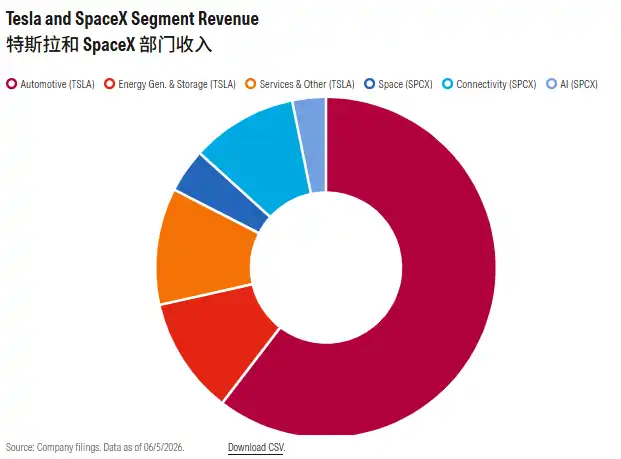
This structure also reveals an important characteristic of a potential merger transaction: currently, the revenues of both companies still mainly come from relatively mature businesses, while capital market expectations for their long-term value are largely related to emerging businesses such as autonomous driving, robotics, and AI infrastructure.
Therefore, the investment logic of a merger is not simply adding together the two companies' existing revenues, but whether the market believes that the combined entity can create greater long-term growth space.
Why is the merger attractive? The core is AI industry chain integration
Morningstar believes that the most compelling reason for a Tesla-SpaceX merger is not cost savings in the traditional sense, but that the two companies are building a highly complementary AI technology and infrastructure system.
Tesla is striving to transform from a traditional automaker into a technology enterprise centered on autonomous driving software, Robotaxi, and humanoid robots. SpaceX, through the Grok AI system, the Starlink satellite communications network, and space infrastructure, provides potential support for this transformation.
For example, Morningstar noted that Grok could serve as the user-facing AI interface for Tesla's Full Self-Driving system and Robotaxi, and be further applied to the Optimus humanoid robot.
Meanwhile, Starlink could also provide communication connectivity for Robotaxi, reducing its dependence on traditional ground-based communication infrastructure.
The two sides' collaboration in energy and computing power is of greater long-term significance.
SpaceX is planning to build orbital AI data centers, hoping to deploy large-scale computing infrastructure in space. This project requires specialized chips, energy systems and related equipment, and Tesla's capabilities in batteries, energy storage and industrial manufacturing could become an important supply source for SpaceX.
Conversely, SpaceX's satellite network, AI computing infrastructure and spaceflight capabilities could also support Tesla's future autonomous driving and robotics businesses.
In other words, Tesla can provide energy, hardware and end-user applications, while SpaceX provides communications, computing infrastructure and space transportation capabilities. The two sides are forming a potential complete AI industry chain synergy.
However, beyond commercial-level synergies, Morningstar believes there is an even more important driving factor: Musk himself wants to integrate his companies into a large conglomerate.
Currently, Tesla and SpaceX are two independent companies. Even if controlled by the same person, talent deployment, technology sharing and related-party procurement between the two companies still require handling related-party transaction disclosures and potential shareholder interest conflicts.
If the two companies merge into the same group, Musk would be able to allocate engineers and technical resources internally more directly, while reducing governance issues that cross-company transactions might trigger.
For Musk, a merger could make the operational management of his companies more unified.
The business logic holds, but a merger may not be the optimal choice
Although Morningstar recognizes the potential value of integrating the two companies, the report also points out that many synergies do not necessarily require a full merger to be realized.
From a long-term strategic perspective, the two companies are converging toward the AI infrastructure and application sector, but their current core priorities still differ significantly.
Tesla's goal is to gradually reduce its dependence on vehicle and battery sales, shifting toward autonomous driving software, Robotaxi services and humanoid robots. SpaceX's near-term focus is to continue expanding the launch capacity of the Starship rocket, expand the Starlink network by deploying more satellites, and promote the commercialization of Grok AI and Colossus data centers.
Among them, developing orbital AI computing clusters is one of SpaceX's most important long-term projects, and is also one of the main reasons Morningstar believes it is seeking IPO financing.
However, this project still faces uncertainty regarding technical feasibility and commercial returns.
Morningstar noted that even if Tesla does not merge with SpaceX, the two parties can still achieve similar commercial synergies through forming joint ventures, signing long-term supply agreements, or establishing traditional supplier relationships. For example, Tesla can continue to supply energy storage equipment to SpaceX, and the two parties can also jointly invest in dedicated AI chips and orbital data centers without changing the existing equity structure.
Therefore, the increasingly close business ties between the two companies in the future do not necessarily mean that a full merger is the most efficient choice.
In addition, regulatory issues may also become an obstacle. SpaceX is an important contractor for the U.S. government and military, while Tesla has large-scale automotive and battery businesses in China. Once the two companies merge, it may trigger further review by U.S. regulators over supply chain and national security risks.
The Real Obstacle: Why Is SpaceX More Expensive Than Tesla?
Compared with business synergies and regulatory issues, Morningstar believes that valuation disagreements may be the most difficult obstacle to resolve in a merger transaction.
According to market data at the time the report was published, SpaceX's IPO pricing of $135 per share corresponded to a market value of approximately $1.8 trillion, while Tesla's market value at that time was approximately $1.5 trillion. This means that even though Tesla has a larger mature business and positive free cash flow, SpaceX's market valuation is still about 20% higher.
More noteworthy is that SpaceX's valuation experienced a significant increase in a relatively short period of time.
Morningstar noted that SpaceX's valuation in July 2025 was only about $400 billion. Thereafter, SpaceX acquired Musk's AI business, with the related transaction valuing SpaceX itself at approximately $1 trillion and the AI business at approximately $250 billion.
By the IPO pricing stage in June 2026, SpaceX's implied market value had further risen to approximately $1.8 trillion. Behind the rapid rise in valuation reflects the market's optimistic expectations for the long-term growth space of Starlink, artificial intelligence, and space computing infrastructure.
But Morningstar cautioned that SpaceX's high valuation already includes a large amount of future growth expectations, and these growth prospects have not yet been fully converted into cash flow. This is also the reason why Tesla shareholders may remain cautious.
The report notes that while Tesla investors are typically willing to evaluate Musk's technical vision from a long-term perspective, in recent years Tesla has generally been able to generate positive free cash flow and has primarily relied on its own funds to support business expansion.
By contrast, SpaceX was still in a negative free cash flow stage at the time the report was published, and also needs to invest substantial capital in capital-intensive projects such as orbital data centers.
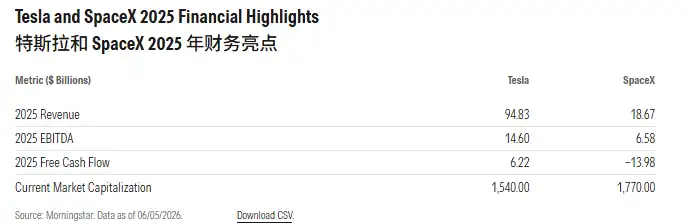
This means that if the two companies merge, Tesla shareholders would not only need to accept SpaceX's high valuation but might also jointly bear its future financing needs. If new investment cannot be covered by operating cash flow, the combined company may need to continuously issue shares to raise funds, thereby diluting existing shareholders' equity.
For Tesla shareholders, the question is not just whether SpaceX has enormous long-term growth potential, but whether that potential is worth buying at the current high valuation, and whether additional financing costs will be required in the future to realize these visions.
Morningstar estimates: Tesla shareholders may demand 50%-66% of the combined company
If the two sides ultimately decide to merge, how to allocate equity in the combined company will become the core negotiation issue.
Morningstar believes that although Musk is a major shareholder of both companies, other Tesla shareholders still have enough influence to potentially demand changes to the transaction terms or even block an unacceptable merger plan.
Especially given that SpaceX's valuation is higher than Tesla's while its free cash flow remains negative, Tesla shareholders may not be willing to accept a disadvantaged position in the combined company.
Morningstar expects that Tesla shareholders may demand at least 50% equity in the combined company, or even hope for a higher controlling stake. Based on Morningstar's fair value estimates for both companies, a more reasonable equity allocation would be approximately 66% for Tesla shareholders and 34% for SpaceX shareholders.
Overall, Morningstar judges that the shareholding range Tesla shareholders might accept is 50% to 66%.
But the problem is that SpaceX shareholders may not be willing to accept such terms. At SpaceX's IPO price of $135 per share, its market cap reaches approximately $1.8 trillion, while Morningstar's fair value estimate for SpaceX is only $63 per share, about 53% below the IPO price.
If the two sides were to merge based on Morningstar's fair value estimates, it would mean SpaceX shareholders would need to accept a valuation far below the IPO price. For new investors who bought SpaceX shares at high prices, this condition is clearly unattractive.
On the other hand, if the deal were priced at SpaceX's IPO valuation, Tesla shareholders might feel they are effectively paying an excessive premium—using a company that generates positive free cash flow to pay for another company that is highly dependent on future growth expectations.
In addition, because the proportion of shares publicly floated in SpaceX's IPO was relatively low, its stock liquidity is relatively limited. Morningstar believes Tesla shareholders and the board may further demand more favorable equity and liquidity arrangements in the transaction structure.
Ultimately, the core conflict facing shareholders of both sides is this: Tesla investors want to avoid overpaying for SpaceX's future growth, while SpaceX investors are unwilling to accept a significant discount to the IPO valuation.
This divergence may be enough to prevent the deal from being reached.
Latest Development: Tesla and SpaceX Formally Initiate Merger Evaluation
In its June report, Morningstar noted that news had already emerged of the two companies discussing a merger, but neither side had formally announced a transaction. With SpaceX's public market valuation established after its listing, Tesla's board will be able to more accurately assess a reasonable price for a potential deal.
Morningstar estimated at the time that, given the speed at which Musk's companies pursue major transactions, if the two sides ultimately decided to merge, the deal could occur within one year after SpaceX's IPO.
Now, that prediction has seen new developments.
On October 21, according to reports from Reuters, Bloomberg and other media, Musk confirmed on SpaceX's third-quarter earnings call that SpaceX and Tesla have each established special committees composed of independent directors to formally evaluate the possibility of a potential merger.
Musk stated that the two companies have broad room for cooperation in areas such as superintelligent software, chip design, Terafab, robotics, orbital data centers and communication networks, and therefore integration has considerable commercial value.
However, because Musk serves as CEO of both companies and holds substantial equity, he stated that he is a conflicted party and will not participate in the special committees' negotiations. Currently, the two sides have not reached agreement on specific transaction terms, and the merger remains uncertain.
According to Musk, the potential deal would also require support from Tesla shareholders, with at least 50% of all Tesla shares voting in favor, not merely a simple majority of the shares that participate in the vote.
Meanwhile, SpaceX's newly released third-quarter financial report provides fresh financial context for a potential merger. The company's quarterly revenue rose 161% year over year to $14.58 billion, while net profit reached $4.4 billion. However, as investment in AI computing infrastructure continues to expand, its capital expenditure for the quarter also reached $19.6 billion.
This means that compared with when Morningstar published its report in June, SpaceX's business scale and profitability have already changed, but its massive capital expenditure needs remain a factor investors must consider.
For a potential mega-merger worth about $3.5 trillion, technological and business synergies may not be the hardest problem to solve. The real challenge remains whether shareholders on both sides can reach agreement on valuation, equity allocation and future financing responsibilities.
The core question previously raised by Morningstar has therefore become even more realistic: can Tesla and SpaceX jointly create greater long-term value, and exactly how high a price investors need to pay for this vision.
Welcome to join the official BlockBeats community:
Telegram Subscription Group: https://t.me/theblockbeats
Telegram Discussion Group: https://t.me/BlockBeats_App
Official Twitter Account: https://twitter.com/BlockBeatsAsia
