Stanley Druckenmiller's standing on Wall Street comes from a track record spanning nearly three decades.
Duquesne Capital, which he managed from 1981 to 2010, delivered annualized returns of about 30% with no losing year.
His beginnings were hardly illustrious. He studied English and economics in college, later entered a PhD program in economics at the University of Michigan, and dropped out midway. After joining Pittsburgh National Bank, he moved from its training program into the investment business. When he founded Duquesne Capital in 1981, he had only two clients and $800,000 in assets under management. By the time he closed the external fund business in 2010, the firm had grown to more than $12 billion. In later reflections, he explained that the pressure of sustaining performance and managing large-scale capital prompted that decision. Since then, he has continued to manage his own money through a family office.
He is better known to the public as the core trader behind Soros's Quantum Fund.

From 1988 to 2000, Druckenmiller worked at Soros Fund Management, serving as the principal portfolio manager of the Quantum Fund and, for most of that period, as chief investment officer, with assets under management peaking at $22 billion.
Shorting the pound in 1992 was one of his signature trades. At the time, Britain was trying to hold sterling's position within the European Exchange Rate Mechanism, but the policies needed to defend the currency put pressure on the domestic economy. Druckenmiller and the Soros team judged that this arrangement was unsustainable and built a short position in sterling. Soros further backed an increase in the size of the bet. On September 16, after intervening in the market and trying to raise interest rates, Britain ultimately announced its exit from the exchange rate mechanism. The public remembered Soros's name, but Druckenmiller was also a key participant in the trade.
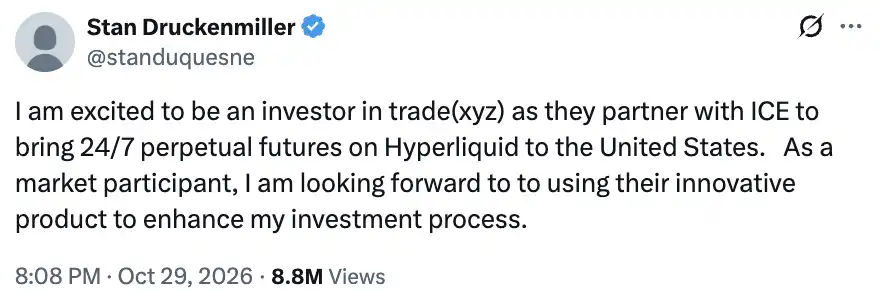
On October 29, Druckenmiller's first post on Twitter was to announce that he would invest in TradeXYZ, saying he looked forward to using its products to improve his own investment process. ICE, the parent company of the New York Stock Exchange, is participating alongside him.
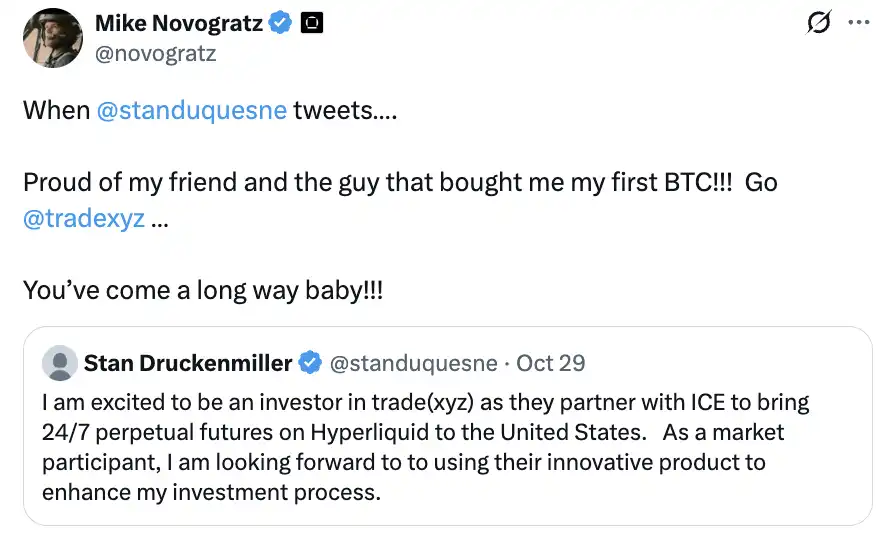
Galaxy founder Mike Novogratz once revealed that TradeXYZ founder Shoku helped him buy his first BTC, a testament to the breadth of Shoku's connections in financial circles.
TradeXYZ and ICE plan to bring round-the-clock perpetual contracts based on Hyperliquid to the United States, covering equities, indices, commodities, foreign exchange, and crypto assets.
ICE Partnership
ICE owns 13 exchanges and 6 clearinghouses, with the technology, licenses, and client relationships to operate trading markets. It is fully capable of developing new trading products on its own. This time, however, it chose to partner with TradeXYZ to build a U.S. market on Hyperliquid while acquiring a minority stake in TradeXYZ.
Another exchange giant, CME, previously took the path of overhauling its own systems. This year, CME extended crypto futures matching to round-the-clock operation, but clearing and settlement still wait until the next business day. It then attempted to launch round-the-clock crude oil futures; the CFTC suspended the listing plan, and CME ultimately withdrew its application in October.
These two attempts show that extending trading hours affects back-office clearing, settlement, and risk management. Existing licenses and a massive trading business do not make this overhaul easy.
HyperCore has already put matching, margin, funding rates, forced liquidation, and settlement into a single continuously running system. TradeXYZ operates equity, index, and commodity markets on this system, with cumulative trading volume exceeding $650 billion over more than a year. By choosing to partner, ICE can simultaneously obtain ready-made trading technology and accumulated product experience.
The division of roles among the three parties is therefore clear: Hyperliquid provides the underlying engine, TradeXYZ designs and implements the markets, and ICE handles the operation of U.S. regulated markets and the clearing system.
For exchanges, adopting external technology means sharing a portion of revenue. ICE's choice of this path reflects the value of ready-made products, technology, and speed to market. For Hyperliquid, this is a business that can scale continuously: other institutions operate the markets and organize clients, while it provides the trading engine and earns revenue from trading in those markets.
HIP-3*
This partnership will be advanced through HIP-3*, and the entire U.S. market still requires regulatory approval.
The key to HIP-3* is allowing deployers to establish markets with participation permissions, adding identity verification, anti-money laundering, and other controls. ICE can thereby operate a dedicated market that meets U.S. regulatory requirements, TradeXYZ continues to handle contract and market design, and the underlying layer still uses HyperCore.
This solves an obstacle traditional brokers face when accessing on-chain markets. The U.S. futures market has clear trading and clearing entities: DCMs are responsible for listing and operating trading markets, and DCOs are responsible for clearing. Brokers need to route client trades into markets that meet these requirements, and ICE is taking on exactly this layer of organization and operations.
Under this structure, TradeXYZ will redeploy a regulated market in the U.S., running in parallel with the already-operating offshore HIP-3 market. Both sides use the same underlying technology, each retaining its own order book and market settings. The offshore business continues to grow, while the U.S. business organizes eligible clients and brokers through ICE.
The clearing system will also be set up separately. Over 99% of ICE's existing participants are institutions, and its original business primarily serves commercial hedging and institutional trading. The new perpetual market targets retail clients seeking short-cycle, round-the-clock trading. The independent clearing arrangement allows ICE to expand into this client segment while isolating the trading and counterparty risk of the new business from its existing institutional clients.
This is a clear approach to business expansion. ICE retains its original institutional futures business and builds a separate retail-facing market; TradeXYZ gains a U.S. compliant operator; and Hyperliquid can support markets with different operators and different access rules at the underlying level.
Broker Network
The second key focus of the partnership is distribution.
Attracting traders one by one through TradeXYZ alone versus connecting to traditional brokers through ICE are two client acquisition approaches of different scale. The latter can reach clients who already have accounts, already have funds, and already have derivatives trading needs.
In the U.S. futures market, FCMs handle client funds and trading access. ICE already has relationships with numerous such brokers and clearing institutions. In the future, once brokers like Charles Schwab, Interactive Brokers, and Robinhood join the new market's clearing system, they can offer the relevant contracts to their own clients. Traders use familiar interfaces, while the market running in the background can be on Hyperliquid.
This also explains the difference between ICE's approach and the previous Kraken path.
Kraken's U.S. plan revolves around NinjaTrader, accessing clients through an established brokerage channel. ICE's plan targets multiple FCMs that can join over time. Each additional broker gives the new market access to an existing pool of clients.
The gap in client base is quite直观. According to Blockworks Research statistics, NinjaTrader holds approximately $600 million in client futures funds, while seven retail futures brokers including Charles Schwab and Interactive Brokers hold a combined approximately $13.5 billion. The channels ICE can pursue cover a much larger pool of client funds and trading demand.
In addition, ICE also plans to distribute these products through its joint venture business with OKX. Both traditional futures brokers and crypto trading platforms can serve as customer entry points for the new U.S. market.
From a business division perspective, this has parallels with Hyperliquid's existing builder code model: the party providing the front end and customer service handles distribution, the underlying market handles trade processing, and all parties earn revenue through fee arrangements. In the U.S., this distribution role will be assumed by regulated brokers, with ICE connecting brokers to the on-chain trading engine.
For TradeXYZ, as long as a small number of active FCMs begin offering these products, there is an opportunity to capture incremental volume from existing retail trading demand. ICE possesses the ability to operate markets and a distribution network, while Hyperliquid and TradeXYZ provide the new products it can sell to these customers.
Druckenmiller sees the opportunity to invest in and use the product, while ICE is preparing to build a new trading business around this technology stack.
Hyperliquid is beginning to attract a new class of customers—financial institutions that have the capability to run their own exchanges but are willing to use it as their underlying engine.
Welcome to join the official BlockBeats community:
Telegram Subscription Group: https://t.me/theblockbeats
Telegram Discussion Group: https://t.me/BlockBeats_App
Official Twitter Account: https://twitter.com/BlockBeatsAsia
