As the U.S. midterm elections approach, congressional control, the magnitude of a Democratic victory, and the impact of local elections on data center construction form the three focal points of Nomura's election-night observation framework.
In its November 2 report "U.S. Midterm Elections — Election Night Toolkit," Nomura noted that the latest polls have raised the possibility of a "blue wave" — broad Democratic victories across multiple key states and districts. However, whether polling advantages materialize and how many seats Democrats ultimately win still require actual vote results to verify.
The final New York Times/Siena College poll cited in the report shows Democrats leading in six of seven key Senate battlegrounds, with Iowa nearly tied. The surveys were conducted from October 23 to November 1, with most polling completed before the recent controversy within the Michigan Democratic Party, leaving local race dynamics still uncertain.
The first results are expected to be released starting the morning of November 4 Hong Kong and Beijing time. All times below are U.S. Eastern Time, which is 13 hours behind Hong Kong and Beijing time.
House: Early Indicators; Senate: Margin of Victory
Nomura believes both polls and historical patterns indicate Democrats are well-positioned to retake the House. Early results in several competitive districts will help gauge their overall performance.
At 6 p.m., some polling stations in Kentucky close, and the Sixth Congressional District (KY-06) will be one of the first competitive districts worth watching. The report notes that Republicans won this seat by nearly 27 percentage points in 2024, but Democrats currently lead in polling. If this shift materializes in actual voting, it would serve as an early signal of strengthening Democratic momentum.
At 7 p.m., attention shifts to Virginia and Florida. Virginia's 2nd Congressional District (VA-02), held by Republicans and closely divided between the parties, is an early bellwether listed by Nomura. Florida's 14th and 22nd Congressional Districts (FL-14, FL-22), previously held by Democrats, have become more competitive after redistricting favorable to Republicans.
At 8 p.m., results from Pennsylvania and Michigan begin to draw attention. Nomura highlights Pennsylvania's 10th and 1st Congressional Districts (PA-10, PA-01), as well as Michigan's 7th Congressional District (MI-07), held by Republican Representative Tom Barrett. Data center development is also a focus of observation in some districts, and Barrett supports measures to accelerate related development.
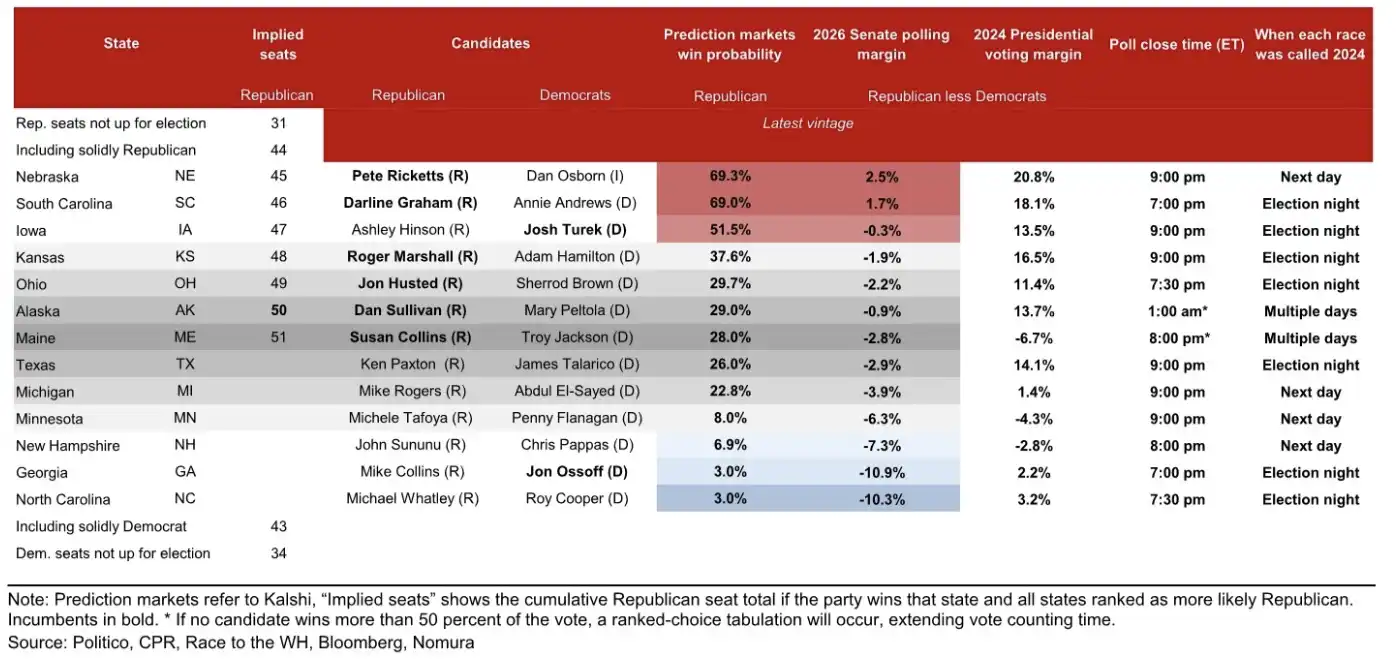
On the Senate side, the earliest strongly indicative results may come from Georgia and South Carolina, where polls close at 7 p.m.
Democrats currently lead in Georgia polling. Nomura believes that an upset Republican victory would significantly weaken Democrats' prospects of retaking the Senate; if incumbent Democratic Senator Jon Ossoff performs strongly, it could strengthen his position in the competition for the Democratic presidential nomination in 2028.
South Carolina is another early observation point for testing the "blue wave." Trump won the state in 2024 by a double-digit margin, but a New York Times/Siena College poll cited in the report shows the local Senate race nearly tied. Whether Democrats can break through in this traditionally Republican-favored state will help gauge the scope of their support expansion.
From 7:30 p.m. to 9 p.m., polls will close successively in Ohio, Maine, Michigan, Kansas, Iowa and Texas. Results in these states will further determine whether Democrats can retake the Senate and how large an advantage they can achieve.
Nomura is particularly focused on Democratic polling leads in Michigan and Texas, but cautions that some close races may not be confirmed that night. A strong performance by Michigan Democratic candidate Abdul El-Sayed could also enhance the progressive wing's influence within the party ahead of the next presidential election.
Governor races may affect AI investment implementation
In addition to congressional seats, Nomura also lists the governor races in Georgia and Texas as important observation points for AI investment. Polls in the two states close at 7 p.m. and 9 p.m. respectively, and a Democratic victory could strengthen regulatory resistance to data center construction.
The policy divide in Georgia is particularly clear. Democratic candidate Keisha Lance Bottoms advocates a moratorium on new data center construction. If elected, the state would be governed by Democrats for the first time in more than two decades. Republican candidate Rick Jackson favors a more decentralized approach rather than strict statewide regulation.
For AI infrastructure investment, the impact of the election results will depend on how campaign proposals translate into concrete policies. If the construction moratorium proposal takes effect, the pace of related projects could be affected; the scope and enforcement of the policy will determine the extent of the impact.
Congressional control may become clear relatively quickly, but tight races still require waiting
Nomura expects congressional control could become clear on election night or the following day. But if Democrats perform weaker than current polls suggest, Senate control could hinge on a few slower-counting states, and uncertainty over the results will persist longer.
Maine and Alaska are particularly worth watching. Both states use ranked-choice voting, allowing voters to rank candidates by preference. If no candidate wins more than half the votes in the first round, counting may continue, eliminating lower-ranked candidates and reallocating votes according to voters' subsequent preferences, thereby extending the time needed to confirm results.
Mail-in ballots will also affect the vote-counting timeline in Alaska. According to the state's official schedule, eligible domestic mail ballots postmarked before Election Day may arrive until November 13; overseas mail ballots have a receipt deadline of November 18. Therefore, in close races, an initial lead on election night may not be sufficient to confirm the final winner.
The core observation points on election night are whether Democrats' polling advantage materializes and the extent of their breakthroughs in traditionally Republican-favored states. If Senate control ultimately hinges on Maine or Alaska, the market may need to wait for more ballots to be counted. Meanwhile, data center policy changes resulting from gubernatorial elections will be another clue for assessing the outlook for AI investment.
Welcome to join the official BlockBeats community:
Telegram Subscription Group: https://t.me/theblockbeats
Telegram Discussion Group: https://t.me/BlockBeats_App
Official Twitter Account: https://twitter.com/BlockBeatsAsia
