As U.S. midterm elections approach, the political issues facing AI infrastructure investment are extending from Washington to state governments and local approval authorities. The investment, jobs, and tax revenue brought by data centers, alongside residents' concerns about electricity prices, water resources, and environmental impact, have become tensions candidates must address.
In this pre-election report, Bernstein sorts through gubernatorial candidates' policy positions and the specific tools available to governments at each level to influence construction. Its core judgment: political resistance to data center construction is increasing, but local economic benefits are also considerable, and elected officials still have incentives to push projects forward. The ultimate policy adjustment may manifest more as tightened construction conditions and developers bearing a larger share of infrastructure costs.
About 60% of project pipeline faces policy tightening risk
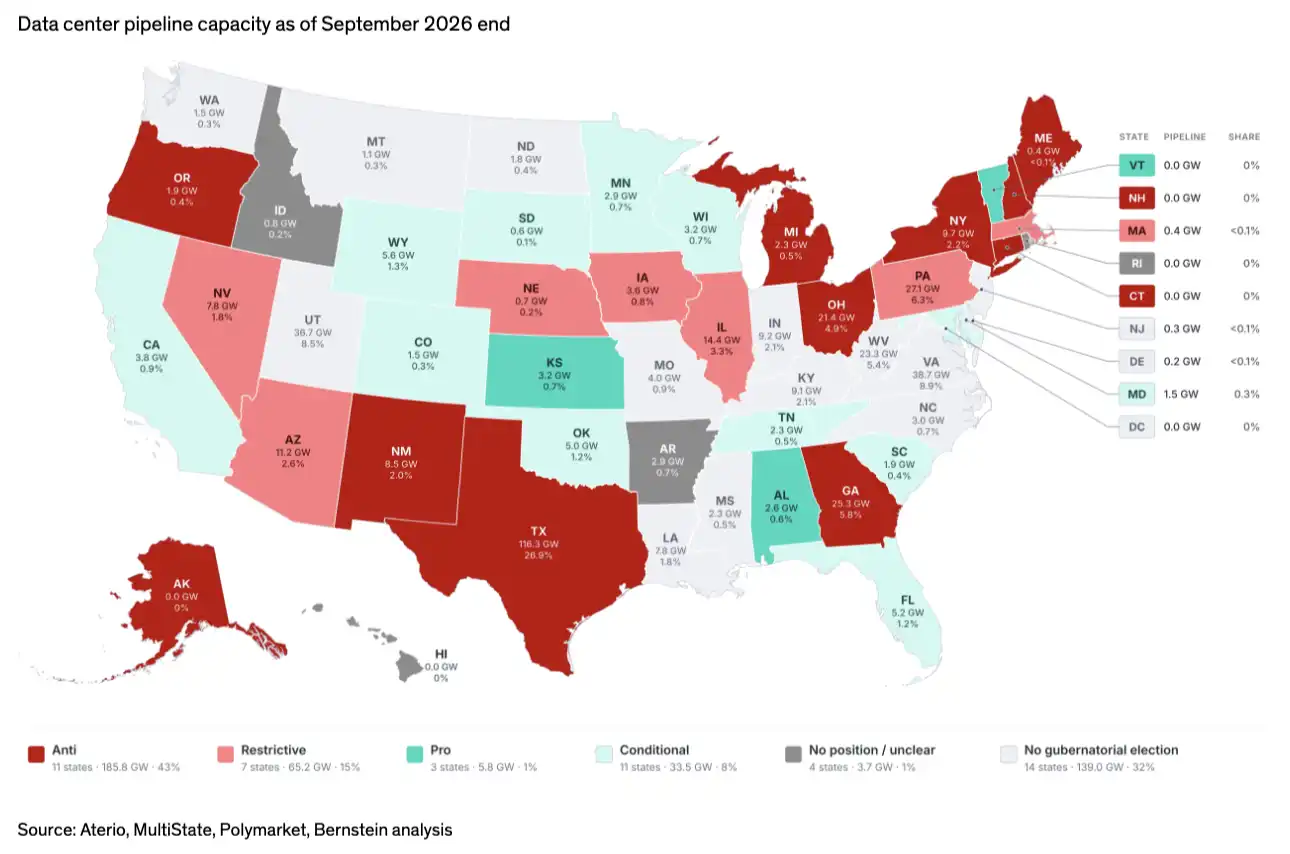
According to the report's statistics as of end-September 2026, the U.S. data center project pipeline totals approximately 433 GW. Among the 36 states holding gubernatorial elections that year, leading candidates in 18 states are classified as "opposing" or "restricting" data center construction, corresponding to approximately 251 GW of project pipeline, or about 58% of the national total.
By comparison, leading candidates in 14 states hold "supportive" or "conditionally supportive" positions, corresponding to approximately 39 GW of project pipeline, or about 9% of the national total. The remaining capacity is located in states where candidate positions are unclear or where no gubernatorial election is being held that year.
These categories cover policy intensities that are not the same. "Oppose" includes candidates who support or have implemented statewide moratoriums on approvals, permits, or grid interconnection, some of which may be temporary or conditional; "Restrict" includes candidates who cut tax incentives and add significant approval barriers but do not support statewide moratoriums. Therefore, 251 GW measures the policy environment surrounding relevant projects and cannot be directly understood as capacity that will be halted.
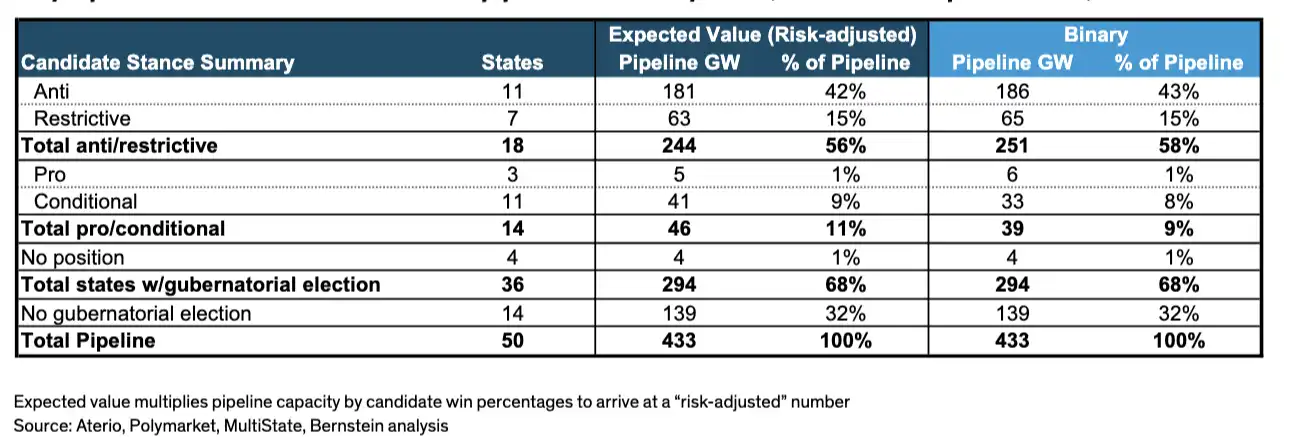
Bernstein also weighted project capacity corresponding to candidate positions based on Polymarket win probabilities, arriving at risk exposure of about 244 GW, equivalent to roughly 56% of the national pipeline. That metric was about 240 GW a month ago, about 235 GW in June, and about 240 GW in April, showing no significant change since spring.
Probability weighting also does not equal project cancellation probability. It links candidate win probabilities with policy positions and does not further quantify policy implementation strength, execution timing, or whether each project can ultimately be built.
Another analysis in the report estimates that about 260 GW of project pipeline is unlikely to materialize. This is an assessment of data center project feasibility and differs from the statistical scope of election policy risk; the two cannot be directly added together.
Partisan differences also need to be understood cautiously. Among Democratic candidates counted by Bernstein, 19 were classified as "Oppose" and 7 as "Restrict"; among Republican candidates, the corresponding numbers were 8 and 5. Democratic candidates overall are more inclined to tighten policy, but related resistance also exists in Republican ranks, major candidates in some states hold similar positions, and election results may not significantly change local policy direction.
What really affects construction is permitting, the grid, and cost allocation
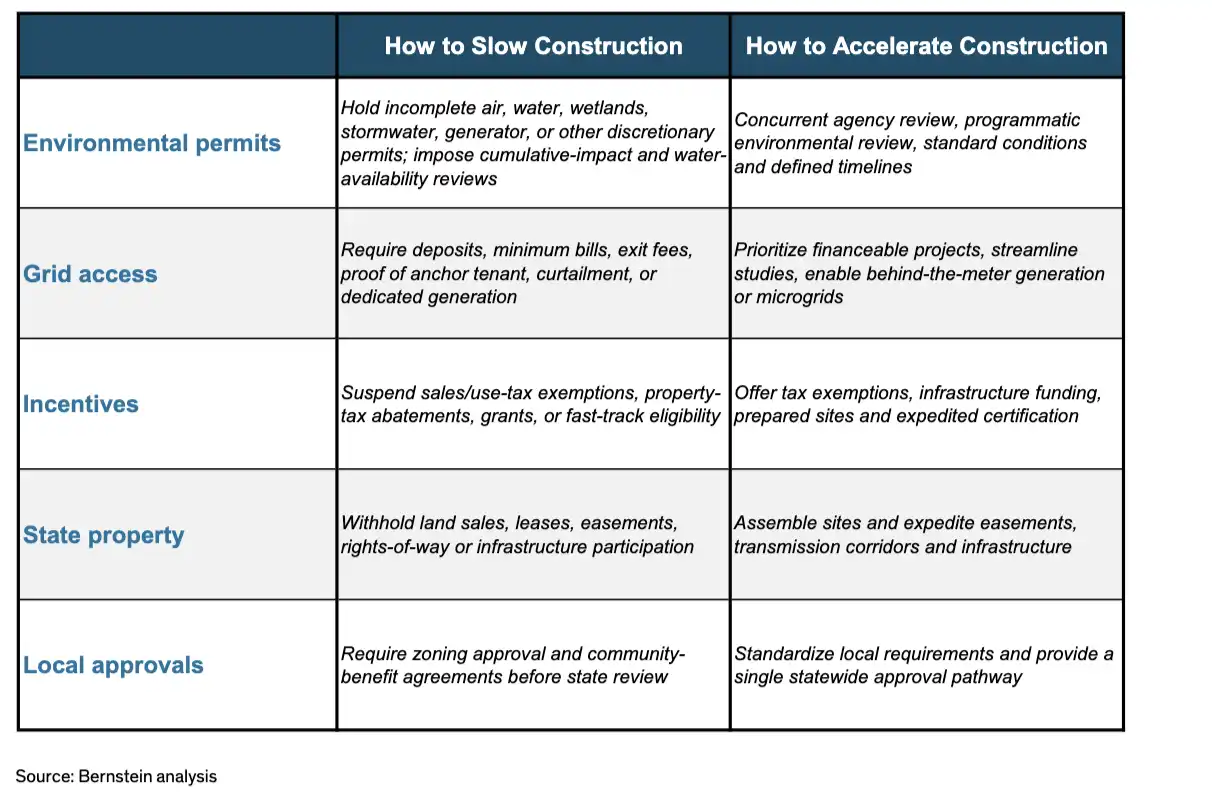
State and local governments control multiple approval steps sufficient to affect construction timelines and project economics.
Governors can influence air emissions, water withdrawal, wastewater, and environmental review through executive agencies, and can also push adjustments to tax incentives, state-owned land use, and interagency approval arrangements. Especially for projects relying on on-site power generation, air emission permits may directly determine whether the power supply plan can be implemented.
Public Utility Commissions (PUCs) are mainly responsible for electricity pricing, investment, and cost recovery arrangements for regulated utilities. For data centers, key questions include what electricity rates apply to large-load customers, whether deposits are required, minimum consumption commitments or exit fees must be borne, and who funds new transmission lines, substations, and generation facilities.
Local governments, meanwhile, typically control land-use zoning and building permits. Even if a state government is willing to attract investment, specific projects may still be affected by community opinion, noise, water use, or land-use disputes.
These powers also have limits. A governor cannot unilaterally halt construction in all cases, and permitting authority, statutory standards, and protections for existing projects vary across states. Permit moratoriums, added review, and full construction stops do not carry the same practical impact.
According to the report, Texas has a project pipeline of about 116 GW, roughly 27% of the national total, making its policy implementation particularly noteworthy. Pennsylvania, Georgia, and Ohio have about 27 GW, 25 GW, and 21 GW respectively, and are also important markets.
Bernstein is particularly focused on Georgia and Nevada. Among the top nine pipeline states it tracks closely, these two states simultaneously have major candidates with differing policy positions and relatively competitive electoral conditions. In states where both candidates lean toward restricting construction, a change in the winner may have less impact on policy direction.
There is still an implementation gap between moratorium measures and project slowdowns
Whether political statements can translate into slower construction still requires watching specific implementation.
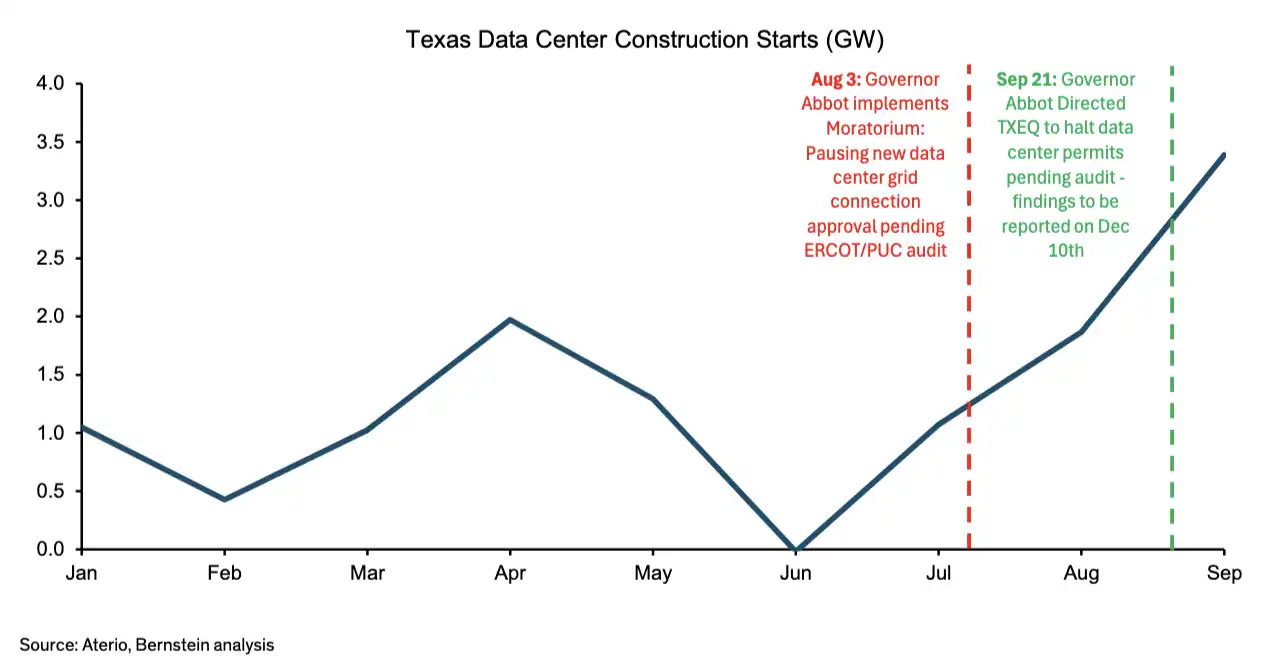
According to the report's tracking, since the relevant moratorium measures began in August 2026, Texas's capacity under construction has increased by about 5.3 GW, and its pipeline of planned but not yet started projects has increased by about 22.4 GW; Pennsylvania's not-yet-started project pipeline has increased by about 9.1 GW, and New York's has increased by about 0.3 GW.
Texas's monthly construction starts also did not immediately fall back. Data listed in the report show about 1.1 GW of starts in July, rising to 1.9 GW in August, and further increasing to 3.4 GW in September.
Bernstein therefore concludes that, at least during the report's observation period, the moratorium measures have not yet noticeably weakened overall development momentum. However, a growing project pipeline does not equal final commissioning, and projects that continue to start construction may already have obtained key permits. Short-term data can show that there is a gap between policy announcements and actual construction, but cannot yet prove that tighter permitting has no subsequent impact.
Local economic interests are a key basis for Bernstein's judgment that policy may ease. The investment, construction jobs, and related wage income brought by data centers give officials an incentive to retain investment, employment, and tax revenue while responding to residents' concerns.
A more likely approach is to strengthen cost isolation while allowing construction: requiring data center customers to bear the cost of dedicated power facilities, providing stronger power usage commitments, and reducing the risk that residential users bear costs if projects are delayed or withdrawn.
Bernstein believes such arrangements already have more precedents, and the incremental impact on developers' overall project economics may be limited. The actual impact still depends on interconnection conditions, power supply plans, and contract terms.
Post-election stock price pressure depends on how policy is implemented
Bernstein notes that if candidates advocating tighter data center construction win, related stocks may face further selling pressure. But the firm also judges that AI-related industrial stocks have already undergone significant adjustment, and elected officials have economic incentives to moderate their campaign positions, so market concerns about political risk may already be excessive.
Within the report's coverage, Bernstein remains bullish on engineering and electrical companies such as Quanta Services (PWR), Eaton (ETN), Forgent (FPS), and Legence (LGN), data center infrastructure companies such as Equinix (EQIX) and Digital Realty (DLR), as well as Vertiv (VRT), nVent (NVT), Johnson Controls (JCI), and Trane Technologies (TT). Its bullish list also includes GE Vernova (GEV), Siemens, Siemens Energy, and Schneider Electric.
This judgment depends on policy ultimately manifesting more as cost reallocation rather than large-scale cancellation of construction. What is more worth tracking after the election is whether air and water permits are delayed, whether grid connection contracts are tightened, who bears the cost of new grid investment, and whether projects move from planning to construction.
If approvals become stricter but construction continues to advance, the impact of political risk on equipment orders may be relatively limited; if permitting, power supply, and financing constraints compound and further lead to project delays or cancellations, then related companies' order fulfillment and profit expectations will face more direct pressure.
Welcome to join the official BlockBeats community:
Telegram Subscription Group: https://t.me/theblockbeats
Telegram Discussion Group: https://t.me/BlockBeats_App
Official Twitter Account: https://twitter.com/BlockBeatsAsia
