On November 3, veteran Silicon Valley venture capital firm Menlo Ventures released this year's "State of Enterprise AI Report."
To figure out how much enterprises actually spent this year, Menlo commissioned Morning Consult in September to survey nearly 400 AI decision-makers at U.S. enterprises, who oversee more than $4 billion in AI spending. According to Menlo's estimates, as of September this year, U.S. enterprises had spent $176.8 billion on AI deployment, 5.4 times the $33 billion from a year earlier.
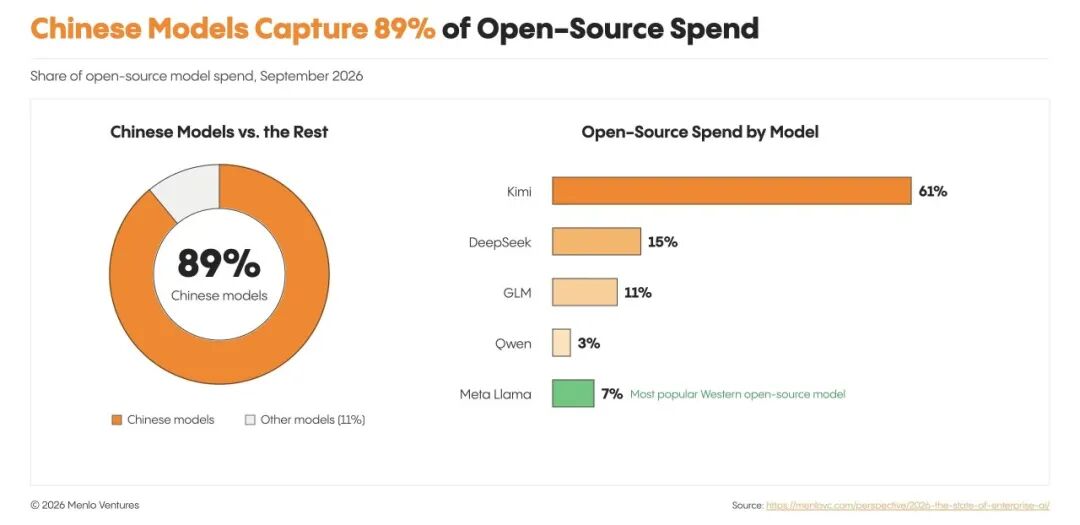
In this report written for Silicon Valley, there is a set of numbers. Of U.S. enterprise production spending on open-source models, Chinese models account for nearly 90%. Among them, Kimi alone takes 61%, followed by DeepSeek at 15%, GLM at 11%, and Qwen at 3%. Meta Llama, the top-ranked Western open-source model, has only 7%.
Menlo Ventures, which wrote the report, is a major shareholder in Anthropic and led its $750 million Series D in 2024.
In addition, Fireworks AI, the top inference cloud that hosts Kimi on servers and sells it to U.S. enterprises and whose annualized revenue just surpassed $1 billion this year, is backed by Menlo; OpenRouter, the model routing platform that processes 160 trillion tokens per week, is backed by Menlo; and Cursor, which the report specifically names and which trained Composer 2 on Kimi K2.5, is also backed by Menlo.
If you look only at the report data, you would think the closed-source giants and the open-source camp should already be fighting to the death, and that models on opposite sides of the Pacific should be clearly divided—but adults weigh pros and cons; only children divide into camps.
Beyond these data points and vested interests, what Beating wants to understand more is why Kimi, of all options, has become the choice American enterprises are most willing to pay for outside of closed-source flagships.
The Price of Rework
To understand Kimi's "61%," one must first understand the peculiar quirk in how American enterprises spent on AI this year: the cheaper the model, the fewer people used it.
Over the past two years, the most popular industry judgment was that inference costs would drop 90% annually, and enterprises would eventually switch their workflows to cheap small models. Labs indeed kept selling small models cheaper and cheaper.
The result was exactly the opposite.
From Q3 2025 to Q3 2026, the enterprise market token share of small closed-source models like Haiku and Luna fell from 29% to 13%, dropping by more than half. The most expensive frontier flagships saw their token share rise from 18% to 42%, and their spending share climb from 35% to 63%.
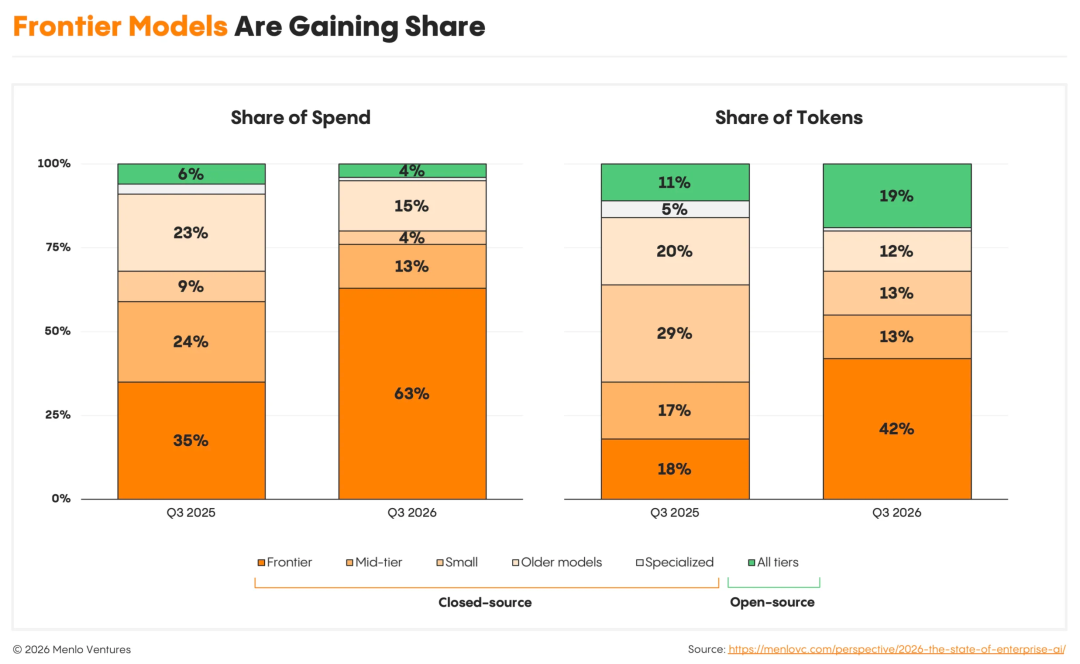
A year ago, the most commonly used workhorses among American enterprises were Claude Sonnet 4.5 at $3 input / $15 output (per million tokens, same below) and GPT-5 at $1.25 / $10. By this fall, everyone was lining up to switch to more expensive flagship models.
Why did savvy American companies suddenly stop chasing cheap?
The reason is simple: the ones doing the work with models shifted from humans to Agents.
In February this year, Agent-initiated traffic on OpenRouter officially surpassed humans; by the end of September, 80% of tokens on the platform were being generated autonomously by Agents in the background, a 37x increase in just over half a year. Of the $77.3 billion in enterprise AI application spending, 76% was concentrated in coding and enterprise Agents.
Agent work and human use of AI do not follow the same logic.
When a coding Agent takes on a task, it often has to run forty or fifty rounds between the codebase, terminal, and sandbox: reading files, calling tools, running tests, checking errors, and revising code again.
In long-chain tasks, the cost of errors accumulates multiplicatively. A model with 99% single-step accuracy running 50 consecutive steps has roughly a 60% chance of completing the task successfully; switch to a model with 95% single-step accuracy, and the probability of getting through 50 steps without failure drops below 8%.
So enterprises quickly understood that when buying models now, they should look not just at the listed unit price on the price sheet, but more importantly at the total cost of getting things done right the first time.
Once you grasp this, the situation of open-source models this year becomes easy to understand.
Over the past year, open-source models' token share rose from 11% to 19%, with call volume 22.5 times that of a year ago; yet their share of spending dropped from 6% to 4%. The reason is that most open-source models got dragged into a price war, with average unit prices falling to less than one-third of what they were, down to just $0.13 per million tokens—less than one-fifth of the blended average price of closed-source models.
Open-source models did nearly one-fifth of the work but took only one-twenty-fifth of the money off the table.
Kimi's 61% is precisely because it didn't jump into the $0.13 trap.
Standard Component
On July 16 this year, Moonshot AI released Kimi K3 with 2.8 trillion parameters, with official API pricing at $3 for input and $15 for output—the same price as the closed-source flagship Sonnet 4.5 from a year earlier, and more than three times that of the previous generation K2.6. The K3.1 Pro launched on October 23 dropped to $2 and $10, still in the flagship tier.
Pricing at flagship levels in an open-source market with an average price of $0.13, the confidence comes first from the model's own results in long context, native multimodality, and coding.
But benchmark scores alone aren't enough.
Open-source model weights are public—swapping to a different model in an inference cloud's dropdown menu only requires changing one line of configuration. Why should U.S. enterprises pay more for it in procurement?
Here lies one of the most headache-inducing engineering problems after open-source models leave the lab.
For data compliance and latency, most U.S. enterprises won't send code and documents directly to overseas servers, but instead buy managed services from domestic clouds like Fireworks, Together, or Amazon Bedrock. But over the past year, engineering teams in Silicon Valley have frequently found that a certain open-source model seems brilliant in official demos, yet once connected to their own production environment and called through third-party inference cloud APIs, it inexplicably becomes dumb after dozens of rounds of consecutive tool calls.
The reason is that inference cloud is a business that places extreme emphasis on GPU turnover rate. How many requests a single card can pack in per second directly determines a cloud provider's gross margin for the quarter. To save VRAM and maximize throughput speed, different platforms often apply different quantization compression to trillion-parameter MoE models in the backend, or simplify the parsing templates for tool calls.
In everyday chat, this slight precision loss is imperceptible; but inside a dozens-of-steps Agent loop where each step is tightly interlocked, the deviation is enough to make the model pick the wrong expert, corrupt the format, and crash the entire workflow.
Customers buy in based on the model's brand name, then the task fails, and the original vendor ends up taking the blame.
Kimi was smart about it: instead of issuing a statement to argue with any particular cloud provider, it directly open-sourced and continuously operates a vendor precision verification toolset.
Back in the K2 era, it open-sourced K2 Vendor Verifier, using the same test suite to compare how various inference clouds and the official API perform on tool calls. When K2.6 was released this April, the toolset was upgraded to KVV (Kimi Vendor Verifier), with test items including tool-call regression samples under long context, JSON schema validation, rejection of malformed calls, million-token-level long-memory tests, and 113 coding Agent tasks. The scores each inference cloud achieves are posted in table form on GitHub.
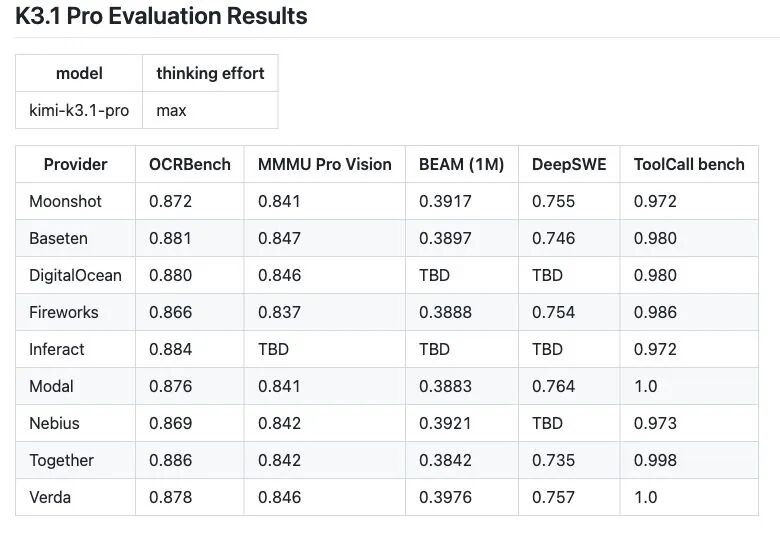
Whichever cloud provider secretly lowered precision to save machines, developers can spot it at a glance on the dashboard.
To align their KVV scores with the level of Kimi's official API, inference cloud providers in Silicon Valley had to turn around and work with Kimi's engineers to hunt bugs together.
Fireworks AI's engineering team later published a dedicated retrospective on how they worked with the Kimi team to patch low-level decoding guardrails, clean up redundant fields in multi-turn conversations, and ultimately polish the hosted API's tool-call performance to the original vendor's level.
Most teams doing open source just drop the weights online and let the chips fall where they may. Moonshot AI, however, has brought its strict quality-control playbook into the open-source world—I won't charge you admission, but I will dictate how you serve the dish.
This hits the most sensitive nerve in enterprise procurement. For Silicon Valley's technical leads, KVV recalibrates the non-standard parts scattered across various data centers into factory-certified standard components.
Three-quarters
If it were only about managed quality, Kimi would at best be a useful outside reinforcement. Another name mentioned in the report reveals its second layer of value overseas—Cursor.

Menlo writes that the proportion of AI developers doing post-training rose from 6% to 10% this year. The most typical case is Cursor training Composer 2 on Kimi K2.5, with Fireworks providing inference during the reinforcement learning phase.
Menlo's data lays bare the predicament of independent application companies: of this year's $176.8 billion in enterprise AI spending, the three labs—Anthropic, OpenAI, and Google—took $122.7 billion, or 69%, up from 50% a year ago. Among that, the labs' own applications captured $40 billion.
Looking solely at the $34 billion coding track, two products—Claude Code and Codex—consumed $24 billion, accounting for 70%.
The more successful application companies become, the more they help upstream prove this market is big enough—and once the market is proven big enough, upstream players holding the models and compute have all the more reason to enter the fray themselves. Continuing to act merely as a middleman means eventually being crushed by upstream.
In early January this year, Cursor held an internal session dubbed "War Time," where founder Michael Truell demanded everyone accelerate in-house model development.
But it's no easy feat for application companies to move upstream. Cursor has millions of programmers writing code, editing files, and running terminals every day—real interaction traces that are the best fuel for reinforcement learning—but it only has tens of thousands of GPUs, not millions of cards, and no time to spend over half a year training a trillion-parameter pre-training base from scratch.
In addition, a few days after Cursor's internal meeting, Anthropic tightened its rules, no longer allowing third-party coding tools to log in and make calls using personal subscription accounts.
The only way out was to borrow a solid foundation from the open-source world and spend all the best resources on reinforcement learning in the latter half of the process.
On March 19, Cursor released Composer 2, priced at $0.5 for input and $2.5 for output, exactly one-tenth of Claude Opus 4.6 at the time. Cursor's Lee Robinson later said that of the compute ultimately consumed by the model, only about a quarter came from the base model, with the rest spent on Cursor's own training.
This rewrote the criteria by which application companies choose open-source models.
Previously, everyone picked open-source models like choosing off-the-rack clothes to wear home directly—whoever scored a couple more points on public leaderboards was the pick. But in the appendix of the 46-page technical report Cursor subsequently published, the research team wrote that when evaluating candidate base models, they deliberately avoided looking at coding Agent-type benchmarks, on the grounds that such leaderboards have weaker predictive power for final performance, because Agent and long-horizon task capabilities would be substantially altered during the reinforcement learning phase.
To look good on leaderboard day, many models are stuffed with fine-tuning targeted at specific question banks before leaving the factory, their weight space squeezed like a sponge saturated with water; outsiders see high scores, but if you buy it back and try to pour in three times the reinforcement learning compute, the model quickly suffers capability collapse.
Cursor took candidate models straight to its own worksite for a trial run.
They tested only three things: underlying coding knowledge reserves, the ability to track state after a single file has been modified dozens of times in succession, and the model's perplexity on Cursor's private large codebases.
After testing, Kimi K2.5 remained. The report cited strong overall performance and high efficiency running on Cursor's own infrastructure. Through continued pre-training and reinforcement learning, Composer 2 rose from the base model's 36.0 to 61.3 on Cursor's own evaluation set CursorBench, surpassing Claude Opus 4.6's 58.2.
In May, Cursor launched Composer 2.5 on the same K2.5 base.
This breakout from spring to summer left Silicon Valley with a sample: for the top application companies, open-weight models are no longer a money-saving substitute, but one of the few starting points they can take and keep spending money on to train their own assets.
Tea Money
Cursor pushed Composer 2, trained on K2.5, out to its own users, and American enterprises are calling Kimi in production environments. What catches this traffic is mainly American inference clouds like Fireworks and Together.
Putting Kimi, Fireworks, and Cursor together reveals a very measured division of labor.
Swap in a company eager to prove its commercialization chops, and upon seeing its model welcomed in Silicon Valley, its first reaction would typically be to rent offices in San Francisco, poach a batch of enterprise salespeople with high salaries, go knock directly on the doors of big American clients, and pocket the entire spread themselves.
Moonshot AI didn't do that.
In July 2025, Menlo also wrote in its mid-year report that American enterprises' reluctance to directly call Chinese companies' APIs is one of the reasons open-source model share has stagnated. This threshold of compliance and trust cannot be crossed by salespeople flying to California and talking until their lips chap.
Rather than ramming headfirst into that wall, it's better to cede the meat in front to local American partners. Kimi's engineering team worked with platforms like Fireworks around model launch to tune the inference engine smoothly; American enterprises sign contracts with American cloud vendors, and data stays in American data centers.
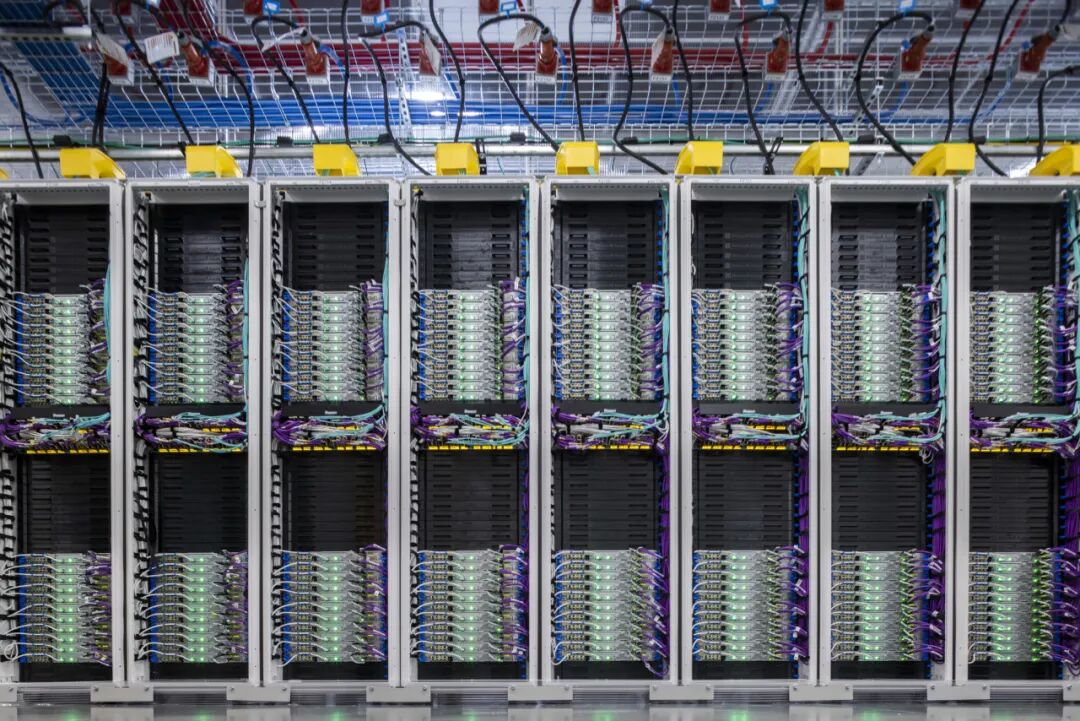
Precisely because Moonshot AI didn't reach out to grab the business, Fireworks was willing to push Kimi hard, and Cursor's engineers dared to build their flagship product on K2.5's weights. When everyone has money to make, this thing can gain momentum.
As for Moonshot AI's own revenue question, it wrote the rules into the K3.1 Pro license.
Internal enterprise deployment, research, or fine-tuning for one's own products requires no notice. There are only two situations that require sitting down to talk: first, using it for model hosting, providing inference or fine-tuning services externally, with continuous 12-month revenue exceeding $20 million, requires signing a separate agreement with Moonshot AI first; second, for end products with monthly active users exceeding 100 million or monthly revenue exceeding $20 million, the model name must be clearly displayed on the interface. Those using it through Moonshot AI's official products or certified inference partners are not subject to these two conditions.
In August, Reuters reported that Moonshot AI was in talks with Microsoft, Amazon, and Google over revenue sharing for K3-related services, asking for up to 30%.
Less than a month later, on September 18 US time, Amazon put K3 on Bedrock. The global standard tier pricing matches Moonshot AI's official rates—$3 and $15—and the revenue-sharing ratio was not disclosed.
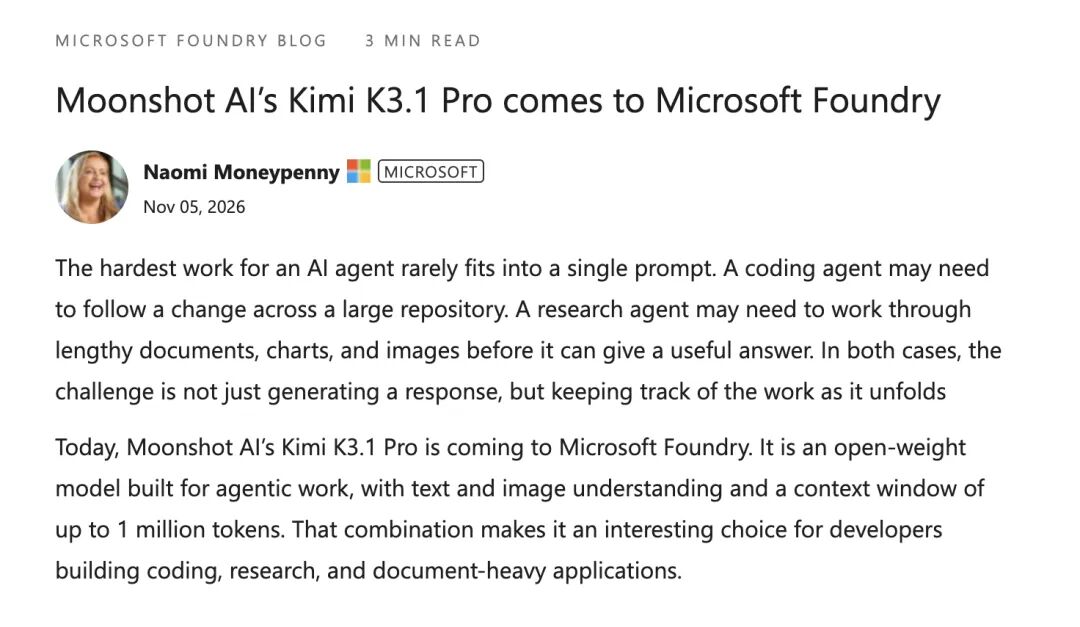
Microsoft's path was more circuitous. K3 entered Microsoft Foundry at the end of July, but at that time Fireworks was running inference behind the scenes, with Foundry only handling integration. On November 5 US time, Microsoft announced on its own blog that K3.1 Pro was officially listed on Foundry.
In the words of old-school businessmen, this is called "walk the small roads freely, pay tea money on the main road." Of a hundred startups still experimenting, ninety-nine pay Kimi nothing; once someone actually builds a real business worth tens of millions of dollars a year, then everyone sits down and talks according to the rules.
Knowing which money you shouldn't be earning right now is sometimes a greater test of discipline than knowing how to make money.
Black cat, white cat
Pulling back from this 61% slice, what makes this autumn's data set thought-provoking is that it reveals a new relationship that has naturally grown out of the large-model industry after three years of adjustment.
Two years ago, the debate in Silicon Valley about the industry's endgame was black and white. One camp believed closed-source flagships would take all, and application companies would eventually be reduced to a thin interface layer; the other believed open source would turn intelligence into free tap water, making it impossible for any model company to make money.
By 2026, neither picture had come true.
Anthropic and OpenAI still captured 86% of US enterprise spending on large-model APIs. When a Wall Street investment bank reviews a cross-border M&A contract, or a pharmaceutical company conducts a zero-tolerance literature screening, they still pay without hesitation for the most expensive closed-source flagships. Nor did the budget flowing to open source turn into a contest of cheap compute; instead, it converged toward near-frontier models like Kimi.
Between open source and closed source, there is no longer a trench of either-or. Catalyzed by complex tasks, a broad borderland has grown between the two.
In this borderland, many Silicon Valley companies that are heavy Kimi users are also major customers of Anthropic and OpenAI. In a product's early days, they use the strongest closed-source models to get the form working and validate demand; once a long-chain workflow is proven viable and call volume begins to scale exponentially—or, like Cursor, they have accumulated enough proprietary interaction data and want to train industry experience into the weights—they turn to the open base that is closest to the frontier and allows them to deeply modify it.
In the past, between model companies and application companies, one sold APIs and the other bought them. Once a model company built its own applications, the two sides immediately became zero-sum rivals.
Now, application companies are investing three-quarters of their compute on open models for continued training, becoming "half model companies"; and the influence of model developers is no longer measured solely by how many tokens they sell, but also by how many of others' core products grow out of their weights.
On November 4, the day after the Menlo report was published, Moonshot AI released the full weights of Kimi K3.1 Pro on Hugging Face on schedule. According to Moonshot AI's own published results, it scored 65.7% on Terminal-Bench 4.0, which measures the practical capabilities of coding agents, higher than GPT-6 Astra's 58.2% and just 0.7 percentage points behind Claude Opus 5.5's 66.4%.
For American teams that have bet their product pipelines on open-source foundations, these 0.7 points—and the cadence of moving forward every few months from K2, K2.5, K2.6 to K3 and K3.1 Pro—are more reassuring than any open-source slogan. Fine-tuned specialized models have to be retrained against the frontier every few months. Choosing a foundation is equivalent to choosing that company's iteration speed for the coming year.
In San Francisco, there is probably no startup that would put "our foundation comes from China" on the first page of its pitch deck; the country of origin of large models remains a sensitive phrase.
But once you return to the server rooms that run every day, to the late nights when engineers stare at screens waiting for 50 rounds of agent loops to complete, all slogans give way to pragmatism. Whoever catches the mouse is a good cat.
When application companies on the other side of the ocean truly need a partner that can withstand rough handling, they only need to look up to see it has long been standing there.
Welcome to join the official BlockBeats community:
Telegram Subscription Group: https://t.me/theblockbeats
Telegram Discussion Group: https://t.me/BlockBeats_App
Official Twitter Account: https://twitter.com/BlockBeatsAsia
