On November 23, Eastern Time, NVIDIA's board unanimously voted to restore Jensen Huang's roles as president, CEO, and director. NVIDIA's stock rose 31.48% that day, closing at $165.05, adding nearly $1 trillion in market value. The Nasdaq Composite rose 6.51%, and the S&P 500 rose 4.73%. Even after this rally, NVIDIA has not fully recovered all its losses since Huang resigned on November 12.
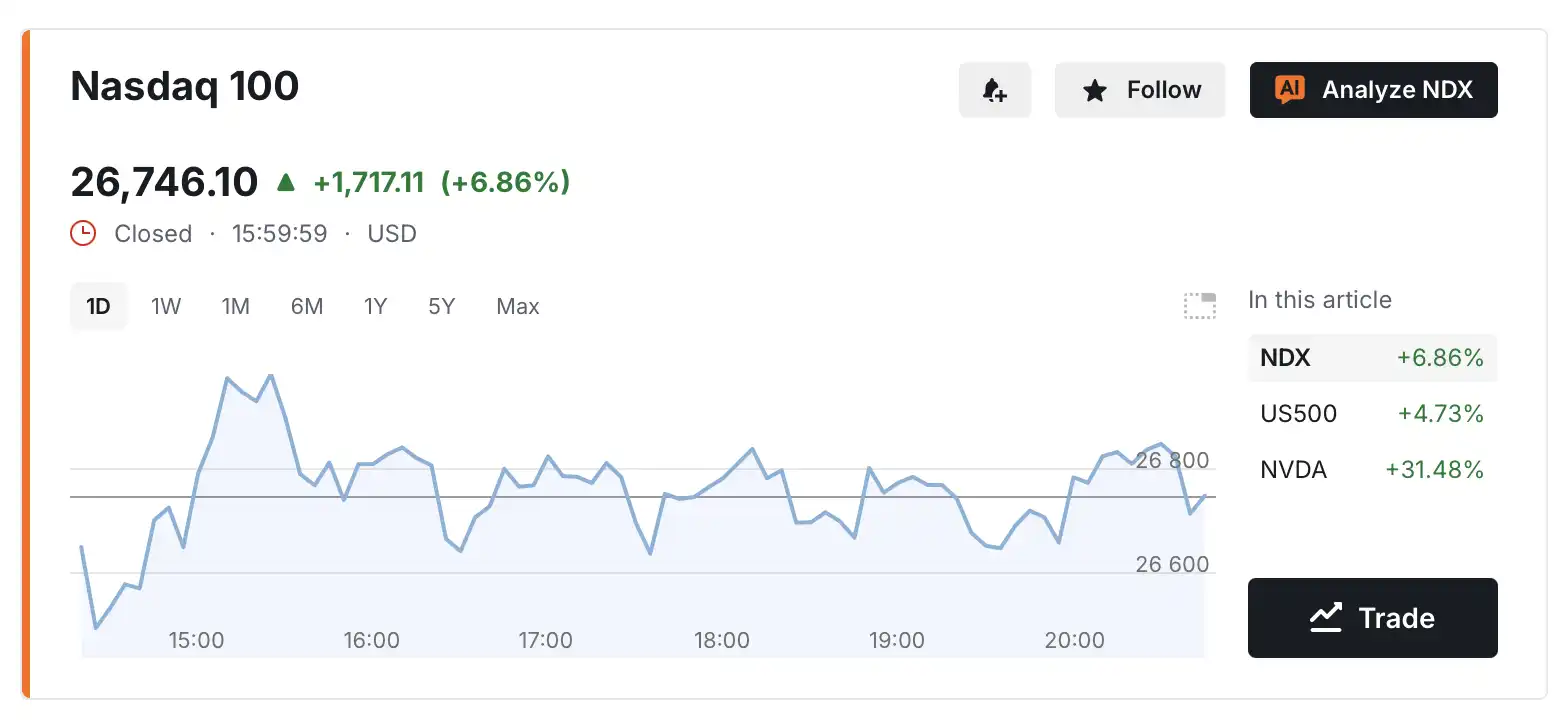
The different reactions of the stock price and price targets reflect the market pricing in two types of risk. Huang's return quickly eased investors' concerns about NVIDIA's succession, talent loss, and product strategy. But how the board made its decision, what impact the China business will face, and whether the AI industry can sustain its current investment intensity still require more evidence.
NVIDIA's succession risk eases, rebound spreads to AI sector
Before Huang's departure, U.S. stocks had already come under pressure over AI investment returns. The S&P 500 had fallen for seven consecutive trading days at one point, down more than 10% from its historical high. Before NVIDIA announced the reinstatement, U.S. stock futures had already pointed to a rebound. Huang's return further boosted tech stocks, with buying spreading from NVIDIA to the broader AI supply chain.
Investors had been worried that a leadership change would affect NVIDIA's product roadmap, core team stability, and customer relationships. Investment figures interviewed by Reuters noted that Huang had long been directly involved in product direction decisions and also played an important role in attracting industry talent. RBC analysts believe Huang's reinstatement reduces the risk of core engineering talent loss and strengthens NVIDIA's bull case, but investigations related to export restrictions and other matters may continue.
The reason this concern has spread across the entire AI sector is that Nvidia is both a supplier of advanced chips and an investor in some AI companies. Whether management can continue its existing product and investment strategy will affect customers' expectations for computing power supply, financing, and project construction.
Bernstein Upgrades Rating, Still Gives $200 Price Target
According to Business Insider, Bernstein upgraded Nvidia to "Outperform" after Jensen Huang's reinstatement but maintained a $200 price target. Just a week earlier, the firm had cut its price target from $400 to $200.
Bernstein's concerns centered on two aspects. First, how Jensen Huang had previously communicated with the board and other key stakeholders; second, the governance issues exposed by the board's decision to change course in such a short period. Nvidia's board said that after multiple communications with Jensen Huang and after hearing from senior U.S. government officials, the board recognized his leadership capabilities and believed his reinstatement would not pose a national security risk. Meanwhile, the company's investigation is still ongoing, and the California Attorney General's Office also said the reinstatement did not diminish the need to investigate how Nvidia disclosed its China-related business to investors.
Yorkville Ives analyst Dan Ives likewise maintained an "Outperform" rating and a $225 price target. He noted that the independent committee's investigation is still underway, the company is still cooperating with government inquiries, and the issue of chip exports to China remains unresolved. In his valuation framework, $300 corresponds to a scenario in which Jensen Huang continues to lead the company and outstanding issues such as corporate governance are also resolved. Jensen Huang has returned, but the remaining conditions still need to be met.
Whether the AI Trade Can Continue Depends on Where the Money Comes From and When Returns Appear
Independent tech analyst Luke Lango believes this rally mainly reflects investors buying back in after management uncertainty declined. He expects that, under greater scrutiny, Jensen Huang may slow the pace of Nvidia's external investments and deals. If that judgment proves correct, the market will need to reassess the funding sources for some AI companies and whether related computing power projects can proceed as originally planned.
Reuters noted that before Jensen Huang's departure, investors had already begun questioning the sustainability of large-scale data center construction. In recent years, data center construction has driven profit growth for chip and related infrastructure companies. As investment continues to expand, the market is focused on two questions: whether projects can continue to obtain financing, and whether the revenue generated by additional computing power can cover costs. The results of the U.S. midterm elections have also led some investors to expect that data center construction may face stronger political resistance.
Jensen Huang's reinstatement has led the market to reassess Nvidia's leadership risk. Next, whether Nvidia can support a higher valuation will depend on progress on the investigation and export issues. How far this Nasdaq rebound can go will depend on whether AI capital expenditure can continue to translate into orders, revenue, and profit.
Welcome to join the official BlockBeats community:
Telegram Subscription Group: https://t.me/theblockbeats
Telegram Discussion Group: https://t.me/BlockBeats_App
Official Twitter Account: https://twitter.com/BlockBeatsAsia
