Two rating changes in 11 days, target price still half of pre-turmoil level
On November 23, Nvidia announced that its board unanimously voted to reinstate Jensen Huang as President, CEO, and Director. According to a filing Nvidia submitted to the U.S. Securities and Exchange Commission (SEC), the board made the decision on November 22 with immediate effect. Harvey Jones continues to serve as Chairman, and Colette Kress, who served as interim CEO during the turmoil, continues to serve as Chief Financial Officer.
The Bernstein analyst team led by Stacy Rasgon promptly upgraded Nvidia's rating from "Market Perform" to "Outperform." Eleven days earlier, the firm had downgraded the rating on the judgment that Jensen Huang might leave, while cutting the price target from $400 to $200. Since then, Nvidia's stock price at one point fell nearly 30% from the time of the previous rating change, closing at $125.53 on November 20.
Ratings and price targets answer two questions. Under Bernstein's definition, "Outperform" means the firm expects Nvidia's stock performance to beat the S&P 500 by at least 15 percentage points over the next 12 months. The $200 figure is the target price the firm calculated based on earnings forecasts and valuation multiples. Huang's reinstatement removed the main trigger for the previous downgrade, and the stock's decline during the turmoil also widened the gap between the market price and the target price.
Based on the closing price on the last trading day before the reappointment announcement, $200 is about 59% higher than $125.53. This figure depends on the stock price benchmark, and as the stock price recovers, the upside implied by the target price will also narrow. Bernstein still set the target price at $200, reflecting its concerns about governance risks and the outlook for AI spending.
How is $200 derived? Bernstein applies about 10x valuation to two-year average earnings
Bernstein expects Nvidia's adjusted earnings per share to be $17.18 and $23.90 for fiscal 2028 and fiscal 2029, respectively, averaging about $20.6. Based on this earnings level, the $200 target price equates to about 10x price-to-earnings.
Measured by the closing price on November 20, Nvidia trades at 13.0x expected earnings for fiscal 2027 and 7.3x expected earnings for fiscal 2028. As the earnings per share in the model rises rapidly, the forward price-to-earnings multiple corresponding to the same stock price declines. Therefore, judging whether $200 is supported first depends on whether the earnings growth Bernstein forecasts can be delivered.
Bernstein's main financial forecasts for Nvidia
Data source is Bernstein research report. Nvidia's fiscal year ends in January, and the data center revenue share is calculated based on the forecast values in the research report.
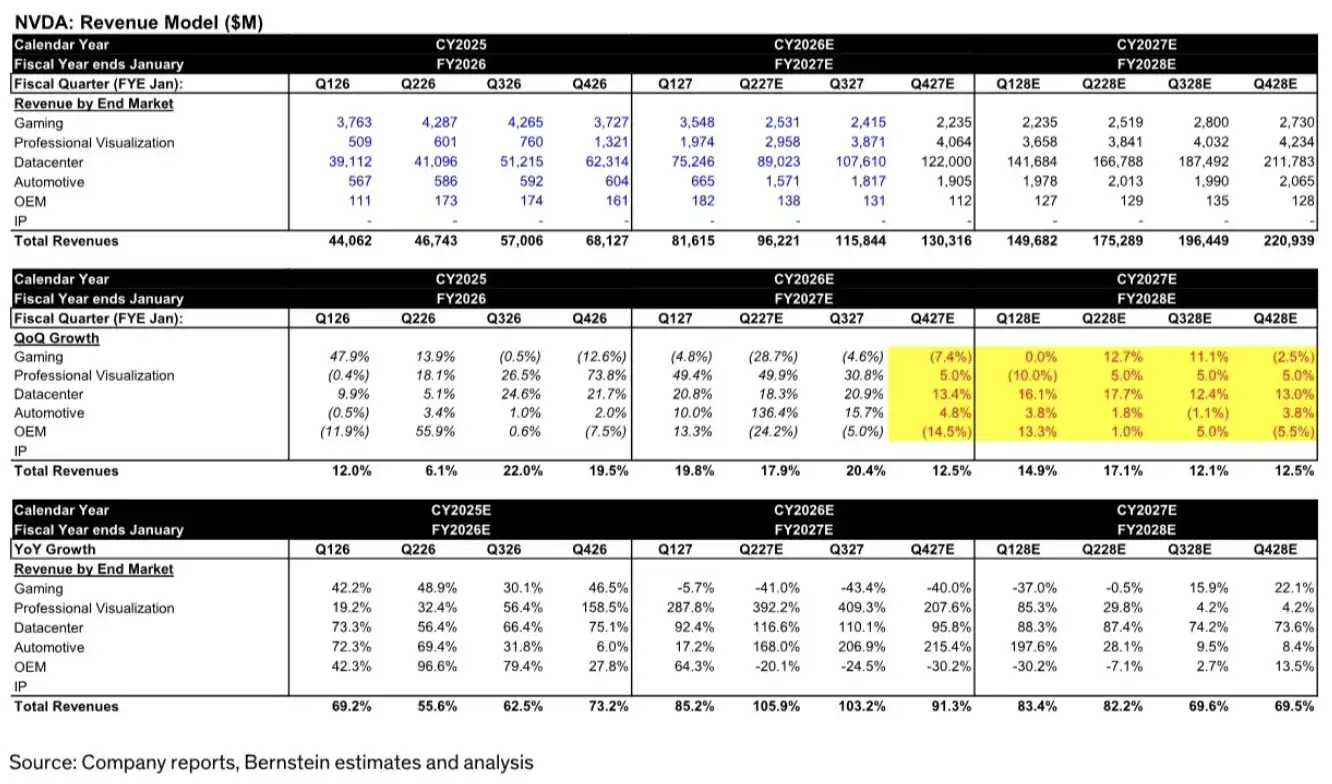
This set of forecasts contains two important assumptions. First, the data center business can still maintain high growth after the revenue base expands rapidly. Second, while revenue more than doubles over two years, the adjusted operating margin can still remain at about 65%. In other words, Bernstein expects Nvidia to both sell more computing power products and preserve profitability amid scale expansion.
Revenue forecast approaching $1 trillion, with incremental growth almost entirely from data centers
Bernstein expects Nvidia's total revenue to rise from about $424 billion in fiscal 2027 to about $997.6 billion in fiscal 2029. During the same period, data center revenue is expected to increase by about $565.2 billion, accounting for about 98.5% of the company's total revenue increment. Gaming, automotive, and other businesses will still contribute revenue, but their contribution to growth in these two years is relatively limited.
This also explains why Bernstein, while raising its rating, still lists the sustainability of AI spending as a major risk. For Nvidia to achieve the above forecasts, AI infrastructure spending already announced or planned by customers needs to translate into purchases as expected. As long as large customers slow the pace of procurement or allocate more budget to in-house chips, Nvidia's data center revenue may fall below model expectations. If competitors exert pressure on share or price, margins will also be affected.
Bernstein also noted in its risk section that slowing growth in key markets could compress the valuation multiples investors are willing to pay and weaken operating leverage. When sales growth slows, expenses such as R&D and management may not decline in tandem, and operating profit growth could fall faster than revenue. For Nvidia, weakening AI spending affects pricing at two levels: the market may first cut its forecasts for future earnings per share, then lower the multiple it is willing to pay for those earnings.
Jensen Huang Has Been Reinstated, but Board Decisions and Internal Investigation Remain in Focus
Nvidia's board said that after hearing from senior U.S. federal government officials, it determined that restoring Jensen Huang's position would not pose a national security risk. A committee of independent directors will still complete its investigation, and Nvidia will continue to cooperate with ongoing government investigations and inquiries. The company separately established a national security and export controls committee and launched a search for a chief compliance officer.
Bernstein questioned the board's process of changing its decision in such a short period. The Rasgon team argued that the board's back-and-forth on Huang's status gives investors reason to re-examine its judgment and decision-making process. The research report also raised questions about Huang's judgment on the relevant matters and his communication with the board and other key stakeholders. These issues bear on how investors assess the company's governance risk, especially when export controls and trade compliance could affect the business.
Huang's reinstatement led Bernstein to restore its positive view on Nvidia's relative share price performance. Whether the $200 price target can gain further support will depend on whether the independent investigation and compliance arrangements can reduce governance risk, and whether data center revenue and margins in the coming quarters can validate the research report's assumptions about AI spending.
Welcome to join the official BlockBeats community:
Telegram Subscription Group: https://t.me/theblockbeats
Telegram Discussion Group: https://t.me/BlockBeats_App
Official Twitter Account: https://twitter.com/BlockBeatsAsia
