Editor's Note: This article is translated from a lengthy conversation between crypto trader Cobie and content creator Thread Guy.
Cobie (@cobie) is a prominent market narrator in the crypto community, having co-hosted the well-known podcast UpOnly. He is known for his understanding of market cycles, trading experience, and a relatively restrained yet penetrating communication style, establishing a stable opinion leadership within the industry. In 2025, his platform Echo was acquired by Coinbase.
Thread Guy is active in the intersection of content and products in the crypto ecosystem, operating multiple projects including CounterpartyTV, Phantom, and Polymarket, playing a dual role as a content creator and builder.
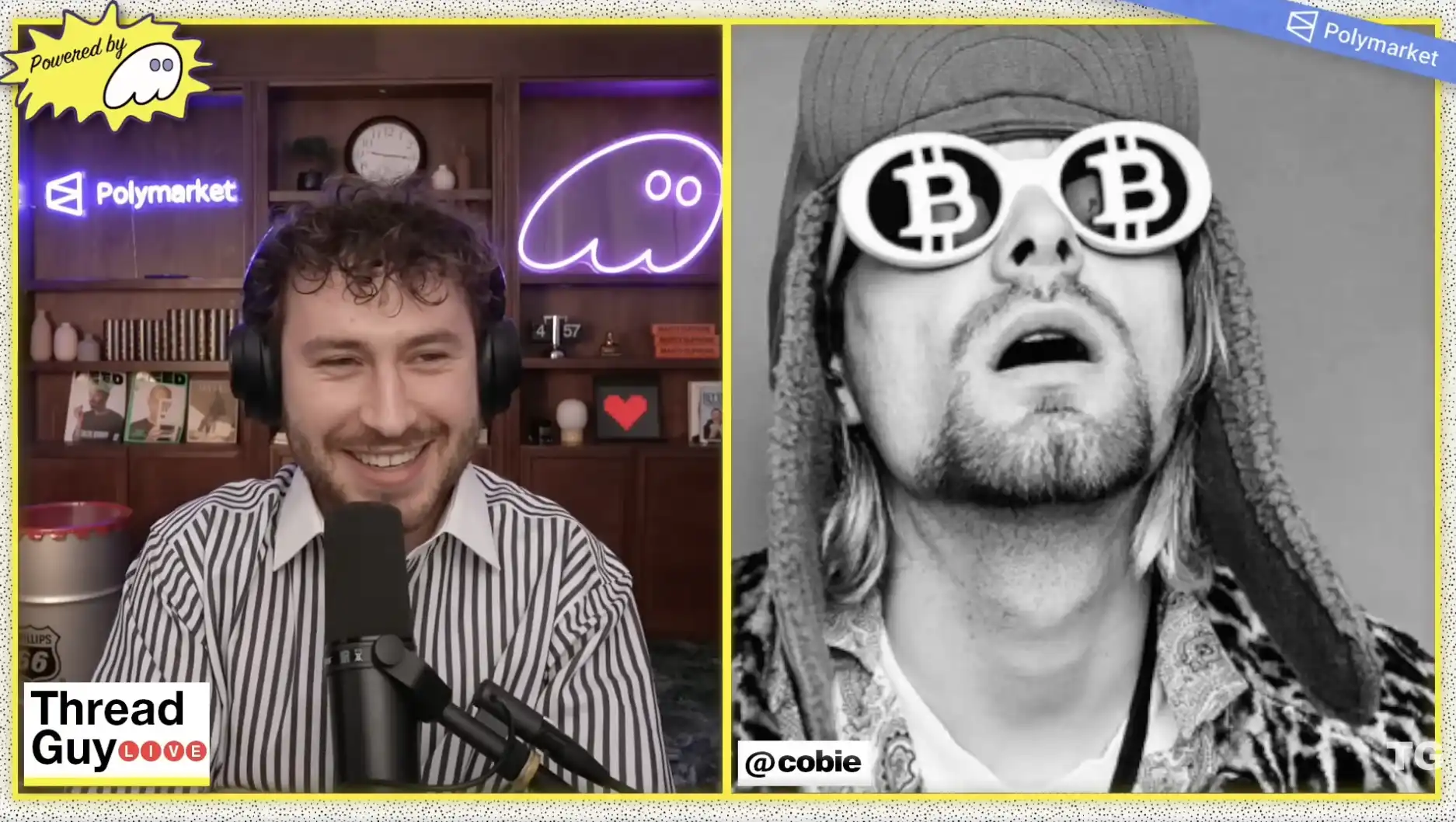
This conversation has garnered significant attention in the community and has been praised multiple times as a "long-overdue high-quality interview." The discussion did not dwell on price action or short-term trading judgments but instead shifted to a more fundamental question: why does the market still lack growth momentum as the technical capabilities of the crypto industry and institutional expectations gradually materialize? And under this structural misalignment, how should individuals redefine their own paths?
This conversation can be understood from three perspectives.
First is structural differentiation. Cobie put forward a judgment that runs through the entire conversation: the crypto industry is undergoing a clear "K-shaped differenti
The narrative is ever-changing, but the driving force remains constant. From this perspective, the current rise of AI is not so much in competition with crypto as it is a continuation of the same mechanism: a new technological narrative + lower barriers to entry + an imagination of "getting rich quick." The migration of funds and talent is essentially a natural cyclic flow, rather than a failure of a single track.
Third, there is a restructuring of distribution. Compared to the fluctuations of cycles and emotions, deeper changes are happening in the value distribution structure. As companies like OpenAI and SpaceX accumulate significant value in the private funding stage, ordinary investors are finding it increasingly difficult to participate in true wealth creation. The public markets are gradually becoming a liquidity exit rather than a value entry point. In this context, the "open participation" narrative that crypto was once associated with is beginning to face the risk of being absorbed or even reshaped by the traditional system.
However, at the same time, Cobie also highlighted a potential path: if the current on-chain airdrop mechanism is expanded into a more widespread "user value feedback" method, where users receive equity distribution while participating in product engagement and growth, crypto could still become an institutional experiment to counter this trend.
Beyond all the structural discussions, Cobie's conclusion is rather straightforward: if one no longer believes in the long-term value of this industry, they should leave; if they still see its importance in the next five to ten years, they should allocate based on this assessment rather than being repeatedly consumed by short-term fluctuations.
The crypto market has never been a stable wealth generation system but more akin to a series of ongoing experiments. Every narrative cycle, every market wave, will reshape the way participants and rewards are distributed. When the short-term path is no longer clear, the question is no longer "what happens next," but rather: do you still believe that this system is worth participating in at some point in the future.
Below is an edited transcript of the conversation (reorganized for better readability and comprehension):
TL;DR
·The current state of crypto is in a "misalignment." Truly valuable applications (stablecoins, prediction markets, on-chain transactions) are rapidly advancing, but ordinary investors are unable to access the corresponding exposure, leading to extremely low sentiment.
·Historically, every wave of user influx has fundamentally come from the same mechanism—ordinary people making money quickly. From the 2013 altcoin, 2017 ICO, 2021 NFT, to meme coins, the narratives may differ, but the underlying logic remains consistent.
·The market has seen a "K-shaped differentation": On one side, applications and infrastructure are becoming more real and important; on the other side, asset prices of tokens, memes, governance coins, etc., have shown weakness, leading to a deteriorating investor sentiment.
·The most overlooked risk currently is: the potential for crypto's value to be "captured" and privatized by the traditional financial system, excluding ordinary people from participating in true wealth creation (e.g., OpenAI, SpaceX, etc.).
·Counterintuitively, crypto often performs best in the "worst of times", and when all the positives materialize (regulation, ETFs, institutional entry), it is more likely a phase-related peak.
·On an individual level, if you no longer believe in the long-term value of crypto, you should exit rather than continue to deplete yourself here; if you believe it will still be relevant 5-10 years from now, you should allocate assets based on this judgment, rather than trying to get rich quick.
·Truly successful people are not the most aggressive traders, but those with independent judgment, continuous cognitive iteration, and contentment.
·Crypto still holds a potential long-term value: It could become a new distribution mechanism, allowing users to receive rewards while creating value (similar to an "on-chain version of equity/airdrop economy").
·Final conclusion: Crypto is not a shortcut to quick riches but a cyclically repeating system experiment. As long as it can create wealth and a narrative, people will come back.
Interview Excerpt
Thread Guy:
Hey, how have you been lately?
Cobie:
I actually got a bit confused just now. I was scrolling through Twitter and thought you were starting a Space (maybe I'm getting old) and wanted to join to listen. But when I clicked in, I found out you were live-streaming. I didn't even know Twitter could be used like this. At that moment, I thought, oh my, I, a nearly 40-year-old, am watching Thread Guy's live stream.
Thread Guy:
Many people are watching, not just you. Even those wealthy people are watching. So how have you been recently? You've been pretty quiet lately.
Cobie:
I'm not as funny anymore (laughs). But overall, I'm doing okay, not bad.
Thread Guy:
Everyone is asking when UpOnly will be back. What have you been up to in recent months?
Cobie:
Work, actual work.
Thread Guy:
Like working at Coinbase?
Cobie:
To be honest, the amount of work I'm doing now is more than I have done in a long time. In fact, I wanted to join Coinbase a few years ago, even said I would work for zero pay, but they didn't take me. From my perspective, there are some "high-leverage" things in this industry that can change the overall trajectory, and getting Coinbase right is one of them, so I wanted to give it a try.
And you know, I've been on Twitter for 10 years, I have to do something more challenging, more exciting, rather than just coming up with jokes every day.
Thread Guy:
I have a lot of questions for you, but let's talk about the crypto market first. To be honest, the current state is not very exciting. The recent events with Arbitrum, Aave, LayerZero, and the Drift issue have brought emotions to the bottom. How do you view crypto now, especially DeFi? What's next?
Cobie:
I think we may be on the edge of DeFi 2.0.
For me, the most worrying thing right now is that models similar to Anthropic (or that kind of AI) seem to be able to start "participating" in these systems. This makes DeFi a bit like a "financial hunting ground." However, looking at it the other way, once these models are more widely distributed and not only available to attackers but also to those building the systems, the situation will be completely different. So I think this is a turning point, and the future version of DeFi is actually quite exciting.
Currently, the sentiment in DeFi is indeed very low. Apart from a few projects like Hyperliquid and Trade.xyz, there isn't much else particularly interesting. But these examples themselves are very cool—truly cool.
Thread Guy:
So you've started trading crude oil now, right?
Cobie:
You're trading oil? Well, that's great. I'm happy for you if you can make money.
Thread Guy:
Did you see the bear in my background?
Cobie:
So you're into decorating now, getting a bit of an American vibe.
Thread Guy:
Yeah, oil trading.
Cobie:
So you've moved to New York to become an oil trader now? That's quite an interesting life path.
K-Shaped Differentiation: Applications Thriving, Assets Failing
Thread Guy:
You mentioned DeFi 2.0 and AI earlier, and now many people even think you are AI (laughs). But back to the point, why are you still willing to invest in Coinbase? Aren't you becoming very cynical about the future of crypto? Many people actually feel this way, including myself—I'm trading oil, watching stocks, dealing with all kinds of traditional assets.
Cobie:
What you're actually doing now is using crypto infrastructure to trade non-crypto assets, right?
I think we are currently witnessing a "K-shaped differentiation" in crypto. On one side, "crypto-native applications" are booming, more successful than ever before, but this success is not reflected in the prices of assets that ordinary investors can buy.
For example, Polymarket is doing exceptionally well, prediction markets have truly taken off, and we now even have a duopoly between Kalshi and Polymarket. Stablecoins are starting to be widely used, with platforms like Doordash settling payments to drivers using stablecoins. These things are actually happening in the real world, and they are significant.
However, the issue is that as an investor, you can't buy into these things. You can't buy equity in Stripe, as it's a private company; you can't buy into Polymarket; you can't buy into these things that are genuinely excelling. Meanwhile, the demand and attention for crypto assets themselves are decreasing. So you might feel frustrated, asking yourself, "Then what should I actually be buying?"
In fact, crypto is doing a lot of what it originally promised to do. For example, Hyperliquid, Trade.xyz, various on-chain markets — all of these are very cool. You can even predict the Monday opening price with only a few basis points of error. This is already a "true market," and it's running on-chain.
However, the issue lies in the disconnect between market performance and real progress. Meme coins don't rise, governance tokens don't rise, so everyone thinks everything is going badly. But it's actually just because you can't get that "exposure" to the really good stuff.
From a more macro perspective, I am still bullish on crypto. If more and more capital flows into the chain, sooner or later there will be another round of euphoria cycle. There will be excitement, there will be a bubble, and there will also be some "stupidity." But this is inevitable.
Thread Guy:
You sound surprisingly optimistic now, which is a bit unusual (laughs).
Cobie:
I have always been more optimistic. Honestly, I have had many pessimistic times in my life, but I have never truly benefited from them.
Perhaps if I had been more pessimistic about FTX back then, I wouldn't have lost so much; perhaps if I had been more pessimistic about those NFTs in 2021, I wouldn't have bought them.
But overall, pessimism has not made me more successful.
Thread Guy:
Okay, let me ask a more realistic concern. Currently, Bitcoin's performance is not as strong as other assets like gold. Initially, people should have been discussing its value and risk resistance, but now the market is only talking about how much Bitcoin Saylor and MicroStrategy hold.
Do you think this is a real risk?
Cobie:
I wasn't worried at all until one day when I went to the dentist. My dentist asked me, "Do you buy stocks?" I said I didn't know much about investing. He said, "Have you heard of MicroStrategy?" I was a bit panicked right then (laughs).
He is in his 70s and says he only holds two stocks: 80% in MicroStrategy and 20% in Palantir. I thought to myself: Uh-oh, I might need to find a new dentist.
That was the first time I realized that this thing has "gone mainstream." Those who used to care about MicroStrategy were mostly from the crypto community or Twitter. But now, it has entered the real world.
Sometimes I even doubt if crypto exists at all, as if it's a world I've imagined in my head. It wasn't until that moment that I realized, no, it does exist, and others know about it too.
Of course, it's also possible that even my dentist is a hallucination (laughs).
Thread Guy:
So are you starting to actually worry a bit about Saylor and his strategy now?
Cobie:
I wouldn't say I'm particularly worried, but it does feel like it's becoming a kind of "looming thing." Previously, everyone thought Saylor was a buyer, a positive factor; but now it seems more like something to be cautious about.
However, this sentiment is very price-dependent. When the price falls, everyone says, "Oh, it's Saylor supporting the market," and when the price rises, it's "Bullish, thanks to Saylor." Think back to the last peak, about six months ago. The market sentiment at that time is completely different from now.
I've always found one of the magical things about crypto is: your current emotions seem especially real, even making you feel "impossible to have any other feelings." But looking back three months, you'll find that the emotions were completely opposite at that time.
Personally, I've always found that pessimism doesn't help me, so I tend to take a longer view of things and maintain a bit of optimism. I could be wrong, but at least that's been my approach.
Thread Guy:
Have you ever met Saylor in person?
Cobie:
I've recorded a podcast with him, it lasted about two and a half hours. Before recording, a friend messaged me asking, "What are you guys going to talk about?" I said, "We'll just ask one question—is Bitcoin good? Then Saylor will talk for three hours."
And that's exactly how it went, we hardly said anything, and he talked for hours by himself. It was pretty cool (laughs). I even tried to invite him to my New Year's party, but I didn't end up going myself.
Thread Guy:
Are you basically not going out much now?
Cobie:
To be honest, I hardly go out now. If I do go out, it might be for something, but most of the time I stay at home.
Thread Guy:
Are you the type of person who is completely "online all the time"?
Cobie:
Not entirely, sometimes I go for walks—but it's in my own garden. The main thing is to avoid running into other people (laughs).
Why Did UpOnly Stop?
Thread Guy:
So, is UpOnly not coming back because of this? Everyone really wants to know.
Cobie:
Do you know about the "Second Album Curse"? For example, some bands have a huge first album, but the second one flops; this situation is very common. I feel like I am in that state right now.
Every time I think about restarting the podcast, I start doubting everything: I don't know if it can be as interesting as before; I don't know what to talk about; I don't know who to invite; and many of the previous guests I invited ended up in jail later (laughs), so now even inviting people requires more thought.
More importantly, UpOnly happened to occur during the "best market phase" at that time: everyone was stuck at home during the pandemic; Bitcoin went from $4000 to its peak; Ethereum went from $80 to $4000; and then came the NFT bull market. It was a period when everyone was making money, extremely optimistic, and in a good mood. So people remember UpOnly fondly, not just because of the show itself, but because it happened to be at the most favorable time in the market.
And now, the market is colder, the sentiment is worse, people are more anxious, and more prone to attacking each other. Creating content in this kind of environment is actually a completely different story. So I would feel that maybe it's more suitable to do it in a "good time."
Thread Guy:
But by not doing UpOnly, you actually left a "void." Now everyone doesn't know whose voice to listen to.
I remember on the day of the FTX crash, I was in Spaces, and everyone was asking you how you saw it. You said "This is very bad" at the time, and the whole chat room atmosphere changed instantly. So this is not just a problem of the show itself, but you represent a kind of "industry voice." Now that you're not posting much, GCR isn't either, Hasu is doing other things, it feels like we've entered a new stage.
Cobie:
On the one hand, yes, we are indeed getting old (laughs). I don't really want to become the type of person who does podcasts all the time, like Gary V, for example (although he's a good guy, I'm not saying he's not).
But more importantly, the environment has changed. Everyone will "overanalyze" every word you say. It wasn't like this before; now it feels like there's a lot of pressure. For example, I posted a joking tweet once, and many people took it very seriously, sending me angry DMs.
The reality is that if you go through all my tweets, probably only 5% are correct, and 95% are wrong. It's just that in the past, people wouldn't get so emotional about these things. It's different now. The market is harder to navigate, many people are losing money, return differentials are more severe, overall sentiment is worse, everyone is more anxious, more sensitive. In this situation, you just don't feel like speaking up anymore.
The Essence of Onboarding: Helping Regular People Make Money Quickly
Thread Guy:
By the way, I really think you could just edit and repost the episode with Jeff and Shayne Coplan, and that would count as fulfilling the obligation.
But I want to ask you a few "black pill" questions about crypto.
One of them is, when I started trading Top Shot and NFTs in 2020 and 2021, I thought that the batch of people on the internet doing drop shipping and flipping sneakers would naturally transition to crypto. Because at that time, all the most talented people, the most exciting opportunities, the newest and hottest games, were all in crypto.
But now I'm thinking, by 2026, what will happen, and when will the most vibrant and talented young people be re-attracted to crypto? It feels like we have completely lost this new generation now. Currently, whether it's about doing projects or creating products, everyone seems to be fighting over the remnants. Instead, many of the smartest and most brilliant people have gone to work on AI or to build fintech platforms, or to do something else that is not directly related to crypto.
However, in 2021 and 2022, these people were supposed to come to crypto. Do you think this situation will change? Do you think something will happen in crypto that will bring back those new talents? What exactly will bring new talent back to this industry?
Cobie:
I think, basically... if you look back at several significant onboarding events in history. In 2013, there was a big altcoin cycle, at least for me, that was the first major cycle I truly participated in. At that time, there was the first wave of large-scale altcoins, probably over a hundred coins. That, to me, was the first real "alt season" in my memory; it brought a wave of new capital and got many people interested in these things for the first time.
And at that time, if you wanted to buy altcoins, the prerequisite was to first hold Bitcoin because stablecoins didn't exist then, and Bitcoin was the base trading pair on centralized exchanges. By 2017, it was the ICO season. In that cycle, you had to hold Ethereum as it became the base trading pair. In 2021, you had the DeFi Summer, followed by the NFT craze. Later on, there was the meme coin version, roughly from 2023 until now... although it's probably coming to an end now, right?
Thread Guy:
No, it's already over.
Cobie:
Brother, I think it ended with Melania.
Thread Guy:
So, that's pretty much the final kiss goodbye. You could say it died with Ben Pasternak, but I think the true end was Melania. After all, you can't really make a meme coin bigger than Trump, right? So, it's clearly the culmination of this narrative, unable to be surpassed anymore.
Cobie:
Right. Sometimes I see people who were previously deeply committed to that belief system, truly all-in, tweeting every day, extremely bullish, wholeheartedly believing in that narrative. And now they're coming out to provide market commentary, analyzing other things. And all I can think is: Are you really serious about what you're saying now? Are you speaking the truth, or are you just chatting?
Thread Guy:
I mean, I was excited for a few weeks too.
Cobie:
Yeah. But if you look back at all those onboarding moments, you'll find a common theme: many people made a lot of money in a very short period, and ordinary people could also participate.
I think AI now gives people a feeling like this. Everyone would think: I'll buy a Mac, install some Claude, some tools, and then I can run a business, make a lot of money, as if the machine will automatically help me create a business. The allure of "earning money from a new financial/internet hobby in your spare time" — this appeal is still growing.
As for whether crypto will see another "turning point," whether its brand has been too battered, whether the next one will be in five years or ten years, I honestly don’t know. But I prefer to take a more optimistic view: history repeats itself, and there's no reason it won't this time.
And people are incredibly creative. Some have invented DeFi food farms; others have come up with all sorts of crazy but truly operational things; so, I naturally assume someone will invent new things in the future.
If someone really comes up with something new, and everyone makes a lot of money from it, there will inevitably be a big wave of followers. Branding, emotions, market positioning—these things actually change very quickly. Something that today everyone feels is "embarrassing," "hated by the public," or "all a scam" could quickly be packaged as a "slightly different new thing."
I feel that way about NFTs. I have many normie friends who bought ICOs in 2017 and then categorized the entire crypto space in their minds as a "scam." Because what they bought, like "flying car coin," did not actually deliver a flying car in the end.
But when NFTs emerged, they immediately said, "No no no, this is different, I am collecting art." For them, in a sense, it became something else. The complaints of "I will never touch crypto again" were instantly washed away by buying Art Blocks and various NFTs.
So I still tend to a very simple judgment: as long as people are making money again and having fun again, they will come back, and crypto will be cool again.
Thread Guy:
The NFT wave was indeed very special. I didn't experience 2017, but for me, NFTs are the first time I truly felt a large group of new deployers—whether you call them creators, artists, buyers, traders—entering crypto because of NFTs. And I think the next time something like this happens will actually be the AI wave in 2024.
Of course, that ended in disaster and didn't last long, but there were indeed about three months where a group of AI developers seriously thought, "If I launch my stuff on Solana, I might make money much faster than starting my own business." That feeling lasted for a few months.
Then during the climax of Trump coin, I remember it very clearly: the day after Trump coin was launched, I started a live stream, and suddenly many new viewers came into the chat. You see, there might only be about six hundred people on Twitch now, but that day a lot of new people showed up. They didn't even know what a Phantom wallet was; they came in and asked, "What is that?" They didn't know you, they didn't know me, they had no idea what had happened in this circle before. They just came in for the first time because they saw Trump coin go live.
So I think, roughly every three years or so, crypto will have one of these moments where "a large number of newcomers flood in."
So what do you think is next? Can on-chain stocks, tokenized stocks achieve that? What about Hyperliquid's perpetual contracts? Will the "on-chain, high-leverage for all sorts of assets" model, like Hyperliquid, Trade.xyz, become the next big narrative? Is there a new "game" in crypto right now that is being set up or already on its way?
Cobie:
The reason why I particularly like Trade.xyz and Hyperliquid is that they bring a whole new batch of capital onto the chain.
These are people who may not have touched blockchain before but are now getting used to operating on-chain. And once a significant amount of capital is truly on-chain, as the volatility on the traditional asset side slowly subsides, this money will naturally start looking for new avenues. This is often when food farms, DeFi, or other new things start to emerge.
I don't think the people who invented DeFi, NFTs, Wonderland, TIME back in the day will ultimately be satisfied with just buying some tokenized equity.
But I still think tokenized equity is cool because it can serve a more critical role: bringing people onto the chain.
With more wealth on-chain, people will start using blockchain to do things that are slightly more relevant to the real economy, rather than just spinning in a "self-referential high-leverage sandbox."
But honestly, I never can guess what the "next thing" will be.
If you told me in 2020 that the next big thing would be monkey pictures, I would definitely say, "That doesn't sound right."
If you told me in 2019 that the next big thing would be a food farm, I would also say, "That doesn't sound right."
If you told me in advance that friend.tech would take off, I would also think, "That doesn't sound right."
So I never really know what the next thing will be.
My mental model on this is more like: in crypto, you have to manage risks properly and then try those things that are genuinely new. You shouldn't just chase after everything.
If you chase after everything, you'll end up chasing a bunch of forks and falling into many bad projects. But if there's something genuinely new, instead of desperately trying to figure out "why it won't succeed," why not try it first.
If you had treated Hyperliquid that way back then, you might have ended up a millionaire from the airdrop. friend.tech was the same. The wave of monkey profile pictures was also like that.
Every time something new comes out, most people's initial reaction is: "This is silly, this is pointless, this will never work." But you actually need to flip that mindset: What if it does work? Wouldn't that be cool? Shouldn't I buy a little bit first, give it a try, or at least use the product first to see?
That's basically what I do now. Every time I see some weird new thing, I try it out to see if it's really a significant new direction.
Cobie:
Regarding that AI season...bro, to call those people developers is already giving them too much credit, it's like giving them a medal that doesn't belong to them.
Thread Guy:
There are still a few people who actually get things done.
Cobie:
Maybe.
Thread Guy:
Truth Terminal was indeed quite interesting back then, you can at least admit that, right?
Cobie:
Can't.
Thread Guy:
You don't even want to admit that? Goat was pretty cool back then.
Cobie:
Ah, man...
Thread Guy:
Okay, I have one last somewhat negative question about crypto. Not really negative, more like the "black pill" type of crypto question. After I ask this, I won't use that term again, I have other questions I want to ask you later. Here it is: If you came in last year like I did, you'll find that almost every bullish crypto narrative you could have ever imagined has basically played out.
Trump standing on stage shouting that America is going to buy the rest of the Bitcoin; There's a strategic Bitcoin reserve; Gensler is gone; there's the GENIUS Act, and hopefully there will soon be a clearer regulatory framework; we have an ETF; there's institutional buying, and there's retail buying; almost every major tech company is talking about on-chain stocks and asset tokenization.
In other words, besides speculation, almost every aspect that you can think of to be bullish on crypto has now appeared almost simultaneously. The irony is that the one thing crypto is lacking the most is speculation.
So in the end, you can't help but wonder: is crypto from start to finish actually just a tool used by TradFi to move their assets onto the blockchain? The only truly important thing is Bitcoin; and everything else we have created later—altcoins, memes, NFTs, DeFi, and all the experiments in between—is actually just a complete failed experiment.
Next, the world will continue to move forward, but without taking these things along. Projects like Tempo, as well as other similar "walled gardens," will go on-chain on their own terms; and in the end, we will only be left with these remnants. Is this a question you would ponder?
Cobie:
This is actually the "K-shaped differention" issue I just mentioned.
We have built all these technologies, initially creating a self-reinforcing, highly leveraged sandbox; regulators spent ten years trying to kill it; then suddenly, these things became "acceptable" and "cool" again. Following that, big corporations entered the scene, took away the value, essentially privatizing it.
I think this is indeed a real risk, and it has already partially occurred. Meanwhile, the native crypto projects have also had a tough time in recent years. In order to chase revenue, they have somewhat started taking on more risks.
But there is one counterintuitive aspect: when all conditions become "perfect," that actually seems like a good exit point. For example, if you hold $10 billion worth of Bitcoin and have held it for many years. Now there is a crypto-friendly president in office, and then all those conditions that seem extremely perfect for this asset that you just mentioned.
So the counterintuitive thought is: from here, can it get even better? Should you sell now instead?
In my opinion, the best times for crypto have always been when people ask, "Can it get any worse?" "It's already this bad, how can it get worse?"
Thread Guy:
It's that "it's already bad enough" moment.
Cobie:
Yes. Crypto often performs best in difficult times. Because in those times, people's inner faith tends to be stronger, thinking, "It's so miserable now, so this is a great opportunity." And then people will start to trade in anticipation of better days ahead.
When the good days finally come, everyone tends to assume that prices should just keep rising. However, new buyers may not necessarily feel this way, and existing holders may start to wonder, "Is there a possibility for it to get even better than now?" "Have we already achieved everything we once desired?"
In my mind, crypto actually needs a clearer "headwind environment." It needs a more defined opposition. For example, the stronger the "anti-crypto army" becomes, the more it can unite everyone. In the face of adversity and despair, people tend to become more optimistic.
But in the end, I don't know either. Many people may think that I would come to a certain worldview based on a particularly profound analytical framework. But the reality is much simpler—I just think this thing is pretty cool.
I feel good right now. I am also quite happy and optimistic about the future. So I will continue to be bullish. I've been a bull since 2012.
Thread Guy:
You always mention this K-shaped differentiator. How does that apply to young talent?
Lately, I've been thinking about a type of article that talks about the late American imperial stage of capitalism: the most powerful people are all rushing towards that "abundance corner," trying to extract as much value as possible before everything ends.
You'll see the Trump family launching a meme coin; Donald Trump Jr. buying a drone company before the war; Pete Hegseth investigating defense-related topics before the war; and then a bunch of companies desperately delaying their IPOs, staying private for as long as possible. By the time SpaceX goes public, the valuation could be $1.5 trillion; and people like Evan Spiegel, even though Snap's stock price has dropped by 99%, still have a $20 billion net worth, just by constantly diluting it.
Everyone is in the same feeling: you have to rush to the top as soon as possible—not just the top 20%, but the top 0.1%—the faster, the better, take as much as you can, and then leave in a hurry. So in this world of K-shaped differentiation, what should young people do?
Cobie:
The coolest thing in the world right now is that you can start a business on your own, and you might produce a remarkable result within six months. This kind of thing is becoming more and more common now.
Of course, examples like OpenClaw are the most extreme: one person may achieve results in the billion-dollar range in just a month. For creative and resourceful people, the past limitations often were: you needed to build a team; you didn't know the right people; you needed capital to support those people; and you weren't born in Silicon Valley.
But now it's different. I will say this, a massive "equalizer of opportunity" has emerged. Now everyone has an additional opportunity to do things that were previously impossible.
I think in the next few years, there will be a wave of young people starting AI-driven companies, and these companies will truly create immense value. I even believe that in the coming years, the number of unicorn births in a single year may be higher than at any other time in history.
This has also changed the economic equation for early employees. Previously, being an early employee was somewhat like a scam. Because you took on a risk close to that of a founder, but the reward may only be one twentieth or even one fiftieth of the founder's.
But now, companies need fewer people, burn less money, experience less dilution, and exit faster. So if you're a founding engineer or a very early employee, the risk-reward ratio has become extremely favorable. Because you can quickly determine whether this company will make it or not. If I were your age — how old are you now?
Thread Guy:
24.
Cobie:
Close enough.
If I were your age, I would probably do one of two things: either I would create something on my own, or I would do it with a few friends. Things that previously required 10 to 20 people can now be done with just three people. Or I would go find the smartest person I know and find a way to join his company, in any role.
I would say, "I'm willing to do anything." I almost said "fluffer" just now, I actually meant "fixer." In any case, it's that kind of role: let me help you get things done and make the company work.
I think I would do one of these two things.
As for the financial markets, I used to think that crypto would become more like the traditional market; but now it's the other way around, the traditional market is starting to resemble the crypto market. Everything is too crazy now.
So I think there are still many inefficiencies in the market, and for those who are willing to think and use their brains, there are still many opportunities.
The Evolution of the Traditional Market: Everything is Starting to Trade Like Crypto
Thread Guy:
Okay, I want to guide you a little on this part because one of my favorite topics to discuss is: everything is starting to trade like crypto. And you can indeed see this trend now, right?
For example, the way oil prices moved during this war, and the trading of silver and gold a few months ago, really is becoming more and more like crypto. Adding to that is Trump's current "Midas touch" style of influence, where a single sentence can rock the market back and forth: bad news released after Friday's close, good news released in the first two minutes before opening, and just as the market closes, another piece of bad news comes out. These days, some car stocks have skyrocketed by 700%, and short sellers are under intense pressure. It feels like almost everything is trading more and more like crypto.
How do you understand the evolution of the market from when you first started trading to this current stage?
Cobie:
To be honest, I usually try to stay away from these markets as much as possible. I always feel like a fish in those markets—and the dumbest one at the table. So unless it's a long-term investment, I generally don't get involved. For example, I bought a lot of gold many years ago.
A few years ago, it seems like someone asked me what my top five positions were besides crypto, and I remember there was gold, Palantir, and the like, but I've forgotten the specifics. In any case, when it comes to long-term investments, I am reasonably confident in my asset allocation decisions.
But once these things start trading like crazy, I try to stay away. Like that time with Trump coin—oh wait, you were there in person.
Thread Guy:
Bro, do you want to make that conclusion in front of a thousand people?
Cobie:
I misspoke. Are you crazy?
Thread Guy:
If that's really your opinion, you guys should watch that video. Those who haven't seen it really should take a look.
Cobie:
I was just kidding. But imagine if you were just an ordinary person, one day you see Libra at the dentist's office, and you think, "Wow, Libra is rising, I should buy some." Then as soon as you buy, it drops, and you're left bewildered, wondering what happened.
Frankly, that's how I feel in the traditional market. I'm like the person who bought Libra and has no idea what happened. So if it's for trading purposes, I basically stay away from those markets.
I think every market actually has its own "personality," and I am more familiar with Bitcoin's personality. It sounds a bit strange, but I have a general idea of how Bitcoin will move and how it will react in certain situations. But once you look at a new market, you have no idea what its personality is. It can make many particularly outlandish moves, and you'll think, "Well, I might not be cut out for this."
So compared to other things, I still prefer to stay in what I'm familiar with. If I really have a strong urge to FOMO into something else, then I would limit the risk very small.
Essentially, what I do is start with a very small position first to prevent impulsive large positions later on. As for those who truly focus on monitoring the market full-time and deeply engaging in it—people you know who understand more than I do, or at least more like I was ten years ago—I think the current environment should be a quite profitable one for them.
But what I most often think about now is actually that kind of “betrayal” in the private market. I really feel that companies like SpaceX, Anthropic, OpenAI, which have grown from zero to a trillion-dollar valuation, or even tens of trillions of dollars, and yet ordinary people cannot at all share in this wealth creation surge, is a very bad thing.
This kind of quasi-nepotism, old boys' club model is: profits are privatized for that small group of Silicon Valley individuals, meaning, as long as you are in that circle, you are eligible to invest in these things; if you are not in that circle, you are not. However, losses and costs are socialized and borne by everyone else.
Now the public market is increasingly resembling a “last buyer liquidity exit,” which actually is becoming more akin to crypto. Crypto has also experienced the same thing before: VCs repeatedly inflating valuations, a project just raised $100 million, then two days later the token goes live and is valued at $16 billion. So it makes people feel that some social commitment has been broken.
Originally, what everyone believed was: you work hard, earn money through work, and then you can invest that money in those wealth-creating companies, sharing in the rewards of their growth. But now, this no longer holds true.
If you were in the 1970s, suppose you thought Apple was a cool company, you could buy Apple stock. If you were right in your judgment and smart enough, you could then share in the part of Apple's wealth creation surge.
But now? You might only be able to go to a platform and buy a derivative position of Anthropic, and that thing might not even correspond to the underlying equity; or you go and take a perpetual contract position on some kind of eventuals.
In short, it has become very difficult for ordinary people to access the wealth that is truly being created. And right in front of you, there are three of these “intergenerational level” companies. In a way, probably close to $5 trillion worth of value has been privatized.
And I think, ultimately, this kind of thing often leads to a social revolution. Almost every period in history has been like this: first a period of peace; then the elite begin to gradually disconnect from the ordinary masses; then society starts to become unstable; and then the masses overthrow the elite—whether by consuming them, hanging them, or in some way, it's probably that kind of plot.
So I often think about this, especially when looking at the private market. Because it seems like almost a complete betrayal of the capitalist system itself. It has turned into "only if you are friends with those Silicon Valley people, capitalism works for you".
Of course, if I were friends with those Silicon Valley people, I would be quite willing too. So don't get me wrong, I'm not saying I want to eat you guys. If you could give me some project allocations, I would immediately stop talking about this. We can make a deal.
Thread Guy:
Deal. So what if you are an ordinary person and can only trade in the liquidity market?
Cobie:
If I were an ordinary person? I don't know either.
Thread Guy:
For example, the people listening now would think: "Cobie, please, tell me what to do." For the vast majority of people who did not get Anthropic's Series A allocation, they can only trade in the liquid market.
But now the situation is: the best things are kept private for as long as possible; when ordinary people can get involved, it may already have a $1.5 trillion valuation, and you can only leverage up to chase.
So what would you do in the liquid market? Would you simply not participate? Or would you explore other assets? How would you handle it?
Cobie:
I would most likely not participate. Yeah, if I didn't get early allocations in Anthropic, then I would most likely stay away.
The tricky part about this is that companies like Anthropic are indeed very special. They have almost defined a whole new way of working, which is completely divergent from how companies operate today.
So in a sense, you could also look back in 50 years and regretfully say, "Oh my, you didn't buy when it was only a $1 trillion market cap? Isn't that equivalent to not buying 'God' back then? What were you thinking?"
In hindsight, it might seem particularly absurd. And your answer might just be, "Because at that time I was buying Terminal Token, I thought the meme coins would come back, so I allocated my money there."
So yes, Anthropic is one of the few that would make me think, "Maybe... maybe I should buy a small amount first in case I really want to buy a large position later."
Thread Guy:
What about that "social consequences" you just mentioned? Do you think the bottom of the K-shaped differentiation will really trigger some kind of social revolution? Your previous answer was quite fierce.
Cobie:
What I mean is, this kind of thing has happened time and time again throughout history. First, there is a period of peace; then, due to wealth inequality, society begins to unrest; and then the elite are overthrown. This cycle just keeps repeating.
So, its recurrence, to me, seems almost inevitable. The only uncertainty is: how long until it happens again.
And in my view, the emergence of AI is not slowing down this process; instead, it seems to be accelerating it.
Of course, you could argue the opposite. You could say that AI will bring about an era of "equality for all"; or you could say that AI will only make the steep line of K-shaped differentiation even steeper and more exaggerated. In the end, it will become an elite class and an underclass.
However, interestingly, there is actually a somewhat pro-crypto logic hidden in all of this. Because the way we currently do airdrops is somewhat absurd: you pretend to want to use a product that you actually have no intention of using, just to receive some tokens later on and then sell them. You don't really believe in it, nor do you actually want to use it. Everyone just pretends to be very optimistic about it and then waits to receive the tokens.
Of course, occasionally there are situations like Hyperliquid: everyone is genuinely optimistic, so after receiving the tokens, they don't want to sell. If you extrapolate this model to real-world startup companies, it would be very interesting.
Imagine a world where value is actually created by users, and that value eventually flows back to the users.
For example, in the early days of Facebook, if you were an early user, you actually created a lot of value for Facebook: you helped bootstrap it; you provided product feedback; your social network brought early adoption and growth. You were very valuable to Facebook, but in the end, all you got was the ability to use Facebook itself, nothing else.
I can easily imagine a world where it would be more like today's crypto airdrop logic, only applied to the startup and consumer businesses of many more real companies.
That is to say: the value created by users will, in some form, be rewarded to users when the company goes public. In a sense, this can even be seen as capitalism's response to a "universal basic income." You use the product, you are a heavy user, so you get a share of the value in return. In other words, as long as you participate in economic activities, value will flow back to the participants themselves.
This is a quite interesting pro-crypto narrative. Because crypto is indeed very suitable for this, and it is global. Of course, it would take a very brave company to truly drive this forward.
Thread Guy:
What would that tipping point be? What would it take for that to really happen?
Cobie:
Right, the way I see it is: do you think if Hyperliquid hadn't done the airdrop initially, we would still see the same outcome today?
Thread Guy:
I mean, maybe, since the product itself is really strong. But I think a key effect of the airdrop is that you end up with a large group of evangelists, who happen to be top-tier traders bringing in the most liquidity, endorsing your product. So strictly speaking, without the airdrop, at least it wouldn't be what it is today.
Cobie:
I mean, this is definitely a question that doesn't have a definitive answer. After all, the product itself is truly excellent, and they really nailed it. But at the same time, a lot of that "community base," support, and loyalty, I think, did come from the design of shared ownership and shared upside potential.
So in my mind, Hyperliquid is almost the flagship success story of the airdrop model in its true essence. Because before that, if you asked me to name a particularly successful airdrop case, I couldn't even think of one.
So you start to think, what will be the next business that can achieve a similar effect? In other words, its outcome to some extent must rely on a one-time airdrop, or if it's a traditional company, on some form of equity distribution. Without this step, it might not have grown into what it is today.
I don't know either, but this is definitely worth thinking about. Why didn't we do it back then?
I can immediately think of five reasons. First, once you issue a token, the revenue model corresponding to the token is usually very unique and may not necessarily be suitable for tokenization. For example, do you really want to be a "token founder"? These kinds of questions really need to be considered seriously.
We actually also considered at the time: should we do an on-chain IPO? Meaning, not a token airdrop, but putting actual equity on-chain and distributing it in a similar way to an airdrop. We seriously considered these possibilities. It's just that the company probably wasn't mature enough at that time to really execute these things.
And the acquisition came earlier than expected. Moreover, considering the stage the company was at then, it was actually a very good outcome. So I also wonder, if I were to start another venture in the future, would I seriously consider this model from Day 1?
Sure, I might be too old now to start a new venture. I'm in my thirties already, and I'm not sure if I still have that "start from scratch" fire in me. I feel like that drive sometimes fades away and then comes back.
But if I were to do it again, I would seriously consider: Should I treat this matter as part of the plan from day one? And what kind of business model would be suitable for doing so?
However, I think it's highly unlikely to be a crypto project. The token holding structure and game theory of crypto are just too peculiar. For me, this model would be more suitable for a non-crypto consumer-oriented business.
At the same time, when you're really running a company, your mind is only filled with thoughts of how to increase revenue, decrease costs, and make users more satisfied. These big structural designs often appear as huge distractions.
Cobie's Legendary Buy Wall
Thread Guy:
Alright, this next question is totally off-topic, but since you're here, I've always been curious. Can you talk about the story behind that buy wall tweet? I've always wanted to know, so whatever parts you can share would be great. That incident happened before I entered the scene. Could you narrate the whole story?
Cobie:
Are you talking about that Covid buy wall?
Thread Guy:
Yes, that's the one. Please, tell the whole story. Start from the beginning—what were you doing at that time, what was your approximate net worth, and how exactly did the whole process unfold. I really want to know.
Every time I meet an OG in the crypto circle, I ask about this story, and each person tells a different version.
Cobie:
To be honest, the actual version isn't as epic as you probably imagine. The version in your mind is likely much cooler. But I'll still tell you, although the version you've envisioned is probably more impressive.
Thread Guy:
Alright, go ahead, I'm all ears.
Cobie:
I was at home in London at the time. The market had started a significant drop that day, and I was in full-time trading mode, so I had set up many price alerts to wake me up in case of a market crash.
I remember it was around 1 a.m. that day when the alert woke me up. I went downstairs, made a cup of tea, and then went back to bed to check the charts. At first glance, I saw a massive red candle, dropping straight off the screen. My initial reaction was: this looks like a bottom. So, I placed a buy order, roughly around 2% to 3% below the current price, around $4,600.
How big was the order, you ask? Basically, it was almost all of my stablecoin balance at the time. In other words, it was almost all of my funds in crypto at that moment. Not all of my net worth, but essentially all the funds I held in USD on-chain at the time. I placed all that money in one buy order and then went back to sleep.
When I woke up the next day, the order had only been partially filled, about 5%. The price never returned to near my order. I thought back then, oh no, I missed the entire bottom. I placed the order and went to sleep, and when I woke up the next day, the price had already risen by 50%; in another two days, it had increased by about 60%.
But even that buy order didn't fully execute. In the end, only about 80% of it was filled, and for the remaining part, I had to market buy in. But it didn't matter much at that point.
Thread Guy:
When was that tweet posted?
Cobie:
I posted the tweet right after I placed the order and then went to sleep. The order basically started executing within a few minutes after I tweeted, but I was totally asleep. I remember posting the tweet and then lying down, semi-awake, occasionally checking my phone and sending another tweet. I was basically tweeting in a half-asleep state.
But every time the market had those single candlestick drops of 50% or 60%, I would actually get excited. I would suddenly become very excited. Because to me, that wasn't "real selling pressure." It wasn't someone sitting there seriously clicking the mouse saying, "Okay, I'm going to sell now." It was them being forced to sell to you.
Meaning, you were getting a very rare opportunity: you were buying from someone who fundamentally didn't want to sell, except they were liquidated, forced to sell to you.
So I was particularly excited at that time, which is probably why that tweet was all in uppercase. And I had relatively high confidence in that position, thinking it was probably the macro cyclical bottom area. Even if it could drop further later, I felt that the price I got was already good.
So essentially, I posted a tweet near the exact market bottom and my buy order was theoretically also placed around that low point. But everyone tends to mythicize this event. In reality, it was just good luck. At that time, I didn't have much money, and my net worth was not very high.
So this is not at all the kind of story where "a massive buy wall saved the market" as some imagine. It was simply all the money I had on-chain at that time, and I didn't even fully execute the trade. So in my view, this event isn't that aura-filled, and it's actually a bit the opposite.
Cobie:
By the way, I feel like the word "aura" is no longer cool. Because when people of my age and my friend group, like me, start using "aura" naturally—it means that the word is totally outdated. Now I know how to use this word correctly, I even checked Urban Dictionary to make sure I'm using it right. But once it reaches this stage, it means it's over. So we can't use this word anymore.
Thread Guy:
Okay, I'll help you come up with a new set of words in the future.
Cobie:
My portfolio is currently talking and heading south.
Thread Guy:
One que
