On April 29th, Beijing Time, Robinhood announced its first-quarter financial results in the US stock market after hours.
In the first quarter, Robinhood's cryptocurrency-related revenue was $134 million, with an in-app nominal trading volume of $24 billion, representing a 47% and 48% year-over-year decline, respectively.
Despite the decline in cryptocurrency trading data, Robinhood made up for it in other areas. The company's overall trading revenue in the first quarter increased by 7% year-over-year to $623 million, mainly driven by a 320% growth in options contract revenue. Additionally, revenue from options and stocks was $260 million and $82 million, growing by 8% and 46%, respectively.
Overall, Robinhood's first-quarter revenue was $1.07 billion, a 15% year-over-year increase, with a net profit of $346 million, a 3% year-over-year increase. Although not outstanding, the overall single-digit growth is indeed satisfactory, especially considering the nearly halved cryptocurrency trading data that boosted the stock price.
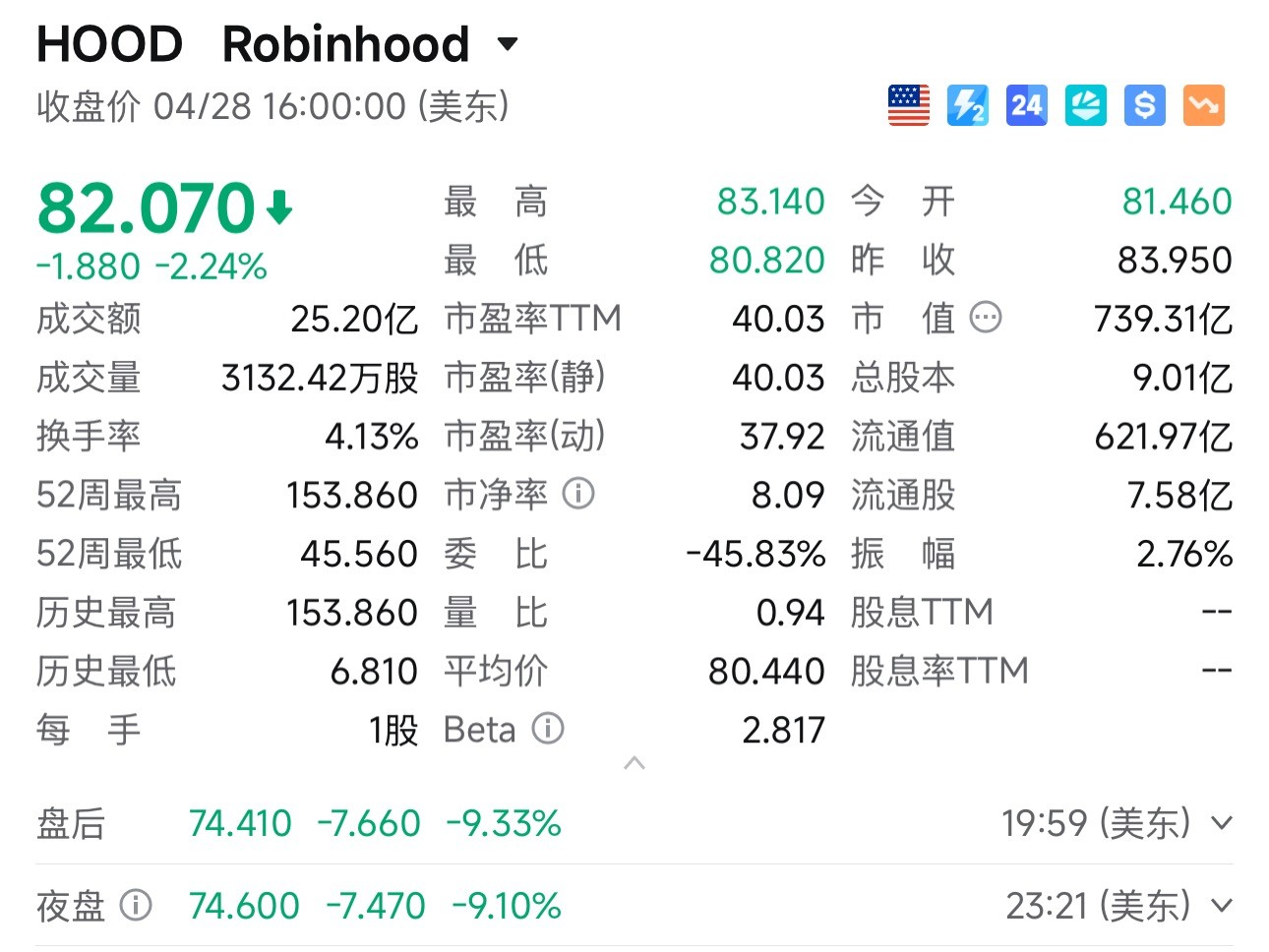
However, what really caused Robinhood's stock price to plummet nearly 10% after hours was the high expenditure on promoting the "Trump Account."
Robinhood stated that the company's expenses surged by 18% in the first quarter and warned that its "Trump Account" promotion plan would require an additional $100 million investment. Furthermore, Robinhood mentioned that the contracts offered to such accounts are based on a cost-plus model, resulting in a lower profit margin.
The so-called "Trump Account" is an account established for American children under the "Big and Beautiful Act," with Robinhood acting as a broker and initial trustee.
For this company that has stepped into the crypto circle, the discussion in the CT community is not about stock price and performance but about its past as a meme stockbroker and how its cryptocurrency business revenue couldn't even surpass Hyperliquid.
An analyst named Shaunda Devens from Blockworks visually compared Robinhood and Hyperliquid's data in a single chart.
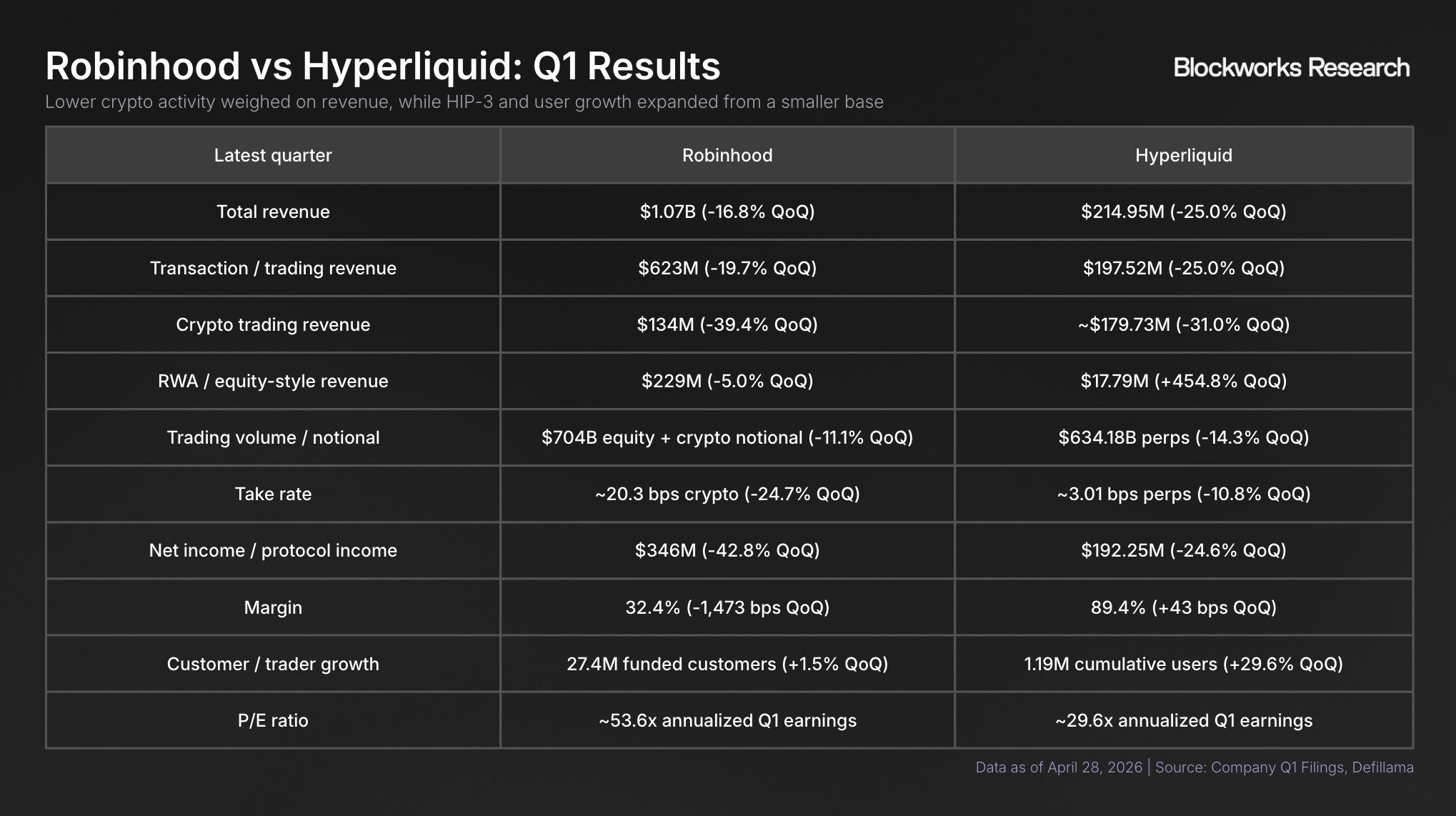
Due to the diversification of their business, many data points lack comparability. However, in cryptocurrency trading, while both Robinhood and Hyperliquid saw over a 30% decrease in revenue in the first quarter, Hyperliquid's revenue from cryptocurrency trading has reached close to $1.8 billion, surpassing Robinhood's $1.34 billion.
In terms of overall profit, Robinhood reported a net profit of $3.46 billion in the first quarter, while Hyperliquid's protocol generated approximately $1.92 billion in total revenue. Although Hyperliquid's cost structure is unknown, the profit margin is likely significant, with its net profit being at least half of $3.46 billion.
Many of Hyperliquid's supporters on X believe that Hyperliquid is severely undervalued. Despite Robinhood having a much larger user base and higher fees than Hyperliquid.
Even in this scenario, Robinhood's estimated price-to-earnings ratio based on first-quarter data exceeds 50 times, while Hyperliquid's is less than 30 times.
Another researcher at Blockworks has raised some doubts about this, pointing out that Hyperliquid's token FDV has reached $39 billion, and if this number is used for valuation, everything seems reasonable.

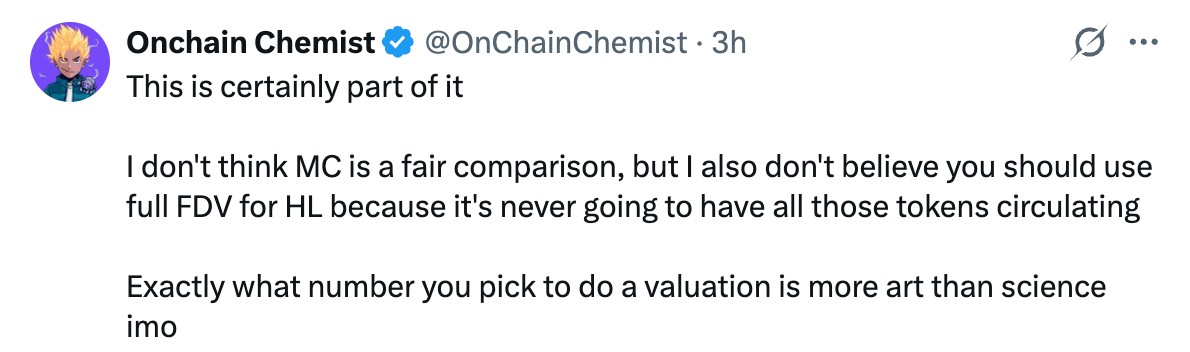
Opponents argue that using FDV to value a project is similar to valuing Robinhood using the future issuance of Robinhood shares. A user named "On-chain Alchemist" also stated that valuation has always been an art rather than a science.
Valuing an on-chain project has always been a topic worth discussing. Projects like Hyperliquid, as DeFi projects, are relatively easier to value among on-chain projects, and often drawing parallels with the stock market's brokerage firms could give a rough valuation range. However, the term "rough" is used because it's challenging to delve deeper.
DeFi projects operate with loose regulations, no tax pressure, unrestricted leverage, satisfying speculative demand to some extent. But how this speculative demand will manifest and what patterns it will exhibit is the core reason the market struggles to estimate project revenue in the future.
Furthermore, the relationship between a project's token and the project itself currently does not have a very clear definition. When you buy Robinhood's stock, you are considered a shareholder. However, buying Hyperliquid's token does not seem to confer any actual power over the Hyperliquid project itself.
Settling transactions on-chain is a major advancement brought to the world by Web 3. In the future, there may be more cases like Hyperliquid where the profitability exceeds that of a company. However, valuing these emerging platforms may, as mentioned earlier, be more of an art than a science.
Welcome to join the official BlockBeats community:
Telegram Subscription Group: https://t.me/theblockbeats
Telegram Discussion Group: https://t.me/BlockBeats_App
Official Twitter Account: https://twitter.com/BlockBeatsAsia
