Amazon delivered a rather mixed earnings report.
On October 29, US time, Amazon announced its third-quarter results. The growth rate of its cloud business AWS hit a new high in nearly five years, and the company's overall operating margin also reached a record level. But after the earnings release, Amazon's stock price fell by about 7% in after-hours trading. According to the Associated Press, the market is focused on the performance of the retail business and the company's massive investment in artificial intelligence.
On one side is the accelerating growth of the cloud business, and on the other is increasingly large cash spending. Breaking down the earnings report, Amazon is using a highly profitable business to support a round of infrastructure construction of an equally astonishing scale.
How does Amazon make money?
Most of Amazon's revenue still comes from the shopping business people are familiar with. North America and international operations together account for the bulk of the group's revenue. But if revenue is replaced by operating profit, the picture changes.
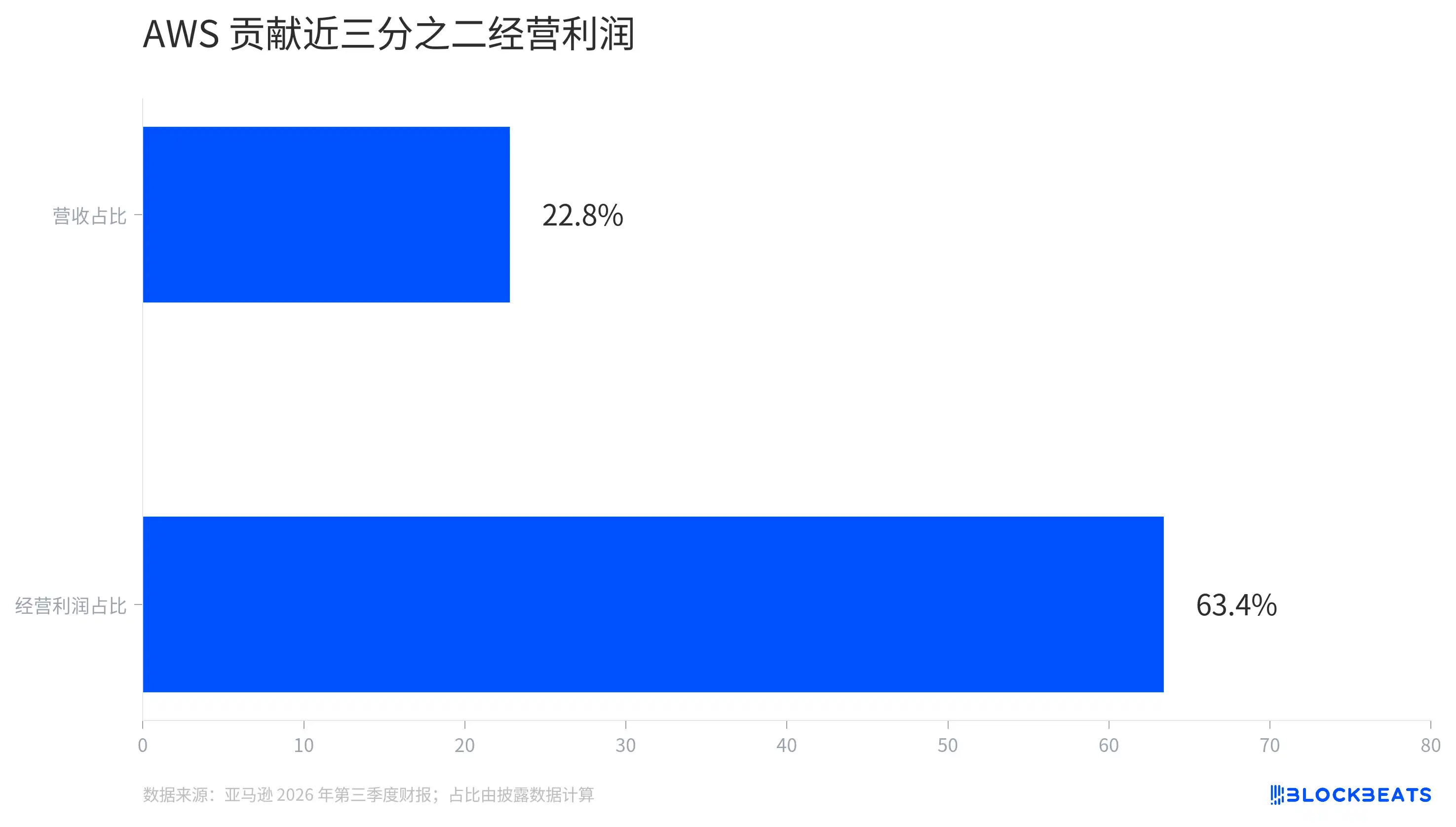
According to Amazon's third-quarter earnings report, AWS accounted for about 23% of the group's revenue in the quarter, but contributed about 63% of operating profit. In other words, for every $100 of operating profit Amazon earns, about $63 comes from the cloud business. The proportions are calculated based on the segment data disclosed by the company.
This reflects the cost structures of different businesses. E-commerce requires purchasing goods, building warehouses, delivering packages, and bearing personnel and logistics expenses. The cloud business also requires huge infrastructure, but in the current quarter's earnings report, the proportion of operating profit it leaves behind is clearly higher.
This does not mean the retail business has not improved. The earnings report shows that operating profit in the North America segment increased year over year, and the international segment also remained profitable. It is just that when readers see Amazon's overall profit hit a new high, the most important contributor is already AWS.
Operating profit and net profit also need to be viewed separately. Amazon's operating profit grew this quarter, but net profit declined slightly. The company explained that the same period last year included pre-tax gains from its investment in AI company Anthropic, which raised the net profit base at that time. Using the year-over-year change in net profit to directly judge whether the main business has deteriorated would miss this layer.
Why is the cloud business worth looking at separately?
AWS is already very large, yet it is still accelerating. According to the company's quarterly earnings reports, from the fourth quarter of last year to the third quarter of this year, its year-over-year revenue growth rate rose for three consecutive quarters.
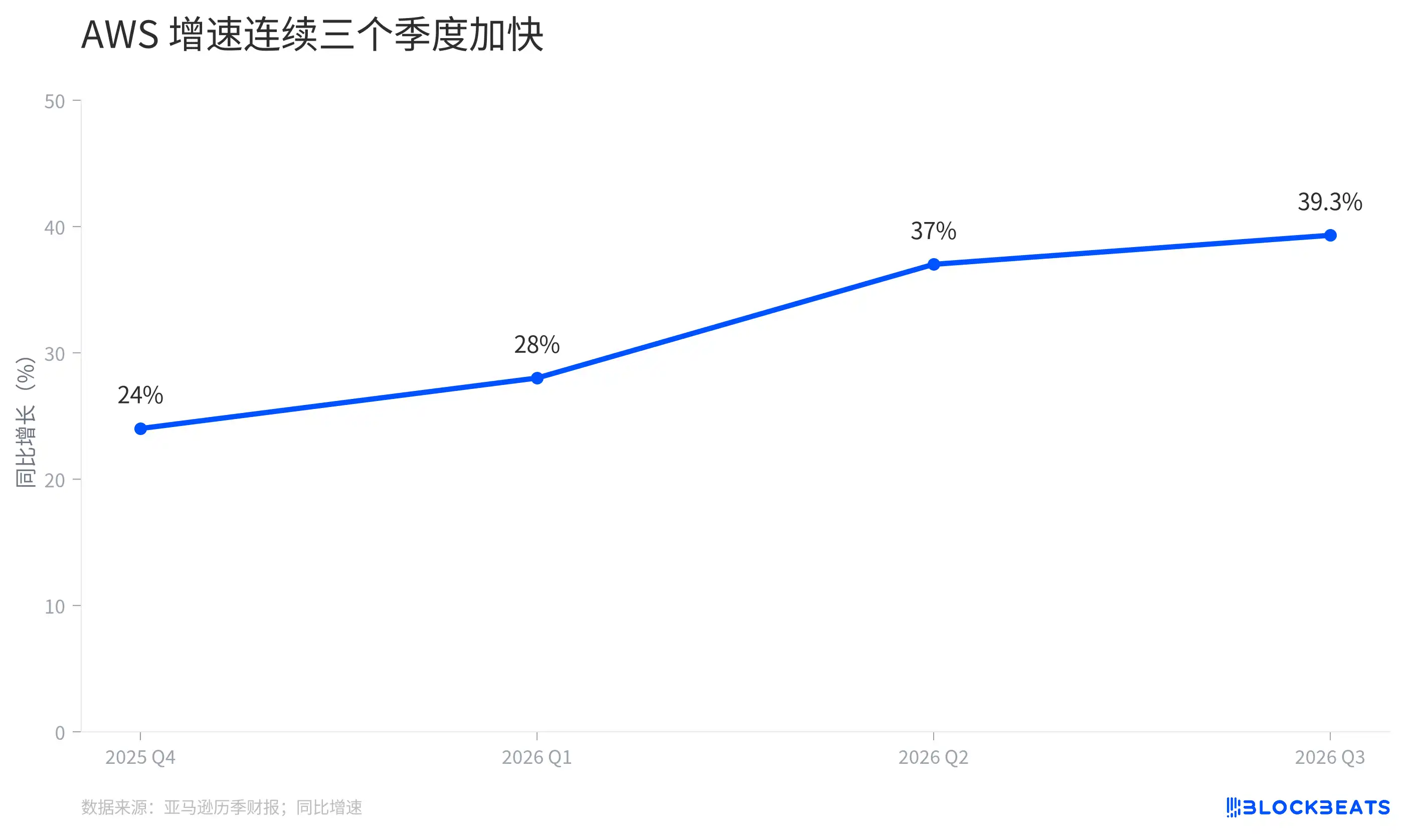
AWS revenue in the latest quarter reached $46 billion, up 39.3% year-over-year. Amazon multiplied the single-quarter revenue by four, saying its annualized revenue run rate reached $184 billion. This figure is merely a conversion based on the current quarter's pace, not confirmed revenue for the coming year.
The larger the scale, the more incremental revenue is typically needed to sustain high growth. Compared with the same quarter last year, AWS added approximately $13 billion in revenue this quarter, equivalent to nearly 40% of last year's same-quarter cloud business revenue. This is why the market looks at the cloud business separately: it is not only a profit center but is also adding revenue for the group.
Amazon CEO Andy Jassy linked the growth to AWS's feature and infrastructure investments in the earnings report. However, the report did not separately disclose how much AI accounts for in AWS revenue, and the entire cloud business increment cannot be attributed to AI.
Where did the money earned go?
A bigger contrast appears in the cash flow statement. Amazon's operating cash flow is still growing, but after deducting net purchases of property and equipment from operating cash flow, the remaining free cash flow has fallen below zero.
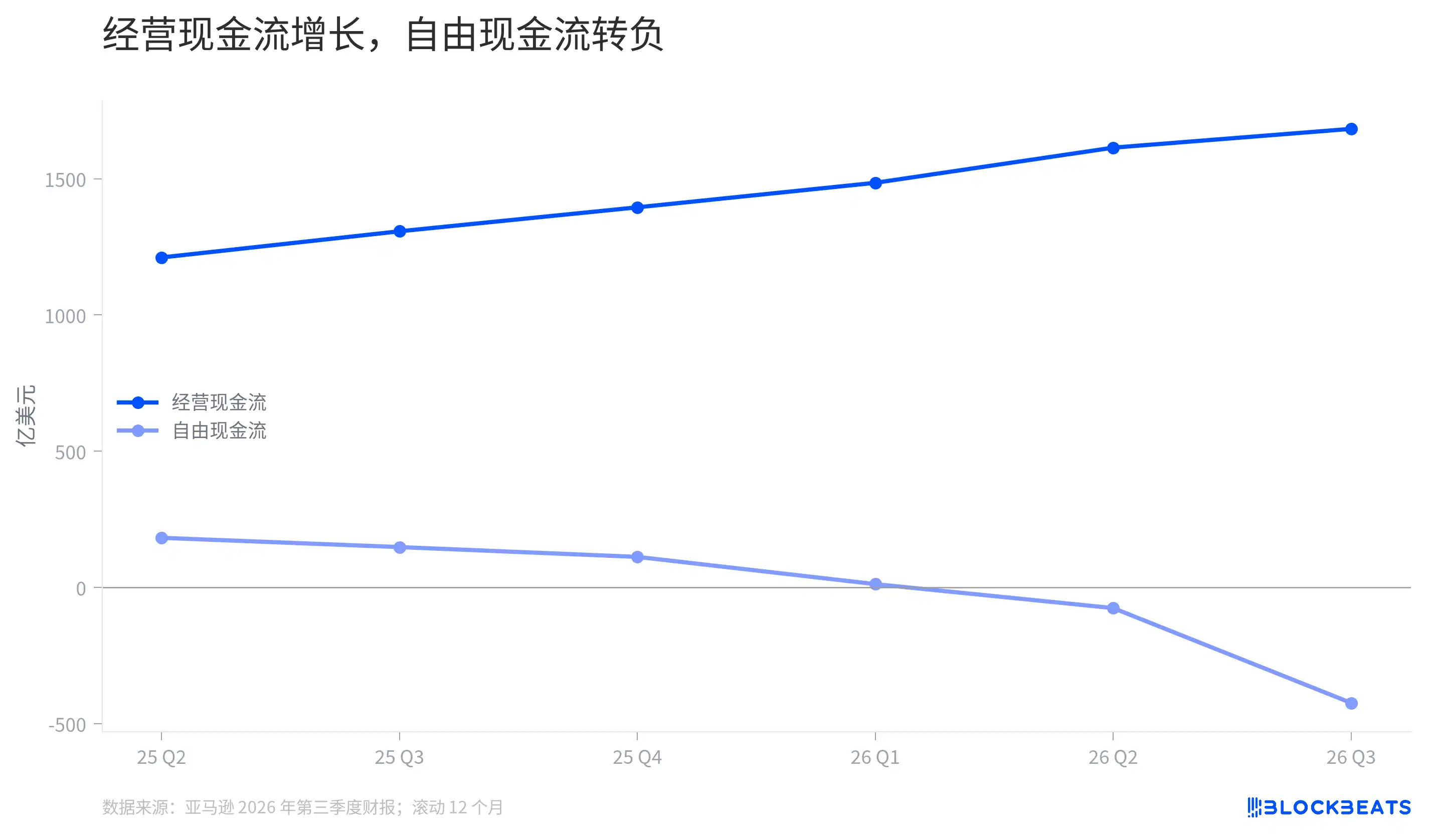
The gap between these two lines can be understood as Amazon's net spending on property and equipment purchases under this cash flow measure. In the most recent trailing twelve-month period, this spending exceeded cash generated from operating activities during the same period. Negative free cash flow does not mean the company had an operating loss for the quarter, nor does it mean the company has run out of cash on hand.
According to the earnings report, free cash flow outflow over the past twelve months was approximately $42.4 billion, compared with an inflow in the same period last year. Amazon said the change mainly came from a year-over-year increase in net purchases of property and equipment, primarily reflecting AI investments.
There is an easily confused time measure here: each point in the chart covers the twelve months ending at the end of that quarter, rather than cash flow occurring in that quarter alone. Adjacent data points overlap substantially in months and cannot be added together.
The income statement and cash flow statement also record spending differently. Purchases of assets such as servers affect cash flow, while related costs typically enter the income statement in installments through depreciation and other means. Therefore, cash flow coming under pressure first and still-high operating profit for the quarter can occur at the same time. What is disclosed in the earnings report is investment and cash flow at the group level, and all spending cannot be directly attributed to AWS or AI.
Amazon still expects full-year 2026 cash capital expenditures of approximately $220 billion. This is the full-year outlook the company provided when releasing its earnings, and final spending will still depend on actual results.
Is retail growth slowing?
When looking at group revenue, you also need to pull out the calendar first. Amazon moved Prime Day promotional events in most major markets to the second quarter this year, while last year all events fell in the third quarter.
This means that in the year-over-year comparison for the third quarter, this year is missing some promotional revenue, while the same period last year included the full event. The company reported group revenue growth of 12% year over year and estimated that excluding the timing shift, growth would have been about 4 percentage points higher.
This adjustment is Amazon's own estimate, not another actual reported revenue figure. It serves as a reminder to readers not to mechanically compare the two quarters, nor can it alone prove the true growth rate of retail demand. Exchange rates, product mix, and other factors still affect the results.
Two threads in this earnings report hold true at the same time: AWS is growing faster, and Amazon is also paying more cash to build infrastructure for the future.
Welcome to join the official BlockBeats community:
Telegram Subscription Group: https://t.me/theblockbeats
Telegram Discussion Group: https://t.me/BlockBeats_App
Official Twitter Account: https://twitter.com/BlockBeatsAsia
