On October 29, Coinbase released its third-quarter earnings report. Crypto market trading was sluggish, yet the company's revenue largely held steady. There is an easily overlooked change in the earnings report: subscription and services revenue is now approaching transaction revenue.
This company, which started with crypto trading, is trying to make more businesses weather market cycles. Stablecoins, subscriptions, and prediction markets have all been put into the same scorecard. But breaking down the proportions, revenue, and profit reveals a more complex picture.
The revenue structure has changed, but has the money increased?
First, look at the most intuitive change. Coinbase's earnings report shows that in the third quarter, subscription and services revenue accounted for 49% of net revenue. This means that out of every $100 in net revenue, nearly half comes from services other than trading.
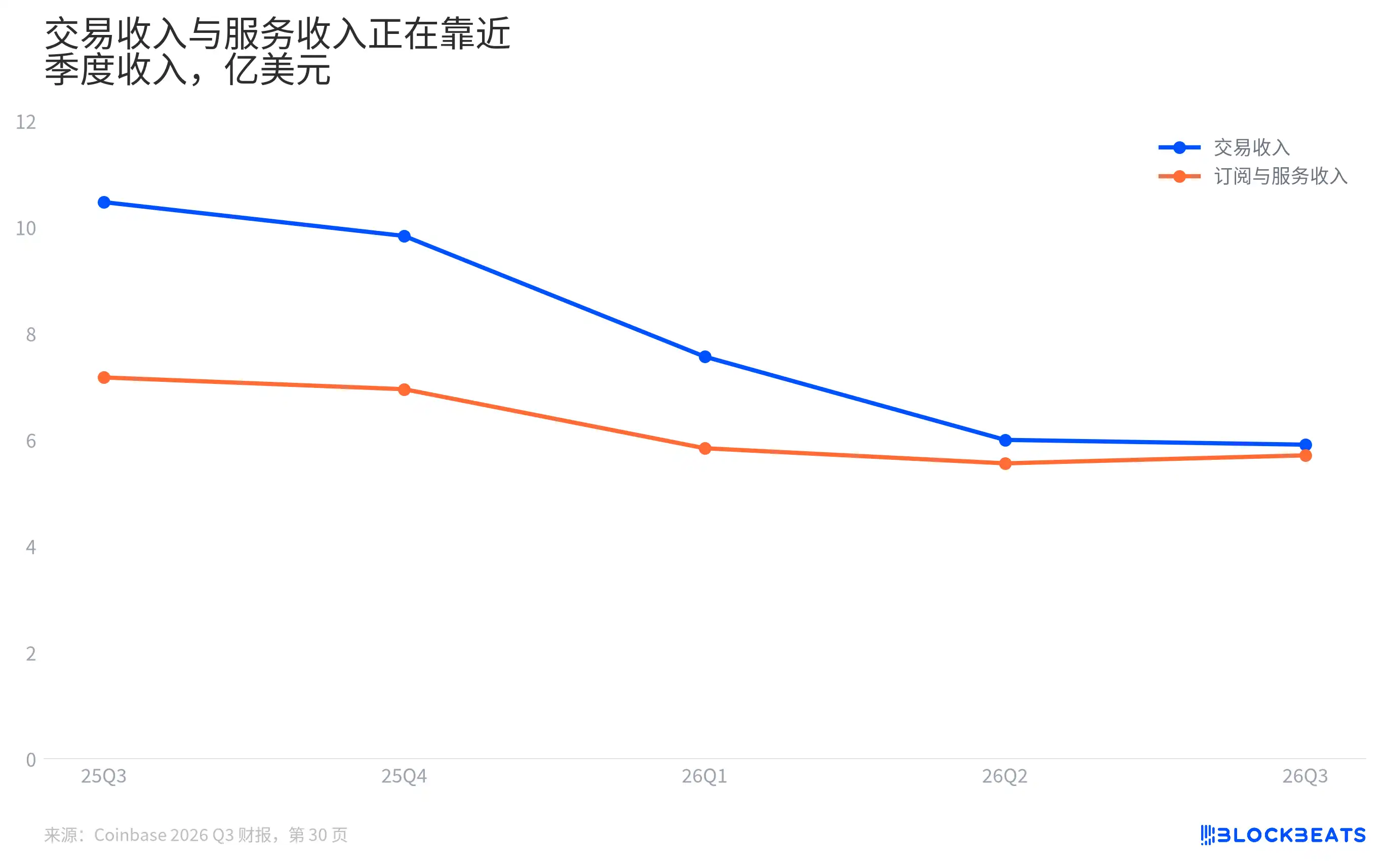
The gap between the two lines is narrowing, but the main reason is that transaction revenue is falling faster. Over the past year, transaction revenue fell 44% year over year, while subscription and services revenue also fell 20%. The higher proportion is a real change, but it does not mean services revenue has escaped the market cycle.
Sluggish trading has specific manifestations. Coinbase disclosed that in the third quarter, total market crypto trading volume fell 10% quarter over quarter, and the company's transaction revenue fell 1% quarter over quarter. The platform's share of crypto trading volume rose for the fourth consecutive quarter, reaching 10.7%. As the pie shrank, Coinbase got a larger slice.
New products are also helping fill the gap. The company said growth in prediction markets buffered the impact of declining consumer crypto spot and derivatives trading volume. Prediction market annualized revenue exceeds $200 million; this is an annualized measure of the revenue run rate over a period, not actual revenue for the quarter, and cannot be directly added to quarterly revenue.
This distinction affects how the figures should be read. Prediction market revenue is included in transaction revenue, while subscription and services revenue includes items such as stablecoins, blockchain rewards, and interest. To observe Coinbase's diversification, one must look both at revenue outside trading and at whether new sources are emerging within transaction revenue.
More USDC, so why hasn't revenue risen in tandem?
Stablecoins are the largest component of services revenue. Coinbase's earnings report shows that third-quarter stablecoin revenue was $307 million, accounting for more than half of subscription and services revenue.
When users hold more USDC in Coinbase products, it usually brings the company more related revenue. But this is not a simple straight line. In the chart, the two indicators are each converted so that the same period last year equals 100, and it can be seen that holdings on the platform rose steadily, while stablecoin revenue remains below the same period last year.
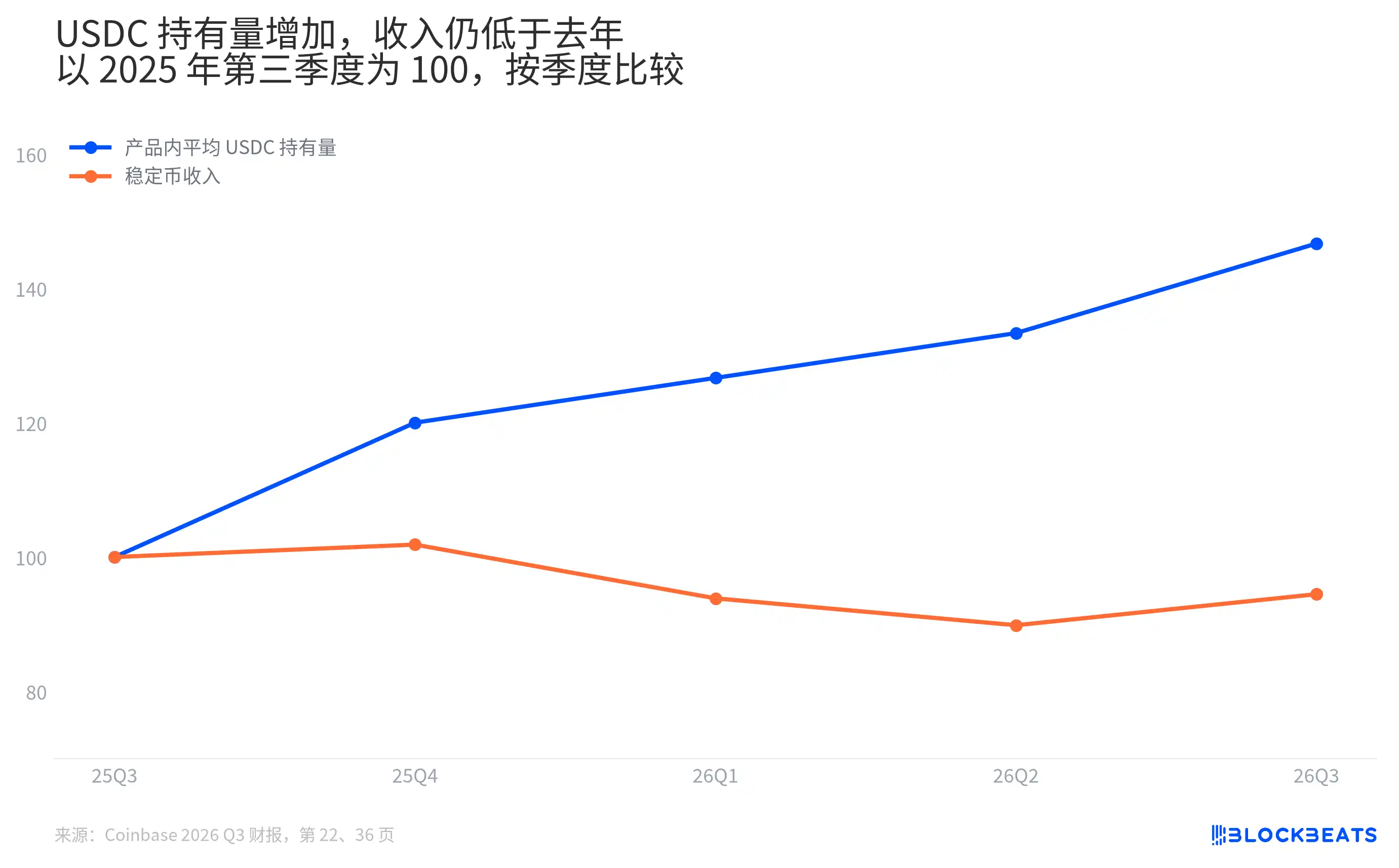
The reason is that Coinbase's stablecoin revenue depends not only on on-platform balances. The company's financial reports divide the economic benefits related to USDC into on-platform product balances and off-platform balances, and the scale and revenue contribution of the two parts can change, while interest rates also affect the results.
The financial reports show that in the third quarter, off-platform USDC-related revenue declined from the previous quarter, partially offsetting the growth brought by record-high average on-platform holdings and rising interest rates. In other words, more USDC staying within Coinbase products does not automatically guarantee a synchronous increase in overall stablecoin revenue.
USDC held by the platform itself also involves accounting differences. The financial report's supplementary table lists revenue generated from the company's own holdings separately and presents it combined with stablecoin revenue. Therefore, when analyzing, it is necessary to distinguish the total amount in the supplementary table from the stablecoin revenue in the income statement.
Earned $700 million—has operations really recovered?
In the third quarter, Coinbase's net income returned to positive territory. The financial reports show net income of $719 million, compared with a loss of $360 million in the previous quarter. Looking at this line alone, it is easy to assume that the company's day-to-day operations suddenly improved by a similar magnitude.
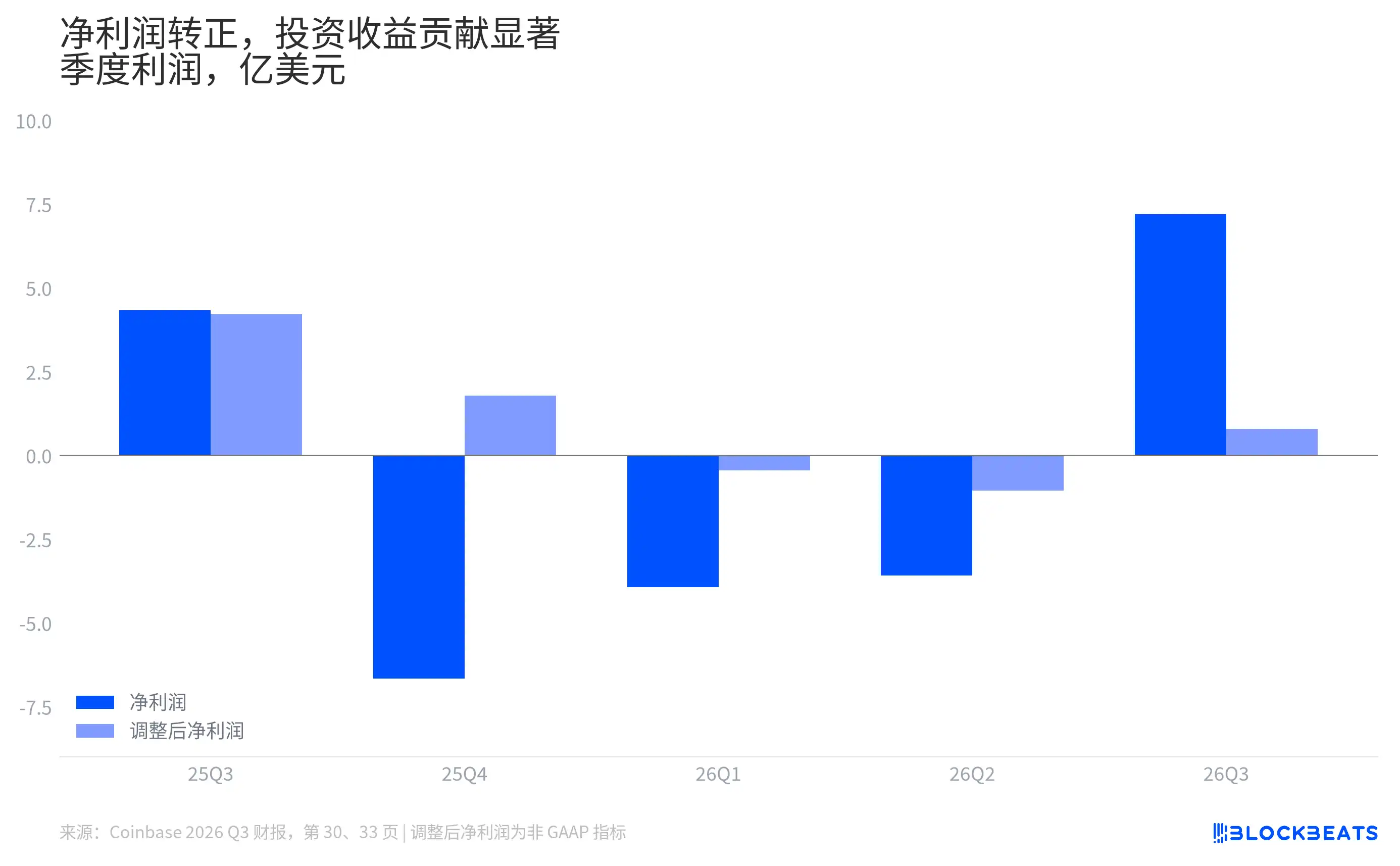
One of the biggest changes in the income statement comes from investments. Crypto assets held for investment by Coinbase generated a net gain of $715 million in the third quarter, compared with a loss on that item in the previous quarter. This gain is included in net income, but it is not fees paid by customers on the platform exchange.
Coinbase also disclosed adjusted net income. This metric excludes gains and losses on investment crypto assets and other investments and takes into account the corresponding tax effects. Under the company's definition, adjusted net income in the third quarter was $77.7 million. It also turned positive, but there is a clear gap between it and net income under GAAP.
This does not mean operations did not improve. The financial reports show that operating income in the third quarter was $61.7 million, compared with an operating loss in the previous quarter. Total operating expenses declined over the same period, and the company said technology development expenses benefited from previous cost cuts, while administrative expenses also fell due to lower professional service spending.
Adjusted EBITDA reached $333 million, up 60% quarter-over-quarter. However, this metric also excludes items such as stock-based compensation, depreciation and amortization, and cannot be directly treated as net income or cash flow. Only by placing the three metrics together can one distinguish the respective positions of investment gains, expense changes, and operating performance.
Coinbase's changes this quarter are hidden in two gradually converging revenue curves, and also between two profit measures.
Welcome to join the official BlockBeats community:
Telegram Subscription Group: https://t.me/theblockbeats
Telegram Discussion Group: https://t.me/BlockBeats_App
Official Twitter Account: https://twitter.com/BlockBeatsAsia
