As the cryptocurrency industry moves towards mainstream adoption, the destination of wealth has never been just a number on paper, but the secure on-ramp to the real world.
By 2026, the cryptocurrency industry is entering a phase of "price discovery maturity," where the logic of fund movement is undergoing profound changes. From on-chain rewards to fiat off-ramps, the C2C link has become a key gateway connecting the virtual and real worlds. Based on the one-year operation data of the Huobi Select Station and combining industry trends with user experiences, this report systematically reveals for the first time a C2C new paradigm centered around "trust" that is taking shape.
Macroeconomic Disparity: $3.11 Trillion "Liquidity Island" and Trust Crisis
According to the "CoinGecko 2025 Annual Crypto Industry Report", in 2025, the cryptocurrency market experienced a dramatic "asset dislocation": despite a 10.4% contraction in the total crypto market cap, the stablecoin market cap surged against the trend by 48.9%, surpassing $3.11 trillion, reaching a historical high.
This starkly contrasting data reveals a harsh industry truth: users are not without profit, but they dare not exit.
A massive amount of funds locked in stablecoins on-chain has formed numerous "liquidity islands." At the root of this is the collapse of security in traditional C2C fiat gateways, leading to an "off-ramp panic." This "panic" is evident from a Huobi HTX C2C user survey—based on thousands of user feedback accumulated through the Huobi HTX OTC using public social media channels (@HTX_c2c) and daily work processes—which systematically analyzes and attributes the typical issues in the C2C trading scene, listing six core pain points for users.
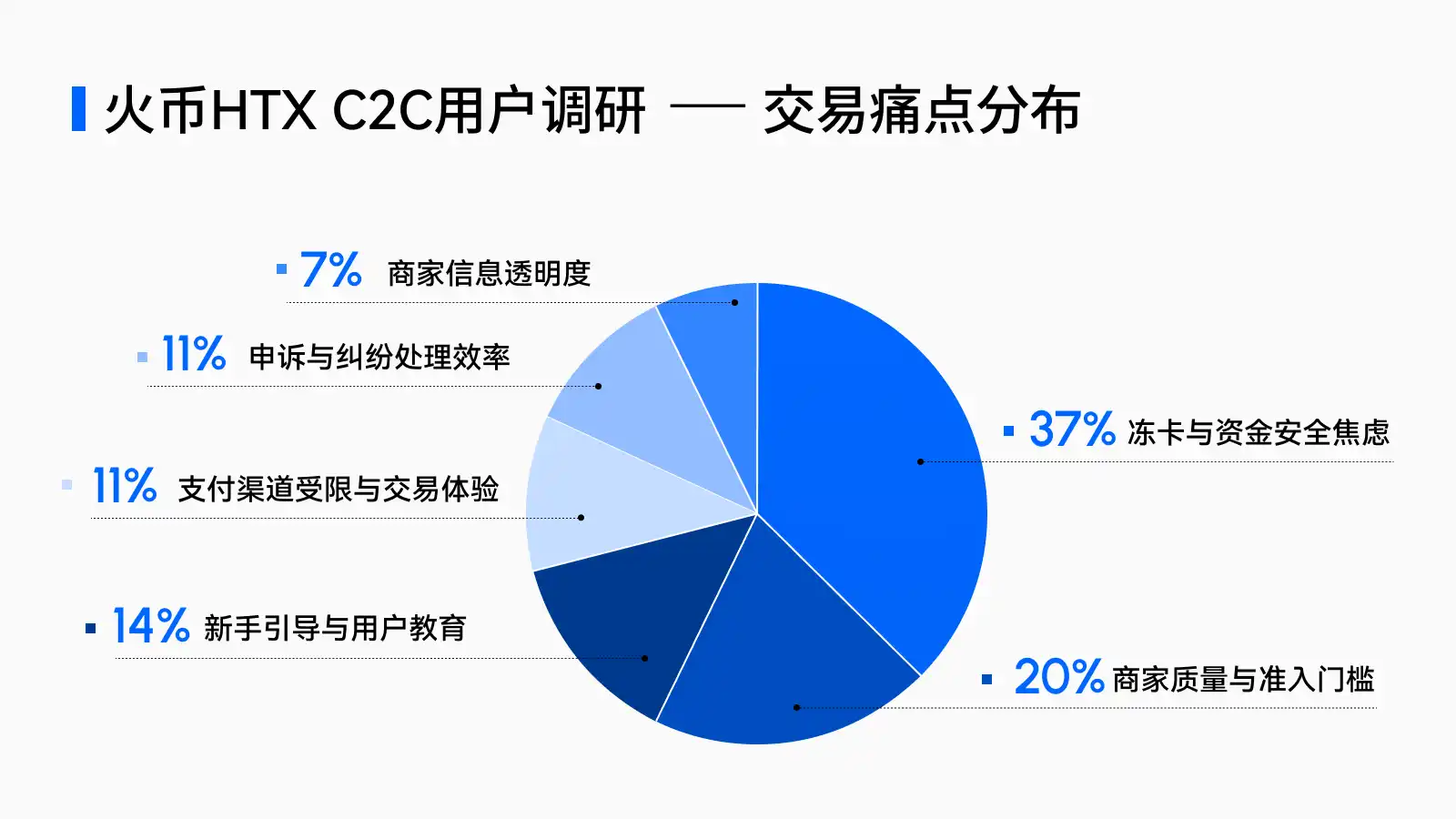
Among the many factors affecting user trading experience, "card freezing and fund security anxiety" overwhelmingly tops the list at 37%. This means that nearly 40% of traders, when trying to cross the virtual-to-real boundary, are no longer primarily concerned about price volatility, but rather about the security of their assets. In addition, 20% of users are trapped by merchant quality and entry barriers, 14% of users feel lost in newbie guidance, with pain points such as limited payment channels (11%), low appeal efficiency (11%), and lack of merchant information transparency (7%), scattered like reefs in the $3.11 trillion liquidity artery.
The key conclusion is clear: the friction of fund transfers today is no longer limited to "exchange rate loss," but has evolved into an account status uncertainty caused by "opaque fund sources." This trust crisis has directly blocked the pathway of hundreds of billions of funds, and the market urgently needs a fiat gateway "Oasis" with absolute security to alleviate that 37% core anxiety from the root.
Microscopic Illustration of the Reef: The Folded Truth of Transactions and Psychological Defense Line
When macro data sinks into real individuals, the retention of three trillion stablecoins is no longer just a financial term, but numerous hesitations and fears on the "exit" edge.
The most intuitive projection of this fear is a psychological trauma known in the industry as "Frozen Card PTSD." A regular urban white-collar worker, accustomed to regularly allocating crypto assets during busy work hours, seeks respectable asset appreciation. However, a seemingly ordinary withdrawal request, due to matching with a complex counterparty background, caused all his associated bank cards to instantly enter a "frozen state." This sudden freeze cut off not only the cash flow but also his connection to real life—mortgage payment reminder calls, doubts in the workplace due to inability to make payments, and even deep anxiety about the personal credit system, instantly diluting the joy of wealth appreciation into survival anxiety. In user feedback from Huobi HTX, this 37% security anxiety stems from the passive harm caused by this "risk spill" phenomenon, leading many defensive users to endure exchange rate losses and almost obsessively seek the "absolute sanctuary" of funds.
At the same time, on the other end of the market, frequent trading "Day Traders" are tormented in another dimension. As a professional trader, his lifeline lies in efficiency. In the life-and-death speed of market fluctuations, he urgently needs to deposit to buy the dip or withdraw to hedge, but the reality is often: payment channel freezes for no reason, low-quality merchants passing the buck, or risk control systems with lagging "indiscriminate strikes." For these frontline "offensive traders" active in the industry, the core pain point is not avoiding all risks but a strong desire for an oasis that can provide "certain feedback" between absolute security and fund turnover rate, no longer allowing opportunity costs to be depleted in inefficient communication.
For those "Whales" who ride out bull and bear markets, the C2C market is more like a "Dark Forest" harboring hidden dangers. The logic of large fund inflows and outflows is vastly different from retail investors, and they know well that their fund size in the transparent on-chain world is like a huge luminous body, highly susceptible to the infiltration of illicit funds. In the past, due to the lack of merchant information transparency (7%), these large holders often had to rely on "probabilistic selection" or past experience to choose counterparties. This information asymmetry has led them to demand a level of service almost like a "private bank" when faced with substantial exit demands—they not only need to trade but also need a credit ace that can isolate risks from the source and dare to make "full compensation" in real money in extreme scenarios.
This micro-level "true settlement" has also sparked widespread resonance on social media. As mentioned by @Yep_Cooper in his in-depth tweet comparing the three major OTC gold truths, "The truth about freeze and compensation is a watershed in distinguishing the platform's underlying color." Everyone's first-hand experience points to a common appeal: on the edge of trust collapse, the market urgently needs a trust model that goes beyond simple matching and possesses infrastructure-level deep trust.
Industry New Paradigm: From "Price Arbitrage" to "Trust Infrastructure," Huobi OTC Desk Maintains a "Zero Freeze" Record Since Launch
After a year of steady operation, the Huobi OTC Desk has successfully implemented a high-standard trust model. Addressing the industry's long-standing pain points, the Huobi OTC Desk has built a three-tier protection system core around "pre-identification + in-process intervention + post-guarantee," shifting C2C transactions from a single "price competition" to "service and trust competition."
1. Dynamic Risk Control: Shifting from "Post-handling" to "Prevention"
To address 37% of security anxieties, the OTC Desk continuously upgrades its risk control system, achieves real-time monitoring during transaction communication by training behavioral models covering thousands of anomalous behaviors. Coupled with a 24/7 manual service system, it ensures that risk events are accurately intercepted before they occur.
2. Ultimate Screening: Resolving 20% of Merchant Quality Doubts
Through a rigorous merchant admission and evaluation system, the OTC Desk maintains a high merchant elimination rate. All participating merchants must undergo real-name fund chain traceability standards, with "0 freeze since entry" as a core hard indicator to ensure the healthy source and flow of funds in the transaction chain. The merchant's "hell-level" screening is also a credit screening: only merchants with truly clean financial strength can enter this "oasis."
3. Transparency Report Card: 0 Cases of Real Freeze and 100% Full Compensation
Since its launch a year ago, the Huobi OTC Desk has maintained a record of "0 cases of real freeze." What truly cements its leadership position is the industry-first "100% full compensation mechanism." Providing users with deterministic underpinning in extreme scenarios, its confidence comes not solely from financial resources but from absolute confidence in its risk control algorithm and merchant management model. This mechanism raises the risk bottom line for C2C from "user-borne" to "platform-backed," completely eliminating users' worries.
On the occasion of its one-year anniversary, as the most robust security bridge connecting a $311 billion ecosystem, the Huobi OTC Desk promises to continue enhancing its risk control infrastructure, committed to becoming the most stable haven in the crypto ocean, safeguarding every trader's right to a "secure transaction." When "full compensation" becomes an industry standard and "zero freeze" becomes a transaction standard, true prosperity in the crypto market will follow. The meaning of wealth will eventually resonate in every secure transaction.
About Huobi HTX
Founded in 2013, Huobi HTX has evolved over 13 years from a cryptocurrency exchange to a comprehensive blockchain business ecosystem, covering digital asset trading, financial derivatives, research, investment, incubation, and other businesses.
As a global leading Web3 portal, Huobi HTX adheres to a development strategy of global expansion, ecological prosperity, wealth effect, and security compliance, providing world cryptocurrency enthusiasts with comprehensive, secure, and reliable value and services.
For more information about Huobi HTX, please follow X, Telegram, and Discord. For further inquiries, please contact glo-media@htx-inc.com.
