TL;DR
During the Singapore stock market trading session on June 3, the Straits Times Index (STI) rose by 1.1%, reaching a high of 5150.69 points, setting a new all-time high. The index had previously set multiple closing and intraday records in May, broke the 5000-point mark for the first time in February, with a cumulative increase of about 32% over the past year and around 11% year-to-date, well above the previous year's low of 3845 points and the long-term average range of 3300–3400 points.
The market generally attributes this uptrend to the global AI boom spilling over into the Asia-Pacific region, the three major banks in Singapore reporting robust profits, a low-interest-rate environment, and the resilient performance of the local economy. These claims capture the surface phenomenon but fail to clearly explain how AI-related capital expenditures have gradually translated into the improvement of Singapore's Non-Oil Domestic Exports (NODX) and how they, along with GDP upgrades, bank loan growth, and a low-interest-rate environment, have formed a mutually reinforcing cycle. This locally driven cycle has enabled the Singapore stock market to no longer simply follow regional sentiment but to have its own support.
STI Breaking Through 5150 Points: Is the Mainstream Explanation Sufficient?
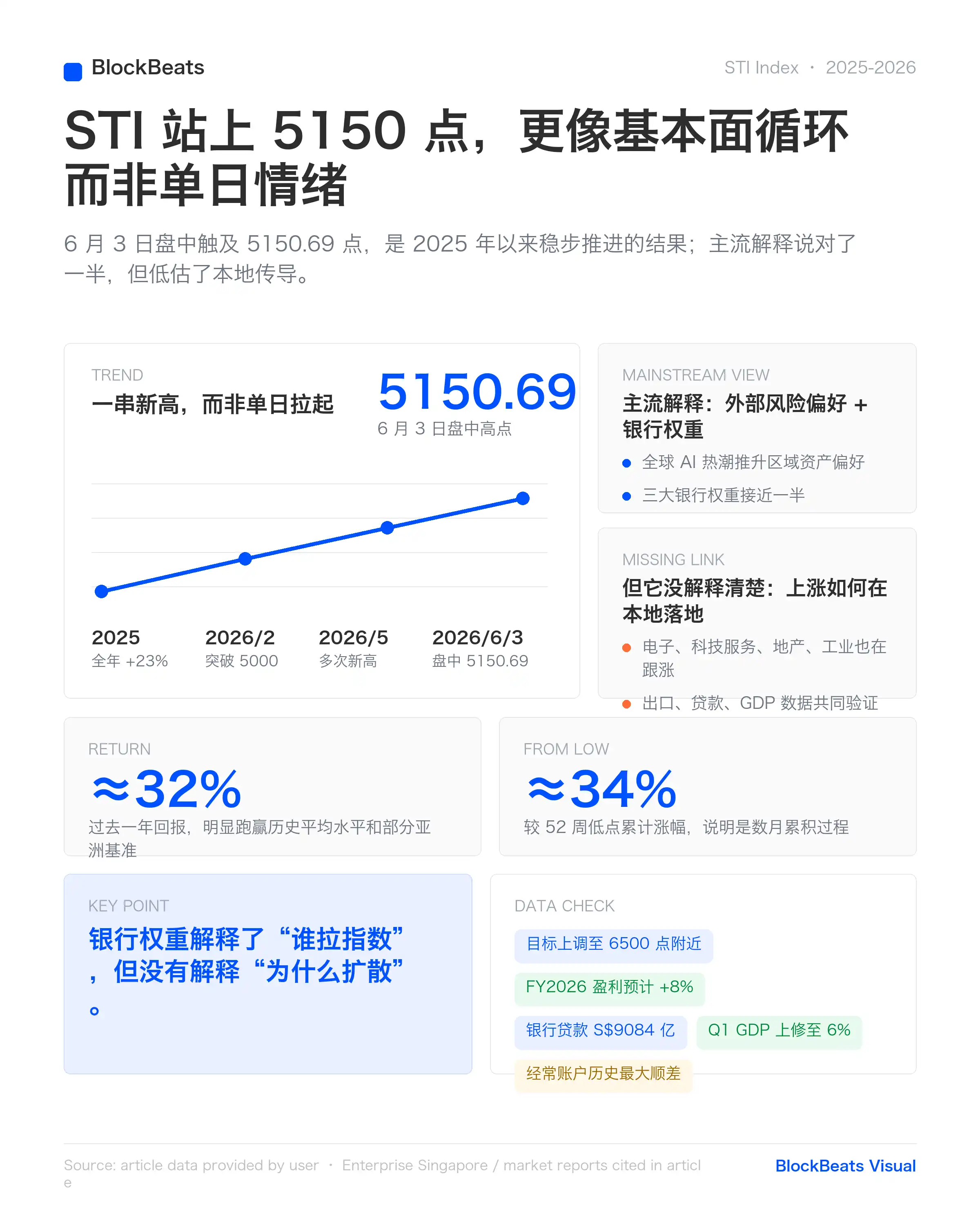
On June 3, the STI reached 5150.69 points, the result of a bull market steadily advancing since 2025, rather than a one-day emotional outburst. The index rose by 23% throughout 2025, broke the 5000-point mark in February 2026, hit new highs multiple times in May, and posted a return of about 32% over the past year, significantly outperforming historical averages and some Asian market benchmarks. Compared to the low point of the past 52 weeks, the cumulative increase is about 34%, part of a gradual accumulation process over several months, with market trading more active than before.
The mainstream view is that the global AI boom has boosted regional risk appetite, combined with the three major banks (DBS, OCBC, UOB) accounting for nearly half of the index weight, improving economic data, and a low-interest-rate environment. Several institutions have raised the index target to around 6500 points, emphasizing an expected 8% earnings growth in the 2026 fiscal year, bank loans reaching a record 908.4 billion Singapore dollars in April, first-quarter GDP revised upwards to 6%, and a historical high current account surplus.
These factors do exist and are indeed reflected in the index performance. However, the statement of "following the AI trend + bank-weighted dominance" is rather simplified. It does not fully explain how the uptrend has specifically been transmitted locally. While a high bank weighting is a fact, if relying solely on banks, non-bank sectors should lag significantly. The reality is that technology, tech services, real estate, and industrial stocks have also contributed to the gains on multiple trading days. This indicates that the AI demand has already materialized through export data and has formed a stronger positive feedback loop with the local economy, rather than solely relying on external sentiment.
How Does AI Export Growth Drive the Local Economic Cycle?
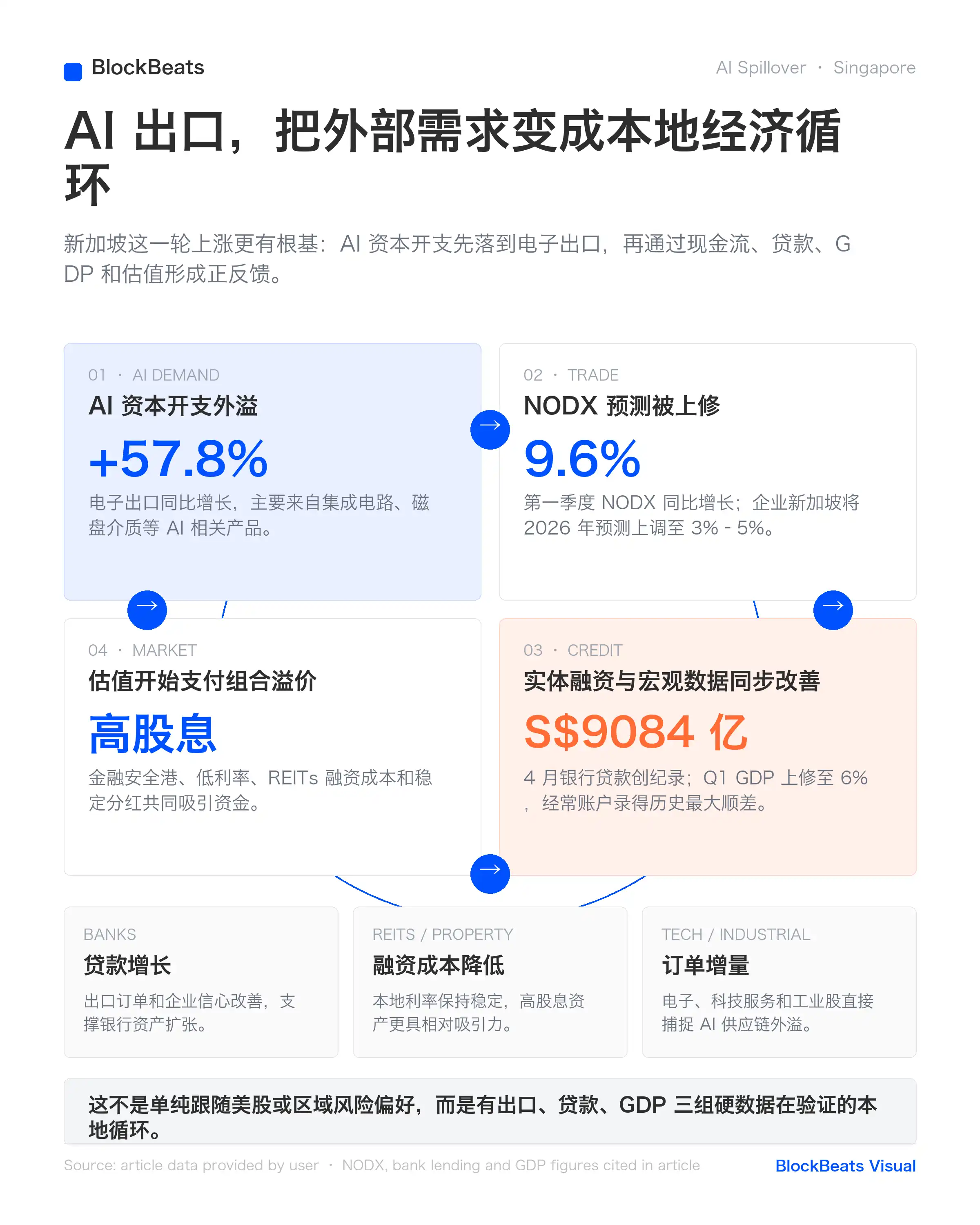
The spillover of AI-related capital expenditure has concretely benefited Singapore's electronics and tech services exports. In the first quarter, NODX grew by 9.6% year-on-year, with electronic exports surging by 57.8%, mainly from AI-related products such as integrated circuits and disk media, while non-electronics exports remained relatively stable. As a result, Enterprise Singapore has raised its 2026 NODX growth forecast from the previously more conservative range to 3%–5%. This improvement, coupled with the upward revision of first-quarter GDP to 6%, record-breaking bank loans in April, and a current account surplus, has formed a positive feedback loop in the local economy.
In simple terms, just as an increase in upstream orders directly improves downstream financing and profitability. AI demand has boosted electronic exports, enhancing corporate cash flow and confidence, leading banks to be more willing to lend to support the real economy. In a low-interest rate environment (with the local benchmark interest rate remaining stable), borrowing costs have decreased, supporting REITs and property valuations. At the same time, the high dividend yields attract funds to these relatively safe assets. This cycle is more foundational than merely following U.S. stocks or regional risk appetite because it is validated by actual export, loan, GDP, and other hard data.
As a result, the market is now pricing in Singapore's stock market not just based on bank net interest margin or policy changes but is starting to pay a premium for the combination of "indirect benefits from the AI supply chain + financial safe haven + high dividend yield." Banks benefit from loan growth support, REITs enjoy lower financing costs, while electronics and industrial stocks directly capture the incremental export orders. This also explains why the index can continue to hit new highs during times of uncertainty in the Middle East — local data provides independent support apart from global sentiment.
Besides Banking Dominance, Sector Coordination Has Formed a Joint Force
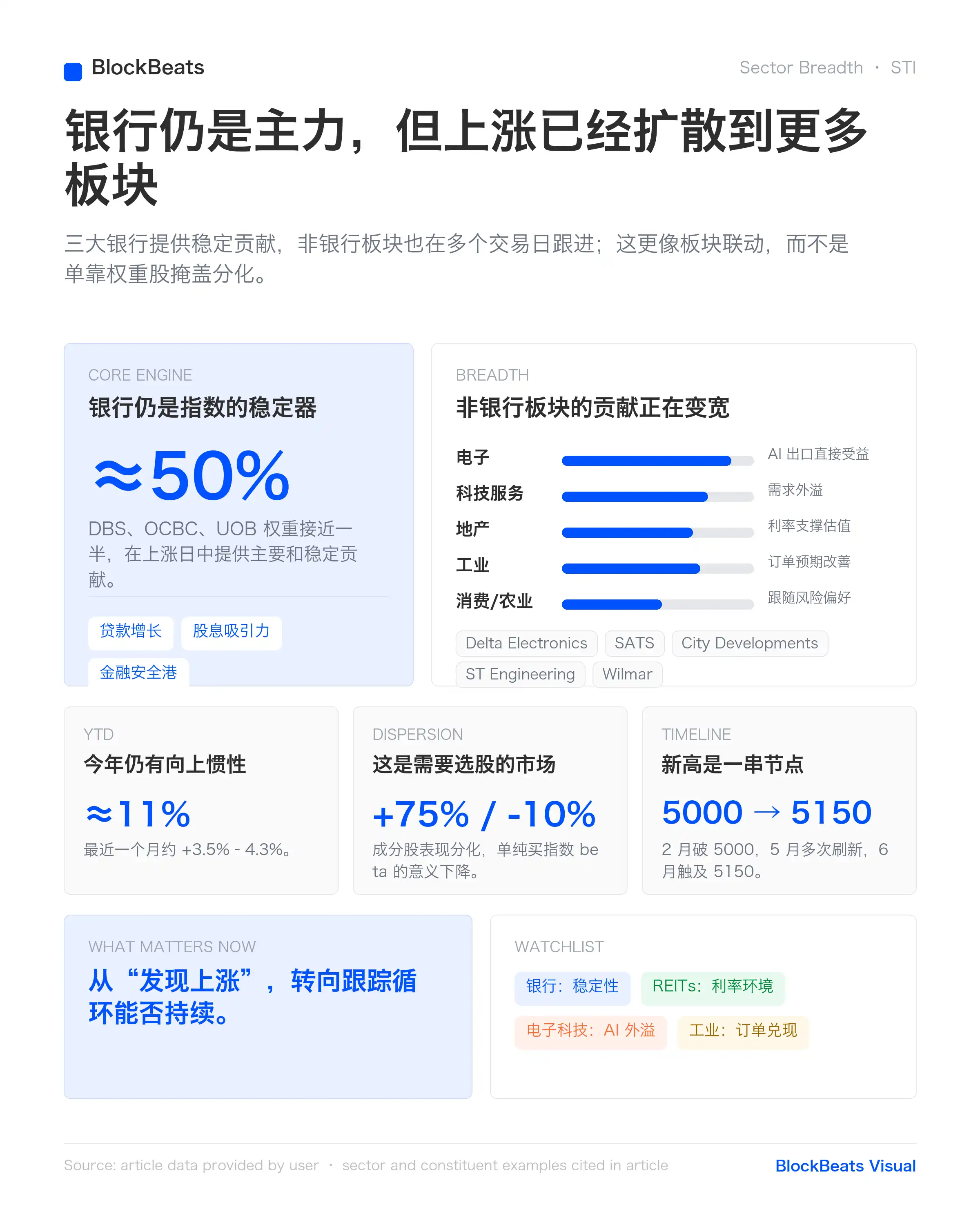
Banks remain the primary driver of the index's rise, with the three major banks accounting for nearly half of the weight and providing stable contributions on multiple trading days. However, the technology, tech services, real estate, and industrial sectors have significantly followed suit. Component stocks such as Delta Electronics, SATS, City Developments, ST Engineering, Wilmar, among others, have also made significant gains in recent trading days, lifting the index alongside banks, rather than being solely overshadowed by bank weightage. If only banks were pulling the index, the performance gap between non-bank sectors should have been larger. However, the actual situation is a relatively broad-based uptrend, indicating that the AI export improvement has translated into a broader range of earnings growth expectations.
In terms of time, this trend is currently in a sustained phase. The period from 2025 to 2026 witnessed a series of gradual new highs (breaking 5000 points in February, multiple refreshes in May, and reaching 5150 points in June). The market has seen an approximately 11% increase year-to-date, with a recent monthly increase of about 3.5%–4.3%. Most institutions have raised their targets, but have also warned that this is a market that requires stock selection, as the performance of index components has been significantly divergent (the best performing stock this year has risen 75%, while the weakest has fallen 10%). This means that simply buying index beta may not be as meaningful as selecting specific beneficiary targets.
If AI spending continues at a steady pace and local data continues to validate, the sector's interconnection is expected to support further valuation expansion. Conversely, if external shocks intensify or sector differentiation widens, the banking weight effect may once again become dominant. At this stage, the trend still has upward potential for investors, making the Singapore stock market a suitable part of diversified allocation—banks providing stability, REITs benefiting from the interest rate environment, and electronics technology stocks capturing AI spillovers. However, the focus now needs to shift from "discovering the rise" to whether this cycle can be sustained, with a focus on the specific sector contributions rather than just index levels.
Profit realization and external shocks remain the biggest tests
Although improvements in AI exports and local positive feedback have provided support, whether the approximately 8% earnings growth in the 2026 fiscal year can truly materialize, rather than remain at the data level, remains a core test. Current valuations already include many optimistic expectations, and if corporate earnings fall short, the upside potential of the index will be limited. Some institutions also warn that this is still a market that requires selective stock picking, and the differentiation between index components may widen.
The Middle East geopolitical situation or changes in the global AI capital expenditure pace represent another boundary for the actual impact on fund flows and market sentiment. Currently, the marginal impact of these factors is limited, with some trading days even being supported by easing related news. However, if oil prices fluctuate significantly or AI spending markedly slows down, the appeal of safe havens may temporarily weaken. The sustainability of trading volume expansion, the degree of sectoral differentiation, and the specific situations of institutional and ETF fund inflows will be key signals to determine whether this trend can continue.
Regarding specific assets, banks such as DBS, OCBC, and UOB still hold allocation value, provided that loan growth and interest margins can be materialized; REITs related to CapitaLand benefit from low interest rates, but caution is advised for a rebound in financing costs; stocks benefiting from exports like Delta Electronics depend on the realization of AI orders. Investors are advised to link subsequent validations and allocation decisions: if financial reports are strong, trading volume is supportive, and differentiation is manageable, this trend is likely to continue; otherwise, it may signal a need for rebalancing, where some positions can be redirected to targets with clearer catalysts, or await a pullback.
The next evolution of these variables will determine Singapore's position as a preferred destination for stable and diversified investment in Asia, and whether its attractiveness can be sustained beyond the current phase.
Welcome to join the official BlockBeats community:
Telegram Subscription Group: https://t.me/theblockbeats
Telegram Discussion Group: https://t.me/BlockBeats_App
Official Twitter Account: https://twitter.com/BlockBeatsAsia
