The World Cup has already begun, and the total trading volume of the prediction market is continuously reaching new highs. However, Kalshi, as the industry leader, may not be feeling too good at the moment.
The reason is not due to Kalshi's own business data fluctuations, but because another strong competitor has "suddenly" appeared in front of Kalshi after Polymarket, and this opponent was once its most important ally.
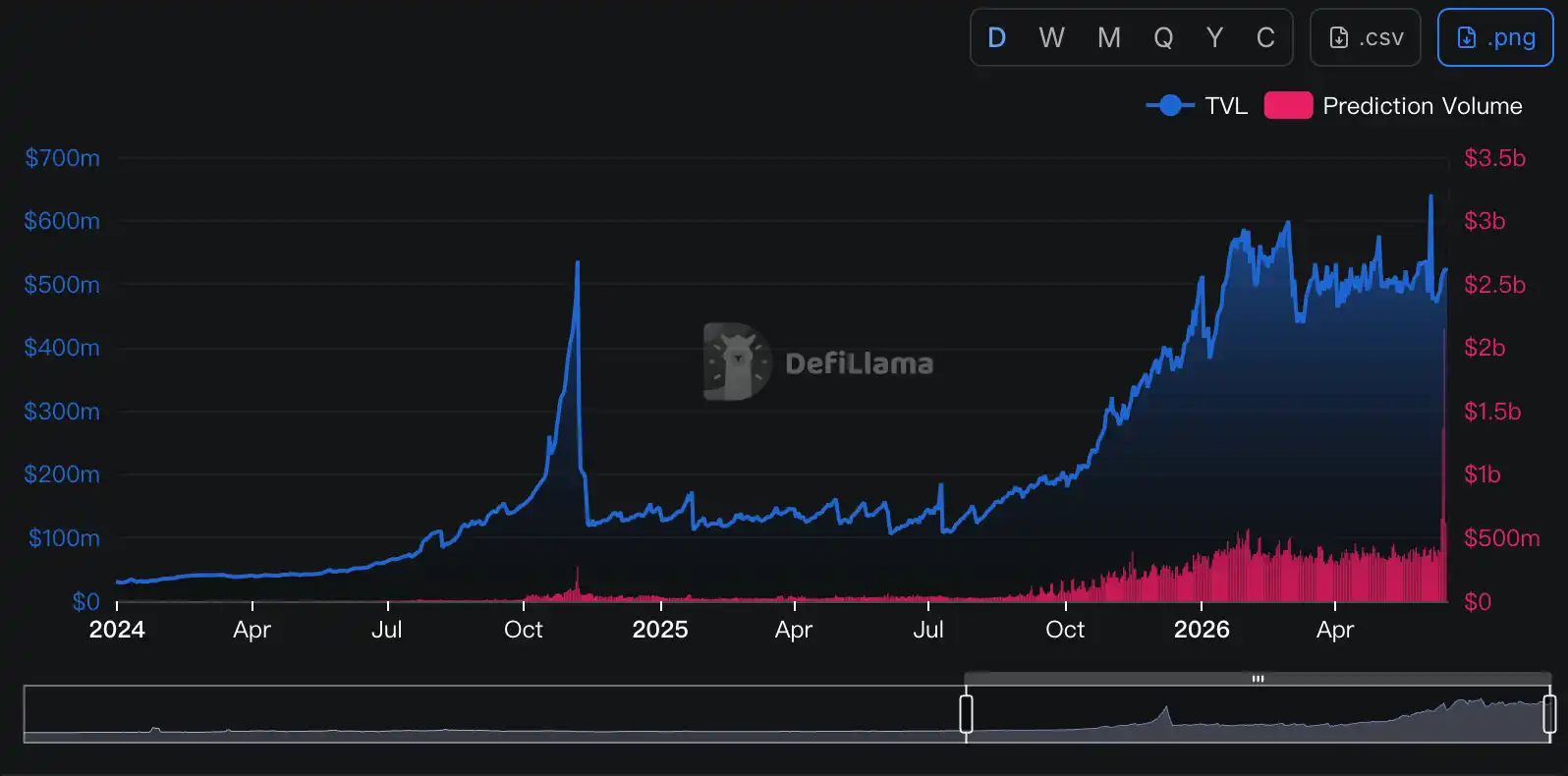
Kalshi's Most Important Traffic Channel—Robinhood
Let's turn back time to March 2025. At that time, Kalshi announced a partnership with the U.S. online brokerage Robinhood, which would leverage Kalshi to provide prediction market trading services to its users, allowing users to bet on events related to politics, economics, sports, and more.
From a business model perspective, this was a typical "mutually beneficial" arrangement—Robinhood, responsible for user entry and trade distribution, could directly use Kalshi's mature product; Kalshi, responsible for the underlying market, matching, clearing, and regulatory compliance system, could access Robinhood's massive retail user pool.
Subsequent events proved the "win-win" result of this collaboration. Through distribution on the Robinhood platform, Kalshi indirectly gained a massive user base and trading volume. Piper Sandler analysts once estimated that "the trading volume completed through the Robinhood channel accounts for approximately 25%-35% of Kalshi's total trading volume."
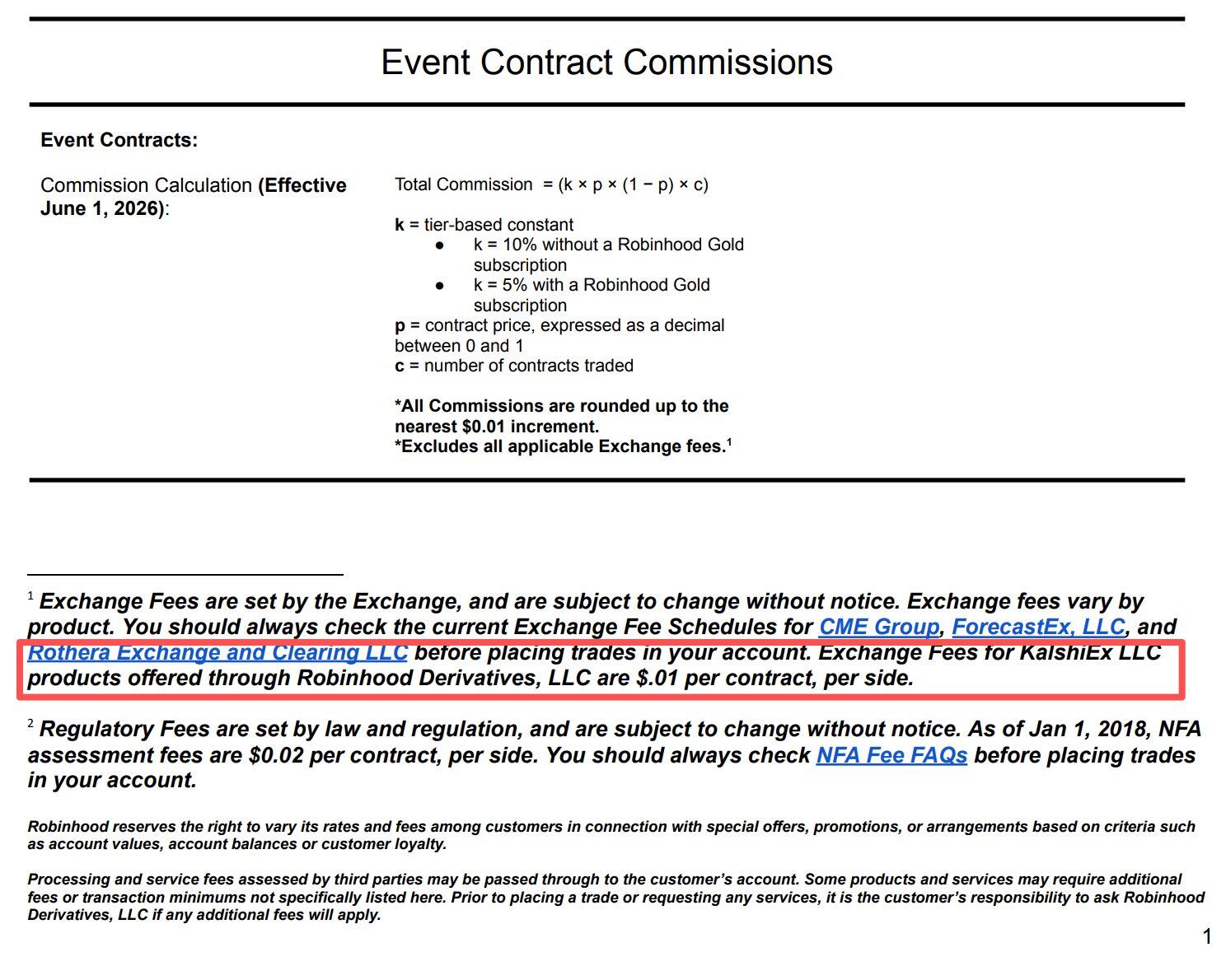
These orders eventually translated into revenue on both sides—Robinhood charges a separate fee for all Kalshi event contracts traded through its platform, charging $0.01 per contract per side, and then sharing the revenue with Kalshi (specific profit-sharing ratio undisclosed).
The Q1 financial report disclosed at the end of April this year showed that Robinhood completed 8.8 billion event contract trades in Q1 this year, driving a 320% year-on-year increase in "Other Revenue," reaching $147 million. The prediction market has become the most eye-catching new engine in Robinhood's product line.
But recently, this relationship has undergone some subtle changes.
Robinhood's Ambition: Taking Back its Share of the Kalshi Cake
As numerous instances in Internet history have proven, when a platform gains enough influence, it is not satisfied with just being a platform. Robinhood is no exception.
Although the partnership with Kalshi has brought Robinhood significant revenue, with the prediction market becoming one of the fastest-growing new businesses on the platform, Robinhood is no longer content with the current revenue-sharing arrangement.
In the collaboration model between the two parties, Kalshi was responsible for providing the market and infrastructure, while Robinhood handled user and order flow. However, as the collaboration deepened, Robinhood gradually realized that the true scarcity might not lie in the market itself, but in the user gateway it firmly controls.
After all, for most Robinhood users, they do not care whether the orders are ultimately executed on Kalshi or another platform—what users see is just a trading gateway within the Robinhood App, not the infrastructure provider behind the scenes.
In other words, Robinhood has always held one of the prediction market's most critical resources—distribution capability. Since the users belong to Robinhood, why should the orders flow elsewhere?
In fact, while Robinhood rapidly validated prediction market demand with the help of Kalshi, another set of plans was launched shortly after.
In November 2025, Robinhood announced a joint venture with Wall Street quant trading giant Susquehanna and plans to acquire the CFTC-regulated derivatives trading platform, MIAXdx. According to official statements, the joint venture will operate an independent futures and derivatives trading platform and clearinghouse in the future, with a focus on the prediction market.
At that time, the external view mostly regarded it as an infrastructure investment. However, with more information disclosed later on, people gradually realized that Robinhood's goal was far beyond finding new partners for the prediction market.
In January 2026, the transaction was officially completed. Robinhood and Susquehanna acquired 90% control of MIAXdx, along with taking over a comprehensive CFTC regulatory framework, including Designated Contract Market (DCM) and Derivatives Clearing Organization (DCO) qualifications. Subsequently, MIAXdx was rebranded as Rothera Exchange, and its clearinghouse was renamed Rothera Clearing.
At this point, Robinhood has already possessed the core elements required for operating a standalone prediction market. What is lacking is just a mature product that can be compared to Kalshi. However, for Robinhood, which has rich experience in developing internet products, this is clearly not a difficult task.
Rothera's Opportunity: World Cup
In June 2026, after about six months of accelerated development, the Rothera product gradually took shape. Robinhood finally made the move that was almost inevitable—gradually shifting the orders that originally flowed to Kalshi into its own self-controlled system.
Robinhood intentionally chose a perfect initial battlefield for Rothera—the World Cup. In terms of prediction markets, the World Cup is undoubtedly one of the most traffic-effective trading themes. Whether it is the outcome of a match, advancement results, or the champion's attribution, related markets can attract a large number of new users to participate in trading in a short period of time. For the newly launched Rothera platform, there is no better scenario for a cold start than the World Cup.
According to Robinhood's official disclosure, during this year's World Cup, which consists of a total of 104 matches, some event contracts will be directed to Rothera for matching and clearing, including markets such as the outcome of a single World Cup match, the eventual champion of the World Cup, and the total number of goals in a single match. In comparison to the previous model that was fully dependent on Kalshi, this is also the first time that Robinhood substantially imported prediction market orders into its proprietary trading system on a large scale.
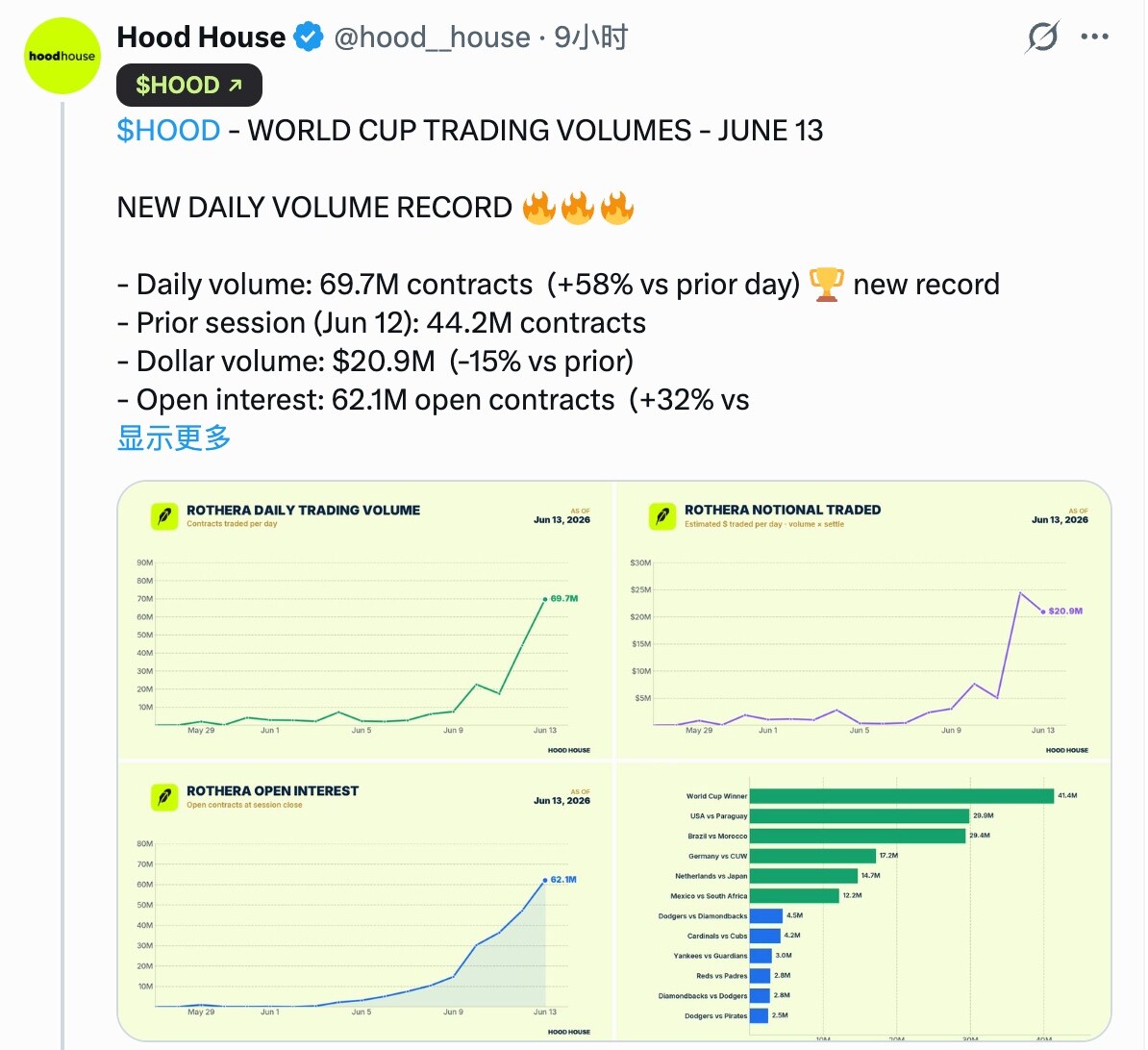
From the results, Rothera clearly seized this opportunity as well. According to data disclosed by the research and media platform Hood House that tracks Robinhood's dynamics, on June 12, Rothera completed 44.2 million contract trades, corresponding to a dollar trading volume of approximately $24.4 million; on June 13, Rothera completed 69.7 million contract trades, corresponding to a dollar trading volume of approximately $20.9 million… Although these numbers still lag behind the popular markets with billions of dollars on Kalshi, considering that Rothera had just launched a few days ago, this performance data is already quite successful.
For Robinhood and Kalshi, this means that the balance of cooperation between the two parties is beginning to tilt. Standing on Robinhood's side, the fee income that was originally shared with Kalshi can now stay more within its own ecosystem. On Kalshi's side, this signifies that one of its once most important growth engines has begun to show signs of loosening.
And the World Cup was clearly just the beginning of Rothera encroaching on Kalshi's territory. Looking further into the future, Robinhood will undoubtedly expand Rothera's coverage to more sporting events as well as themes such as economics and politics. Those orders that originally flowed to Kalshi will then be intercepted by Rothera.
Since Robinhood and Kalshi have never publicly disclosed the revenue-sharing ratio between them, we cannot know the specific value of this interception. However, considering that Robinhood achieved $147 million in forecasted market-related revenue in just Q1, and the World Cup in Q2 and further midterm elections are expected to bring even larger-scale trading activity, on an annual basis, the value of this interception may reach hundreds of millions of dollars.
Who Controls Distribution, Controls Everything
Robinhood and Kalshi's transition from allies to competitors once again illustrates a logic that has been repeatedly validated in the internet market—products are easy to build, but traffic is hard to come by; whoever controls distribution, controls everything.
Over the past few years, the market has generally believed that Kalshi's core moat comes from regulatory licenses, trading platform qualifications, and clearing capabilities. Therefore, whether it is a brokerage like Robinhood, or various media, communities, and traffic platforms, essentially they are only channels and traffic entries for Kalshi.
However, Rothera's emergence proves one thing—amid the severe homogenization of products, the product itself may not be the most important factor. What is truly scarce is users.
Where users are, there is liquidity; where there is liquidity, there is a market. When Robinhood holds the entry of tens of millions of retail users, it has the complete ability to direct these users to any trading venue. For users, they don't care whether the order is ultimately executed on Kalshi or Rothera, as long as the experience has no significant differences, it doesn't matter who is behind the matching and clearing.
If the theme of the prediction market industry in recent years has been the market rivalry between Polymarket and Kalshi, then the theme in the coming years may perhaps turn into a channel war. Robinhood incubating Rothera is essentially a reverse integration from the channel side to the market layer; and as more and more platforms with traffic entry points realize the strategic value of the prediction market, similar stories are highly likely to continue to unfold.
Whether it is a trading platform, a brokerage firm, a social media platform, or a media platform, any of them could become a new entry point for the prediction market.
And when the entry point begins to dominate the market and the channel starts to have pricing power, the ultimate winner in the prediction market industry may no longer be the platform responsible for order matching, but the one closest to the user and most able to control distribution.
This is the case in the Internet age, and it is also true in the mobile Internet age. This time, there are no surprises either.
Welcome to join the official BlockBeats community:
Telegram Subscription Group: https://t.me/theblockbeats
Telegram Discussion Group: https://t.me/BlockBeats_App
Official Twitter Account: https://twitter.com/BlockBeatsAsia
