In this World Cup, the most exciting action is not just happening on the field.
As World Cup-related prediction events heat up, more and more users are starting to participate in transactions with real money.
Topics that used to be pre-match chat among fans, such as who will win, the scoreline, potential upsets, red cards, and which player will score, have now been broken down into individual prediction events that can be traded.
When predictions turn into trades, users need more than just emotions and intuition: odds changes, team status, injury information, head-to-head history, and market sentiment all become references before trading. In this process, AI models are increasingly being brought into the World Cup prediction scene.
Large models such as Qianwen, ChatGPT, Gemini, Claude, DeepSeek, Qwen, and Copilot can not only answer "which team is more likely to win," but also provide scoreline predictions, identify potential upsets, assess red card risks, analyze key player performances, and predict match trends. For participants in the prediction market, AI's pre-match analysis is becoming another layer of reference beyond odds, news, team data, and market sentiment.
However, ultimately, predictions still come back to the matches themselves.
With the World Cup officially underway, the results of the first few matches have been revealed. The AI analyses that users relied on before the matches to assist their judgments now finally have tangible answers to compare with: Did they predict the correct scores, foresee any upsets, identify red cards, last-minute goals, or accurately capture the flow of the matches?
The First to Gain Attention was surprisingly Qianwen
The most entertaining moment on the first day of the World Cup was undoubtedly brought by Qianwen.
In the opening match between Mexico and South Africa, Qianwen predicted a 2-0 victory for Mexico. After the match, the scoreline did end up being 2-0. The highlight was that a total of three red cards were shown during the game, which closely matched Qianwen's pre-match risk assessment indicating that "South Africa's defensive actions were too aggressive, possibly leading to an early red card and playing with one less player."
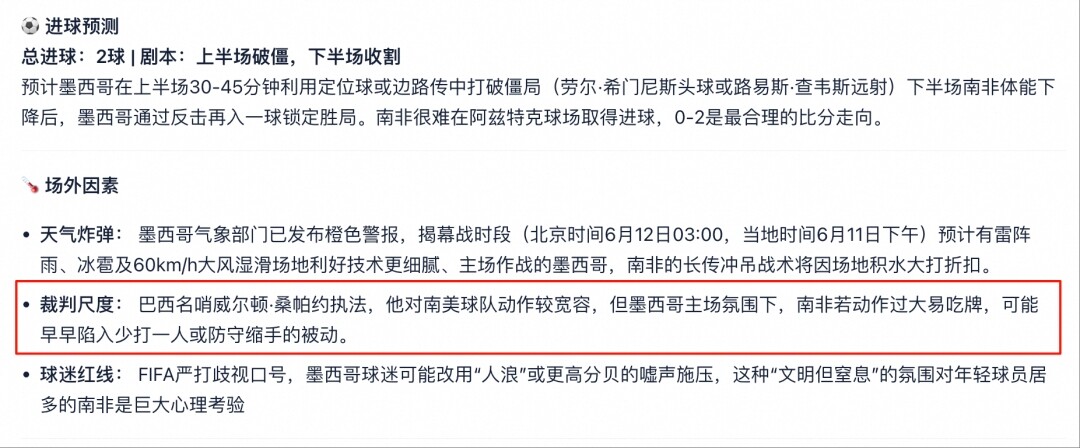
If only predicting Mexico's win, it would not have been too surprising. As one of the host nations, Mexico itself was already a favorite. However, Qianwen hit the mark on more specific match details this time: a 2-0 scoreline, the red card risk for South Africa, and the gradually opening pace of the game in the later stages.
Next, in the match between South Korea and the Czech Republic, Qianwen once again predicted a 2:1 victory for South Korea.
This match was not easy to predict. The Czech Republic excels in physicality, poses a threat from set pieces, and boasts the typical big tournament experience of a European team. The game itself was evenly matched, with the Czech Republic taking the lead first, South Korea equalizing later on, and the score remaining 1:1 for a long time. It wasn't until the final stages that South Korea scored the winning goal, resulting in a final score of 2:1.
With this outcome, Qianwen's prediction gained a stronger sense of "dramatic flair." While predicting the winner can rely on the teams' capabilities, forecasting the exact score may involve an element of luck. However, details such as red cards, comebacks, and late-stage winning goals truly make the prediction more compelling. After the first two matches, Qianwen has already increased the attention on AI predicting the World Cup.
Copilot: Brilliance and Obvious Missteps
Prior to the matches, USA Today had Copilot predict all 104 games of this World Cup. Looking at the matches that have concluded so far, this prediction had both shining moments and noticeable errors.
Among them, three match predictions stood out.
In the opening match between Mexico and South Africa, Copilot predicted a 2:0 victory for Mexico, which turned out to be correct. In the South Korea versus Czech Republic match, it forecasted a 2:1 win for South Korea, aligning with the actual result. Then, in the Brazil versus Morocco match, Copilot once again provided a 1:1 prediction, and Brazil indeed ended up with a draw against Morocco.
Especially noteworthy was the Brazil 1:1 Morocco match. Brazil is, after all, a traditional football powerhouse, ranking top in both squad quality and attention.
Although Morocco reached the semifinals in the previous World Cup, predicting a draw against Brazil directly before the match was not a particularly safe choice. After the game, Brazil failed to secure an opening win, and Morocco continued to show their resilience in major competitions. Copilot's prediction in this match was indeed a stroke of genius.
However, Copilot's shortcomings quickly emerged.
It predicted Canada would beat Bosnia and Herzegovina 2:1, but the match ended in a 1:1 draw; forecasted Switzerland to narrowly win 1:0 against Qatar, yet Switzerland was also held to a draw; and predicted the USA would defeat Paraguay 2:0, although the actual score was 4:1, underestimating the offensive intensity.
More obvious missteps occurred in several matches where there were surprising upsets or top teams were thwarted.
In the Turkey versus Australia match, Copilot predicted a 2:1 victory for Turkey, but Australia caused an upset with a 2:0 win. In the Ecuador versus Ivory Coast match, it predicted a 2:1 win for Ecuador, but Ivory Coast emerged victorious with a 1:0 scoreline. In the Netherlands versus Japan match, it foresaw a 2:1 win for the Netherlands, but Japan equalized twice, resulting in a 2:2 draw. For the Sweden versus Tunisia match, it predicted a 1:1 scoreline, but Sweden dominated with a 5:1 victory.
Copilot was able to predict the exact scores of specific matches in Mexico, South Korea, and Brazil, showing that it doesn't just follow popular teams to provide answers. However, its predictions for Australia defeating Turkey, Qatar drawing with Switzerland, and Japan drawing with the Netherlands also revealed that its judgment of underdogs and draws is still somewhat conservative.
ChatGPT: Comprehensive Analysis, but Misses on Underdogs
Compared to Copilot's comprehensive match predictions, ChatGPT is more like a "pre-match analysis-oriented player".
In its opening match prediction, ChatGPT predicted Mexico to win 2-0 against South Africa, and the final score matched. Its reasoning was also thorough, including Mexico's home advantage, recent form, South Africa's lack of attack, and factors such as Mexico City's high altitude and home atmosphere. This time, ChatGPT not only provided the result but also aligned the reasoning behind it with the match outcome.
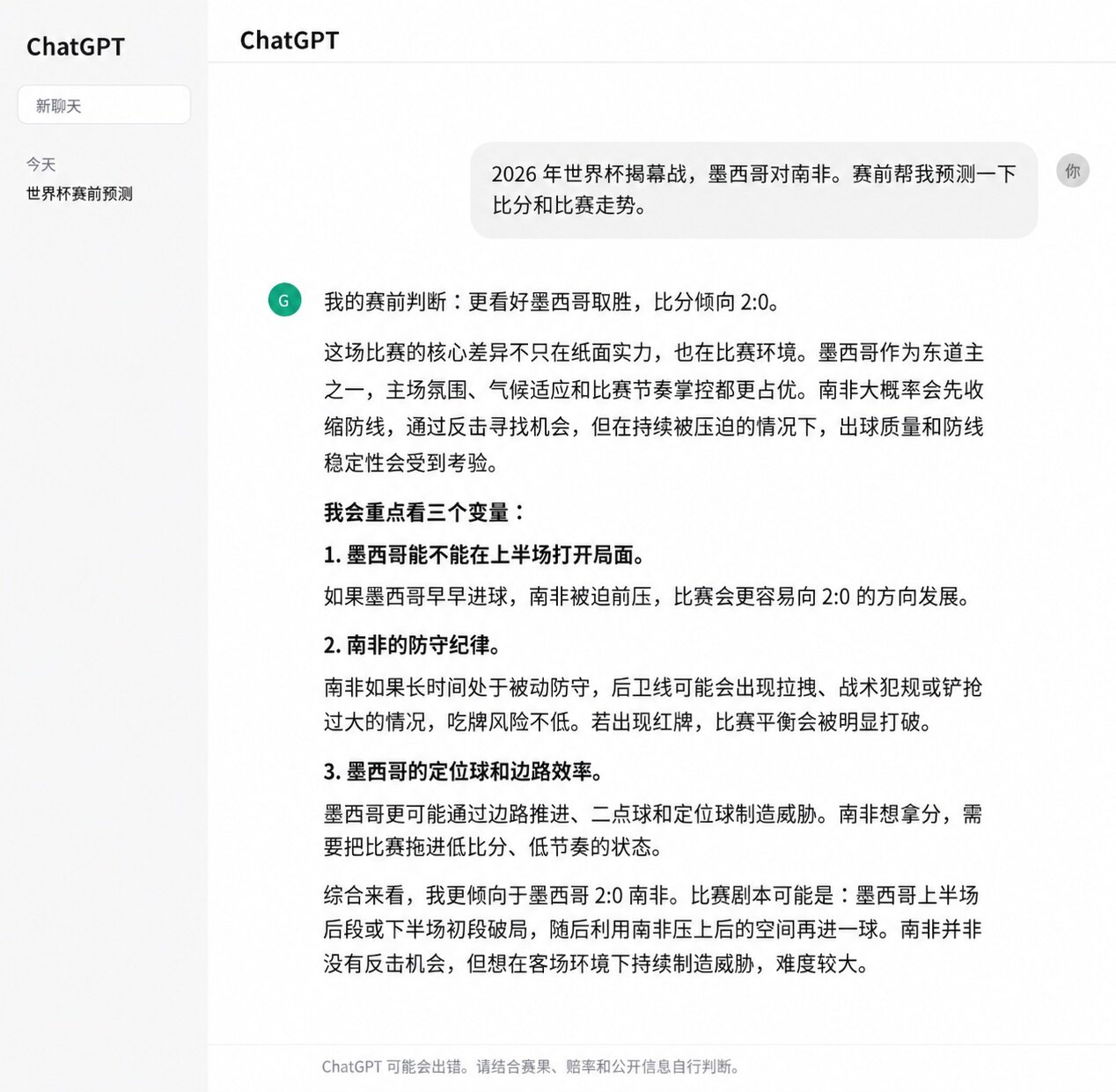
However, when it came to predicting the entire World Cup schedule, ChatGPT's consistency was not as strong. Although it correctly predicted Mexico 2-0 South Africa and Brazil 1-1 Morocco, and also got the direction of victory right in several matches like Scotland, Germany, and Sweden. But in matches like South Korea 2-1 Czech Republic, Qatar 1-1 Switzerland, Australia 2-0 Turkey, and Japan 2-2 Netherlands, ChatGPT's predictions favored the teams with higher perceived strength on paper. For example, Switzerland should have beaten Qatar, Turkey should have beaten Australia, and the Netherlands should have narrowly defeated Japan.
ChatGPT does have predictive ability; it can analyze team strengths, home environments, and recent form very clearly, and it can accurately predict scores in some matches. However, based on the current results, it is better at explaining "why the popular team is more reasonable" rather than identifying in advance which matches might deviate from the popular script.
Gemini, Grok, Claude: Different Models Writing Different Scripts for the Same Match
In addition to Qianwen, Copilot, and ChatGPT, some social media users fed the same match to multiple models for pre-match predictions.
Using the opening match between Mexico and South Africa as an example, a blogger simultaneously tested ChatGPT, Gemini, Grok, and Claude, four AI models, for pre-match predictions. The results showed that ChatGPT and Gemini both predicted a 2-0 win for Mexico against South Africa, and the final score was spot on; Grok predicted a 2-1 win for Mexico, Claude predicted a 3-1 win for Mexico, although both correctly foresaw Mexico's victory, they did not predict the exact score.
The prediction for this opening match presented three different 'scripts' according to various models. ChatGPT Go and Gemini Pro were closer to the actual game: Mexico had the upper hand, South Africa's offense was weak, and they were ultimately shut out. Grok provided a more open-ended score, suggesting that South Africa would score on a counterattack. Claude Sonnet, on the other hand, raised Mexico's offensive expectations, resulting in a more lopsided 3-1 outcome.
Summary
Due to the limited number of AI prediction samples available for reference, it is currently not possible to definitively determine which model understands football the best.
However, based on the few matches that have already concluded, differences are starting to emerge. Qianwen has been the standout so far, correctly predicting Mexico's 2-0 victory over South Africa, Korea's 2-1 win against the Czech Republic, as well as foreseeing red card risks and match trends, showcasing strong performance in a small sample size. Yet, further validation through more matches is needed to confirm its consistency.
Both Copilot and ChatGPT have successfully predicted specific scores, but they have also revealed a common issue—in matches where Australia defeated Turkey, Qatar drew with Switzerland, and Japan drew with the Netherlands, deviating from the teams' on-paper strengths, their judgments have not been sufficiently sensitive.
As for models like Gemini, Grok, and Claude, their publicly available samples are mostly focused on individual matches or social media comparisons. While they provide some reference value, they are not yet suitable for direct rankings.
AI has become a layer of reference for World Cup prediction market users, but it is far from being the definitive answer.
Welcome to join the official BlockBeats community:
Telegram Subscription Group: https://t.me/theblockbeats
Telegram Discussion Group: https://t.me/BlockBeats_App
Official Twitter Account: https://twitter.com/BlockBeatsAsia
