Stablecoins used to be just a dollar tool in the crypto industry, but now they have become crypto's savior.
Traders use them for buying and selling, DeFi relies on them for lending and collateral, and cross-border users use them to bypass banks and borders. They may seem like just infrastructure within the crypto market, but as their scale grows, their nature changes. When a stablecoin grows large enough to buy U.S. short-term debt, cater to global dollar demands, and alarm U.S. regulators, it no longer remains just a dollar stand-in on-chain but begins to function as a new distribution network for the dollar system in the digital finance era.
With the advancement of the GENIUS Act in the United States, establishing a gradual stablecoin regulatory framework, stablecoins have received a clearer federal regulatory framework in the U.S. For established players, this raises the bar; for new players, once the rules are laid out, it means the gaps for disruption are being leveraged. USD1 and WLFI hit upon exactly this gap.
If USD1 is merely seen as another dollar stablecoin and WLFI as another crypto project bearing the Trump family label, this story would appear too superficial.
Stablecoin Competition Shifts from Product Upgrades to Institutions
Over the past few years, stablecoin competition has primarily focused on liquidity and channels.
USDT excels in trading platforms and global circulation. Many users use USDT not because they have researched its reserve structure but because it is supported everywhere. USDC's strength lies in compliance and institutional interfaces. For institutions, DeFi protocols, and U.S.-based partners, USDC is more readily accepted.
However, post the GENIUS Act, stablecoin competition has added an additional layer of barriers.
The Act requires that payment stablecoins have full reserves, monthly disclosures, and a more defined issuer admission system. Stablecoin issuers need to meet requirements such as reserves, audits, AML, and sanctions compliance. While these terms may not be appealing to the average trader, for stablecoins, they determine whether an asset can enter a larger financial system.
As stablecoins grow larger, they get closer to banking and the money market. They serve not only on-chain traders but also encounter issues related to payments, remittances, reserve management, treasury demand, and financial stability. At this point, compliance is no longer just a cost but also starts to become a ticket. Looking deeper, the compliance of stablecoins also holds practical significance for the U.S. A compliant USD stablecoin is typically backed by cash, bank deposits, and short-term U.S. Treasury bonds. Every additional globally accepted stablecoin on-chain represents an additional demand for dollar-denominated assets. While in the past, the dollar expanded outward through the banking system, trade settlements, and offshore markets, stablecoins now provide a new distribution channel for the dollar in the digital finance era. For the U.S., this isn't a weakening of the dollar system but an extension of the dollar's reach in the digital finance era.
This is the opportunity for the next-generation stablecoins. Existing players have scale and momentum. New entrants find it challenging to directly challenge USDT with a better user experience, and it's also difficult to immediately surpass USDC with enhanced compliance. However, after the regulatory changes, new players can redesign their products, reserve structure, distribution channels, and political narratives around the new regulatory framework.
The uniqueness of USD1 lies here. It emerges not during the most chaotic period of stablecoin regulation but at a time when U.S. stablecoin rules are gradually becoming clearer, the Trump administration openly embraces digital assets, and the U.S. policy narrative starts shifting towards the era of on-chain dollars.
In a race where the rules are being rewritten, being the first to enter within the rules is an asset in itself.
The Key Strengths of USD1 are its Policy Window and Robust Distribution Channels
While the stablecoin market may seem low-entry, it is deceptively challenging. In the DeFi era, there are dozens, if not hundreds, of stablecoins, but only a few survive.
Traders are already accustomed to USDT, and institutions are more inclined to accept USDC. For DeFi protocols integrating a new stablecoin, they need to consider liquidity, price stability, smart contract risks, reserve transparency, and redemption experiences. Liquidity providers are not quick to invest just because of a new name.
Therefore, the most challenging aspect for a new stablecoin is not issuance but getting others to actually use it as money.
USD1's cold start is notably stronger. In March 2025, World Liberty Financial launched USD1. Subsequently, MGX settled a $2 billion investment in Binance using USD1, rapidly tagging USD1 for institutional settlement scenarios. Such a starting point is rare for a new stablecoin.
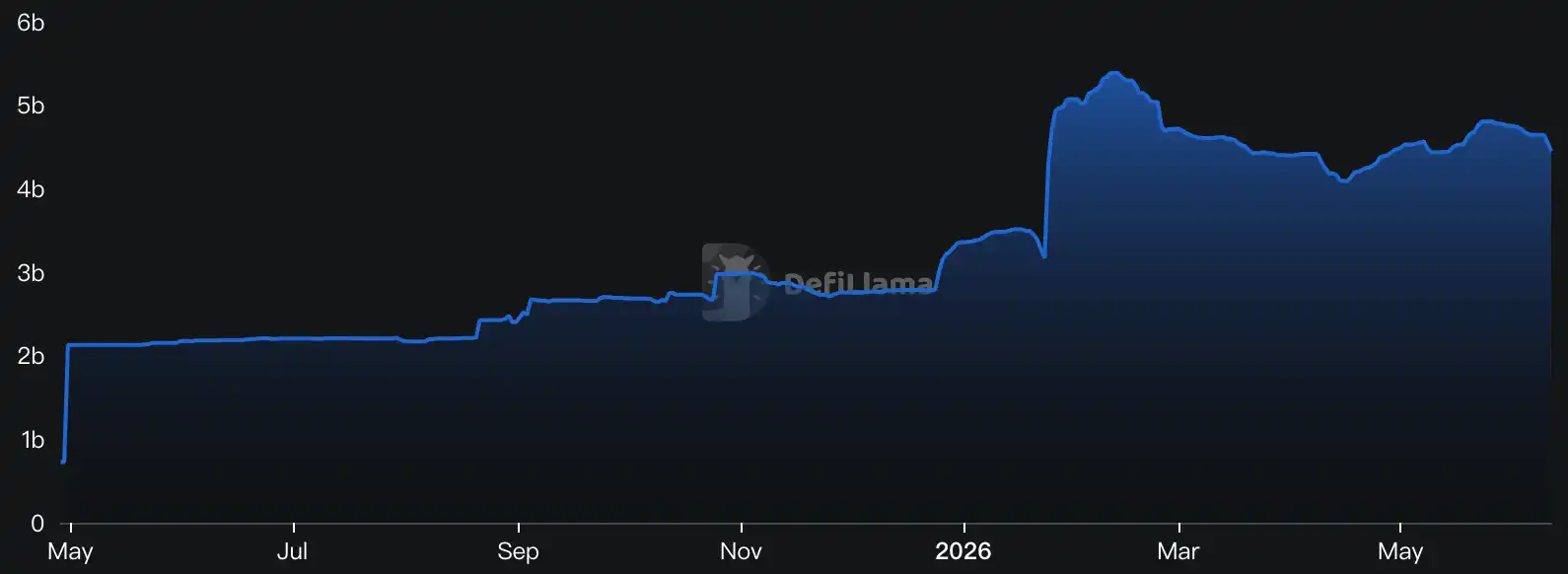
Subsequent data also shows rapid growth for USD1. Within a little over a year of its launch, it entered the top ranks of global stablecoins, at one point reaching a circulation scale of billions of dollars. Stablecoins are not like meme coins that can rise solely based on emotions. The expansion of stablecoin scale typically requires issuance, custodianship, trading platforms, market-making, reserves, and usage scenarios to work together.
However, USD1's growth structure also has notable issues. Public on-chain analytics indicate that at one point, Binance-related wallets held around 87% of the USD1 supply. During this process, USD1 achieved rapid growth from a circulation level of hundreds of millions to over $4 billion. This data shows that Binance is the core channel for the rapid bootstrapping of USD1 and also indicates that USD1's distribution structure is not yet fully decentralized.
This is both an advantage and a risk.
The advantage is that the most difficult part of a stablecoin is achieving a cold start. As the world's largest cryptocurrency exchange, Binance provided USD1 with the highest traffic entry point and trading scenarios, eliminating the need to educate users from scratch. The risk is that if a stablecoin's supply is highly concentrated on a single exchange, its network may appear large but is still structurally fragile. Once the exchange's strategy changes, incentives decrease, or market confidence fluctuates, liquidity can also be quickly affected.
Therefore, the most important question for USD1 in the next phase is whether it can expand from a single strong channel to other areas.
Structure is More Reliable Than Ranking
When looking at stablecoins, one should not only consider their market capitalization ranking. Market capitalization ranking can only indicate how much has been minted, not how the stablecoin is being utilized. USD1's growth path is quite unique: it initially opened up awareness through large institutional settlements, then relied on Binance to achieve rapid distribution, and subsequently expanded to a multi-chain ecosystem and payment scenarios.
The initial volume of USD1 came from very specific large-scale settlement events. In May 2025, Zach Witkoff, co-founder of World Liberty Financial, stated at TOKEN2049 in Dubai that the Abu Dhabi investment firm MGX settled a $2 billion investment in Binance using USD1.
In terms of scale, USD1's growth rate has indeed been rapid. Public data shows that USD1 was launched on the Ethereum and BNB Chain in March 2025, and by the first quarter of 2026, the circulating supply had reached nearly $4.5 billion. This scale allowed it to quickly rise to the forefront in the stablecoin market and become one of the fastest-growing fiat-backed stablecoins in this round of growth.
The structure of USD1 during its rapid growth is not uniform. The most critical data comes from Binance. A blockchain analysis by Forbes in February this year showed that approximately 87% of the USD1 supply is held in wallets related to Binance. This data partly explains why USD1 was able to rapidly grow but also indicates that its distribution still heavily relies on a single exchange. For new stablecoins, Binance serves as the most effective cold start entry point. It can instantly bring users, trading depth, and usage scenarios. However, if the supply remains concentrated on one platform for an extended period, USD1 appears more like an exchange-distributed stablecoin rather than a fully-fledged on-chain dollar network.
It is for this reason that the focus of USD1's subsequent actions is shifting from where it trades to where it is used.
From a multi-chain ecosystem perspective, according to the USD1 website, it has already integrated with networks such as Ethereum, BNB Chain, Plume, Tron, and Solana, providing cross-chain bridges and a reserve report portal. BNB Chain has taken on early transactions and Binance ecosystem distribution, Ethereum offers mainstream assets and institutional recognition, and Solana is more suitable for high-frequency payments and on-chain transactions.
Looking at reserve transparency, the USD1 website specifically states that USD1 can be redeemed 1:1 for the US dollar, with the reserve backed by the US dollar and US government money market funds, and reserve reports are released monthly. World Liberty Financial has also launched the USD1 Proof of Reserves page, utilizing Chainlink's data feed to display reserve and supply-related information.
In terms of use cases, USD1 is also attempting to transition from being solely a balance on trading platforms to a broader US dollar entry point. Tempo corresponds to stablecoin payments and AI Agent payment scenarios, World Swap corresponds to on-chain forex and cross-border remittances, DeFi lending corresponds to collateral and yield demands, and the payment card brings on-chain dollars back to real-world spending.
Therefore, based on the current data, a clear conclusion can be drawn about USD1: it has already achieved a very strong cold start and is gradually expanding towards multi-scenario and multi-network integration.
Making USD1 the Value Engine of WLFI
Many cryptocurrency projects face a common issue: the project performs well, but the token does not experience growth. This is even a major obstacle to the development of cryptocurrencies.
The protocol has Total Value Locked (TVL), but the token lacks cash flow. The product has users, but the token is merely a governance symbol. While the stablecoin market is growing, related tokens can only rely on speculative price fluctuations. Eventually, the market will realize that there is no true channel between the product's value and the token's value.
If the issuance, trading, redemption, lending, and payments of USD1 can generate fees or other economic benefits, and these benefits flow into WLFI through burning, buyback, distribution, or governance rights, then WLFI may transform from a political concept asset into a value capture layer for stablecoin business.
The team has already begun to take several actions.
One is the protocol's self-owned liquidity fee buyback and burn. In other words, if the liquidity provided by the protocol generates transaction fees, a portion of these fees is used to buy back WLFI on the market and then send it to a burn address.
The second step is to refactor the supply side. According to public reports, WLFI has implemented longer-term lock-in and release arrangements for early investors and insiders, including a design that involves a 10% burn of a portion of insiders' holdings. Such arrangements can alleviate short-term unlocking pressure and demonstrate to the market the team's proactive management of the long-term circulating structure.
The third step is to expand the ecosystem. USD1 is responsible for providing the on-chain dollar base, World Liberty Markets for corresponding lending demand, World Swap for on-chain forex and cross-border remittances, while payment cards and a retail app bring the on-chain dollar to real-world consumption scenarios. When these actions are viewed together, WLFI is not just relying on the stablecoin narrative but is building a set of transaction, lending, payment, and settlement networks around USD1.
For a rapidly expanding nascent ecosystem, this supply-side adjustment and product-side advancement are in themselves signs of its ongoing progress.
AI Payments as a Future Option for USD1
AI Payments are not yet the main growth driver for USD1, but this direction no longer needs to educate the market again. Stripe and OpenAI jointly released the Agentic Commerce Protocol, while Visa is also collaborating with OpenAI to explore payment capabilities within ChatGPT, indicating that AI agents entering payments and commercial flows is a direction that both payment giants and AI giants are proactively laying the groundwork for.
Therefore, USD1's integration with Tempo is not just about adding another chain; more importantly, it opens the door to the AI field through Tempo.
This can be compared with USDC. Circle is promoting its Arc, aiming to place USDC into a dedicated chain for payments and tokenized finance. In other words, USDC is strengthening its stablecoin network with its own infrastructure. While USD1 does not have the mature issuance history and institutional backing that Circle has, by choosing Tempo, it is essentially leveraging the payment infrastructure behind Stripe and Paradigm to seek a pathway that directly competes with USDC.
The value of Tempo lies in its association with Stripe. Stripe itself is one of the world's most important payment infrastructures and deeply serves AI companies. According to official Stripe data, it is the financial services platform for 78% of the companies in the Forbes AI 50 list, with customers including OpenAI, Anthropic, Midjourney, and Cohere. For USD1, accessing such a payment chain means not just immediately contributing a significant transaction volume in the short term, but having the opportunity to enter the payment network where AI companies, developers, merchants, and programmatic payment scenarios reside.
Binance tackled the distribution issue at a $1 level, allowing it to quickly gain users, trading depth, and market awareness. Tempo, on the other hand, is aiming at the next generation of payment needs, especially AI-driven payments, cross-border transactions, on-chain settlements, and merchant payments. One is responsible for jumpstarting the ecosystem, while the other is responsible for long-term ecosystem expansion.
From Momentum to Establishment
In the first 14 months of USD1, it has accomplished the most challenging initial phase for a new stablecoin—being acknowledged by the market.
Through regulatory support, large institutional settlements, and trading platform distribution, it rapidly joined the ranks of leading stablecoins. For an asset scheduled for release in 2025, this speed is compelling in itself. The stablecoin market is not yet fully settled, and as long as the regulatory framework, the narrative around the US dollar, distribution channels change, new players still have opportunities to enter the game.
Next, USD1 needs to demonstrate its transition from strong channel distribution to multi-scenario utility. WLFI, on the other hand, needs to prove its ability to sustainably accommodate the growth of this ecosystem.
In the early stages, focusing on resources and speed, USD1 has been successful. In the growth phase, focusing on utility and establishment, it needs to transform its political advantage into real-world use cases, converting balances on trading platforms into USD liquidity used in payments, lending, settlements, and consumption. If this phase is successful, USD1 will not just be a new player in the stablecoin arena. It will become one of the most intriguing case studies as stablecoins move into the political era.
Welcome to join the official BlockBeats community:
Telegram Subscription Group: https://t.me/theblockbeats
Telegram Discussion Group: https://t.me/BlockBeats_App
Official Twitter Account: https://twitter.com/BlockBeatsAsia
