On October 15, on-chain data firm Allium released a report stating that stablecoin payment volume reached $482 billion in the first nine months of 2026, up 45% year-over-year, while stablecoin supply grew only 0.4% over the same period to about $305 billion. Payment volume is rising while supply has barely moved, which suggests that stablecoins have shifted from "hoarded on-chain" to "spent."
In the same week, Mastercard launched Stablecoin Security (a stablecoin risk-control API), Visa via Mesh connected wallet balances to about 175 million merchants, and Stripe expanded its multi-currency stablecoin card to more than 65 countries. Stablecoin card providers are making increasingly large moves.
Within $482 billion, shopping accounts for only a small slice
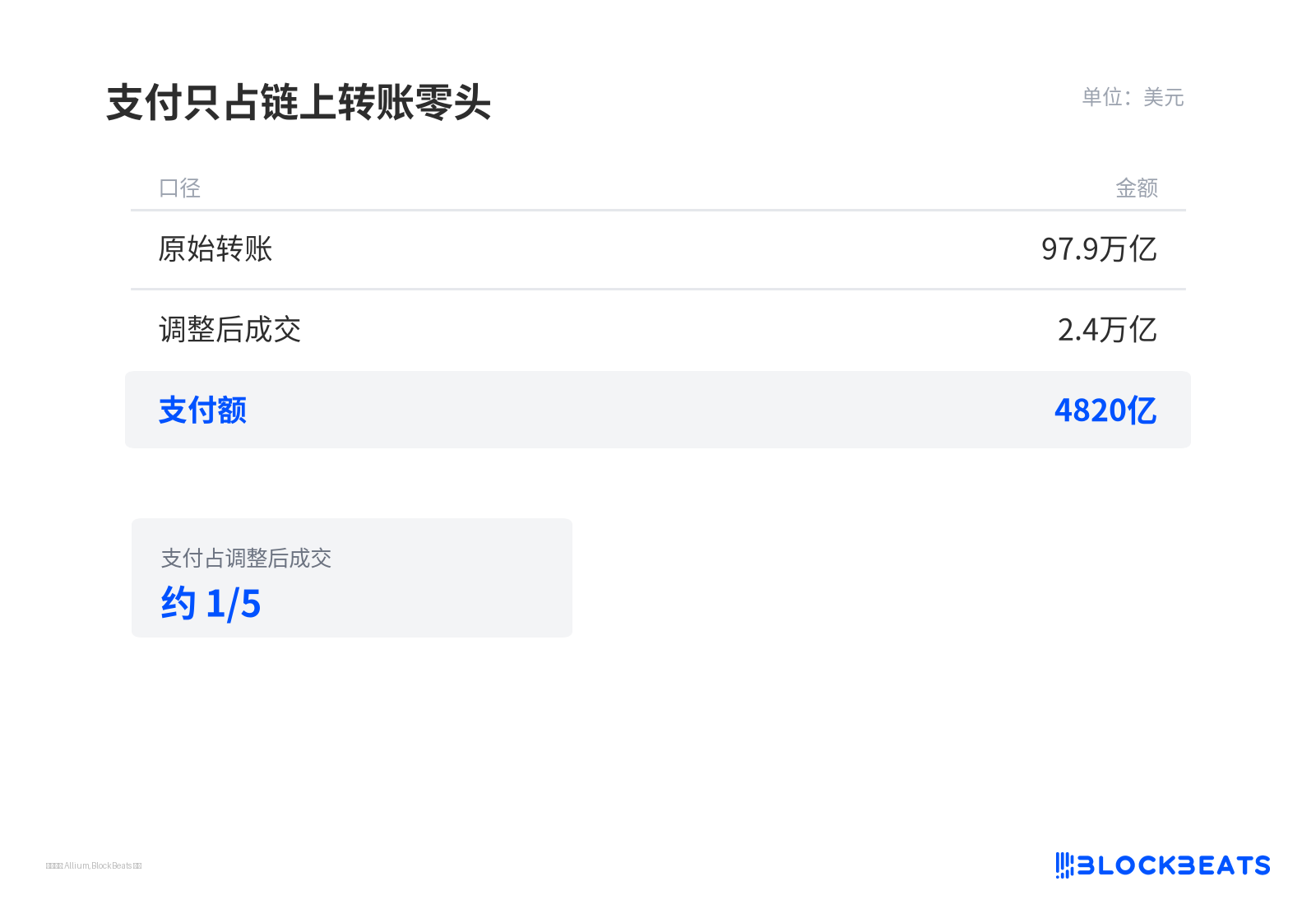
Allium measures payment volume, not the merchant acceptance volume in Visa's quarterly reports. It stripped exchanges, DeFi, and infrastructure transfers from the raw $97.9 trillion in stablecoin transfers, leaving about $2.4 trillion in "adjusted transactions," accounting for only 2.5%. Payment categories were about one-fifth of that, or $482 billion. The vast majority of on-chain transfers remain internal financial circulation, and the share that lands in payments is very low.
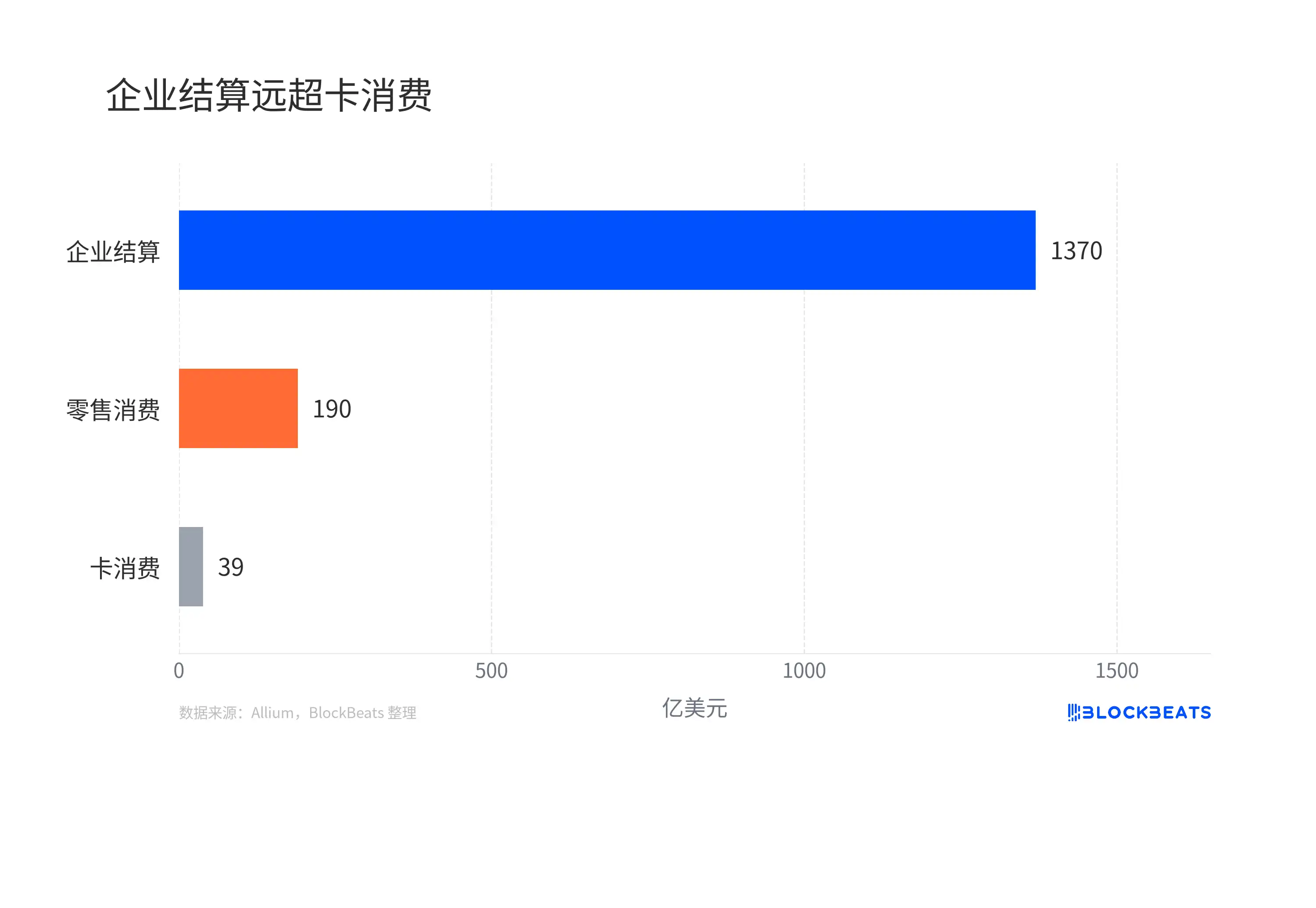
Everyday consumption accounts for an even smaller share. Stablecoin card spending in the first nine months was $3.9 billion, up about 10x year-over-year, but relative to Visa's roughly $4 trillion in quarterly payment volume, that is only about 0.03%.
According to Allium's classification, enterprise receipts accounted for 58% to 64% of payment volume from January to August, business-to-business settlement was about $137 billion to $153 billion, and retail consumption was only about $19 billion. The main battlefield is not swiping cards in shopping malls.
Supply static, payment volume driven by faster turnover
Supply is barely moving, yet payment volume is rising—the key is velocity of circulation.
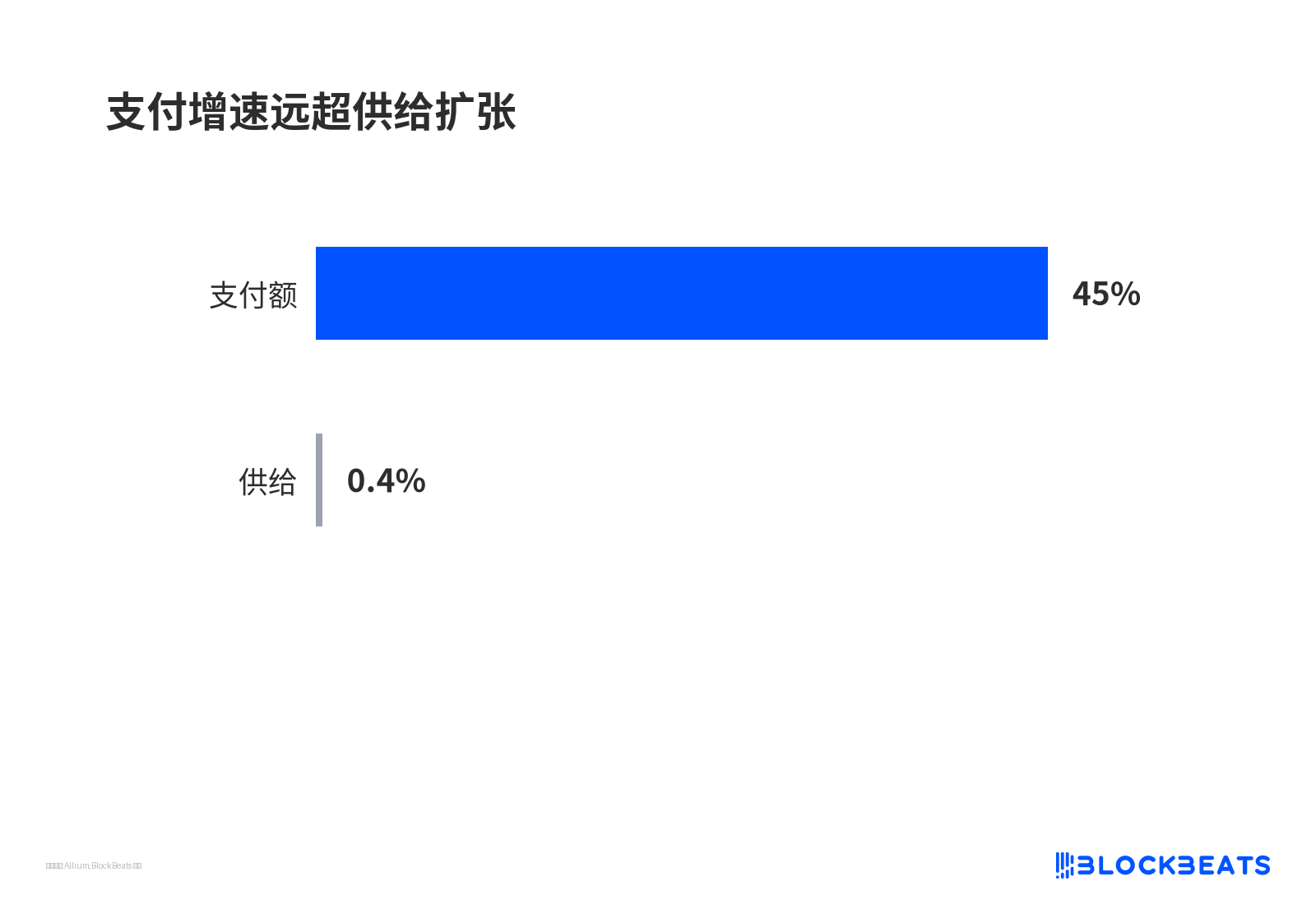
With the same roughly $305 billion in tokens changing hands more frequently, total payment volume can expand. Payment count grew 71% to 1.04 billion transactions, with the average transaction size falling from $544 to $462. September alone saw $72 billion in payment volume, up 51% year-over-year in Q3.
This turnover cycle is mainly occurring on USDT and the Tron network. USDT accounts for 84.2% of payment volume, with Tron contributing about two-thirds. It looks more like enterprises, cross-border merchants, and payroll distributors conducting more frequent on-chain settlements rather than ordinary consumers making everyday purchases. Once inter-enterprise settlements or cross-border activity cools, payment volume could fall back just as quickly.
For issuers like Circle, without supply expansion, issuance revenue lacks incremental growth—payment volume growth does not directly translate into its revenue.
Card networks target acceptance and risk-control fees
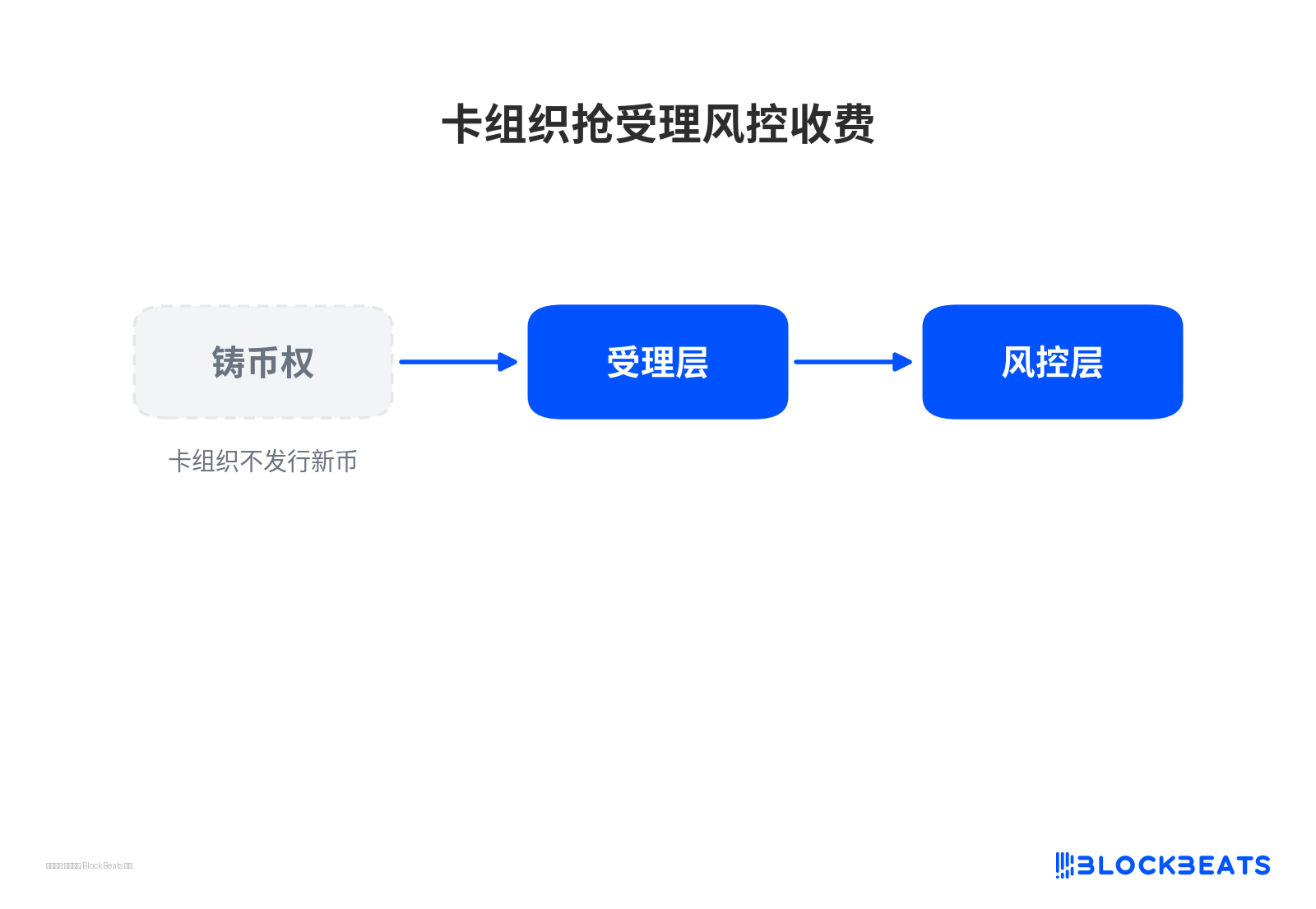
Card networks see the opportunity, but what they are capturing is the fee rights over acceptance, conversion, and risk control—not the right to issue coins. Mastercard's Stablecoin Security, released on October 19, is an API that adds risk-control intelligence to existing stablecoin flows, launching first in North America with a global commercial target set for 2027. Mastercard executive Ann Johnson positioned the selling point around risk control and compliance, not issuing another new coin.
Visa is taking the acceptance layer. Mesh CEO Bam Azizi framed the problem as "the last mile"—stablecoins sit in wallets, but what's missing is a direct spending outlet. After Mesh's partnership with Visa, participating wallets can convert stablecoin balances into Visa credentials for spending at approximately 175 million merchants, with merchants still receiving local fiat currency.
Launch dates and wallet lists have not yet been announced. Stripe and Plasma's multi-currency stablecoin card follows the same logic—connecting on-chain balances back to existing acceptance networks and charging conversion, risk-control, and settlement fees. None of the three touches minting rights; they only provide connectivity and charge fees.
Remittance Duo Issues Tokens: Guard Balances First, Scale Later
Western Union's USDPT is issued by Anchorage on Solana, launched in May, with on-chain circulating supply of about $17.5 million in October. MoneyGram's MGUSD is built on Stellar, and its new global app in October integrates remittances, cash withdrawals, and stablecoins. Both want to keep customer balances inside their own wallets and cards, reducing reliance on correspondent banks and remittance rails.
But scale remains negligible. USDPT is a rounding error against the $305 billion stablecoin supply, and MoneyGram has not disclosed comparable on-chain scale. Western Union's stock is down about 70% over five years, and its app active users fell year over year in September—fundamental pressure has not disappeared because of token issuance. What can be confirmed now is strategic positioning; it cannot yet be written that the remittance duo has defended the market with its own stablecoins.
On-Chain Settlement Speeds Up, but Replacing Card Swipes Is Still Far Off
The judgment supported by current evidence is that stablecoin stock turnover is rising, with incremental growth mainly in on-chain enterprise settlement, cross-border payments, and payroll, while card spending remains a small fraction. This week's card network products are about capturing fee rights in acceptance, conversion, and risk control—and they come later than the data period. The rails are being laid, but that is not enough to prove stablecoins have replaced everyday card swipes.
The biggest uncertainty comes from Allium's payment tags. They are rule-based inferences, not merchant receipts, and misclassification risk affects the quality of the $482 billion figure. Actual transaction volume, wallet adoption, and MGUSD scale for this week's products have not been disclosed. Federal rules under the U.S. GENIUS Act (the federal stablecoin bill) are still being finalized; the compliance rails are taking shape, but the effective date has not been fully settled.
If card spending in Q4 remains in the single-digit billions of dollars, USDPT and MGUSD fail to reach meaningful scale, and Allium payment volume continues to be driven higher by inter-enterprise settlement turnover in USDT and Tron, then this round of the story still belongs to faster on-chain settlement. Only when wallet-native payments and card spending begin to scale up will fee rights migrate from the acceptance layer to new entry points.
Welcome to join the official BlockBeats community:
Telegram Subscription Group: https://t.me/theblockbeats
Telegram Discussion Group: https://t.me/BlockBeats_App
Official Twitter Account: https://twitter.com/BlockBeatsAsia
