Hyperliquid's Season 3 airdrop has another noteworthy clue.
On October 19, Hyperliquid's policy advocacy group HPC submitted a comment letter to the U.S. Securities and Exchange Commission (SEC). It seeks regulatory clarity on the treatment of a type of airdrop: rewards distributed by a project on an already fully operational network based on users' own activity or contributions, where the rewards can be announced in advance, distributed multiple times, or executed according to predetermined rules.
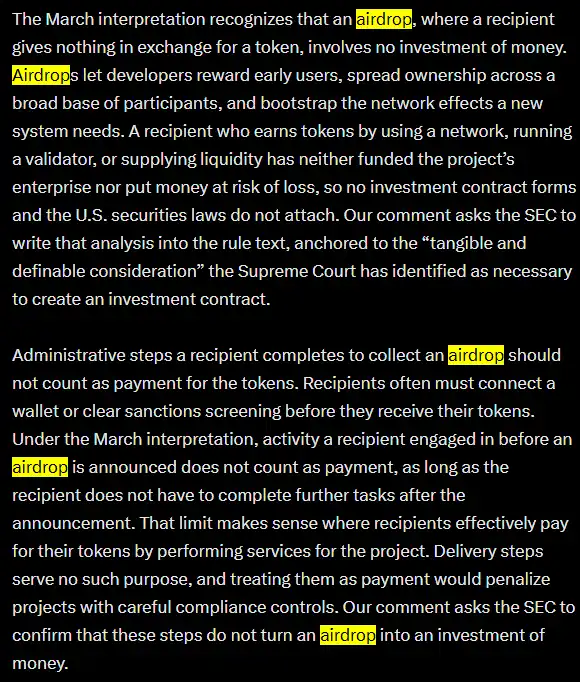
For users anticipating a Hyperliquid airdrop, "can be distributed multiple times" is especially important. If Hyperliquid decides to continue rewarding participants, the rules HPC is advocating for could help it reduce some legal concerns.
What Is an Airdrop
The airdrops HPC hopes to explicitly cover have several preconditions: the network is already fully functional, eligibility derives from users' own participation behavior, and the token distribution is not used to raise funds from users. It is discussing tokens that are not securities, with the focus on how such rewards should be treated.
Under these preconditions, HPC hopes projects can inform users in advance that rewards will be distributed, can conduct rewards repeatedly, or distribute according to pre-established rules.
What does this mean for future airdrops?
Suppose Hyperliquid wants to distribute another round of tokens to those who have used the network over a period of time. It would need to consider which behaviors can serve as the basis for rewards and whether announcing rewards in advance would bring additional legal issues. These are exactly the matters HPC is requesting clarification on.
Furthermore, under the rules HPC hopes to secure, community rewards could also be conducted on an ongoing basis. Projects would not have to treat each token distribution as an independent surprise—they could publicly explain the reward arrangements so participants know what returns sustained contributions can bring.
Some community members even envision that Hyperliquid's community allocation could become an ongoing mechanism in the future, continuously rewarding participants as the network grows.
This vision explains why people are excited. However, "can be distributed multiple times" has not yet determined how often distributions would occur, let alone when the next one would be. What HPC is advocating for is a clearer regulatory basis for such practices; whether Hyperliquid adopts them is still up to the team to decide.
Why Airdrops
The most confusing aspect of airdrops is why, when users clearly did not pay to buy tokens, distributing airdrops could still involve securities regulation.
According to HPC's argument, it is necessary to distinguish what exactly users are exchanging with the project when they do these things.
When a person uses the network for their own needs, provides liquidity, or participates in network maintenance and later receives token rewards, these actions cannot simply be treated as this person investing funds in the project just because they helped the project. HPC hopes the SEC will clarify that receiving participation rewards should not automatically equate to purchasing an investment product.
If future airdrops are distributed based on past network activity, then continuous use of the product, provision of liquidity, and similar behaviors can enter the scope of discussion regarding reward eligibility.
However, "having participated in the past" is still a set of specific rules away from "how much can be claimed." Whether trading volume is counted, how fees are handled, and how much weight different activities carry—none of these are addressed in this comment letter. What it seeks is to enable projects to more clearly determine how such rewards should be distributed.
HPC also considered the operations involved in actually claiming tokens. Connecting a wallet, signing a claim transaction, and completing eligibility or sanctions screening are all steps that may be required when a project distributes tokens to users. HPC hopes to confirm that simply because users complete these procedures, they should not be treated as having spent money investing in the project or as having performed additional work for the project.
For users, this means that "using the product first and receiving rewards later" should not change in nature merely because claiming requires connecting a wallet, signing, or passing screening.
These issues are very specific and will indeed be encountered in actual token distributions. Putting them together makes it understandable why some believe HPC is preparing for future airdrops.
A Second Interpretation
This letter also has another interpretation: it could help Hyperliquid clarify the legal treatment of past airdrops.
HPC's emphasis on airdrops may be either preparation for a new round of distribution or an effort to secure a clear conclusion regarding past airdrops in order to advance work related to the U.S. market.
This is not speculation without basis. HPC did indeed request that the SEC apply the relevant analysis equally to past airdrops. Even if the project currently has no decision to issue tokens again, this work has its own value.
However, seeking a clear conclusion for the past and clearing obstacles for future rewards can proceed simultaneously. HPC's proactive proposals of "advance publication," "multiple distributions," and "execution according to rules" give this letter utility for future airdrops.
Welcome to join the official BlockBeats community:
Telegram Subscription Group: https://t.me/theblockbeats
Telegram Discussion Group: https://t.me/BlockBeats_App
Official Twitter Account: https://twitter.com/BlockBeatsAsia
