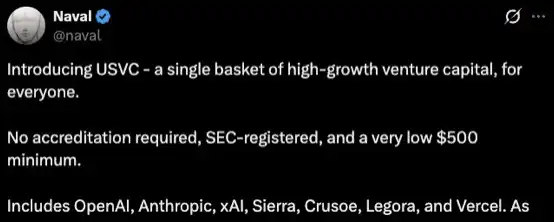
Editor's Note: Recently, Naval Ravikant, the author of the "Navalmanack," and a well-known Silicon Valley investor, launched a new investment product called USVC (U.S. Venture Capital) on social media. This product is aimed at the general public with no need for accredited investor status and a minimum investment of $500, offering a basket of equity in high-growth startups including OpenAI, Anthropic, xAI, Vercel, and others. The narrative is clear and familiar: allowing ordinary investors to enter the previously exclusive venture capital market, achieving "democratization of opportunity."
However, the question remains: when this "gateway" is truly opened, are retail investors actually sharing in the growth, or are they taking on chips that have already been priced?
This article starts from this seemingly progressive product and looks back at a key "social contract" implicit in the U.S. capital markets over the past few decades. The stock market is not only a financing tool but has also effectively taken on the role of wealth distribution. Through the pension system and index funds, ordinary workers can indirectly participate in corporate growth, allowing them to share in capital appreciation while inequality expands.
However, as companies stay private for longer and more value is accumulated in the private funding stages, this mechanism is undergoing a structural change: the public market is no longer where value is created but has become the endpoint of value distribution; index funds are no longer just risk diversification tools but may instead be passive buyers absorbing overvalued chips.
In this context, whether it is USVC or the institutional design around index weights and the IPO mechanism, their common feature is not "broadening participation" but providing existing holders with a more efficient exit path.
As the boundary between "increasing participation" and "having more people take over" becomes blurred, a deeper issue arises: as the way ordinary people participate in the market shifts from "sharing in growth" to "taking over exits," does the implicit contract that has long maintained the stability of the capital market still hold?
Below is the original text:
You may have noticed that after driving up the valuations of a batch of private companies to a trillion dollars, these venture capital firms are finally preparing to exit. The only issue is: they need to find the "exit liquidity" to pick up the chips.
It should be noted that I am not accusing the old boys' club of San Francisco's venture capital of having done anything illegal. I am accusing them of doing something morally dubious and eroding the social compact of capitalism.
This "transaction."

America doesn't have a European-style welfare state, nor did it intend to go that route from the start. The deal was: let the stock market take on the function of the welfare state. Defined benefit pensions have gradually given way to defined contribution pensions; traditional pensions have been replaced by 401(k) accounts; Social Security has become a "baseline" that no one expects to live on alone.
The implicit premise as an alternative was: every worker would become a shareholder, and the "elevator" of capital appreciation would lift workers along with it. Wages could stagnate, inequality could widen, because retirement accounts in the background continued to grow with compounding interest, everyone was on the same track— the end result would be "not bad" on the whole.
It is this mechanism that has kept America's inequality politically "acceptable." As long as your 401(k) rises along the same curve as your boss's assets, you can accept that your boss's income is four hundred times yours. Passive index funds are the purest expression of this deal: cashiers, teachers, plumbers, all can "free ride," relying on professional capital to achieve price discovery, capturing the market's entire return, and then go on to live their lives in peace. The market has, in a sense, become a "public good."
But this transaction had conditions: the open market must still be a place where value is truly created; the gains from rising must be widely accessible; the "marginal dollar" of new capital formation must be a dollar that an index fund can hold. These conditions were once long-standing, but now, they no longer hold.
This is what they took from you.
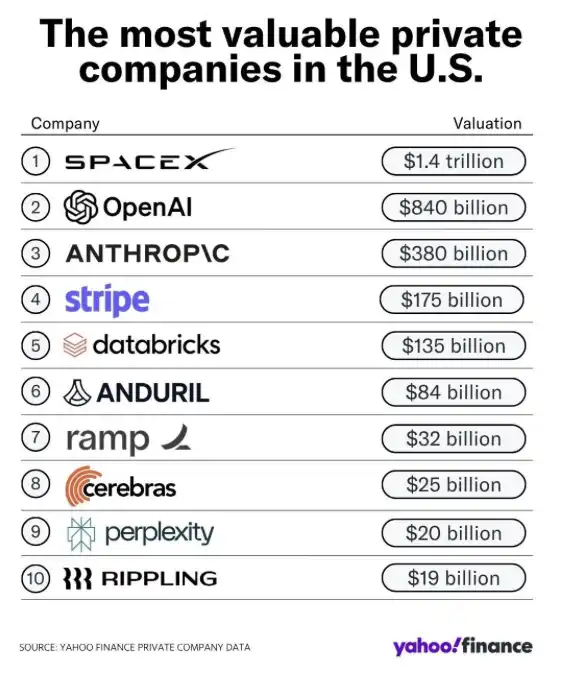
When companies grow in the private stage to a trillion-dollar valuation before going public, the open market is no longer where value is created, but a place where value is cashed out. What is happening in the public market today is "distribution," not "compound growth." Every percentage point return that should have belonged to passive retirement funds during the company's growth process, is now flowing to those who were already on the shareholder roster well before the company reached a two trillion dollar valuation.
After Figma went public, its stock price dropped by 50% in just a few weeks compared to its private valuation; Klarna, on the other hand, plummeted by 90%. Unfortunately, this system is exactly what is meant by "working as designed."
The industry has also noticed that this structure is excluding retail investors, so they have proposed a solution—allowing retail investors to participate in the private placement market as well. This is their argument: democratization, open access, and bridging the gap.
However, what is actually being offered is at the top of a ten-year continuous private market expansion cycle, to buy into positions that insiders had already built when these companies were valued at only a thousandth of their current value. The so-called USVC (U.S. Venture Capital channel) is not about "open access," but rather a channel for distributing assets that have already gone through a round of appreciation. Even Naval himself's statement has already acknowledged this point.
The Designed Exit Mechanism
As always, the crypto industry was the first to figure out this "playbook."
When some foundations found themselves holding a large amount of locked token assets, with the native retail demand depleted, and no one to take over as the unlock node approached, this playbook emerged. The solution was to package these locked tokens into equity vehicles, allowing regulated Traditional Finance (TradFi) buyers to participate as well.
Tokens that retail investors would not directly purchase were "packaged" into stocks—institutions could buy through compliant channels, and retail investors could participate through brokerage accounts. The chips were distributed. Regulators (SEC) did not intervene. The foundation successfully exited. And the equity buyers ended up with a position in an underlying asset that was already "designed to be sold to them."

The San Francisco venture capital ecosystem saw the feasibility of this mechanism and realized it could be scaled up to the "trillion-dollar level." The USVC is one door, and NASDAQ's rule adjustments are another.
NASDAQ is proposing that for companies that have just gone public and have a low free float percentage, their weight in the index can be calculated at five times their float percentage (not exceeding full weight), and recalculated at each quarterly rebalancing. For example, a company (such as SpaceX) that goes public with a float of 5% and a $1.75 trillion valuation, will force passive funds to buy in at a weight equivalent to $438 billion in market cap 15 days after listing—hardly any "observation period."
Meanwhile, the lock-up period can be precisely scheduled to expire around the next index rebalancing node. At that time, the index weight will automatically increase to "full weight," and passive funds will be forced to buy stocks massively at a time when insiders can legally reduce their holdings. SpaceX aims to go public in mid-June, with the next significant rebalancing scheduled for December—this "math" works out.
What was supposed to be an index fund as a tool for retail investors to counter insider trading has now turned into a mechanism for insider trading to be completed. Your 401(k) is being "front-run."
The structure of these two paths is the same: insiders first accumulate positions in a market where retail investors cannot participate; the positions mature; the natural demand of the native market is not enough to absorb supply at the target price; thus, a "wrapper" is designed to allow another type of funds to participate—usually through retirement accounts or passive fund inflows. These funds are "price-insensitive" because they buy according to rules, not based on judgment. Therefore, insiders exit, and new entrants take over.
All of this is "legal" because the structure itself is designed to be legal; and the reason regulators have not taken action is because these "rules of the game" are within the system.
Consequences
This partly explains why figures like Sam Altman face extreme protests, why Waymo vehicles are attacked, and why data centers become protest targets.
Those who ignite the flames do not need a theory of "exit liquidity." They just need to observe their own lives: some people "arrived early," others "arrived late," and the gap between the two is widening at a pace far faster than any narrative of "effort, ability, or timing" could explain.
The tech bureaucratic class is creating a visible and sustained reality: ordinary capital is being "harvested" to cash out the excess gains obtained by those already in advantageous positions.
"K-shaped differentiation" will only further intensify. What comes next will not be just a simple market correction.
An adjustment occurs only within systems where participants still believe in the rules. The burning flames are fundamentally a political issue.
