The biggest winner of yesterday's Taipei Computex event was MRVL.
Huang Renxun spent over $6.5 billion in the past three months to invest in a large number of optical companies, including Marvell (MRVL). At the event, Huang Renxun stated that Marvell will be the "next trillion-dollar company." MRVL surged 32.52% in a single day at the event, with a trading volume of over 100 million shares, marking the largest one-day gain in the company's history.
Incidentally, the entire optical module sector was ignited: Coherent rose by 17.3%, Lumentum by 13.3%, Corning by almost 12%, Ciena by over 8%, and Nokia also followed suit with an increase.
Regarding the logic of optical modules, the BlockBeats had already conducted in-depth analysis. In an article from half a month ago titled "In the AI Era, the 'Great Famine' Moment of Fiber Optics and Copper", the author had already clearly outlined the underlying logic of the physical limits of copper cables, the fiber optic famine, and the AI data center interconnection demand. It was explained that the amount of fiber optic required for AI clusters is 36 times that of traditional CPU racks, with an 18 to 24-month production cycle for optical rods and a short-term unsolvable supply rigidity issue.
MRVL closed the day with a 32% surge at $290, surpassing a market capitalization of $250 billion; Nokia's logic of AI optical networks has also been increasingly recognized by more and more people, becoming a frequently mentioned main theme. These two names seem to have become synonymous with optical modules.
However, the author of BlockBeats intends to conduct a deeper study, dissecting the entire optical module industry chain into segmented sub-tracks to find those targets that have not been fully priced by the market but still hold significant influence in their respective bottleneck segments. Many investors only focus on 800G and 1.6T optical modules themselves, but the entire industry chain can be divided into at least six segmented sub-tracks and levels, with selected targets in each sub-track.
This will help readers identify, in the U.S. stock market's optical module sector, which other targets besides MRVL and NOK are truly worth paying attention to?
The stock selection methodology of this article is inspired by "Wall Street's New Stock God" Serenity, who is currently the most outstanding analyst of the optical communication and AI supply chain "bottleneck theory," known for the "chokepoint" logic, specifically uncovering the hidden bottlenecks in the AI data center optical interconnection upstream, rather than directly chasing large-cap stocks such as NVIDIA and Broadcom.
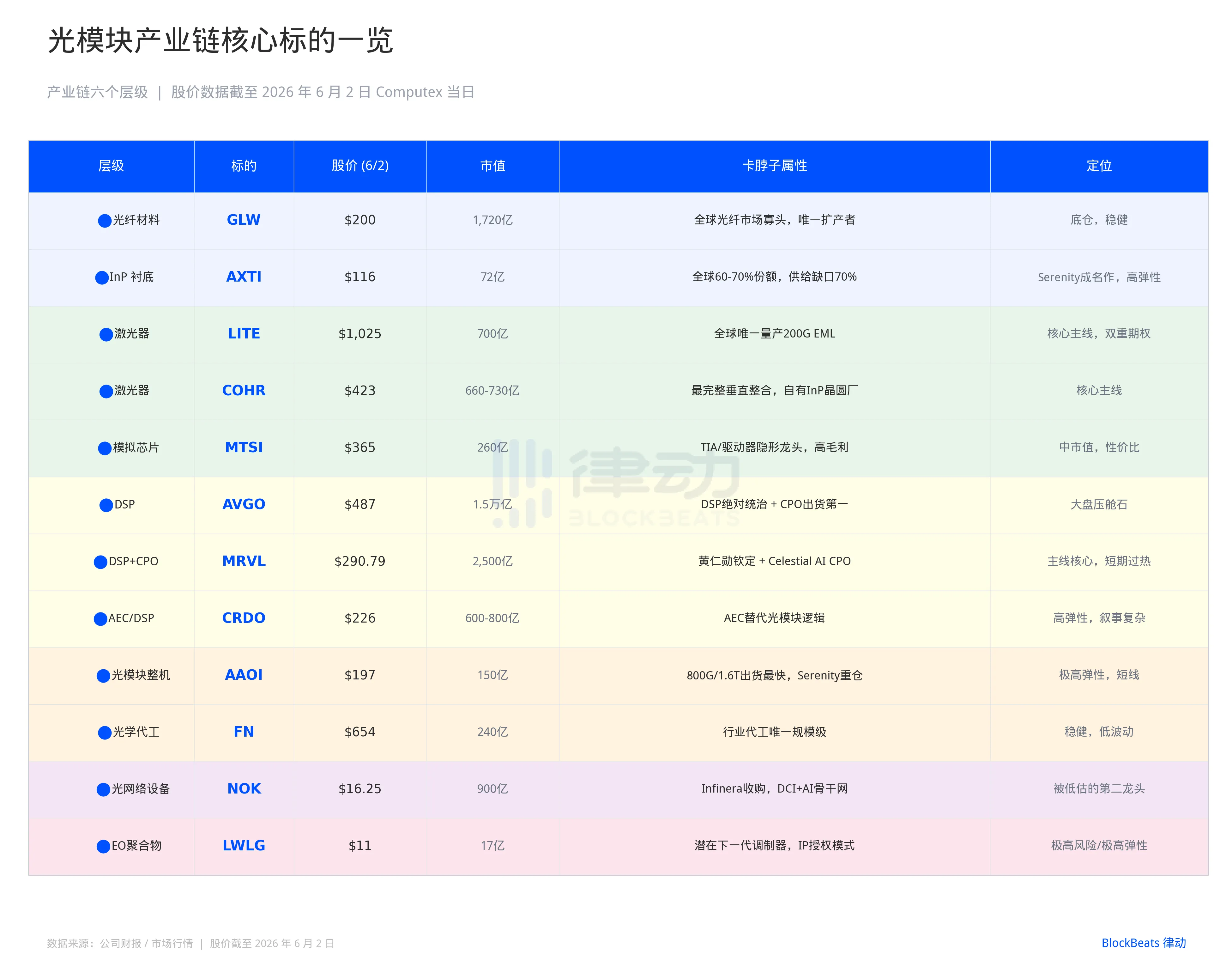
Optical Fiber Material: GLW (Corning)
This is the bottom layer of the entire industry chain and the most difficult to replace physical layer. The core raw material of optical fiber is called a preform, with an expansion cycle of up to 18 to 24 months and an extremely complex process. The amount of optical fiber required for an AI data center is 36 times that of a traditional CPU rack, and the fiber demand for a single Meta Hyperion data center project reaches 8 million miles.
GLW
Corning holds the highest global market share in the optical fiber market, establishing an absolute oligopoly. GLW currently has a market capitalization of approximately $172.0 billion with a stock price of $197.
Founded in 1851, the inventor of low-loss optical fiber, there is no second company that can replace its production capacity in the near term.
The core of its moat: Preform manufacturing is a highly integrated process of "material science + precision manufacturing," with yield accumulation over decades. Corning has accumulated over 40 years of expertise in this process. The net profit of its optical communications business increased by 28% year-on-year in 2024, 71% in 2025, and a staggering 93% in Q1 2026, with the growth rate still accelerating.
On May 6, 2026, NVIDIA and Corning announced a multi-year strategic partnership, with a total investment scale of up to $3.2 billion in warrants. They require Corning to expand its U.S. optical connection manufacturing capacity by 10 times and increase its optical fiber capacity by over 50%, building three new factories. This is NVIDIA's largest single bet in the entire optical supply chain. Corning is also the fiber optics and connector supplier for Broadcom's CPO platform TH5-Bailly, serving as the common foundation for the two CPO ecosystems.
The stock price has surged over 315% in the past 12 months. Serenity included Corning in its "Material Petrochemical" supply chain bottleneck chart, positioning it as a stable core asset.
Indium Phosphide Substrate: AXTI (AXT)
This is the most underestimated part of the entire industry chain and the most famous call by Serenity.
Why is Indium Phosphide (InP) so crucial? Because silicon cannot emit light. All laser diodes in optical modules require InP as a substrate material. NVIDIA's optical interconnect chips, all high-speed transceivers, and the optical engines in CPO rely on InP wafers at their core. Even more critically, the growth process of InP single crystals is an order of magnitude more complex than silicon, with an expansion cycle of over two years, making it impossible to quickly solve with capital investment.
By 2025, the global shipment volume of InP substrates is expected to be around 600,000 to 700,000 pieces, while the actual market demand is between 1.5 million to 2 million pieces. There is a supply gap of over 70%, which cannot be eliminated in the short term.
This market is highly concentrated, with three companies controlling 80-90% of the global market share: Japan's Sumitomo Electric, Japan's JX Metals, and the U.S.'s AXT.
AXTI
AXT controls 60-70% of the global InP substrate production and is the largest single supplier in this oligopoly market. AXTI currently has a market capitalization of around $7.2 billion with a stock price of $116.
This is Serenity's breakthrough and one of his most discussed targets (mentioned in public tweets over 70 times). His core argument about AXTI can be summarized in one sentence: "The entire AI industry's development relies on this company, and all players, including Google, NVIDIA, and Microsoft, depend on its indium phosphide substrate. Without the InP substrate, the entire AI optical interconnect story will come to an end in 2026."
AXT is the largest single supplier in the global InP substrate market, with customers including Google, NVIDIA, Microsoft, and all major optoelectronic module manufacturers. In the April 2026 Q1 financial report, revenue was $26.9 million, a 39% year-on-year growth, with InP business revenue reaching $13.6 million. The company has just completed a $632.5 million financing round dedicated to expanding InP capacity, aiming to double it in 2026 and 2027. Order demand is expected to double in 2026 and double again in 2027.
Serenity initially entered around $12 with a target price of $150. As of the time of writing, it is approaching $141, with a floating profit of over 1000%. This trade clearly validates his methodology: small market cap, a customer list filled with trillion-dollar giants, and a product that is the only choice upstream. Once these companies are "discovered" by the market, their elasticity is several times that of large-cap companies.
However, a key risk to note is that AXT's production lines are mainly in China, creating a geopolitical supply chain risk, which is a core risk variable.
Laser and Optoelectronic Chip: LITE, COHR, MTSI
This is the highest technological barrier manufacturing segment in the optoelectronic module industry chain. In the AI era, the real scarcity is not the complete optoelectronic module but the chip that generates the optical signal itself, namely the EML (Electro-Absorption Modulated Laser) and CW Laser (Continuous Wave Laser). A 1.6T optical module requires 200G/lane EML, and only one company globally is mass-producing this type of chip.
LITE
Lumentum is the only supplier globally to mass produce 200G/lane EML, with no second source at this node. LITE currently has a market capitalization of around $70.0 billion, with a stock price of $1,025.
This represents the highest technological barrier to entry in the current optical module race track. NVIDIA has pre-purchased this capacity at scale, pushing delivery dates beyond 2027, triggering industry-wide supply constraints. Serenity has identified LITE as a core benchmark in the optical wave narrative, discussing in detail its dual role in pluggables and CPO.
In March 2026, NVIDIA invested $2 billion with multi-billion-dollar multi-year procurement commitments. OCS (Optical Cross-Connect) backlog orders exceed $400 million, with additional CPO orders in the hundreds of millions, all to be delivered in the first half of 2027. FY2026 Q2 revenue was $6.655 billion, a 66% year-on-year growth, with the company guiding for next quarter's year-on-year growth rate to exceed 85%. Greensburg fab will be fully operational by early 2028, ultimately supporting a $5 billion annualized capacity. On the day of Computex, the stock rose by 13.3% to around $1025. Rothschild has a target price of $1270, Jefferies $1200, and JPMorgan $1130.
COHR
Coherent is the most vertically integrated company in the optoelectronics industry, owning the entire production line from InP raw material to lasers to packaging to modules. COHR currently has a market capitalization of around $66-73 billion, with a stock price of $427.
Formerly known as II-VI Incorporated, founded in 1971, it was renamed after the acquisition of the original Coherent in 2022. Coherent's moat comes from doing something no other company does: owning the entire production line from InP raw material to lasers to packaging to modules. It is one of the world's largest InP ecosystem vendors, with its own InP wafer fab, laser production line, and packaging and module capacity, with no other company doing all these four steps on their own.
The data center business book-to-bill ratio has been over 4x for several quarters, indicating demand far exceeds capacity. NVIDIA has also invested $2 billion with multi-year procurement commitments. FY2026 Q3 revenue was $18.06 billion, a 21% year-on-year growth. The 6-inch InP production line expansion is ahead of schedule. The stock has risen approximately 455% in the past 52 weeks. In early 2026, it was added to the S&P 500, continuously attracting passive funds. Serenity has included COHR in its DCO and laser supply chain core map.
MTSI
MACOM is a hidden leader in the optical module high-frequency analog chip field, with many of the most difficult-to-replace links such as TIA (Transimpedance Amplifier) and laser drivers originating from it. MTSI currently has a market capitalization of around $26 billion with a stock price of $365.
What many people do not know is that in the optical module, the most expensive and hardest-to-replace component is not just the DSP, but also high-frequency analog chips like the TIA and laser drivers, many of which come from MACOM. The competitive landscape is quite concentrated because the design and process optimization of high-frequency analog circuits require years of accumulation and cannot be rapidly replicated through heavy investment.
MACOM's product roadmap already covers the 1.6T and 3.2T ecosystems. FY2026 Q2 revenue was $2.889 billion, with Q3 guidance midpoint around $3.35 billion, and the growth rate is still accelerating. With a gross margin of 55.9%, it is one of the few small to midsize companies in the optical module industry chain with a robust high gross margin. Serenity includes it in the analog/mixed-signal IC and optical module chain, positioning it as a hidden gem target for players in this space. EBC analysts describe it as the "cleanest mid-cap choice for investors hoping to gain exposure to optics without taking on the pure-play fragility."
DSP Chips: AVGO, MRVL, CRDO
In an 800G optical module, the DSP accounts for 30-40% of the cost and the gross margin is much higher than that of the entire module. Many times, the real money-makers are the DSP companies rather than the optical module companies. This layer is the most "semiconductor-like" part of the optical module industry chain, where the competitive landscape is determined by SerDes technology accumulation and customer certification barriers.
AVGO
Broadcom is the undisputed ruler of optical module DSP chips and is also the largest player in CPO (Cloud Provider Offload) switch shipments. AVGO currently has a market capitalization of around $1.5 trillion with a stock price of $487.
Almost all high-end 800G and 1.6T solutions cannot avoid Broadcom's PAM4 DSP and SerDes, showcasing its clear market leadership. It is also the most active promoter of CPOs, having shipped over 50,000 units of the Tomahawk 5 Bailly CPO switch throughout 2025. The third-generation product, Tomahawk 6 Davisson, has a switching capacity of 102.4 Tbps, making it the largest player in CPO switch shipments.
Serenity lists AVGO as a downstream reference in the supply chain, alongside NVDA and MRVL, but indicates that it is not the focus of their attention on "small-cap bottlenecks." Due to its large size and limited flexibility, it serves as the "bedrock" of this industry chain.
MRVL
Marvell is the target mentioned by Huang Renxun at Computex, with a single-day surge of 32.52%, hitting a record high. MRVL currently has a market cap of around $250 billion and a stock price of $290.79.
After acquiring Inphi in 2021, Marvell's optical module DSP capability saw a significant increase. The "brain" behind many 800G modules is Marvell DSP. In February 2026, Marvell completed the acquisitions of Celestial AI and XConn, establishing a complete technical stack covering silicon photonics, CPO optical engines, and CXL switches. It is currently the only company that covers the four dimensions of "Custom ASIC + 1.6T Optical DSP + Silicon Photonics + CXL Switching" simultaneously.
Huang Renxun personally called it the "next trillion-dollar company" at Computex, with a single-day surge of 32.52%, pushing the market cap above $250 billion. Serenity is actively holding a position and has posted multiple times affirming MRVL's potential while also pointing out valuation and faith risks. FY2026 full-year revenue is $8.2 billion, with the data center business accounting for over 75% of it. The Custom ASIC business is expected to generate revenue exceeding $10 billion in FY2029, with a revenue target of $16.5 billion for FY2028. In the short term, it has significantly exceeded the sell-side consensus target price (mean of $222 versus post-surge $290), so overheating risks should be noted.
CRDO
Credo is a leader in the AEC (Active Electrical Cable) track, cutting into part of the optical module market with copper cables. It is the most complex narrative in this industry chain. CRDO currently has a market cap of around $60-80 billion and a stock price of $226.
The most outstanding product is the purple AEC (Active Electrical Cable), which uses copper cables to provide low-latency short-distance connections, directly cutting into part of the pluggable optical module market. The core logic is: not all short-distance connections require optics, and AEC is a cost-effective and low-latency solution in specific scenarios. FY2026 Q2 revenue is $268 million, with a staggering 272% year-on-year growth and a growth of over 120% year-to-date. Serenity has included it in the interconnect/switch chain, positioning it as highly elastic but narratively complex. Both potential disruption and potential vulnerability coexist, making it the most intricate target in this industry chain.
Optical Module Assembly and OEM: AAOI, FN
This layer is the most well-known track in the market, also the most fiercely competitive with intense price pressure. Enterprises that can excel here either have vertical integration of upstream components (Coherent, Lumentum) or extreme manufacturing efficiency.
AAOI
AOI is a pure-play target with the fastest shipment speed of 800G and 1.6T optical modules, and is also one of the targets with the highest Serenity shout-out frequency, with over 123 public tweets. AAOI currently has a market cap of around $12-15 billion, with a stock price of $197.
It is also one of the few pure optical module companies in the United States, with the core logic being the purest and fastest shipment of 800G volume. In 2026, it has secured over $200 million in large orders (including major hyperscale cloud providers such as AWS and Microsoft), with a full-year revenue target exceeding $1 billion. Year-to-date, it has seen a price increase of approximately 441%, making it the best performer in the entire optical module sector.
The high elasticity comes with high concentration: revenue is concentrated on a few major hyperscale customers, and any changes in order pace will have a significant impact on the stock price. Suitable for short-term speculation, not for long-term holding.
FN
Fabrinet is the only player of scale in the optical manufacturing field, benefiting no matter who wins in the entire industry. FN currently has a market cap of around $24 billion, with a stock price of $654.
The cleanest expression of optical manufacturing logic. A large proportion of products from optical device manufacturers such as LITE and COHR are manufactured by Fabrinet in Bangkok, Thailand. It does not bet on a single technology roadmap and serves as the industry's beta amplifier for expansion. Pluggable modules, CPO, and OCS all require precision optical packaging, and in the field of precision optical packaging, Fabrinet is the only manufacturer of sufficient scale.
FY2026 Q3 revenue and EPS hit record highs, with Q4 revenue guidance at $1.25 billion to $1.29 billion. The stock has increased by about 150% over the year, with low volatility, making it suitable for core portfolio allocation.
Optical Networking Equipment and Next-Gen Materials - NOK, LWLG
NOK
Nokia is the most easily overlooked second-tier player in this Computex market wave, covering both DCI and AI backbone networks after acquiring Infinera. NOK currently has a market cap of around $90 billion, with a stock price of $16.25.
Serenity has mentioned NOK on multiple occasions, discussing its relationship with policy, supply chain, and the product layout after acquiring Infinera. Following the acquisition of Infinera, Nokia has become one of the few suppliers in the optical networking equipment market to simultaneously cover both "DCI Data Center Interconnect" and "AI Backbone Network" directions.
In Q1 2026, Nokia's Optical Network business saw a 20% year-over-year growth, while AI & Cloud-related sales increased by 49%. The Q1 profit surged by 54%, and the stock price hit a 16-year high. The new product lineup includes a 1.6T coherent pluggable module and a compact amplifier for multi-fiber applications, actively securing DCI orders from hyperscale cloud providers. With a market capitalization of around $26 billion, it is the relatively undervalued second leader in this sector—a target easily overlooked in the Computex market.
LWLG
Lightwave Logic, the smallest market capitalization, most cutting-edge narrative, and highest-risk target on this list, is betting on electro-optic polymers to become the standard material for the next-generation silicon photonic modulators. LWLG currently has a market capitalization of around $1.7 billion, with a stock price of $12.67.
LWLG is not a photonics module company; instead, it focuses on the next-generation modulator material in silicon photonics—the electro-optic polymer (EO Polymer).
While traditional silicon-based modulators have a bandwidth of 40-50GHz, LWLG's polymer modulators target specifications of 110GHz and above, supporting 400G/lane, representing a 2-3 generation leap over existing technology. In March 2026, LWLG signed an agreement with Tower Semiconductor to integrate its polymer modulator solution into Tower's silicon photonics PDK, enabling any customer using Tower's production line to directly access LWLG's material solution. Currently, four Fortune 500 companies are in Stage 3 prototype development, including collaboration with a second Global 500 customer on developing a 400Gb/s CPO solution, with a commercial supply agreement expected to be finalized in 2027. PhotonCap (an optical engineering firm speculated to be affiliated with Serenity) has authored an in-depth analysis report on LWLG's collaboration with Tower.
Rationale: If EO polymers become the standard modulator material in silicon photonics, LWLG's IP licensing model will be a high-leverage winner. However, with no substantial revenue yet, it is suitable for positions with extremely high risk tolerance and not for core holdings.
Welcome to join the official BlockBeats community:
Telegram Subscription Group: https://t.me/theblockbeats
Telegram Discussion Group: https://t.me/BlockBeats_App
Official Twitter Account: https://twitter.com/BlockBeatsAsia
