From the spectacular debut of ChatGPT to the various AI Agents now taking on complex tasks, the rapid pace of change is truly astonishing.
The AI Agent is no longer just a chatbot. As they begin to make autonomous decisions, move funds, and even enter into "contracts" with other Agents, a whole new financial world is quietly taking shape on-chain. The trend of on-chain finance + AI Agent is mostly defined by most as Web4.0.
On April 21, BlockBeats×Dynamis×Zhihu×Cobo×MuleRun jointly organized an event in Hong Kong to discuss the financial development trends of Web4.0. The event was sponsored by Cobo, MuleRun, and NOXCAT, with the luxury sports car Lotus and Web3 app NOXCAT in attendance. This event focused on the deep integration of the crypto world and AI Agents.
The Trend is Here
To kick off the event, Zhang Shuhao, the editor-in-chief of BlockBeats, shared a set of data.
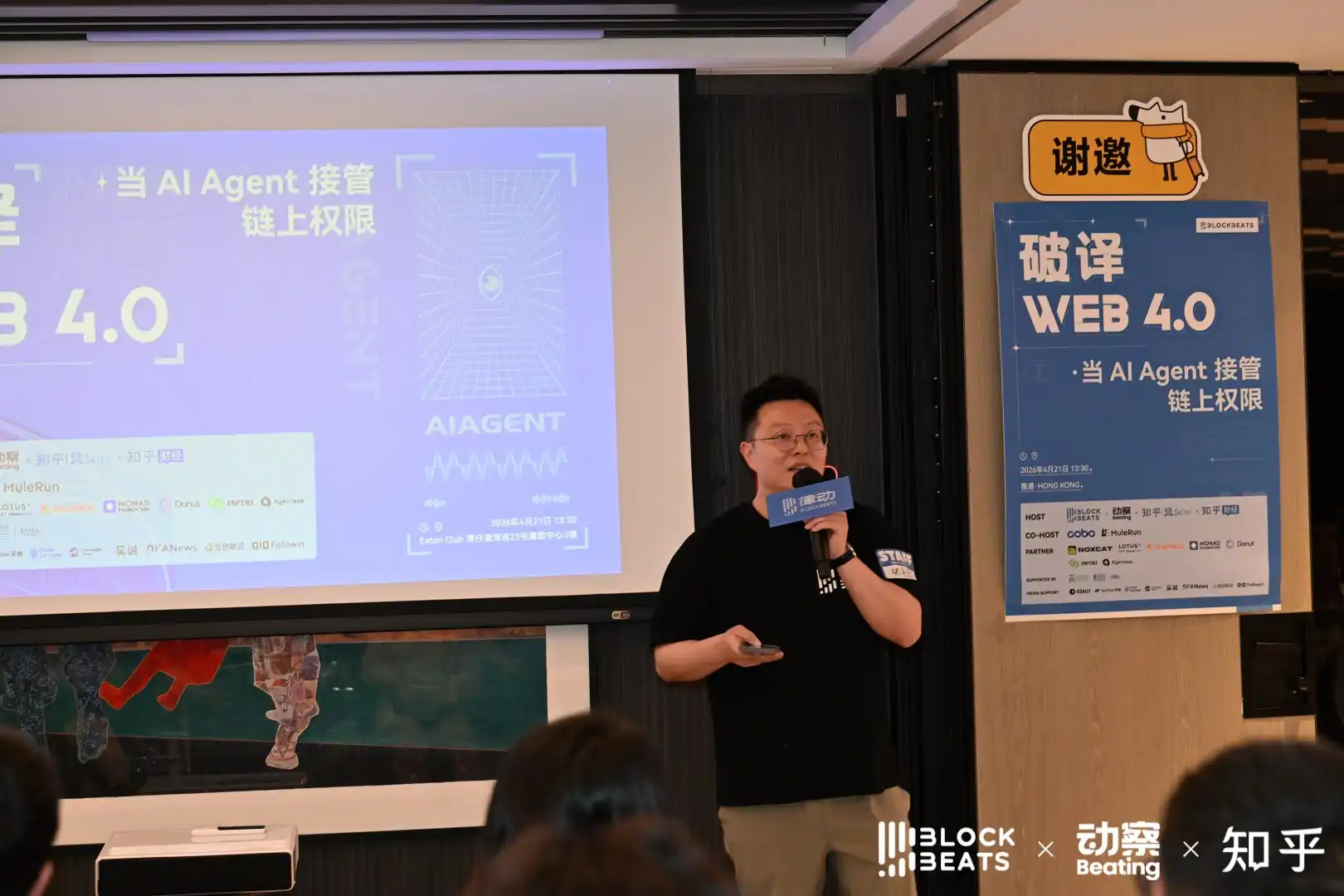
In traditional thinking, on-chain transactions may seem like just a "small circle game" of cryptocurrency. However, on the on-chain commodity trading platform Trade XYZ built on the Hyperliquid platform, the crude oil position reached $1 billion during a specific geopolitical event.
Zhihu's Senior Vice President Zhang Rongle pushed the topic further.
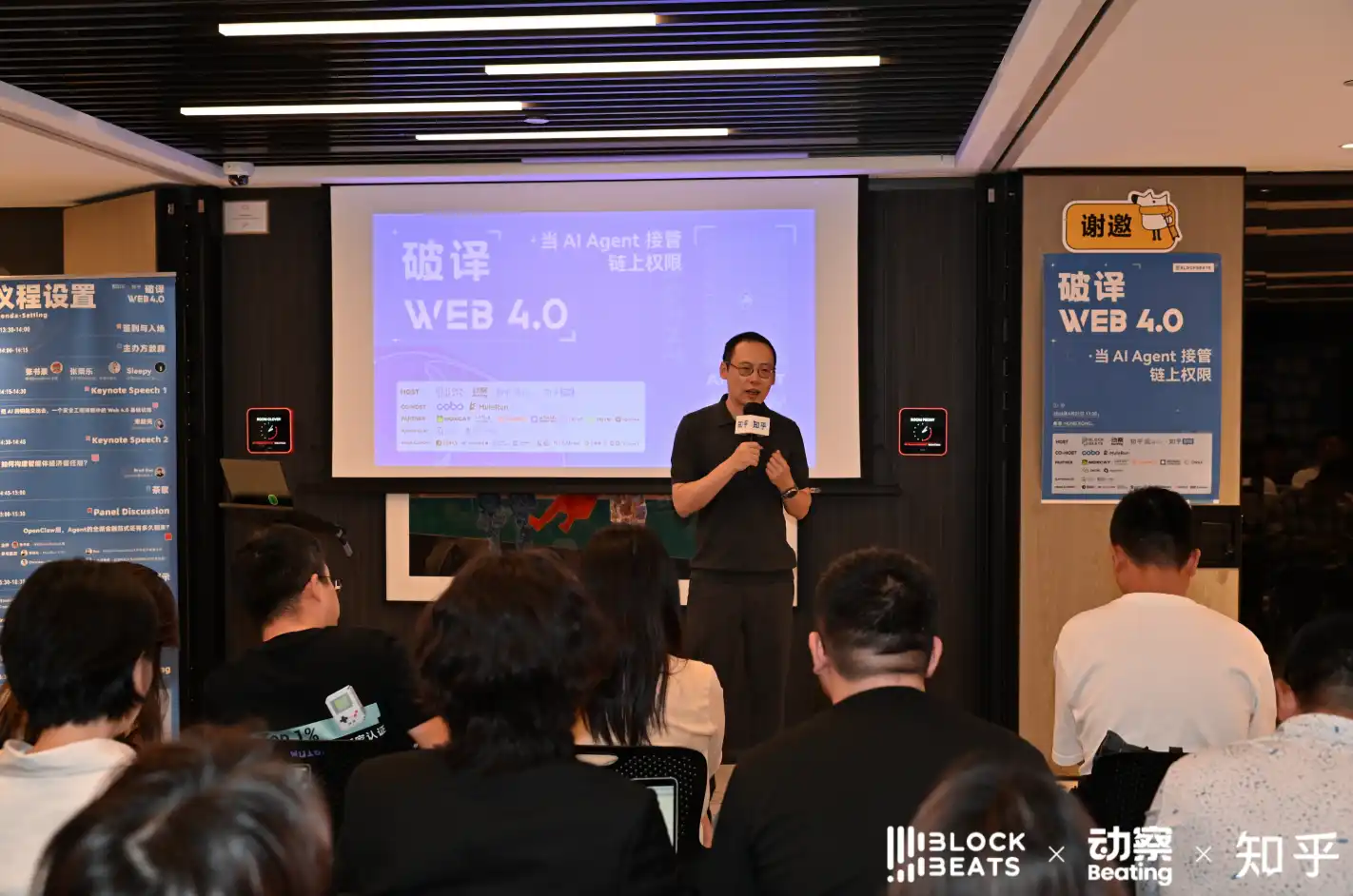
As a student of the EMBA program at HKUST, when he just started, AI was only used to ask questions and write content; later, AI became a key member in decision-making in case studies; and now, everyone is thinking about how to transform business models with AI Agents.
When these things are placed on-chain, the changes will be even more profound. Agents can make transactions autonomously, even run a complete set of complex strategies for you.
So, we will face a more fundamental question: When AI Agents can make autonomous decisions and take actions, how should we rethink production relations and business models?
What Zhihu is doing is turning this new trend into a topic that the public can understand and participate in. From Web3 to AI and now to Web4.0, more and more people are joining the discussion. These topics, which were originally more technical and finance-oriented, are gradually moving from the realm of a few to a broader public discussion.
Sleepy, the founder of Dongcha, succinctly explained what Dongcha Beating is all about in a few words.
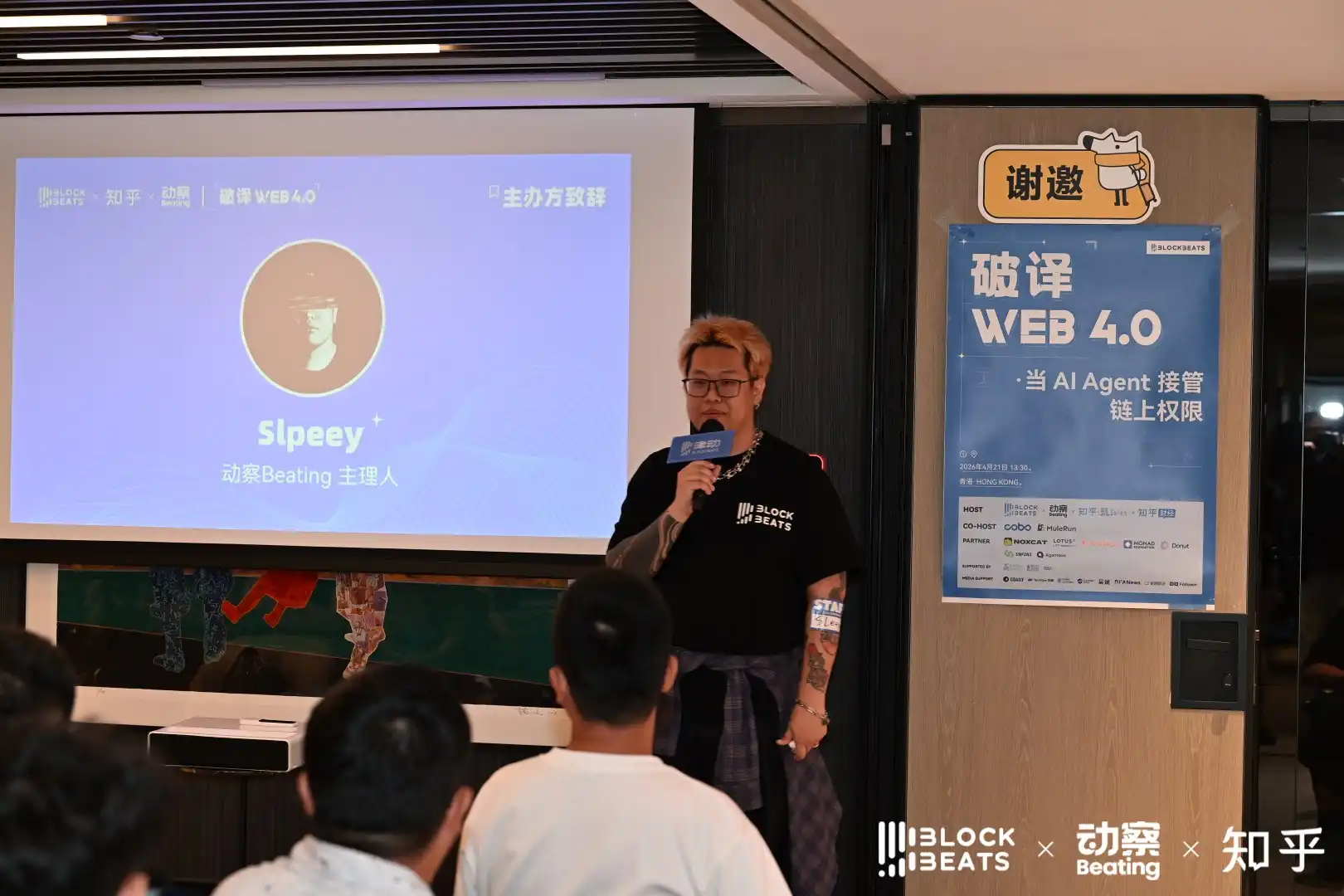
The approach is simple: technology and humanity.
From stablecoins to Crypto, from AI to brain-computer interfaces, from the Mars industry... Dongcha will pay attention. How do new technologies, new trends, and new ideas actually impact this generation of young people? How do they impact this era and society? Dongcha wants to use various media to make these seemingly distant things more tangible.
“I hope you can perceive how it affects you and me, how it affects real life.”
Keynote Session
CTO Junliang Shu from MuleRun and AI Growth Lead Brad Bao from Cobo gave speeches, discussing their respective views on the AI Agent's capabilities and trust relationships.
A Security Engineer's View of Web4.0 Infrastructure
Junliang Shu, CTO of MuleRun, believes that to understand the future, we must first understand the capabilities of an AI Agent.
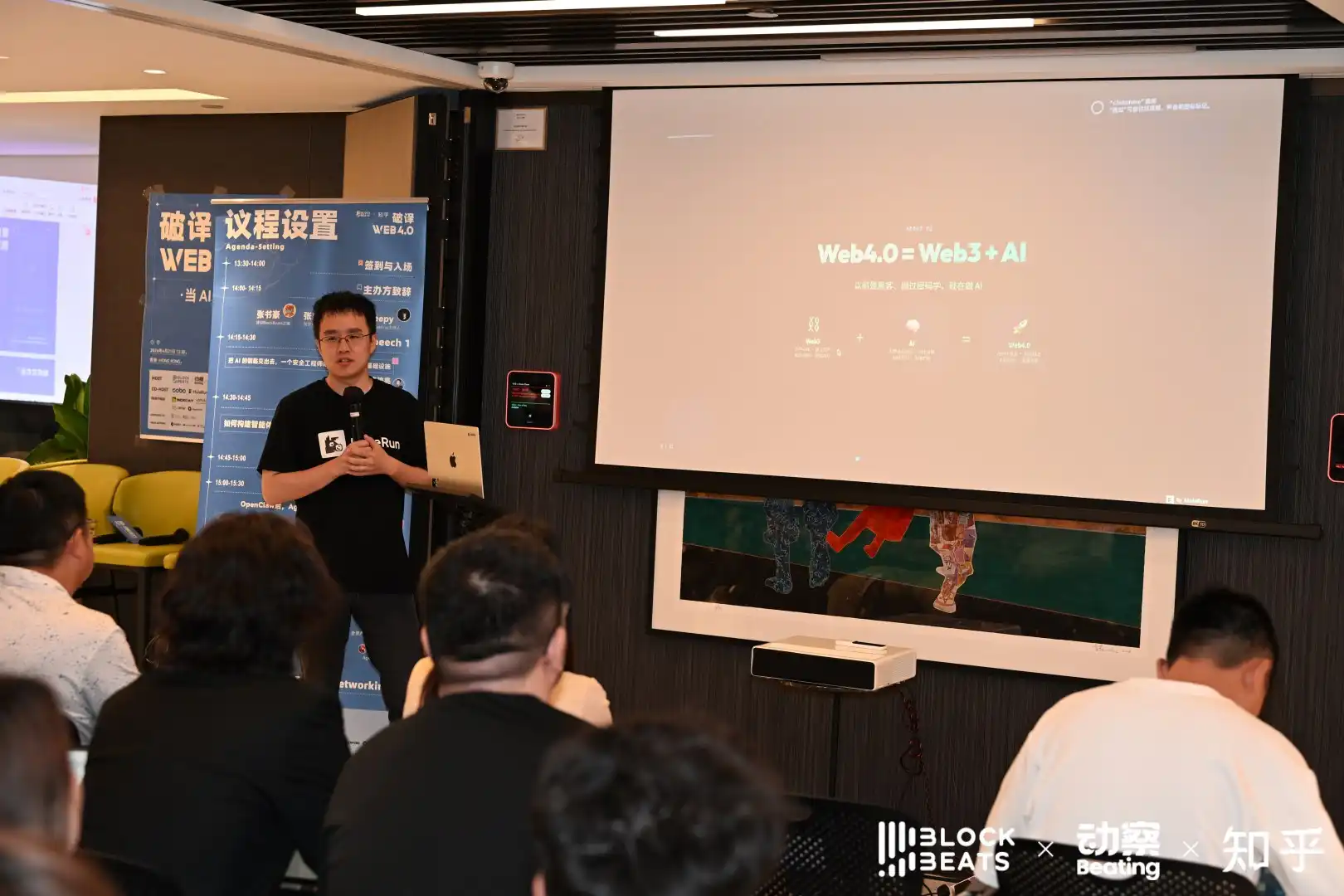
He abstracts a mature Agent into six dimensions:
- Mouth: Not limited to web pages, the Agent can already interact with you through mainstream IM software like WeChat, Telegram, Discord, responding to commands at any time.
- Eyes/Ears: Data sources determine everything. It will proactively search the Internet, but more importantly, it can call professional APIs to obtain real-time, accurate financial information, overcoming the data latency and missing data issues of free APIs.
- Brain: The ability to handle complex problems. It can handle tasks ranging from "price checking" to "performing volatility calculations, strategy backtesting," and engineering-wise optimize Token consumption to reduce costs.
- Hands: The Agent has a stable 24/7 cloud operating environment, enabling it to perform long-term monitoring tasks, and even has a public IP address, capable of building and hosting a publicly accessible website or monitoring system.
- Memory: An excellent Agent possesses long-term memory. The longer you use it, the better it understands you, reducing repetitive communication.
- Knowledge Graph: A shareable knowledge graph where, simply put, others' experiences can be borrowed for your use.
He showcased a self-built investment system using MuleRun by a friend: fetching news, financial reports, sentiment data, and automatically providing signals to increase position.
At the same time, Shu Junliang also presented his thoughts on the future development trend of AI Agents:
- Era of Fully Autonomous Execution: In the future, AI Agents will be able to complete the entire strategy cycle without human intervention, and the competition between different Agents will intensify.
- Narrowing Product Differences, where the usage method becomes a source of excess returns. The underlying models and API capabilities of various Agents are converging. What truly sets them apart is how users define tasks, design workflows, and leverage memory and knowledge sharing.
- Shift in Infrastructure towards AI-native Design. In the future, APIs will no longer be optimized for human UI but rather designed for Agent invocation.
How to build a trust layer for the Intelligent Economies?
When an Agent starts using funds, to whom should on-chain permissions be entrusted?
Brad Bao, AI Growth Lead at Cobo, led the discussion on this topic.
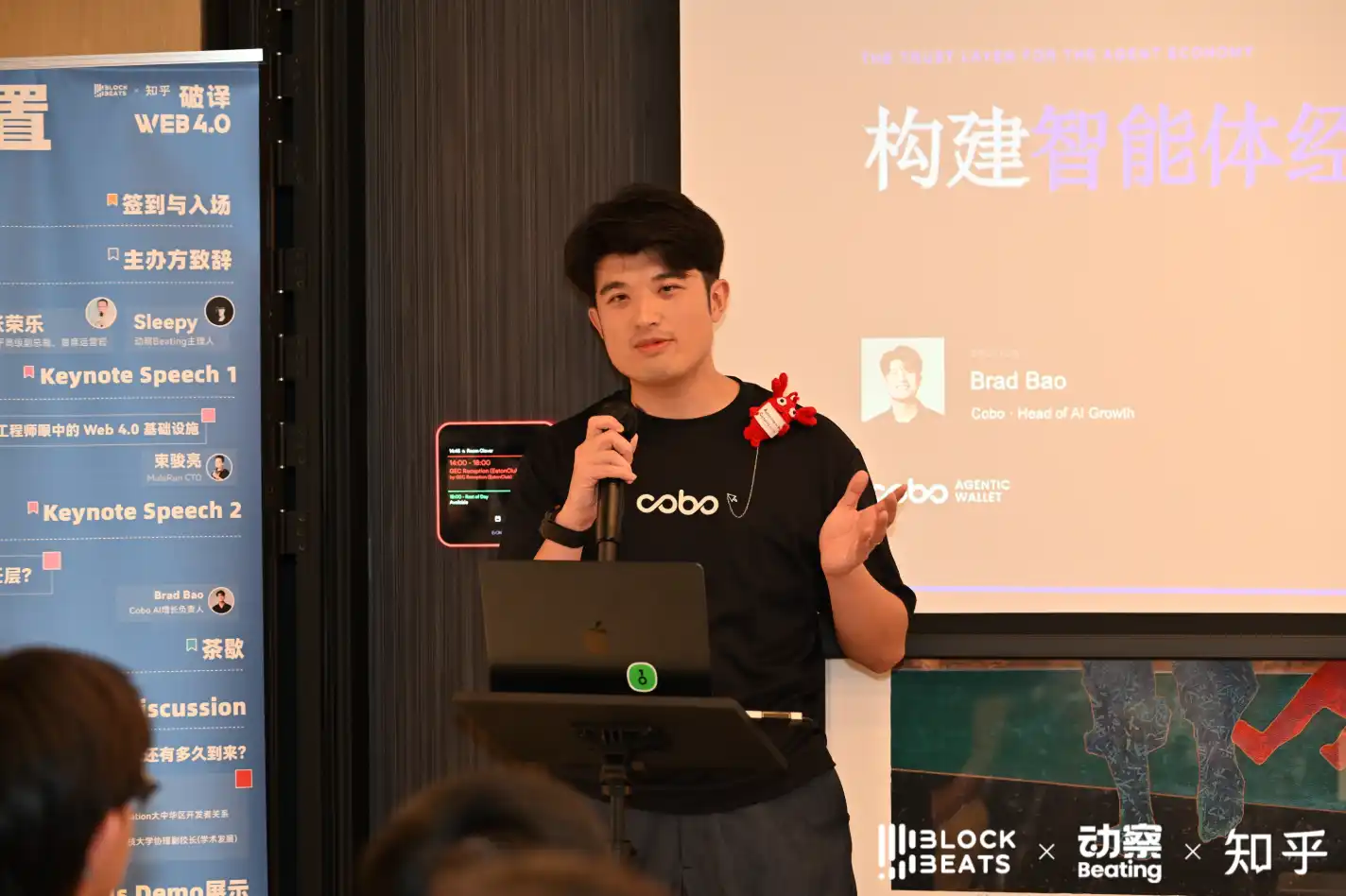
“It's not about giving or not giving but about how to provide negotiable, traceable, and revocable permissions.”
While Web3 addresses asset ownership, Web 4.0 aims to resolve economic relationships between Agents: what they can do, cannot do, and who is responsible if things go wrong.
Cobo's solution involves introducing the concept of a “Pact.” A Pact includes:
User Intent: What is the objective?
Execution Plan: Which chain to go, which address?
Rule Governance: What conditions must be followed?
Completion Conditions: How is completion defined? When does it end?
This contract defines an executable, auditable, revocable "trust layer" between humans and Agents. Leveraging MPC technology, the Agent can roam freely, but humans always retain ultimate control.
Their product, Cobo Agentic Wallet, has launched an early access version, with core capabilities including but not limited to:
- Users creating sub-wallets for the Agent with Pact constraints
- Using Multi-Party Computation (MPC) encryption technology to eliminate single-point risks
- Real-time monitoring of Agent behavior, with automatic freezing of any anomalies
- Support for humans to revoke all permissions with one click
Agentic Wallet + Pact = Turning "whether authorized" into "how to jointly execute a contract."
Web 4.0 is not about machines replacing humans but about humans and AI Agents establishing trusted economic relationships.
How Long Until the Arrival of a New Financial Form Under Agent Influence?
In the second half of the event, several of our guests engaged in a roundtable discussion on the new form of AI Agent.
Guests:
Junliang Su: MuleRun CTO
Box: Monad Foundation Developer Relations, Greater China
Christian: Infini Founder
Professor Jialong Xu: Associate Vice President (Academic Development) of The Hong Kong University of Science and Technology
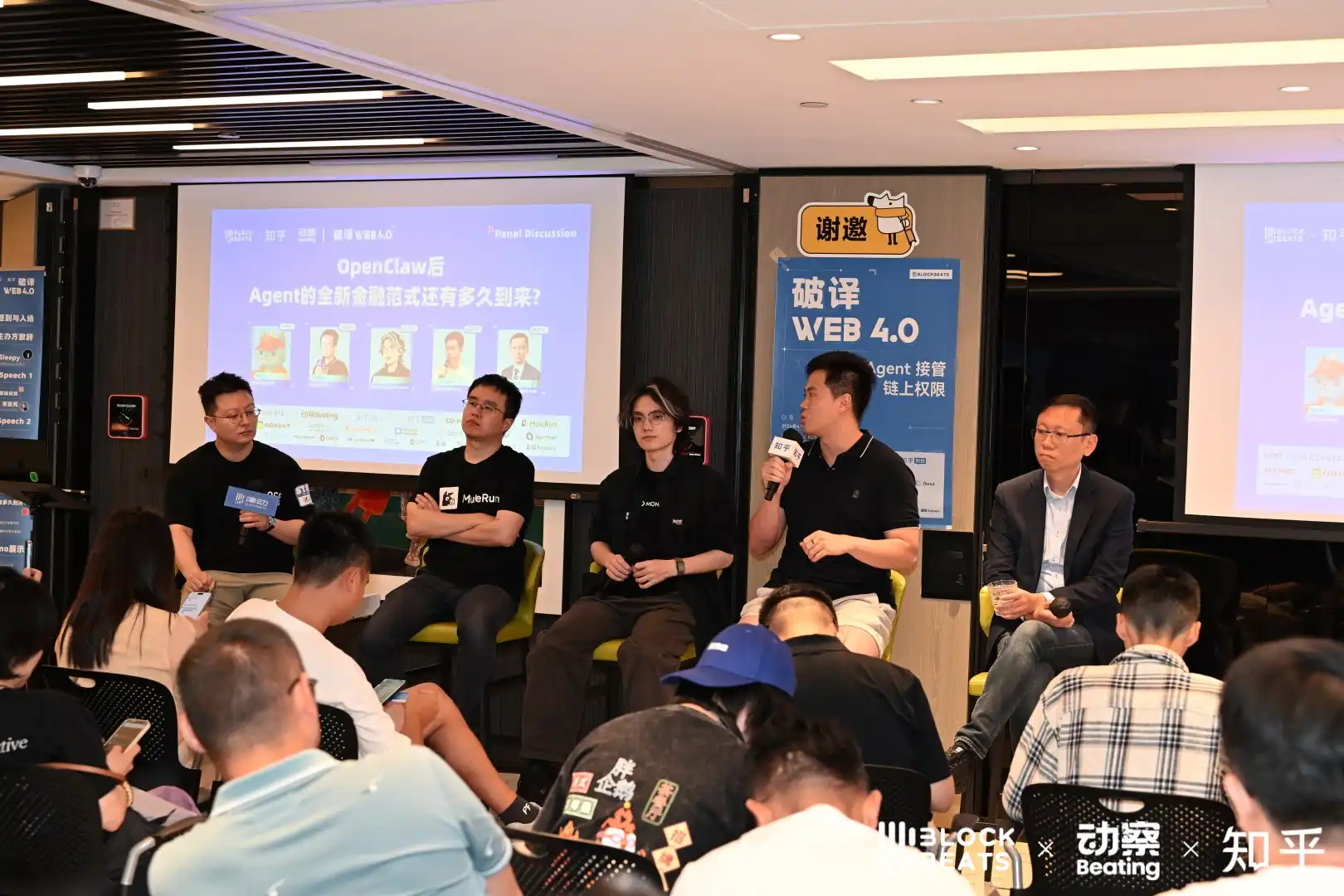
"Does an Agent's moat really exist?"
This question unexpectedly united the four guests.
First to speak, Box stated: "The majority of Agents have an incredibly weak moat. Any employee in Claude can reverse-engineer what you've done in just three weeks."
He gave an example: "Last year, a bunch of startups did Co-work. Once Claude entered, these companies went bankrupt on the spot."
"Either be faster in updates or have a founder with significant influence. Otherwise, it's a death sentence."
Su Junliang added from a technical perspective: The gap in models is closing fast, and domestic models have almost caught up to GPT-4.6. Coding ability has also seen an explosive improvement. Previously, a feature that took two people a month to develop can now be done by one person in three days.
“Copying a competitor's feature? One week is enough.”
So, what truly constitutes a moat?
Su Junliang believes there are two points:
First, exclusive data. Some sensitive data can only be accessed by you and not others.
Second, user memory. Gemini does not provide a memory export feature. Once you have used it for a long time, you won't want to switch, and that is true stickiness.
“In 2026, will agents be able to perform complex transactions?”
Box's answer was brief: “Anything humans can do, agents can do. Rebalancing, DeFi nesting, LEGO combinations, you name it. But then he shifted the conversation: “I am not optimistic about letting AI help you make money.”
You can run 100 agents simultaneously, and there will always be one that succeeds, but that's probability, not strategy.
“The people who can make money are still those people; AI only changes the speed, not the ability.”
Christian provided a more specific assessment: at the information level, watching the chain, event-driven strategies have already been implemented; agents can run 24/7. In terms of capital efficiency, flash loans, leverage risk control, liquidity optimization – tasks that humans cannot continuously monitor, agents can.
“People cannot monitor the liquidity changes of lending protocols every day, but agents can. When people sleep, they cannot watch the leverage ratio, but agents can.”
The trading strategies that people want to execute, agents can now execute them all, but whether they can make money depends on whether you could make money in the first place.
“How will agents change the financial system?”
Professor Xu first drew a line: differentiating between “value creation” and “speculation.”
Using agents to analyze company assets and find the best analytical methods is valuable. Using agents to predict the market is no different from gambling and offers no distinction from the traditional world.
From Su Junliang's perspective: Agents will flatten the information asymmetry.
It used to be easy to make money because there were greater fools in the market than you. Now, with AI assistance, newcomers are rapidly upskilling. People who didn't use to trade can now write scripts, backtest, and run strategies using agents.
“Veterans need to rebuild their edge; otherwise, they will become the fools themselves.”
“Stablecoin + Agent, what kind of spark will it ignite?”
Shu Junliang believes that stablecoins will accelerate everything. “Stablecoins are the new infrastructure, naturally bringing AI closer.”
Box gave the example of ordering takeout with a thousand questions. Agents can already help you order bubble tea, and the potential expands greatly if integrated with platforms like Taobao. If stablecoins can be issued within enterprises with real-life use cases, it will create a powerful synergy.
Christian is pragmatic; he says stablecoins fundamentally serve two purposes: a USD alternative and a tool for regions with weak financial systems.
“For a traditional company to start accepting payments, it would take at least one to two months. Now, a payment link can be generated in a minute, sent to the customer, and paid with a click.”
A hundredfold increase in speed – that is the greatest value of Agent + stablecoin.
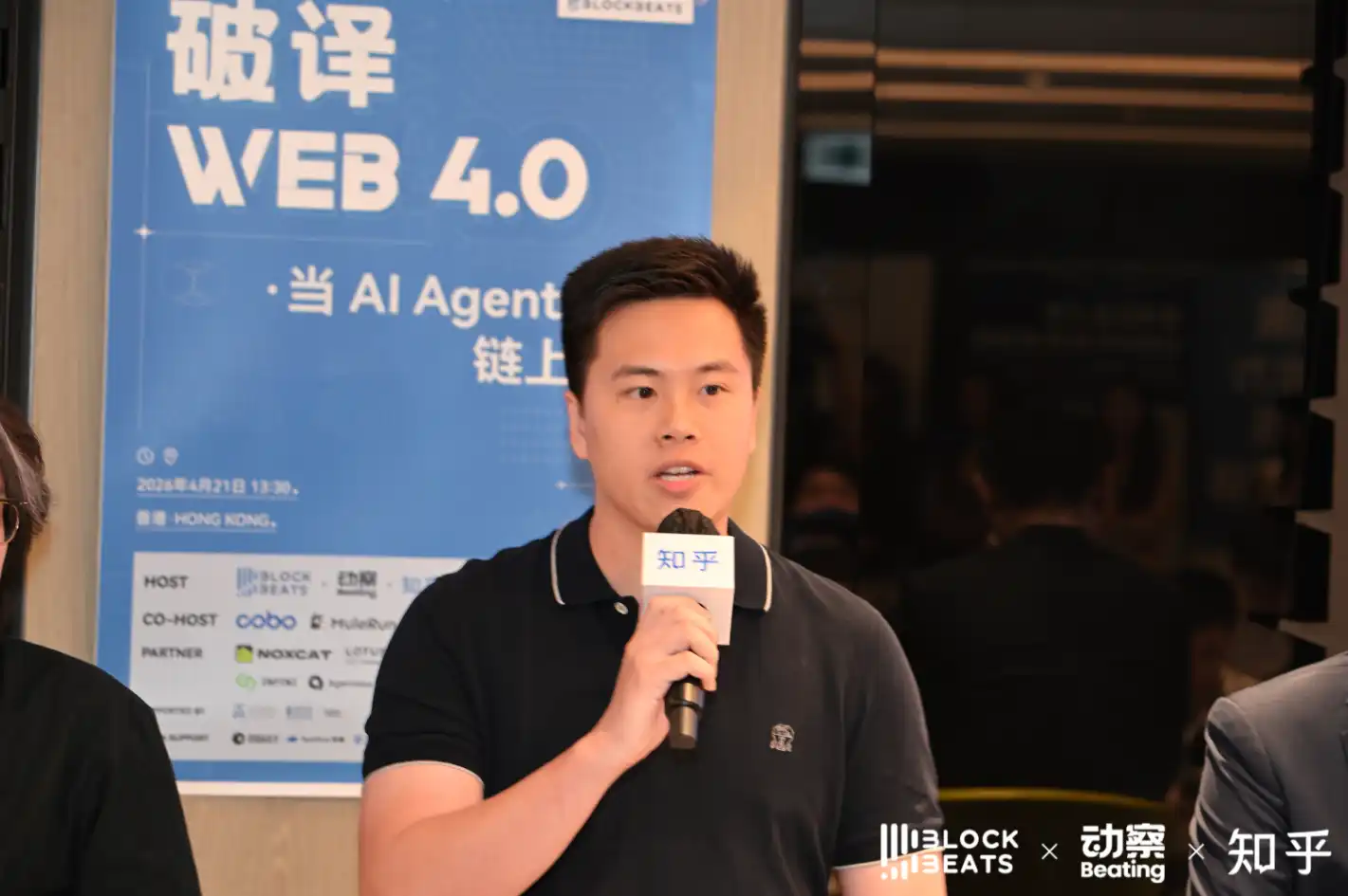
Professor Xue revisited the underlying logic: stablecoins provide transparency and tamper-proof records, making them popular in low-trust regions because they offer security. “However, platform owners may detest stablecoins as they expose their fund allocation operations.”
He concluded by saying: The purpose of technology is to enhance societal value, not just to make a zero-sum profit. If the sole aim is profit, it's too low a goal.
Skills Demo Showcase
Agentic Wallet / Brad Bao (Head of Growth at Cobo AI)
The Agentic Wallet released by Cobo is an Agent wallet with expenditure control, approval, and end-to-end audit capabilities. Its core idea is: have your Agent sign a Pact contract instead of handing over the private key.
Brad showcased three scenarios from simple to complex. The simplest being a Uniswap transaction, where the Agent submits the contract, and the user approves with a single tap on their mobile phone.
A bit more complex scenario of cross-chain transfer, where the Agent autonomously plans the fastest and most cost-effective route, self-debugging in case of failure, with no human intervention throughout.
The most complex Hyperliquid hedging strategy, where the Agent devises its own arbitrage scheme. Once the contract is in effect, all operations for the next thirty days do not require any additional authorization. The underlying technology of this product is Cobo's MPC multi-party secure computation technology developed over many years. Your funds are always in your hands, and while the Agent can execute trades, it can never take control.
"Trust should not be an additional feature of the product but should be the foundation of the Agent economic system," Brad said.
Macro Monitor Agent Skills / xingpt (full-asset trader and Twitter blogger)
xingpt has been involved in Crypto VC investments for many years and recently shifted focus to AI content and investment research. His core belief is that the tools are already sufficient; what's lacking is "how to use" them.
He has established a community called Web Trading to share Agent trading strategies. He primarily looks for Beta opportunities himself rather than just chasing Alpha.
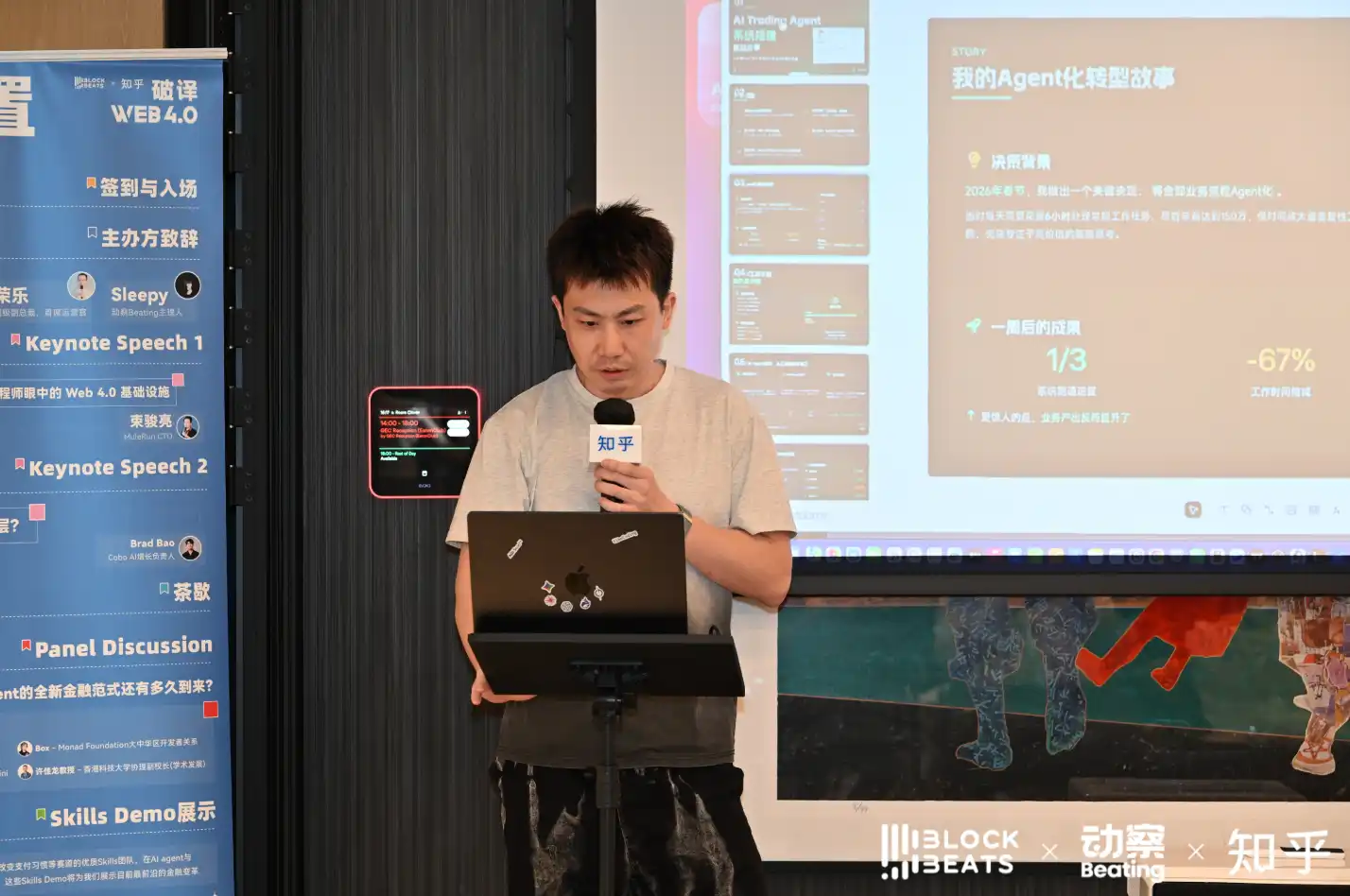
He showcased three Agents that are already active:
The first one is a geopolitical risk monitoring Agent that specifically focuses on the Strait of Hormuz. It pulls daily data on ship traffic and passage status, while simultaneously comparing firsthand sources from Iran and the U.S. This monitoring, faster than domestic Chinese media's second- and third-hand news, led him to go long on oil and make a 15% profit in three days.
The second one is a Bitcoin bottom-fishing Agent that combines on-chain data, technical indicators, and social sentiment. It gives a buy signal when multiple signals resonate. This indicator resonated at sixty-six thousand Bitcoin, validating its effectiveness.
The third one is a U.S. stock dollar-cost averaging Agent. Through backtesting, he found that U.S. stocks had a less than 20% maximum drawdown in the past decade with an excellent Sharpe ratio, making it suitable for long-term allocation.
He then made two suggestions: First, the database is crucial; second, offline expert exchanges are even more critical.
"You need to have a weekly chat with industry experts."
Full-Asset Active Trading Agent: Donut / Chris Zhu (Donut Founder)
Donut is positioned as an 'active trading Agent' in high-risk asset scenarios — it does not wait for user instructions but actively pushes trading opportunities to the user.
The product demo showcased a comprehensive Agent evaluation framework. The system automatically tests every answer from the Agent, every data source, and every tool call: metrics such as time consumption, pass rates, user sentiment feedback, etc., are all quantitatively tracked. This framework ensures that the Agent can continuously iterate and optimize in a data-driven manner.
The current product serves two types of users:
• "Pro Users" use the Dashboard to access features such as backtesting, position analysis, and paper trading.
• "Novice Users" directly interact with the Telegram Bot, which has the same underlying model and data source as the professional version, ensuring no differentiation.
$9,999.10
Chris Zhu shared three product methodologies:
• "The product must be substantial" – It cannot just be an API or Bot. UI/UX is a key medium for users to understand what the Agent is doing. The Agent's decision-making process must be explainable and visualized; otherwise, trust cannot be established.
• "The data feedback loop must be fast enough" – Every order placement and P&L is a feedback signal. These data points must flow back to the evaluation system in real-time, informing the model: "You took this suggestion, and the result was profit/loss." The finer and faster the feedback loop, the quicker the Agent evolves.
• "The team must be systematized enough" – Every team member should have their personalized Agent, automatically summarizing the key information they review daily and acting as a central nervous system to transfer context to other members. This approach significantly accelerates team iteration speed.
The Donut team successfully implemented the "systematic team" model by developing the proactive central AI Agent "Turing bot." It overcame the limitations of passive instruction tools by daily pushing personalized context summaries to members, proactively routing related information to break information silos, and automatically accumulating real-time updated structured knowledge. It became a proactive information pusher, eliminating team information blind spots, and efficiently linking the entire team's context.
Vertical AI Employee: Agentese / Scarlett (Agentese CMO)
The Agentese team doesn't create general Agents but opts for vertical AI Employees, assigning a dedicated AI to each role to address specific use cases.
$9,999.11
They have already launched four products:
The first is the Meeting Copilot, offering real-time multilingual translation, automatic meeting summary, and Action Items. It can be integrated into customer service systems, live streams, and online classrooms.
The second one is the job assistant "Pink Potato". After uploading your resume, the system will automatically screen high-scoring positions on LinkedIn and Boss Zhipin 24 hours a day, pushing them to your phone. Each match costs less than 1 cent, and the Agent can even help you negotiate your salary.
The third one is the security auditor CodeAuth. Upload your code for a free scan for security vulnerabilities, currently covering the EVM and Solana ecosystems.
The fourth one is the life assistant Life Cloud, which helps you make restaurant reservations and order food through Telegram or Line, currently focusing on the Southeast Asian market.
Prediction Market Agent Trading / Ryan (Insider bot founder)
Ryan believes that the prediction market is the most suitable asset class for Agent trading because it is fragmented, decentralized, and event-driven. Over the past few months, some Agents have made millions of dollars trading on it.
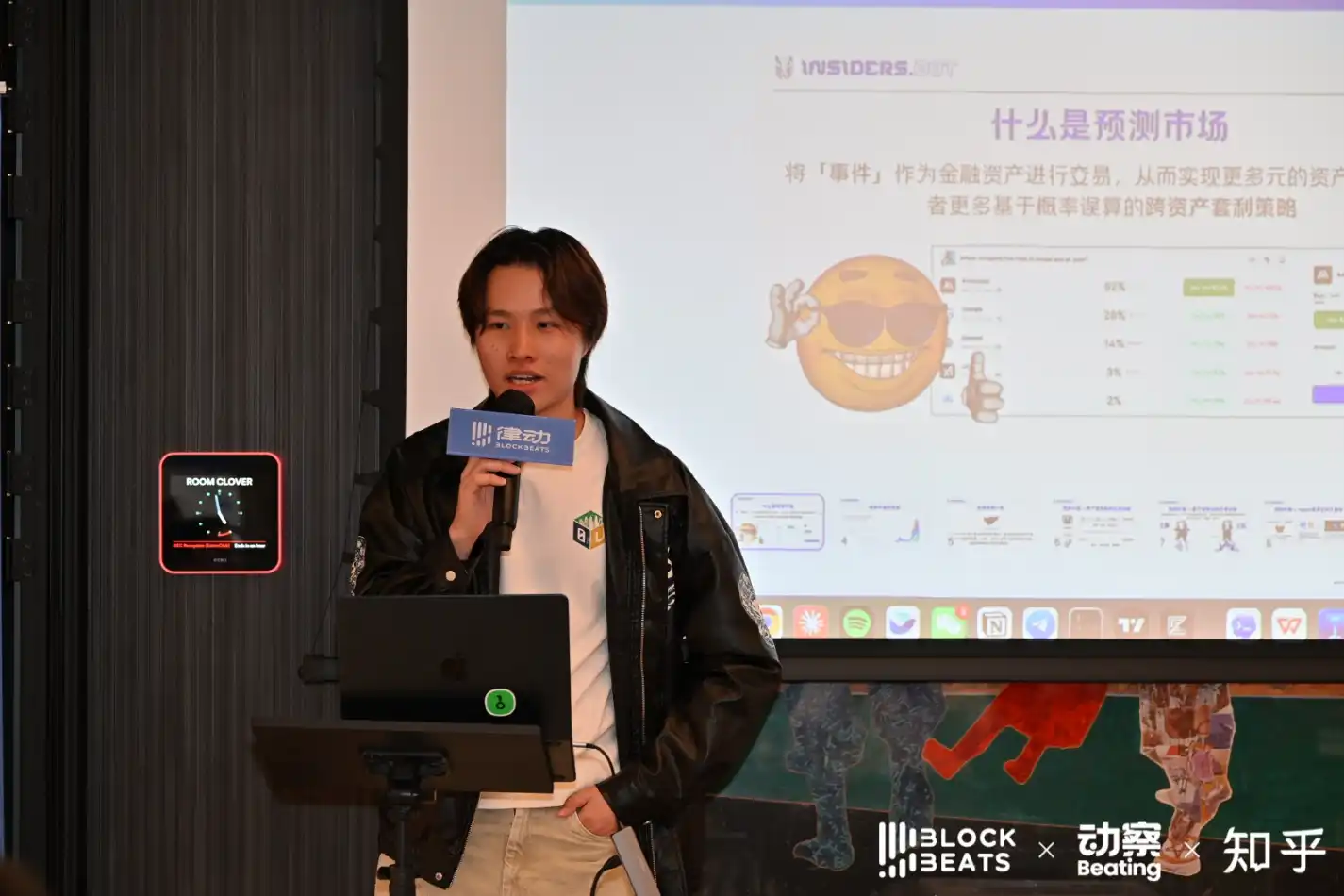
The Insider bot showcased three use cases.
First is the intelligent backtesting system. How do you take profit and stop loss when copying a wallet? How do you outperform the target wallet? The Agent can help you optimize this.
The second is the intelligent trading system. Once integrated, the Agent can access all smart money databases, follow signals, and users can even ask it in natural language "why trade."
The third is the Tg Bot, where users can execute trades with a single sentence.
Ryan promptly displayed their wallet database, where all metrics are updated in real-time. This was not just a technical demonstration but also a harbinger of the future infrastructure of Agent trading.
The live demo showcase session has concluded, but the development of AI Agents has only just begun. Agents have stepped out of the laboratory and are now developing strategies, monitoring chains, bridging chains, negotiating salaries, and scanning for vulnerabilities. The question is no longer "can it be done," but rather "is it secure," "who is responsible," and "how to scale."
At the intersection of AI Agents and on-chain finance lies a layer of the "trust system."
The "Decoding Web 4.0: When AI Agents Take Over On-Chain Permissions" offline event concluded in Hong Kong. The Web3 application NOXCAT, which integrates MPC wallets, social transfers, and on-chain security, attended the event and revealed its on-chain escrow contract mechanism—when users engage in off-chain transactions, the funds are automatically locked in a smart contract and can only be released after mutual confirmation, eliminating the risk of one party running off from a mechanism standpoint.
NOXCAT stated that this feature is designed to address the long-standing pain point of trustlessness in Web3, with the application expected to launch officially in June 2026.
This hours-long event ultimately centered around one word: trust.
No matter how advanced the technology is, it remains just a tool; no matter how much data there is, it remains just a raw material. What truly powers Web 4.0 is a layer of "trust mechanism" that everyone can rely on. The future financial world is likely to be filled with AI agents everywhere, assisting individuals, companies, and various protocols in making decisions, conducting transactions, and collaborating, at speeds far exceeding human capabilities.
Humans will no longer be focused on daily execution details, but rather on establishing rules, providing strategies, and monitoring outcomes, transitioning from "workers" to "rule-makers."
Moreover, this future is not so distant.
Welcome to join the official BlockBeats community:
Telegram Subscription Group: https://t.me/theblockbeats
Telegram Discussion Group: https://t.me/BlockBeats_App
Official Twitter Account: https://twitter.com/BlockBeatsAsia
