Article by Sleepy.md
Interview by Kaori
Ideation, Moving Forward
April 2026, Zhangjiang, Shanghai, at the Little Red Book Hackathon.
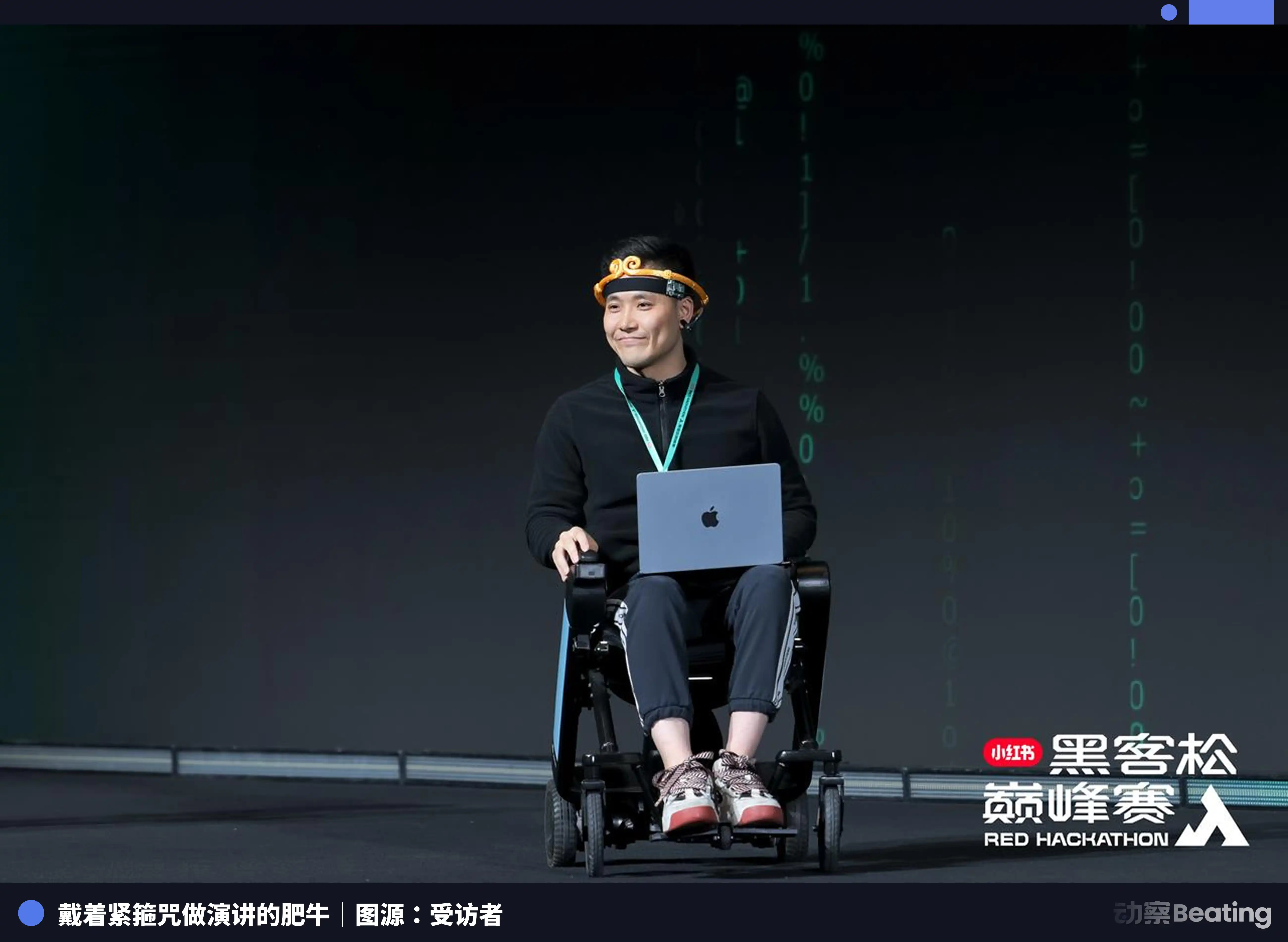
There was a person sitting on the demo stage. His name is Fei Niu, real name Wang Ning, 32 years old, a spinal cord injury patient, a wheelchair user. He wore a Sun Wukong's golden hoop on his head, with several electrodes on the hoop, attached to his scalp, quietly reading the electrical signals inside his skull.
Then, he took his hands off the wheelchair's control panel.
And then, the wheelchair moved.
Not pushed by anyone, not by a remote control, no physical contact either. It just moved forward for a while, steadily. Over 200 people in the audience, including developers, investors, and Little Red Book employees, many remained silent for a few seconds, then burst into applause.

In this edition of the Little Red Book Hackathon, organized by Little Red Book, Hillhouse Capital, and Zhangjiang Group, with a ¥500,000 prize pool, 200 young developers, 48 hours of closed extreme creation. Fei Niu and his wife Xiang Gu, just the two of them, no teaming up, no engineering background, one was a radio host, the other used to write online novels. This time, they won the first prize in the hardware track.
After the award ceremony, Fei Niu stepped down from the stage, and more than ten investors added him on WeChat. Someone told him, "The social value of this thing you've done is greater than its commercial value." He smiled, didn't argue, but he knew in his heart that he didn't do this for the kind of "social value" that would be written on a PowerPoint slide.
He did this because he knew that feeling - a complete mind, a clear consciousness, everything you want right in front of you, but your body doesn't obey. It is a predicament longer than death.
This story goes back six years.
On the Eve of the Wedding
October 2020, Shenzhen.
A few days before Fei Niu and Xiang Gu's wedding thank-you banquet. The invitations were sent out, the banquet was arranged, and relatives and friends have been gradually arranging their schedules. They have known each other since high school, been together for fifteen or sixteen years, and both know that among the group of couples who used to go out together, it seems that only the two of them are left standing at the end.
The smoothest times in life are often when fate is about to play a trick.

The fatty beef's neck began to hurt, and the painkillers couldn't relieve it. He felt like something inside his neck was pushing out. He went to the emergency room, got an X-ray. After looking at the X-ray, the emergency room doctor was silent for a moment, then said that he had been practicing medicine for thirty years and had never seen this before.
The fatty beef was so scared that he began to make funeral arrangements.
The fragrant mushroom did not collapse. She turned her social circle upside down, contacting everyone within the six degrees of separation who had any connection to the medical field. That night, they went to Guangzhou.
The test results came out, and it was discovered that there was a tumor in the fatty beef's spinal cord.
There are seven vertebrae in the neck. His tumor extended from the second cervical vertebra to the sixth, 13.5 centimeters long and 1.2 centimeters thick. It was the first time he realized how long his neck was. The tumor compressed the nerve to the side, occupying the space that originally belonged to the spinal cord.
The doctor told him that from the second to the sixth cervical vertebrae, all the switches related to his breathing, heartbeat, and all vital functions were located here, and all these switches were being pressed by the tumor.
"If you sneeze, fall, or brake suddenly, you could be gone."
The fatty beef's immediate reaction was, "Can we postpone the surgery until after my wedding?"
The doctor was stunned for a moment, then realized that this young man in front of him had no idea how dangerous his situation was.
The fatty beef soon underwent surgery. The first time, it was a close call. The spinal cord was cut open from the back, with a incision of over ten centimeters. The tumor was removed, and part of the nerve was also cut, leaving the fatty beef paralyzed. But three to four months later, he stood up and could walk again.
He thought he had passed the most difficult part.
In 2023, he went for a follow-up examination, wanting to have a comprehensive check-up on his spine for maintenance. He loved sports, and before the first surgery, he asked the doctor two questions: whether he could have his wedding first and if he could still exercise in the future. The doctor said yes, but he had to take it slow. He remembered this and had been waiting for the right time to "take it slow."
When the test results came out, the tumor had recurred.
"I went from a narrow escape to a dead end in one go."
He later told us that if he had to go through it again, he didn't think he could endure it.
The first time, he was like a newborn calf, not afraid of the tiger, understanding nothing and therefore fearless. The second time, he knew what was waiting for him: a long incision, a pain pump, hallucinations after being medicated in the ICU, not being able to distinguish between dreams and reality even when awake during the day.
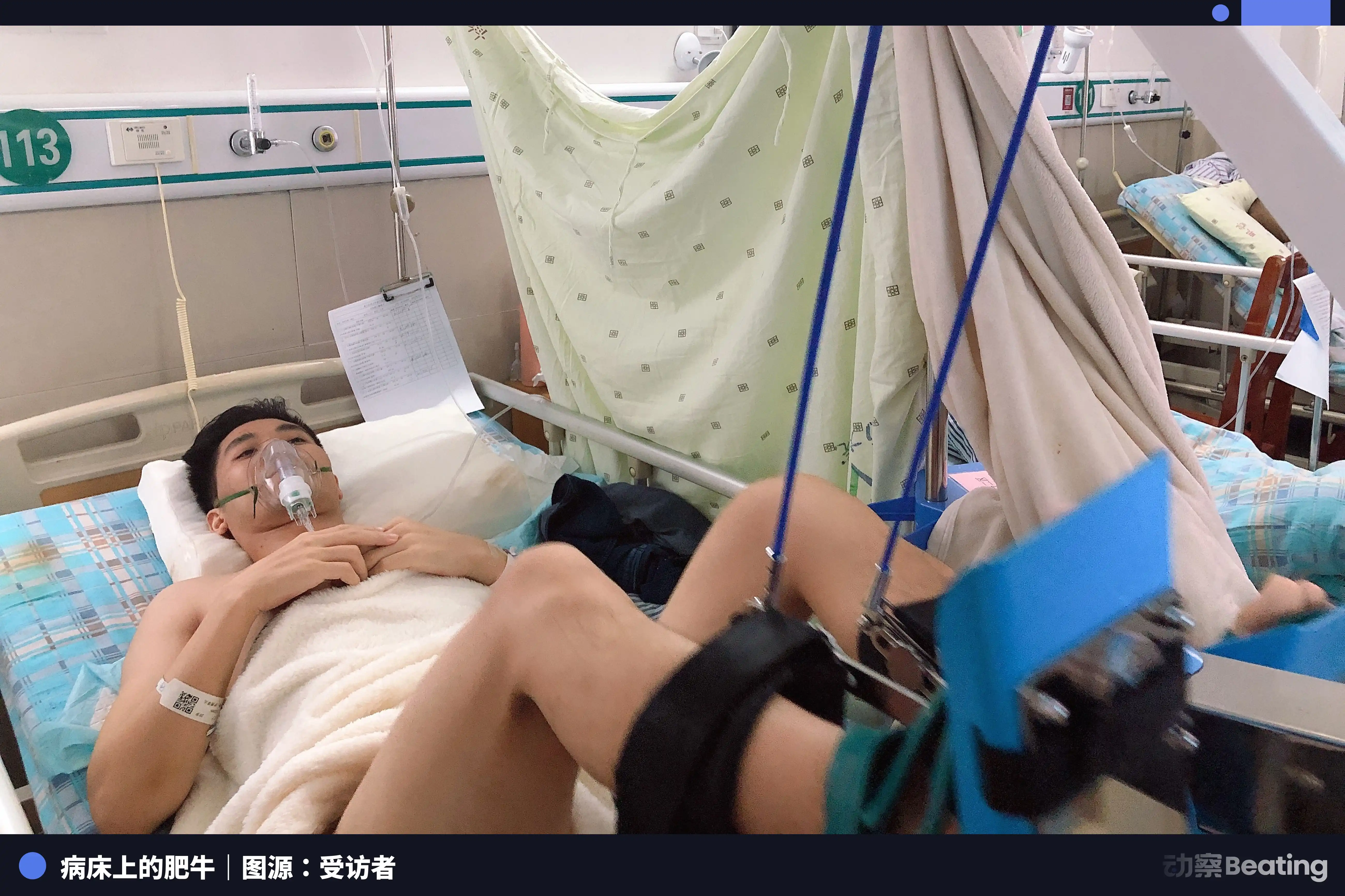
After the second surgery, he was paralyzed again. This time it was more severe, and the recovery was slower.
It was the year 2023, and the art education industry had been basically wiped out under the "Double Reduction" policy. The chain of institutions he had opened in Shenzhen one by one went out of business. With his body paralyzed, his company bankrupted, and debts weighing on him, these events happened simultaneously, with no specific order, leaving him no room to breathe.
"The entire person, from willpower to business to life, was in a state of collapse."
At that time, they were in Shenzhen, faced with a mess to clean up, handling the closure procedures of over a dozen institutions, debts, and his own 24-hour neuropathic pain. The pain occurred randomly, possibly in the middle of the night, maybe the moment you fell asleep, or perhaps just 10 minutes after waking up, it would suddenly "zap" with pain.
He dealt with this pain for a long time, so long that eventually he could manage to use part of his willpower to resist the neuropathic pain while diverting another part of his attention to studying other things. But that was much later.
During the darkest period, even tilting his head was a challenge.
There was a time when Fat Beef's first morning task upon waking up was to confirm if his legs were still there. He had dreamt of amputation several times, so he had to check as soon as he woke up.
Later, the first thing he did upon waking up changed. It became searching for mushrooms.
He said that during that period, if the world gave him two buttons, one for life on the left and one for death on the right, he would press the death button countless times. The only thing that made him try the life button was mushrooms.
Mushroom Fat Beef
One day, Mushroom borrowed his wheelchair.
It was during Fat Beef's paralysis period when online trends included "Experience a CEO's Day" or "Experience Someone's Day." Mushroom said, "I'll experience your day." She left at 8:30 in the morning and didn't return until 10:30 at night.
Fat Beef waited at home all day.
When she returned, she cried.
She said, "We grew up together, visited so many places, went to so many cities side by side. Even on a wheelchair, we explored many places together. But today, I realized that although we are still together exploring this world, you are no longer the same. The world we see together, my perspective and yours, are completely different now, with no overlap."
She said, "I didn't realize that just a 3 cm slope would stop you. A 3 cm barrier, and you would have to seek others' help. I didn't know you faced so many stares on the road, and those gazes made you so uncomfortable. Strangers thought it was care or curiosity, but for you, in a strange environment, it was a piercing pain."
The Wagyu Beef said that at that moment, he was pulled back from a lonely world into a world where someone walked alongside him.
The Shiitake Mushroom didn't just verbally encourage him with "You can do it," she put herself in the Wagyu Beef's shoes, using her own body to understand his.

"She was able to pull herself out of her busy schedule, stand on my shoulders, see the world from my perspective, take a brief look at this world with me, and empathize with the me in this world."
He said that empathy was one of the key moments that allowed him to gradually pull himself out of pain. It wasn't just mere encouragement; it was genuine empathy. He said that the encouragement of "You can do it" addresses the speaker's own need to encourage and does not solve his problem. Shiitake Mushroom didn't do that. She stood by his side, looked at the world with him.
"I feel like I should live up to this emotion; I should also move in this direction. Even though my body is controlled by pain and paralysis, she is also controlled alongside me. Since she can pull herself out of those messes, take a brief look at my situation, why can't I do the same as her?"
And so, he began to gradually pull himself out of 24-hour nerve pain, trying to feel Shiitake Mushroom's world, to see from her perspective.
During that time, Shiitake Mushroom was writing online novels to support the family. Cultivation Unlimited Updates, she had to write 4000 words a day, readers demanded updates, sometimes unable to write, later managed to keep up with AI. She said that what AI wrote sometimes "really looks like crap," but it significantly shortened the workflow, "shortened the process of producing crap."
Now, she has been on hiatus for a long time because of more and more things on her plate. She said she was embarrassed to tell others that she was that author, fearing being exposed.
The day we interviewed them, they were in a bubble tea shop. The internet was down at home, so they came out for lunch, and coincidentally, to use the Wi-Fi at the bubble tea shop for the interview.
This is their current daily life.
Shiitake Mushroom is a Hakka girl, a Gemini, free-spirited, with many ideas, the kind of person who says, "If this problem can't be solved, let's not solve it for now, let's see if there is another way." The Wagyu Beef is a Scorpio, stubborn, with strong structured thinking. He won't move on if one point isn't clear, but once it is, he will delve into it. He said he might have a bit of ADHD, understanding conceptual things quickly, able to quickly structure an idea, but gets stuck on small details, needing to clarify every point before moving on.
The two of them, one responsible for finding the direction, the other for running along that direction.
The Fatty Beef said they had been together for half a lifetime and didn't need to have a meeting to divide the work. Each would complete their own part, and when put together, it was just right at one hundred percent.
Directly Facing AI with the Brain
In 2021, while Fatty Beef was still in the paralysis recovery period, Shiitake began to help him find rehabilitation methods. She sifted through academic literature to find methods with experimental group comparisons, looking for relatively safe and self-tried solutions. When they couldn't buy some equipment, they modified it themselves. When they encountered problems, they solved them, gradually learning step by step.
Fatty Beef's rehabilitation doctor once asked him to do one thing: close his eyes, imagine that he moved, and imagine how he used to move.
Fatty Beef's immediate feeling was, "Isn't this creating a secondary trauma for me?"
He said that feeling was like someone telling you to use your mind to bring the cup beside you over, let it float in the air, and then drink with your mind.
The doctor told him that imagining he could move with his mind would help his recovery. He thought this was ridiculous. Was spinal cord injury really so desperate that it forced doctors to use this almost cult-like method?
However, he secretly tried it.
When there was no one around, he talked to his legs. The caregiver told him, "Your legs are your partners. They have been with you for so many years, and now they are injured. You should not blame them but encourage them. You should talk to them more." At that time, he thought this advice was too strange, but later, driven by curiosity, he tried it.
Of course, it didn't work.
But this experience planted a seed in his mind—if he really could control things with his mind, that would be amazing. Not only could he do small things, but he could also suddenly become a superhero and fight back. This kind of plot involuntarily emerged in his mind, replaying repeatedly.
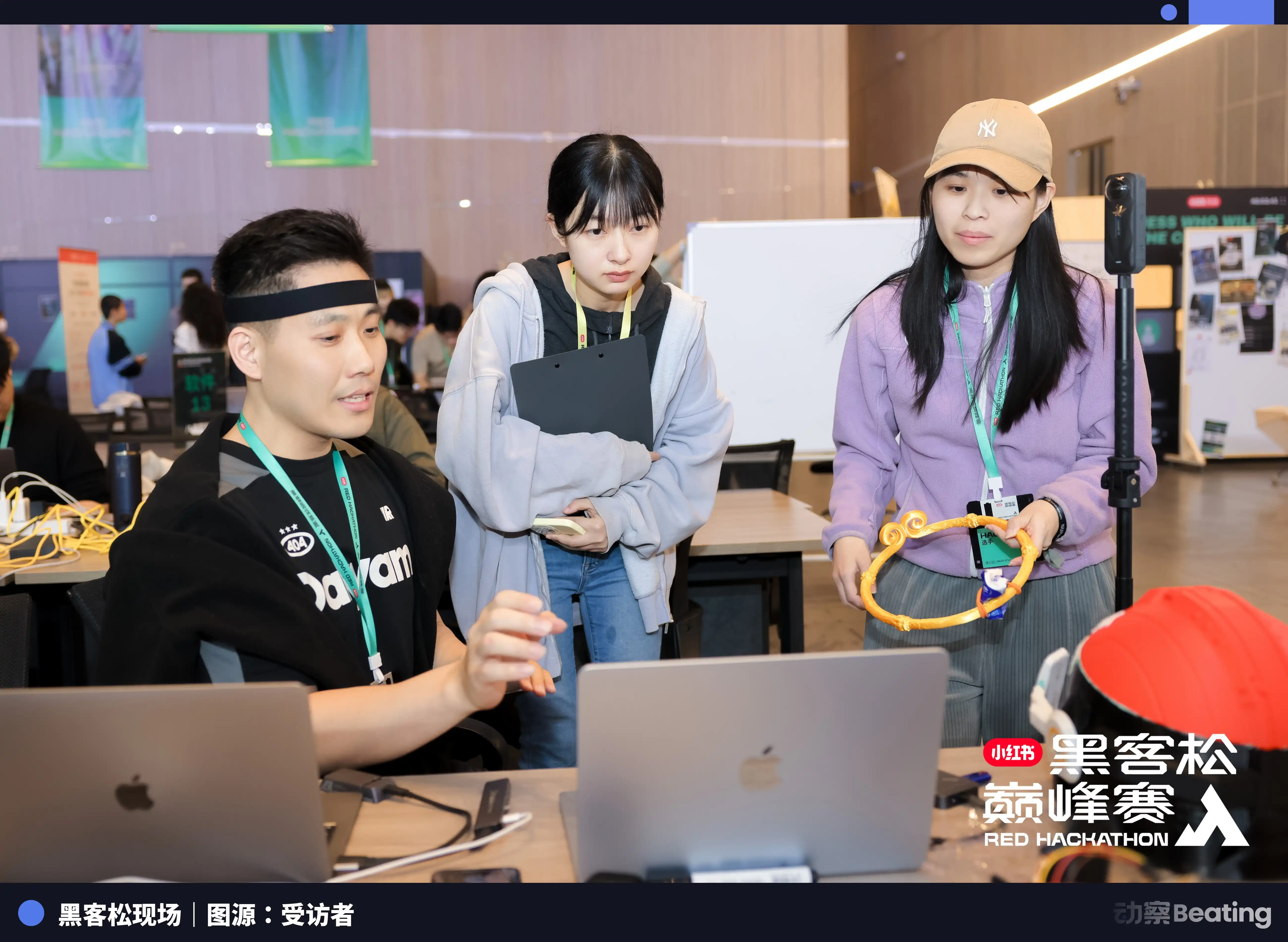
The day after ChatGPT 3.5 was released, Shiitake started using it. At first, they treated AI as a working assistant, assigning unimportant paperwork to it. Later, they found it was more powerful than imagined and slowly began entrusting important tasks to it, treating it as a Think Tank and a CTO. Fatty Beef said, "When AI Big Brother was still a little brother, we already saw it as a big brother."
This habit helped them at the hackathon.
For this hackathon on Xiaohongshu, Fatty Beef and Shiitake went alone without forming a team with others because they didn't want to "harm others." They were not sure if they could make it. If they had pulled others in and ended up not accomplishing anything, they would be sorry for those who had come from afar to participate in the 48-hour competition.
They went there to give themselves a "chance to dream."
"We have debt, the pressure of starting a business, and products to develop. During these 48 hours, we set aside everything else, created a vacuum, and went to fulfill the dreams we had when we were paralyzed. In just 48 hours, either we achieve it, or if not, we may not specifically touch this thing again in the future."
They had a feeling of "undeservedness" about brain-machine interfaces. This term was coined by Beef Noodle themselves. They had studied the literature and knew what brain-machine interfaces were, but always felt it was something confined to the laboratory, too high-end, not something their grassroots team could touch. They had a sense of keeping a respectful distance.
On the first day of the hackathon, they hit a wall, both in terms of ideas and the wheelchair.
Although the brainwave signals were successfully read, they couldn't control the wheelchair. The signals were too noisy and unstable, each wave read was different every time, making it impossible to translate into commands.
The traditional research path for brain-machine interfaces is to first translate the brainwave clearly, understand which wave means "forward" and which means "stop," and then combine it with commands for programming. However, the issue is that brainwaves themselves are unstable. When you want to go "forward," there are other thoughts in your mind simultaneously, causing too much noise, leading to significant signal degradation.
As a result, the wheelchair went out of control and crashed into the wall. Beef Noodle said that at the time, they felt that "crashing into the wall was already quite good, at least they could find the brainwave, control it, and crash into the wall." But this thing couldn't be used, it seemed like a failure.
Then Mushroom said a sentence that changed the whole direction.
Mushroom's idea was to skip the translation step. This idea, Beef Noodle later repeated to others, saying each time, "This is truly a genius idea."
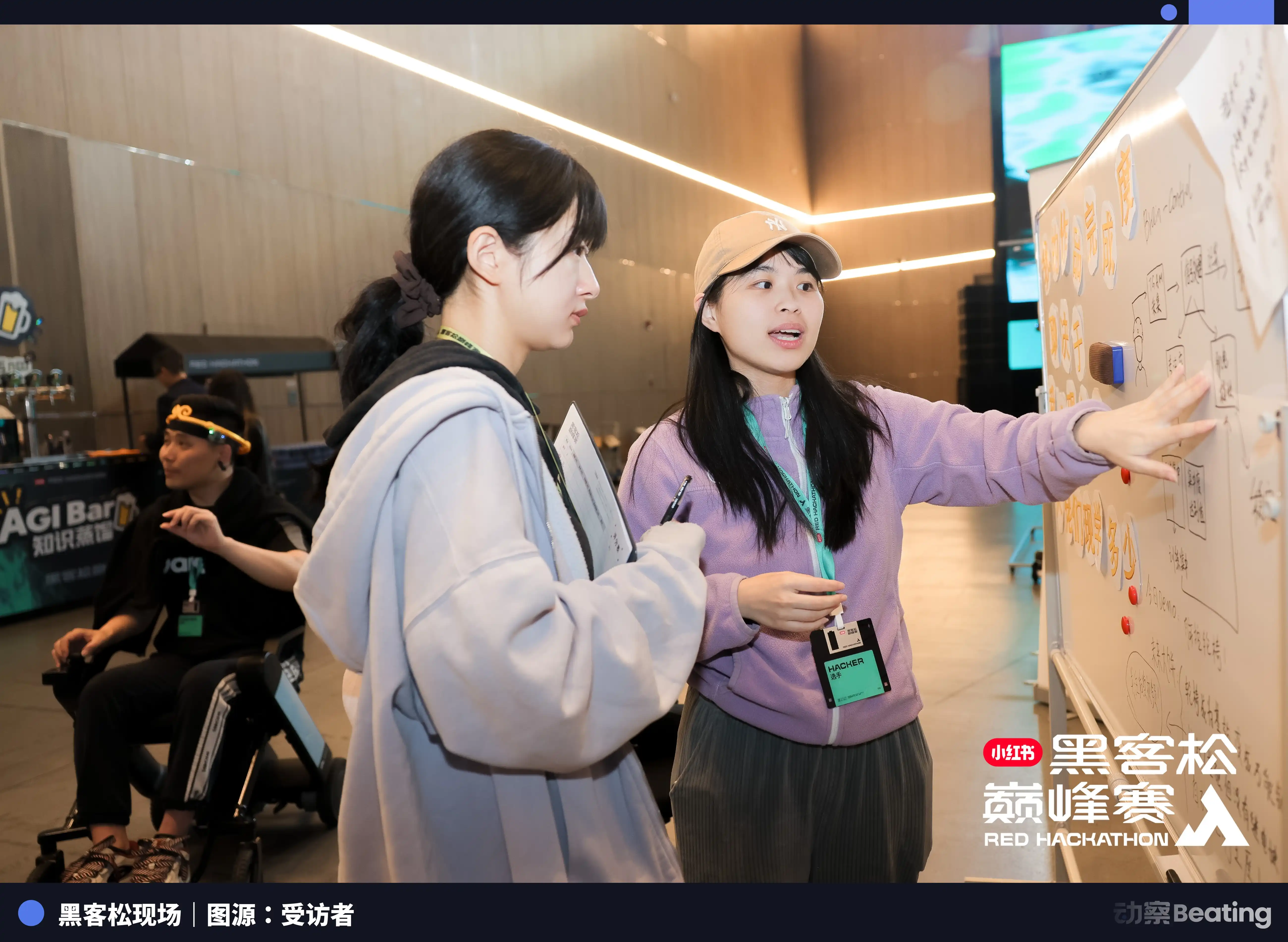
They no longer tried to define what a particular brainwave meant but instead handed it directly to AI, allowing AI to perform algorithmic calculations between two data packets, finding a few stable data packets and directly combining them with programming instructions.
"We're no longer acting as intermediaries. Let the brain face AI directly, with no one intervening in the middle."
Beef Noodle said that he later searched for similar research, finding some in a similar direction, but all were still trying to translate brain waves, and no one had attempted to skip the definition step like this. He believed this direction had reached the level of applying for a patent.
With this breakthrough, their progress on the second day was rapid. They identified several stable data packets, combined them with wheelchair directional control, introduced a myoelectric module, implemented multimodal fusion, making the control more stable.
During the final demonstration, Fei Niu removed his hands from the control panel, and the wheelchair moved smoothly and seamlessly.
They designed the headgear used to control the wheelchair to resemble the "Boundless Lock" on the Monkey King's head.
Xiāngū mentioned that before becoming the Victorious Fighting Buddha, the Monkey King was the Great Sage Equal to Heaven. Similarly, those paralyzed patients must have had incredibly exciting lives before their paralysis. They are all Great Sages, but the disease has placed a Boundless Lock on them, confining them. The master and his three disciples underwent the 81 challenges, and although the confinement still lingers, he has become the Victorious Fighting Buddha.
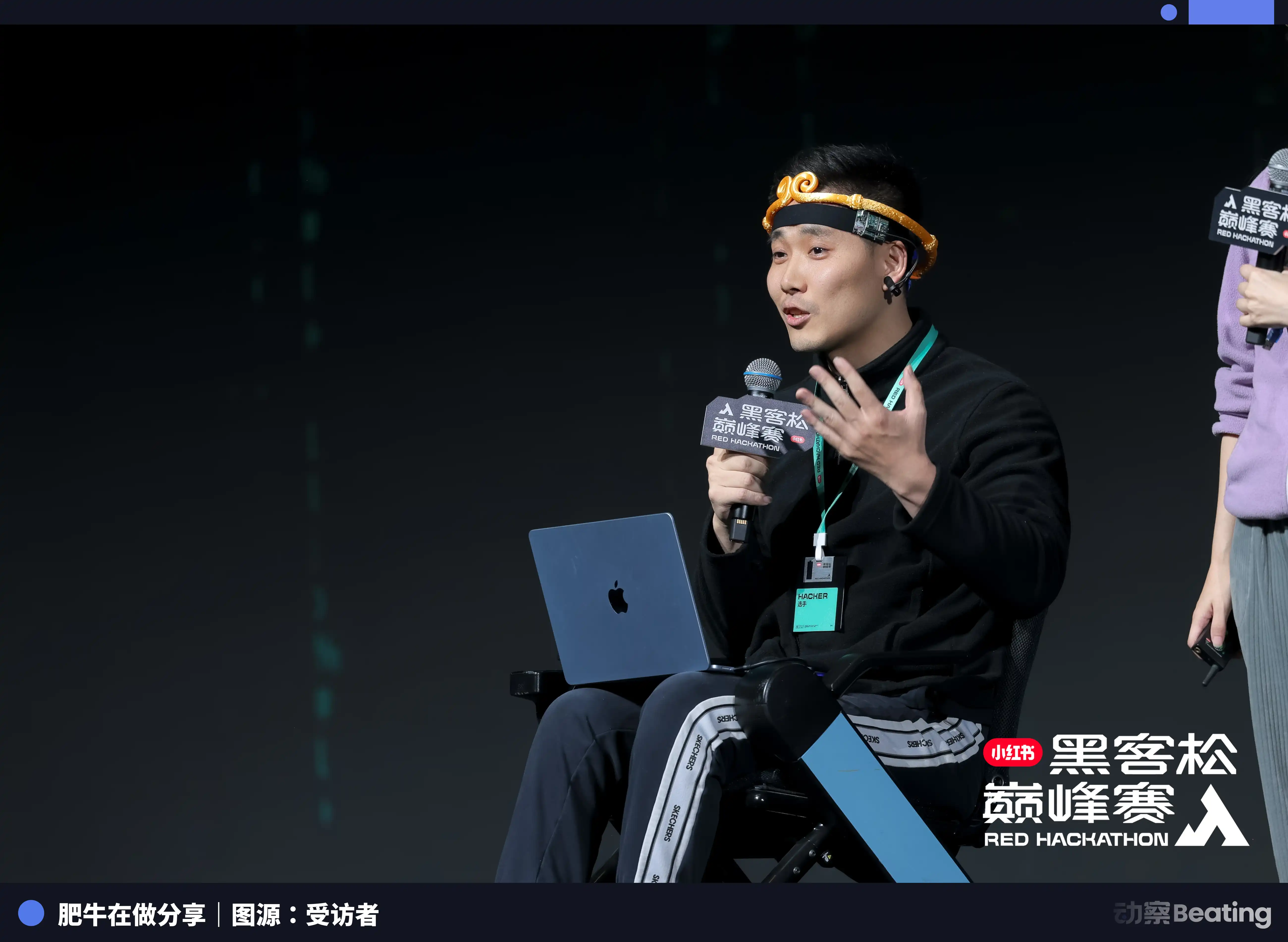
Fei Niu said that when he heard this analogy, he was deeply moved and excited, experiencing a feeling that was challenging to put into words.
Thinking About the Universe While the Bill Brings You Back to Reality
After receiving the first prize, Fei Niu stepped down from the stage, and more than ten investors added him on WeChat.
Some inquired about his path to commercialization, while others asked about his next plan. He answered each one calmly, with a demeanor of someone who has been through a lot, not indifferent but genuinely calm, like the calmness one exhibits after facing more significant challenges.
However, the night before our interview, they were pressed for debt repayment. They owed money to a friend, and upon the friend's husband finding out, he exerted substantial pressure on them, demanding immediate repayment.
Xiāngū mentioned that she told Fei Niu to delay and wait until she could slowly earn some money back. But due to the pressure from the friend's husband, the friend insisted on seeing the money today or tomorrow. This pressure was not just about the money; it was a dilemma entwined with friendship and debt that they had to deal with but couldn't immediately resolve.
Fei Niu said the feeling was like this: you are thinking about the universe, alien civilizations, whether brain-computer interfaces can help humanity evolve to the next level of civilization, but do you need to pay for that cup of milk tea? Do you need to pay this month's electricity bill? What about the rehabilitation costs?
"It all brings you back to reality."
Fei Niu is fascinated by "consciousness transfer." He mentioned that communication between high-dimensional civilizations might not involve language or text but directly delivering a complete information package to each other. You wouldn't just know where that restaurant is; you would simultaneously experience the taste, price, and mood of that meal.
While this might sound like science fiction, he believes that a person lying in a hospital bed unable to speak should at least have a way to inform their family whether they are currently in pain, angry, or at peace.
He said these words while sitting in a bubble tea shop, with Mushroom Tea sitting next to him, outside on a typical Shenzhen street, during an ordinary afternoon. A person who was once trapped by his body was now discussing the efficiency of consciousness transfer; someone who had just been chased for debt by a friend and had not slept well the night before was pondering the next leap in human civilization.
But these two matters were not contradictory to him.
He said that in such moments, there was no need to confront fate head-on when feeling terrible. One could temporarily avoid the sharp edge, take a moment to catch their breath, wait until they felt better, and then actively face the situation.
"Being able to prevent sadness from completely taking over oneself, I think that is a success in life."
Mushroom Tea said, "As long as you are still on this path, you should not be afraid of being left behind. If you keep walking, you will definitely reach a bright place." This statement was something they told themselves and also something they gave to all those who had similar experiences.
Be a Light
During Fat Beef's hospitalization, he encountered an old grandfather who couldn't speak or move.
He was seventy or eighty years old, with all white hair, receiving acupuncture every day, like a flowing mat, undergoing several sessions in a day. Everyone in the ward knew him, knew his name, and knew his bed number. One day, the old grandfather's face looked particularly ruddy, and everyone praised him, saying that he looked better recently and maybe one day he would be able to speak and move.
The old grandfather couldn't speak or move, but his intellect was normal. He could understand what others were saying, knew where he was, and understood his situation. During the evening's bedtime care, a nurse found an acupuncture needle stuck in his leg, bent under pressure.
That needle had been pressing into him all day long.
He felt that needle, he felt the pain throughout the whole day, but he had no way to tell anyone. His face looked rosy not because he was in good health but because of the pain.
Fat Beef said that when he heard about this incident, he felt extremely uncomfortable. He said he wanted to create a brain-machine interface that could identify emotional states. He wanted to place an LED light at the old grandfather's bedside that would change color: red for anger, green for happiness, yellow for anxiety, and blue for calmness.
"When the old grandfather's family visited him and interacted with him, they could see the changing light. He would use light and color to communicate with his family on a certain emotional level."
"He could also convey such an emotion in very desperate times."
This detail was one of the core motivations for Fat Beef's actions. It wasn't the kind of "social value" written on a PowerPoint slide; it was a specific old grandfather, a needle bent under pressure, and a day of silent pain.
He said the old man was not a symbol, not a data point, but a real person, a person with emotions, feelings, and dignity. It's just that his dignity is trapped in a body with no way out.
Currently, there are approximately 3 million spinal cord injury patients in China, most of whom don't even have the opportunity to sit in a wheelchair.
Fei Niu said that among this group, those who can sit in a wheelchair are already considered at the "Tsinghua, Peking University, 985, 211 level." That is a relative freedom, a relative stroke of luck.
More people can only lie in bed, turning their bodies every two hours to prevent pressure sores from reaching their bones. They can't wait for the technological singularity, they can't wait for the future where the brain-machine interface is precise enough and affordable enough. They are in bed now, they need a color-changing lamp now, they need an interface that can reconnect them to this world now.
Another reality is that China's current barrier-free facilities have legal requirements at the regulatory level. Every public project must involve a barrier-free planner to be approved. However, in actual social operation, how well this requirement is enforced, Fei Niu and Xianggu simply said "in name only" in private, then chuckled and did not continue.
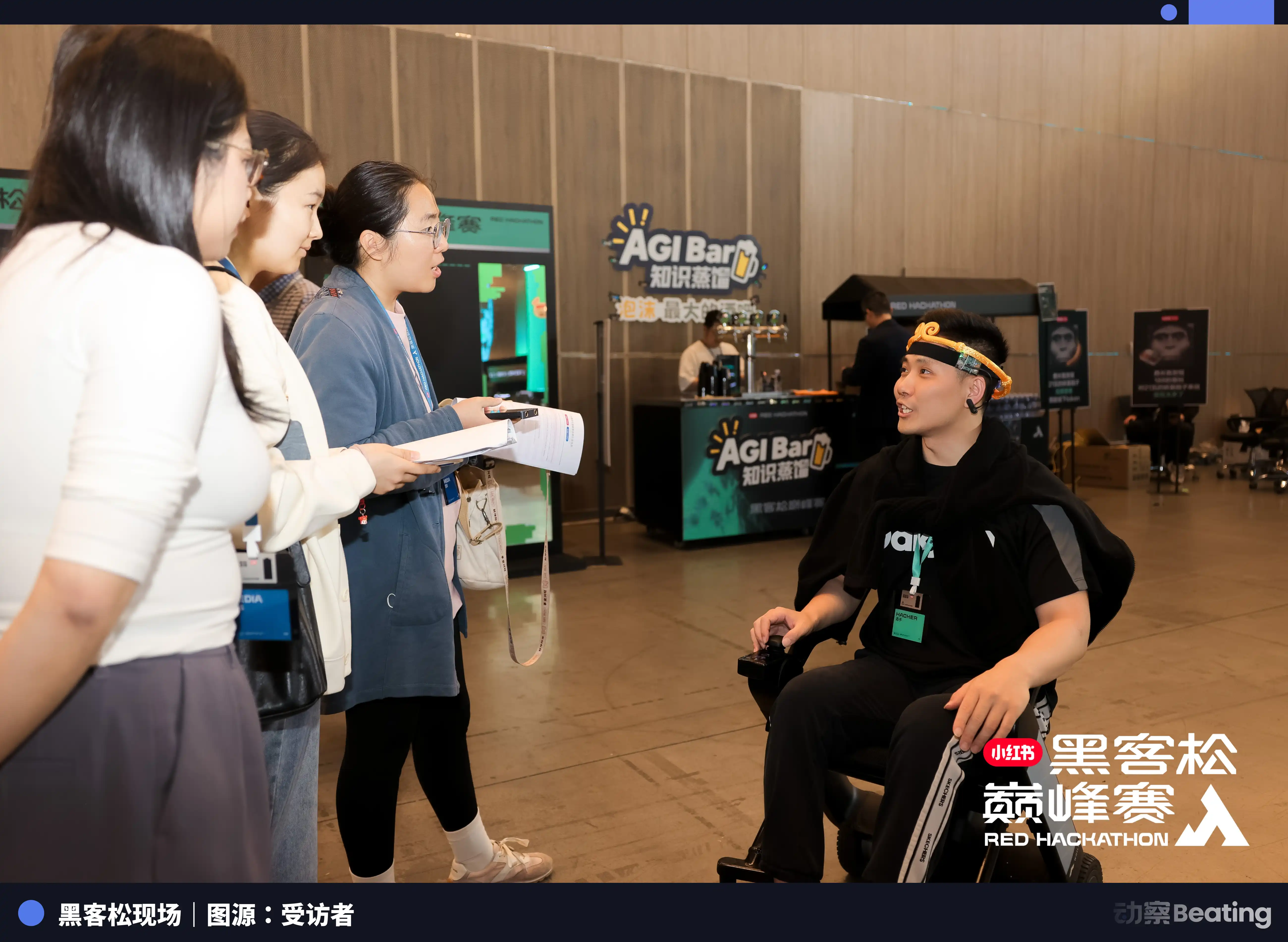
Last year, there was news of a wheelchair-bound disabled person who fell and died due to issues with the barrier-free ramp. Fei Niu said that was just a reported case because that person had influence. This kind of thing happens every day, but most of the time, no one knows.
"Time moves too fast, and those left behind cannot wait for the day when technology is perfect. They just want to return to the starting point of an average person and live a relatively normal life. What we consider a natural starting point is the unreachable endpoint for many."
Fei Niu said.
A Lamp to Wait
In 1995, Jean-Dominique Bauby, the editor-in-chief of French magazine ELLE, suffered a sudden stroke and was completely paralyzed, with only his left eyelid able to move. He blinked, letter by letter, using his eye to finish writing a memoir titled The Diving Bell and the Butterfly.
The diving bell was his body—heavy, sealed, trapping everything. The butterfly was his consciousness—free, light, able to fly anywhere.
Bauby's way was to blink to spell out letters, releasing the butterfly of his consciousness bit by bit from the diving bell. It took him ten months to dictate a book, and then on the tenth day after the book was published, he passed away. The book was later adapted into a movie, winning the Best Director award at Cannes.
What Feinuo is doing is making a key for that diving bell.
The precision of his wheelchair can currently control the direction. He is planning to embed brain control into an accessible navigation map, allowing completely immobile individuals to input their destination through their minds, correct their route, and control their direction.
He aims to keep the final product's price at around twenty to thirty thousand, adding brain control, autonomous driving, and accessible navigation. He said this is not an unattainable number. As of now, a more luxurious wheelchair costs around twenty to thirty thousand. What they are doing is technical integration, not starting from scratch to build hardware. They do not have a technical obsession, do not reject multimodal fusion of voice control, electromyographic control, electroencephalographic control, as long as it can be implemented, as long as it can make these people's lives a bit more free—even if it's just controlling a light, that is freedom.

Next, they will participate in the HarmonyOS development competition to build up the ecosystem. They have a group of patients, a base, a large amount of real user demand data, and are willing to be the bridge between the tech gurus and this community.
"In this matter, there are no opponents, everyone is a teammate, everyone needs to come together to solve a group of people's problems."
At the hackathon venue, after someone experienced the brain-controlled wheelchair, jokingly said, "Just give me this. Although I am not paralyzed, I want it too. I don't want to get up to turn on the lights at home. Make one that I can use directly when I put it on." Feinuo said, of course, that was a good-natured joke, not the user profile they envisioned. But he also said that if the cost of this thing is low enough, he does not rule out a broader range of use cases.
What he can't forget is that old grandpa.
He said he is the 0.001% miracle that doctors talk about as being able to stand up. He is an epitome within this group, but he is the luckiest one. He can sit in a wheelchair, he can stand up, he can participate in hackathons, he can win first place, he can have investors add him on WeChat.
What are those who have not stood up yet, those still lying in bed, those who have been poked by a needle all day and are unable to speak waiting for?
They are waiting for a light. Anger is red, happiness is green, irritability is yellow, calmness is blue.
No need to speak, no need to move, just need someone to see that the light is changing, to know that you are still there, know that you have emotions, know that you are a complete person.
This matter is more urgent and more specific than any grand narrative.
Welcome to join the official BlockBeats community:
Telegram Subscription Group: https://t.me/theblockbeats
Telegram Discussion Group: https://t.me/BlockBeats_App
Official Twitter Account: https://twitter.com/BlockBeatsAsia
