TL;DR
· SPCX rose by approximately 19% on its first day, driven by its low float and the Musk narrative.
· Bulls bet on chip scarcity before the initial unlock, while bears focus on the future release of shares by existing shareholders.
· Related Tickers: SPCX, RKLB, ASTS, TSLA, Starlink.
SpaceX's entry into the public market in the form of SPCX didn't offer investors an ordinary tech IPO.
On one side are Musk, Starlink, space transportation, defense contracts, and the Mars narrative, all carrying a natural valuation premium. On the other side is a stock that surged on its first day, closing with a market cap of around $2.1 trillion, but with few tradable shares in its early days. The fundamental question for retail investors is straightforward: By buying SPCX now, are they betting on the scarcest space asset in the public market or providing liquidity for existing shareholders' future exits?
Over the past few days, the X community and Chinese investors have focused their discussion on this point of contention. Bulls believe that the low float, FOMO, Musk narrative, and potential passive buying pressure if included in an index could continue to drive up the stock price before the initial unlock. Bears are looking at another aspect: Apart from this offering, existing shareholders still hold about 95%+ of the shares. As the lock-up period gradually opens, the secondary market will face more low-cost chips entering the trading pool.
What is currently being traded for SPCX is not just the ultimate vision of SpaceX but a time lag: how high can the price be squeezed due to supply scarcity before the initial unlock, and how much of the narrative premium will be digested by the additional supply after the initial unlock.
First-Day Surge Amplified Low Float Pressure
According to an official announcement from SpaceX, the company's IPO issued 555,555,555 shares of Class A common stock at a price of $135. The stock is expected to trade as "SPCX" on June 12 on the Nasdaq Global Select Market and Nasdaq Texas, with an additional 83,333,333 shares under the greenshoe option. Multiple media reports indicate that SPCX closed at around $160.95 on its first day, representing an increase of about 19% from the offering price, with a closing market cap of about $2.1 trillion.
This scenario has left enough room for short-term speculation. For a newly listed large-cap stock, this is no longer just about the excitement of an IPO but the market pricing a scarce asset with an extremely high valuation.
The low float is the first building block to understand this round of trading. According to the prospectus, post-IPO Class A is around 7.38 billion shares, Class B is around 5.696 billion shares, and the IPO's new shares account for just over 4% of the total shares outstanding. In other words, a very small portion of the shares entered public trading through the IPO.
When a stock has limited supply and buying pressure is collectively driven up by hot trends, media, social platforms, and institutional imagination, the price is prone to squeezing. It's not that the fundamentals have suddenly strengthened overnight, but rather that there are many buyers and few sellers available.
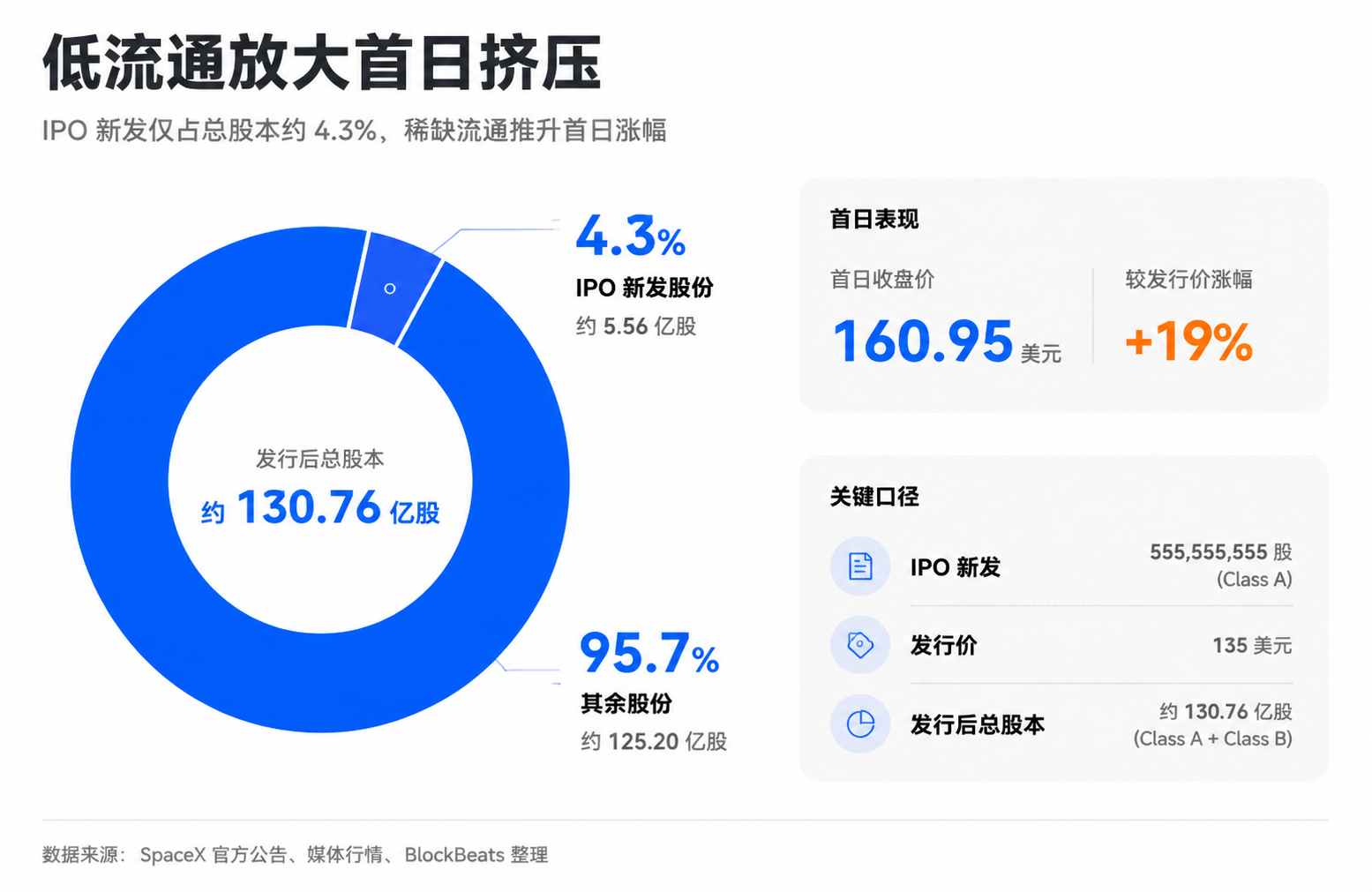
This explains why some investors view SPCX as a short-term trading opportunity rather than just following traditional valuation models. Starlink provides a clearer revenue base, the space launch and national defense businesses offer scarcity, Musk himself amplifies the asset narrative. For short-term funds, these factors may not need to be realized as profits immediately, as long as they can attract continuous buying pressure, which is enough to support the strong performance in the early stages of trading.
Potential index funds are also a variable in the bullish narrative. The logic is not complex: if SPCX is included in a major index in the future, index-tracking funds need to allocate according to the rules. This type of buying is usually not because they actively bullish on the company but because they must track the index. When the float is very small, passive buying may further amplify the supply-demand imbalance.
However, this can only be described as trading speculation. Index inclusion is not officially confirmed, and the so-called allocation window cannot be considered a definite arrangement. For SPCX, index funds are not a realized positive development but an option that the bulls use to explain the possibility of continued short-term buying pressure.
The Initial Unlocking Will Alter the Supply Curve
The risk for SPCX is not that the "company is not great enough," but that the relationship between stock price and tradable supply will change.
The role of the IPO lock-up period is to prevent existing shareholders and employees from selling immediately after listing, which could impact the new stock price. What many retail investors tend to overlook is that the lock-up period is primarily a supply issue. For the same company's stock, the market pressure is entirely different when the tradable shares are scarce compared to when a large number of shares can be sold.
SPCX's unlocking arrangement is not a simple "one-time release after 180 days." The prospectus indicates that after the 180-day lock-up period, starting from the second full trading day after the release of the 2026 Q2 financial report, a maximum of 20% can be transferred. If the stock price at that time meets at least 30% above the issue price and meets other conditions such as being met for at least 5 of 10 consecutive trading days, an additional 10% can be released. Subsequently, 7% can be released at intervals of 70, 90, 105, 120, 135 days, and all will be released after 180 days.
The specific release date of the Q2 financial report has not been confirmed yet. If following the usual disclosure schedule, the speculated first window in the market discussion may fall around August, but it still needs to be confirmed by subsequent announcements and SEC filings. The filings also indicate that Musk's shares are locked for 366 days, with some major shareholders extending their lockup until after the 2027 Q2 financial report and releasing them in phases.
This is the core of the short interest. As long as the initial unlock has not occurred yet, the low float is the long's friend. Once the unlock approaches, the low float will become a risk warning because the market will preemptively ask: how many low-cost shares are ready to be sold?
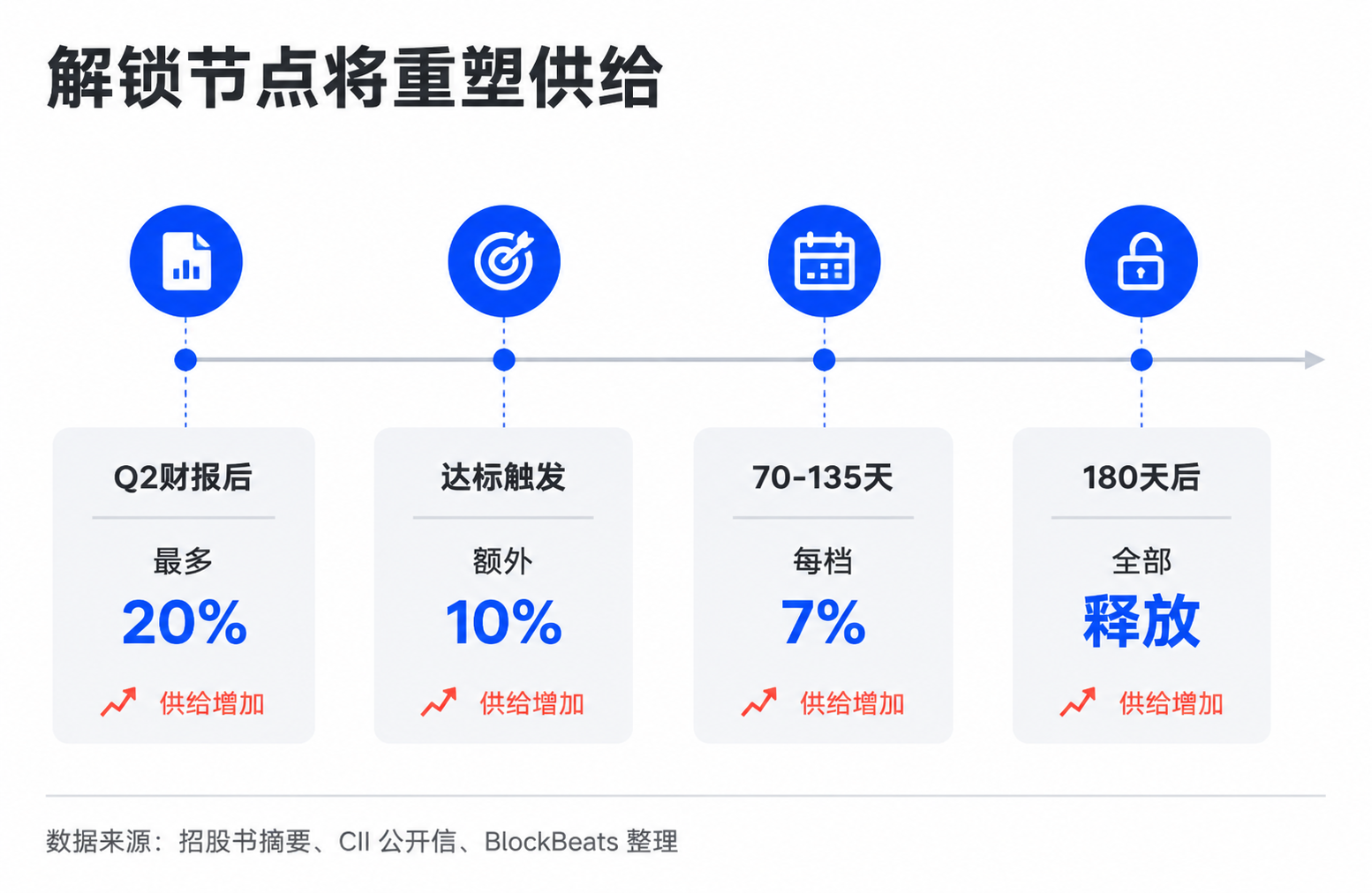
Potential selling pressure does not necessarily lead to a sharp drop on the unlock day. Its more common impact is to make buyers cautious, make rebounds more prone to selling pressure, and make valuation expansion more difficult. Especially when a stock has already been pushed to over $2 trillion in the initial public offering, even if the new supply is not dumped all at once, it will change the market's judgment on "who will take the other side".
Therefore, the questions of "can it still rise before the initial unlock" and "is it worth chasing in the medium term" can coexist. In the short term, with tight supply, hot sentiment, and a strong narrative, the stock price may still be squeezed. In the medium term, the real exit demand of existing shareholders and employees does exist, and their holding costs are usually much lower than those of secondary market buyers. These two judgments do not focus on the same time frame.
High Valuation Turns the Financial Report into an Amplifier
If SPCX were just a low float IPO, the unlocking pressure would already be significant. What's more complex is that it is also a low float IPO placed in an extremely high valuation range.
According to SpaceX's roadshow materials, the company's revenue is about $18.7 billion in 2025. Market discussions on revenue in 2026 mostly fall between $22 billion and $24 billion, but this is not confirmed company guidance. Calculated at a market value of about $2.1 trillion on the first day of trading, it is obvious that the market is not only buying into current Starlink revenue but also satellite internet, commercial spaceflight, defense collaboration, Starship transportation capabilities, and even Musk's long-term ecosystem synergy.
Paying a high price for a future story is not the issue itself. This pricing has repeatedly appeared in the history of tech stocks: when the market believes that a company has a unique entry point, it will pre-discount years of profits into the stock price. The problem lies in the sensitivity of this kind of pricing to the pace. Once financial reports, orders, profit margins, or user growth do not catch up with expectations, the market may not necessarily deny the endgame, but it will reevaluate the speed of realization.
This makes the Q2 financial report a key juncture before the initial unlock. It is not only the first report card after going public but may also become an amplifier of unlock expectations. If the financial report is strong, the longs will say that the fundamentals can support the valuation, and the short-term squeeze logic can continue. If the financial report is weak, the shorts will link it to the unlock window: the fundamentals have not proven the current valuation to be reasonable yet, more shares are about to be released, why should the secondary market buy in at a high level?
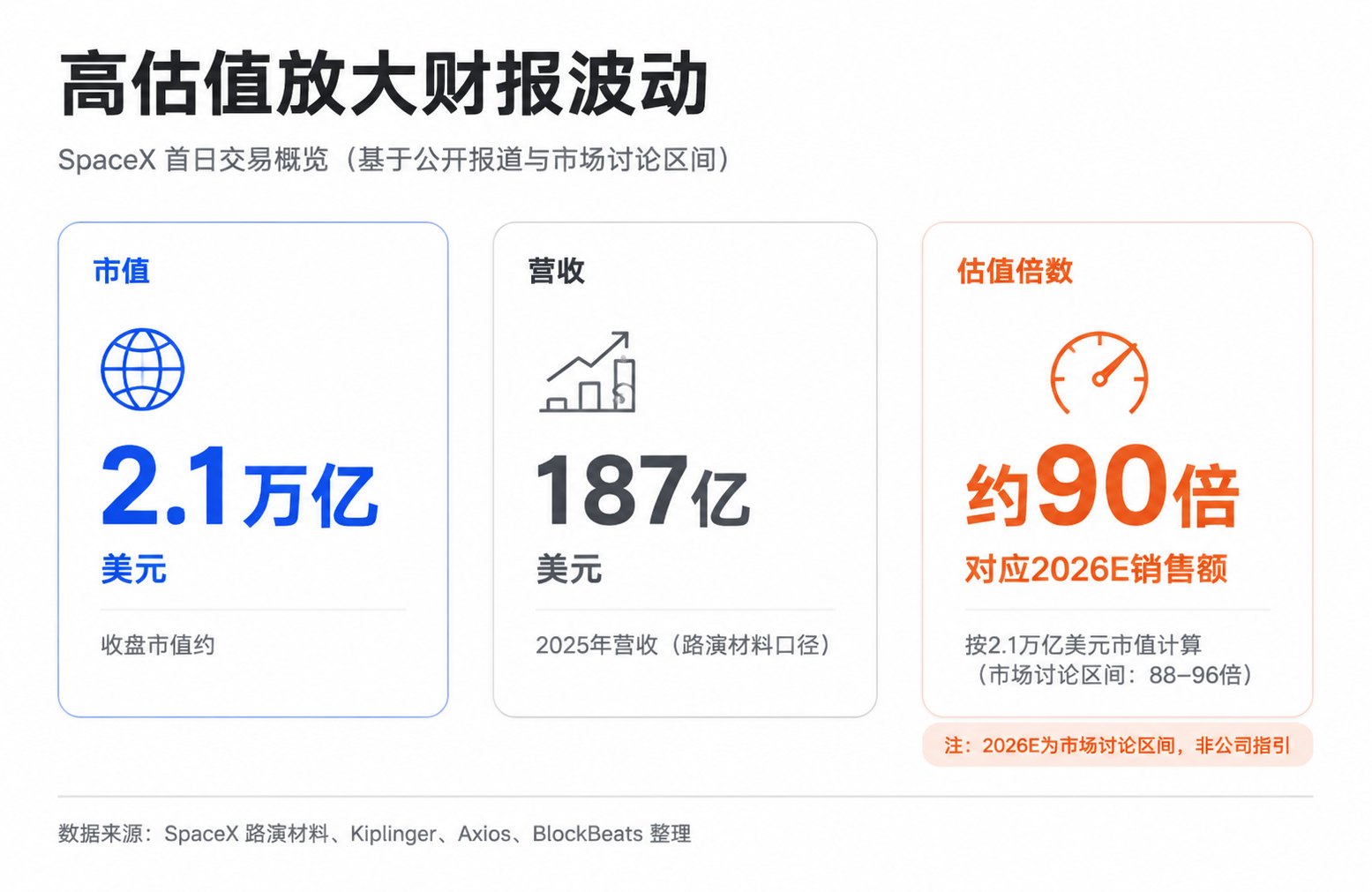
This is also where SPCX differs from mature tech stocks. The impact of mature tech stocks' financial reports is more reflected in earnings forecasts and valuation multiples. SPCX's financial report will also affect trading confidence before and after the lock-up period. It needs to address two questions simultaneously: whether business growth can support a long-term narrative and whether there will still be enough buying interest when tradable supply is about to increase.
Analogy to TGE, with the core being low circulating supply with an expiration date
In the Chinese community, some investors liken SPCX to "trading small circulating supply after a top-tier VC project's TGE."
TGE refers to the token generation event of a crypto project. When many top projects first launch, the circulating supply is low, the narrative is strong, and early investors' and team tokens are locked up. In the early stages of the launch, due to the limited available tokens and high attention, the price can easily be driven up. However, as the unlock period approaches, the market begins to anticipate future selling pressure, and the price may enter a consolidation phase.
This analogy is not entirely accurate. IPOs of stocks and token issuance in crypto have differences in regulation, information disclosure, and investor structure. However, it captures the same market mechanism: low circulating supply is not a long-term positive but a supply-demand mismatch with an expiration date.
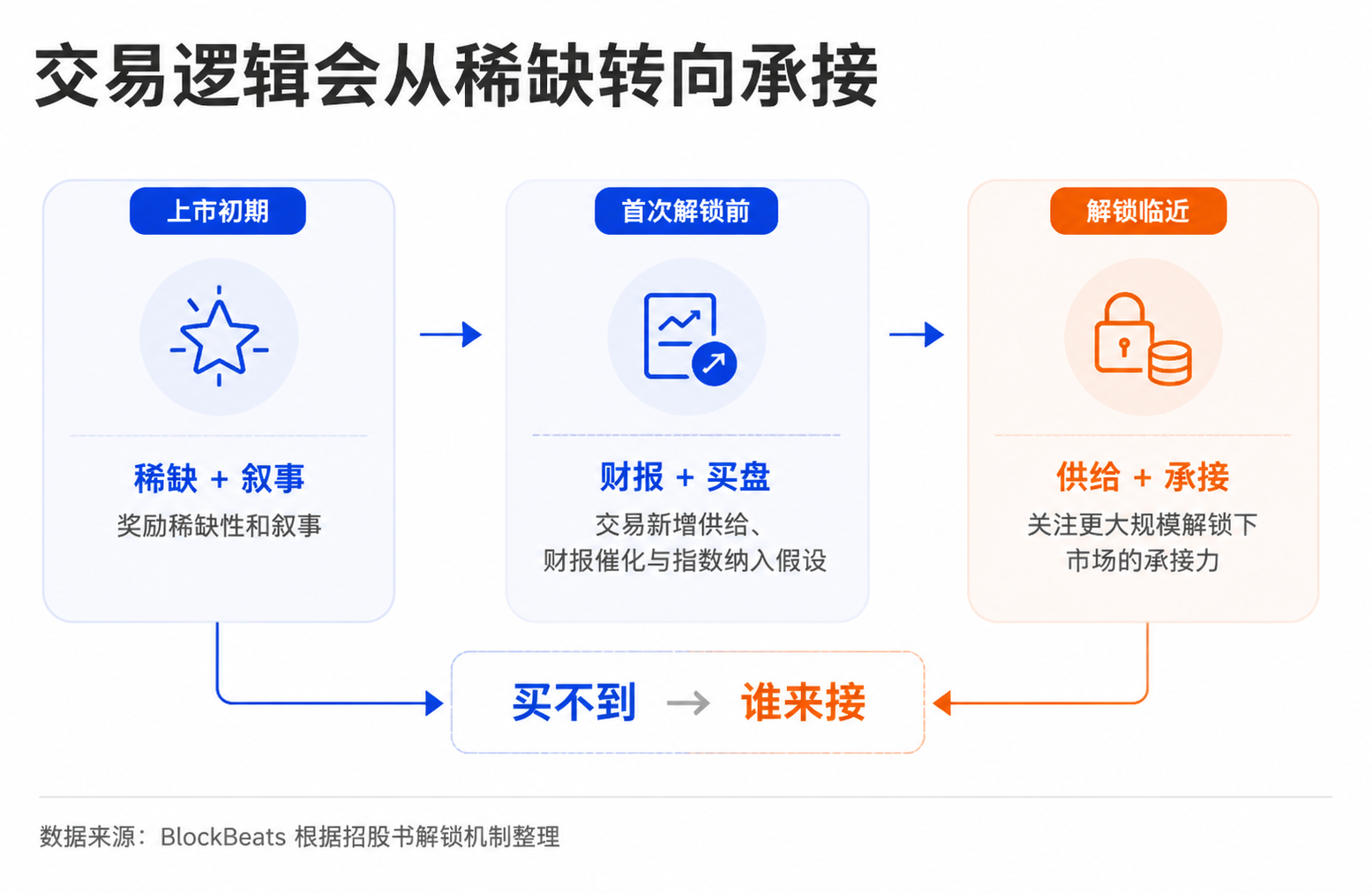
Within this framework, trading after SPCX's listing can be divided into several stages. In the early stages of listing, the market mainly rewards scarcity and narrative, and buyers are concerned about whether the price can still go up. Before the initial unlock, trading becomes more complex, and investors will simultaneously consider the additional supply, financial report catalysts, and potential index inclusions. As a larger-scale unlock approaches, the market will shift from "unable to buy" to "unable to sustain."
This also explains why there may be a combination of "short-term optimism and mid-term caution" in community discussions. It is not wavering but different time slices of the same supply-demand framework. During the low circulating supply phase, the bulls have the upper hand. During the unlock phase, bearish logic begins to strengthen. The key is not to judge whether SpaceX is great, but whether the current price has already priced in the scarcity before the initial unlock.
What to Watch Next: Unlocking Schedule, Financial Reports, and Passive Buying Interest
For the future trend of SPCX, the most important validation points are not in the Mars narrative or social media sentiment but in several more specific variables.
Firstly, what needs to be observed is the unlocking arrangement in the final documents and subsequent disclosures by the company. The initial transferable ratio, price trigger conditions, financial report release timing, extension of lock-up for shareholders will all directly impact the future supply curve. For investors, this is more important than single-day price fluctuations.
Next is whether the Q2 financial report can support the current valuation. SPCX has a compelling long-term story, but what the secondary market is currently focused on are still revenue, orders, profit margins, and cash flow. The stronger the financial report, the easier it is for the low float squeeze to continue. The weaker the financial report, the easier it is for the unlock selling pressure to become the main pricing theme.
The inclusion in the index also needs to be continuously monitored, but until a clear announcement is made, it is still just a long trade assumption. If subsequent inclusion and allocation demands indeed materialize, it may temporarily alleviate some of the unlock pressure in the short term, but it does not mean it can permanently absorb the exit demands of existing shareholders and employees.
SPCX is now more like a supply and demand experiment with a countdown. Before the initial unlock, the low float and strong narrative may still help the price maintain resilience. After the initial unlock, the market will begin to test how much real support this $2 trillion space asset truly has. For ordinary investors, rather than guessing a target price, it is more important to focus on this inflection point: when the story of "unavailable for purchase" turns into a question of "who will buy," the trading logic has already shifted.
Welcome to join the official BlockBeats community:
Telegram Subscription Group: https://t.me/theblockbeats
Telegram Discussion Group: https://t.me/BlockBeats_App
Official Twitter Account: https://twitter.com/BlockBeatsAsia
