TL;DR
· NVIDIA is pushing for 800VDC (800-volt DC), aiming to enable the next-generation high-power AI server racks to continue stacking computing power.
· The market needs to consider not only GPUs but also power supply, liquid cooling, connectors, power devices, and full-rack testing capability.
· Related companies: NVIDIA, Vicor Corporation, Schneider Electric, Delta Electronics, Dell Technologies, Wiwynn, Quanta Cloud Technology, Infineon Technologies, STMicroelectronics.
For the past few years, GPUs have been the key player in AI infrastructure. Whoever gets more H100s and B200s has a stronger supply of computing power. But as we move into the Rubin platform and beyond, investors need to look one level deeper: can the GPUs fit into the server rack, can the rack receive stable power supply, can it dissipate heat, and can it undergo full load testing before leaving the factory.
800VDC has started to be discussed in the market for this reason. NVIDIA has been openly advocating for the 800VDC architecture since 2025 and has incorporated it into the design direction of the next-generation AI factory and high-power server racks. On the surface, this marks a shift in voltage specifications from traditional low voltage to high-voltage DC. However, looking deeper, AI servers are no longer just an assembly of cards and chips but are increasingly resembling an electrical engineering project.
For a regular investor, this can be understood as follows: a full rack of AI servers is like a small building with high electricity demand. The previous power supply methods could support tens of kilowatts or hundreds of kilowatts in the server rack. However, as the power continues to rise, the issue is no longer just "how many GPUs to buy," but rather how to deliver electricity, dissipate heat, and run the machines continuously at full load before leaving the factory.
High-Power Server Racks Approaching the Low-Voltage Power Supply Limit
The starting point of this round of changes is that AI server rack power is increasing too rapidly. Traditional server racks may only have a few kilowatts to tens of kilowatts, but with NVIDIA's GB200 and GB300 generations, the full rack power has already reached the level of hundreds of kilowatts. According to Tom's Hardware, the GB200/GB300 NVL72 is approximately 120-140kW.
After Rubin, the power density may continue to rise. Some in the supply chain and industry estimate that the Rubin NVL72 could further increase to around 180-220kW. This range is not officially confirmed by NVIDIA and should still be considered a third-party estimate. However, the direction is clear: cutting-edge AI server racks are becoming higher-density electricity units.
The electricity issue can be explained with a simple formula: Power equals voltage multiplied by current. To deliver the same 600kW of power, if the voltage is lower, a larger current must be used. The higher the current, the thicker the cables and copper bars need to be, the more heat is generated, and the higher the energy loss in the lines.
Traditional low-voltage power supply is like slowly delivering a large amount of water through a very thick pipe. It works, but the pipe keeps getting thicker, heavier, and taking up more space. The cabinet space that should have been reserved for GPUs, memory, networking, and cooling structures is instead occupied by power shelves, cables, and copper busbars. As power continues to scale to hundreds of kilowatts and even higher power levels, stacking low-voltage high current becomes increasingly uneconomical.
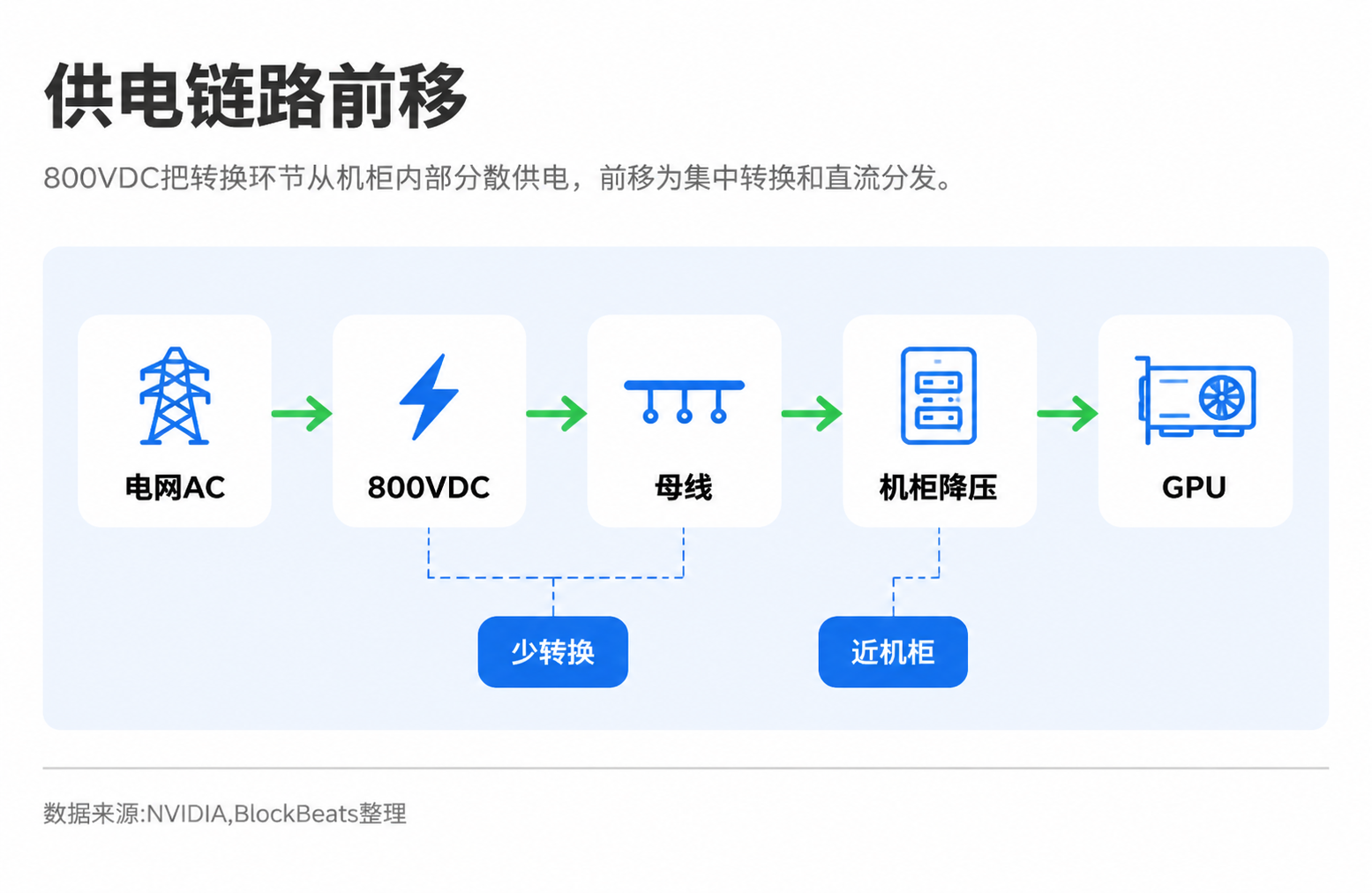
The concept of 800VDC is to increase the voltage to deliver electricity more efficiently to the vicinity of the cabinet and then step it down locally for GPU usage. It is like increasing water pressure to transport the same amount of water through a narrower pipeline. According to official NVIDIA materials, 800VDC can reduce current, copper usage, cable volume, and conversion steps, with efficiency improvements of up to 5% and TCO improvements of up to 30%. Some third parties and partners have also estimated that copper usage could decrease by around 45%, with actual benefits depending on data center and cabinet integration.
It's not just about saving copper. For NVIDIA, the core value of 800VDC is to allow the next generation of AI cabinets to continue increasing compute density. Low-voltage systems are not obsolete, but in the highest-density AI factories, they are reaching an engineering limit.
NVIDIA Redesigns Infrastructure Division of Labor with Reference Architecture
An important aspect of NVIDIA's initiative is not just proposing a voltage plan but redefining the ecosystem division of labor with a reference architecture. Starting in 2025, NVIDIA has repeatedly publicly introduced the 800VDC architecture and showcased design directions for high-power systems such as Rubin and Kyber rack in technical blogs and events like OCP.
According to NVIDIA's official blog, its 800VDC ecosystem partners include Delta Electronics, Schneider Electric, Vertiv, Infineon, STMicroelectronics, and also companies like ABB, Eaton, GE Vernova, Hitachi Energy, Siemens, Navitas, and Texas Instruments. It is more accurate to describe this as ecosystem collaboration and adaptation, rather than assuming that orders have already been placed.
800VDC involves not just individual component upgrades but a complete transformation across the entire chain from data center power distribution, cabinet power supply, backup batteries, power devices, connectors to full cabinet integration. In the past, power conversion may have been scattered across UPS, PDUs, server PSUs, motherboard power supplies, and other components. Under a high-voltage direct current architecture, power is closer to the cabinet and then stepped down by modules inside the cabinet or near the GPU.
The weighting in the value chain will also change accordingly. In the traditional server era, investors paid more attention to GPUs, CPUs, memory, and complete machine manufacturing. In the high-power AI rack era, power shelves, busbars, connectors, power semiconductors, liquid cooling systems, and rack-level validation capabilities are starting to become part of the delivery capability.
The boundaries need to be clarified as well. While 800VDC is more like a key reference architecture for cutting-edge high-density AI factories, it is not a standard that all data centers will immediately switch to. A significant number of existing data centers will continue to use traditional AC or hybrid architectures, and new projects will adopt a tiered approach based on power density, cost, owner's retrofit willingness, and safety standards. What is truly being traded in the market is not a complete switch to 800V this year, but rather the changing infrastructure rules for the highest-density AI racks post-2027.
Power, Connectivity, Liquid Cooling, and Rack-Level Testing Pushed to the Forefront
From an investment perspective, the most direct impact of 800VDC is bringing the previously backstage infrastructure processes to the forefront.
The first category includes power infrastructure companies such as Vertiv, Schneider Electric, Delta Electronics, and some South Korean and Taiwanese power equipment manufacturers. They are not only selling traditional data center power equipment but are also involved in the design of next-generation AI factory power distribution, cabinet power supply, backup batteries, and high-voltage DC systems. According to Asia Business Daily, NVIDIA has been in communication with South Korean power equipment companies such as LS Electric, HD Hyundai Electric, and Hyosung regarding 800VDC data center infrastructure. The report is based on information from industry insiders and does not equate to finalized orders, but it does indicate that power equipment suppliers are being included in the AI factory ecosystem.
The second category is power devices, specifically SiC/GaN (Silicon Carbide/Gallium Nitride) and other next-generation power switches. These are more suitable for high-voltage, high-frequency, high-efficiency scenarios compared to traditional silicon devices. Previously discussed in the context of electric vehicles, charging stations, and industrial power supplies, they are now spilling over into AI data centers. Companies like Infineon and STMicroelectronics are thus coming into focus for investors. However, the benefits of power semiconductors depend on specific designs, market share, prices, and yields and cannot be simply equated with being "800VDC concept stocks."
The third category includes connectors and mechanical structures, such as copper bars, busbars, high-voltage connectors, high-end backplanes, and some thick copper and high-layer PCBs. With the increase in voltage, there is a decrease in current, which eases the copper loss pressure. However, the requirements for insulation, safety, connection reliability, and structural design are higher. Low-end copper materials do not naturally benefit; the real value lies in materials that can adapt to high-power, high-reliability rack connections and power supplies.
The fourth category is Liquid Cooling and Full Rack ODM. As power consumption increases, heat dissipation is no longer an afterthought. For servers to run reliably in customer data centers, they must undergo full rack-level testing before leaving the factory, including power supply, cooling, networking, and GPU full-load stability. Full rack delivery providers such as Dell, Wiwynn, Quanta Cloud Technology (QCT), are competing not only in assembly efficiency but also in whether they have sufficient power, space, liquid cooling testing, and system tuning capabilities.
Clear Design Direction, Delivery Capability Needs Real-world Testing
NVIDIA has already outlined a clear technical direction, but supply chain execution will not automatically be smooth. The tension here is precisely what investors need to track.
Independent supply chain analyst Dan Nystedt has recently reiterated information from Taiwanese media and industry sources: AI Server ODM revenue is strong, Rubin-related production preparations are progressing, but components, power infrastructure, and full rack burn-in testing (full-load aging testing) are becoming real constraints. The so-called burn-in can be understood as a pre-delivery stress test for servers. The full rack GPU runs at full load for a long time, and power supply, cooling, and system stability all need to pass together.
If a single rack requires continuous power supply at the 100-200kW level, the testing facility itself needs to have power and cooling capacity close to that of a small data center. Such supply chain signals cannot be written off as the industry already universally having backup power generation nor can it be directly inferred that power supply has replaced GPU as the primary bottleneck. It is more of a reminder that in the Rubin era, delivery involves not only GPU arrivals and motherboard assembly but also ensuring that power, liquid cooling, testing, and full rack stability are all in place.
Some ODMs, power equipment, and liquid cooling companies are being revalued, and the rationale lies here. Their value does not only come from participating in AI servers but from whether they can reliably deliver high-power racks to cloud providers. In the future, if they also obtain NVIDIA's reference design, what may truly differentiate them is the testing facilities, power capacity, liquid cooling tuning experience, and delivery yield.
For AI cloud providers like CoreWeave, Nebius, 800VDC is not a direct component benefit logic but rather a variable affecting capital expenditure efficiency and time to market. Whether high-density racks can be deployed on time will impact computing power delivery, depreciation cadence, and revenue realization. Companies such as Marvell, Lumentum, involved in high-speed interconnects or optical module chains, belong more to the parallel logic of AI cluster expansion and should not be mixed up with the direct benefits of 800VDC.
By 2027, Keep an Eye on Kyber Rack and Order Fulfillment
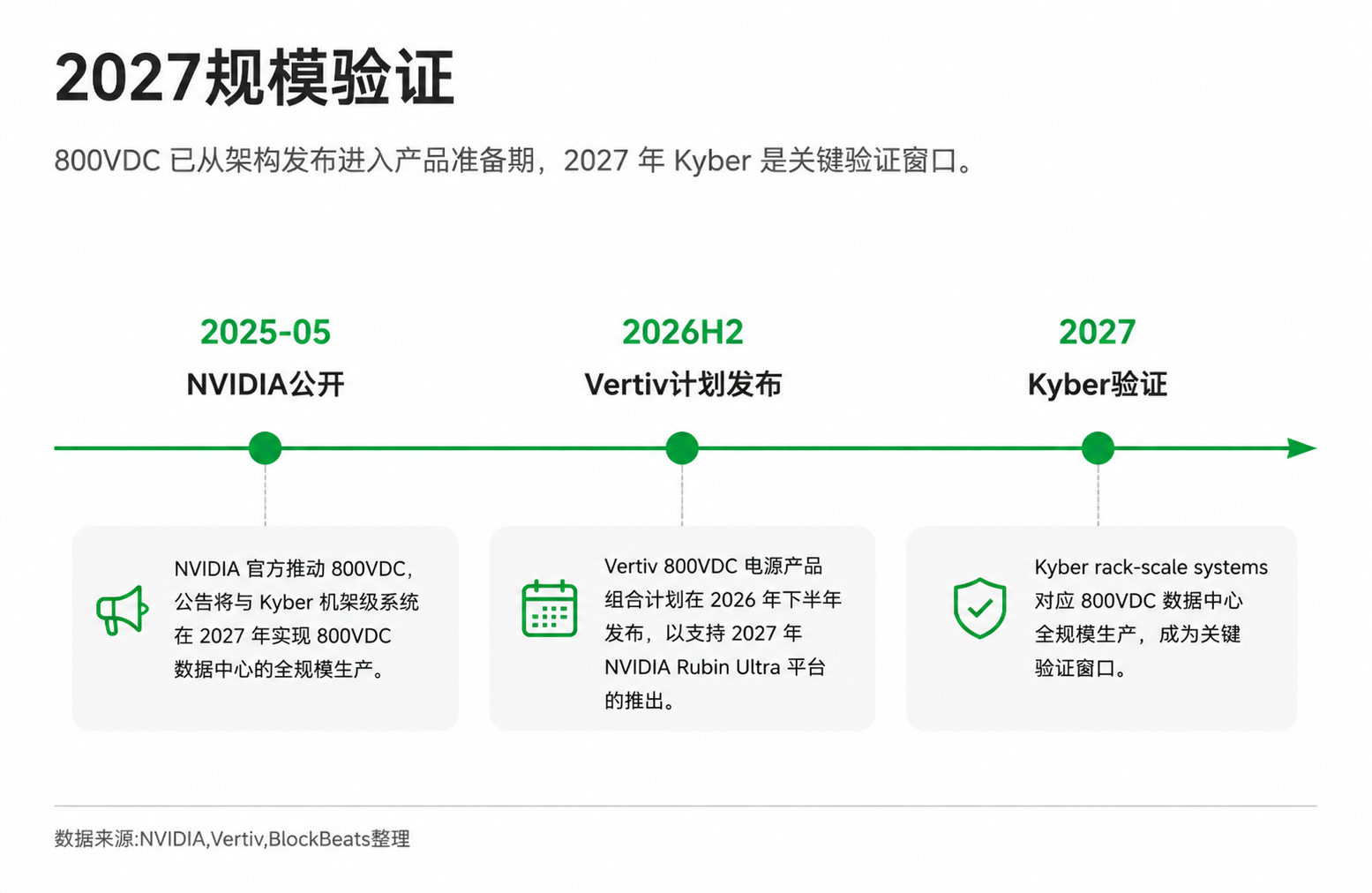
The direction of 800VDC is now much clearer than a year ago: driven by NVIDIA, partner ecosystem alignment, physical constraints, and the need for more efficient power delivery in cutting-edge high-density AI factories. However, it is still in the preparation and early deployment phase. NVIDIA officials stated that full-scale production of 800VDC will align with the 2027 release of Kyber rack-scale systems, with the true validation depending on the subsequent products and successful implementation in customer projects.
What will be most interesting to observe next is not whether a company mentions "AI Power" in their announcement, but rather if there are clear indications of involvement in 800VDC-related products, customer validation, and order fulfillment. ODMs disclosing enhanced full cabinet testing capabilities, the reliability of liquid cooling systems under prolonged full load, and whether data center owners are willing to adapt power distribution and safety standards for the high-voltage DC architecture will all impact the pace of this transition.
If the Rubin-related cabinets smoothly ramp up and 800VDC component orders transition from sampling and validation to scale procurement, the market will continue to emphasize the enhancement of power supply, liquid cooling, connector, and full cabinet delivery capabilities. Conversely, if power consumption is lower than expected, customers opt for a more conservative hybrid architecture, or testing of power and liquid cooling reliability delays deployment, the 800VDC transaction will shift from directional assessment back to order and pace validation. While GPUs remain the core, post-Rubin, the ability to reliably deliver an entire high-power rack system is beginning to emerge as an asset pricing variable.
Welcome to join the official BlockBeats community:
Telegram Subscription Group: https://t.me/theblockbeats
Telegram Discussion Group: https://t.me/BlockBeats_App
Official Twitter Account: https://twitter.com/BlockBeatsAsia
